
VCI Institute · CVCA Level 3 · Certified Value Creation Analyst

Verification

You are handed a value creation thesis and the corpus it was built from. Your task is not to agree with it or to disagree with it. It is to establish what is actually evidenced, what has merely been inferred, and what the distance between the two is worth.

499 US dollars. One payment. Seven day refund while the course is unused.

14 modules29 lessons2 proprietary instruments~70 document corpus365 days access
CVCA Level 3 Verification, a VCI Institute certification

Analysts are rarely caught out by a number they got wrong

They are caught out by a number they never checked. It was plausible, it came from somewhere respectable, and by the time it reached the model nobody remembered it was an assumption.

AAudited and independently verified. A third party staked its name on it.
BContemporaneous internal record. Made at the time, for a purpose other than persuading you.
CManagement representation. Prepared by people with an interest in the answer.
DRecollection or verbal assurance. Confident, unrecorded, and frequently wrong.
EInference. Nobody said this. You concluded it, and it now behaves like a fact.
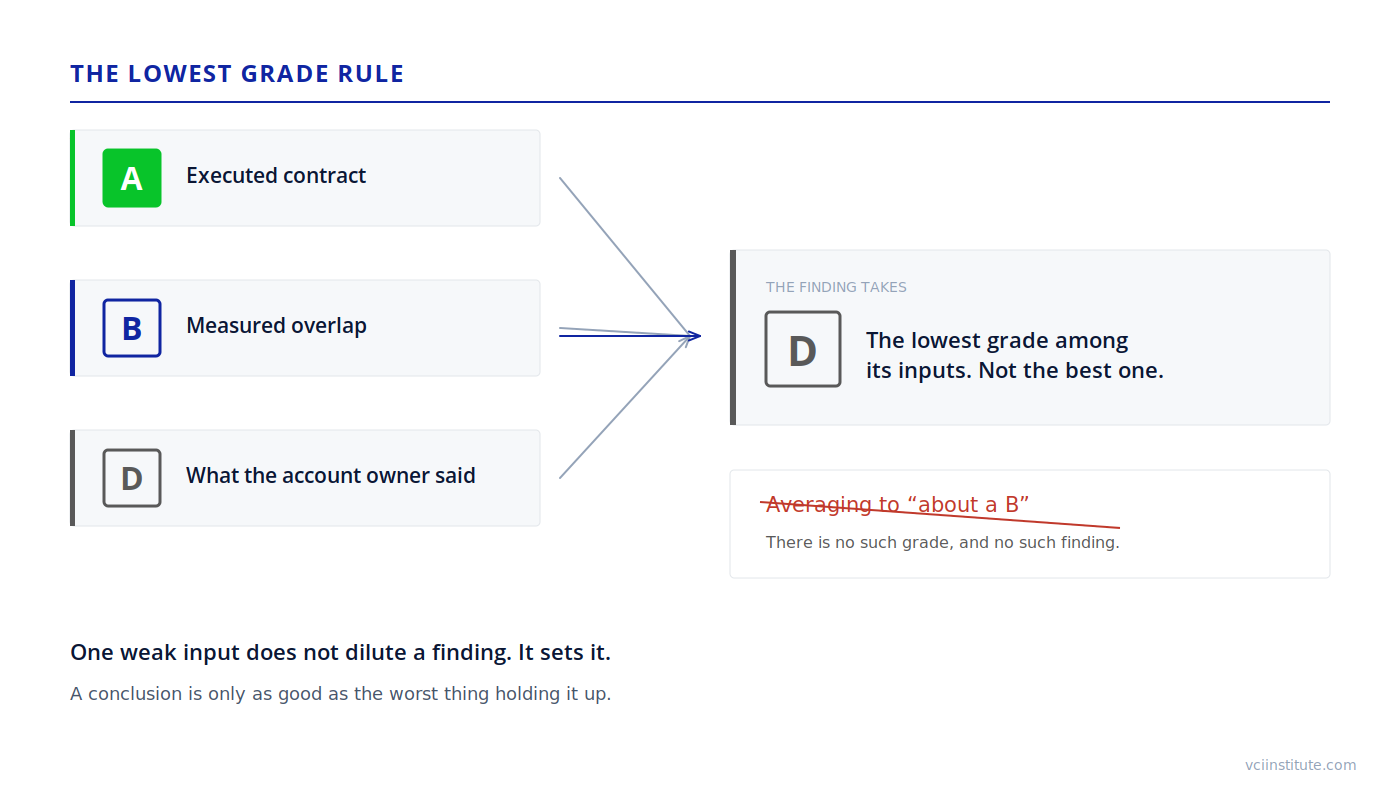
A finding inherits the lowest grade of any input it depends on. There is no averaging. One grade E input makes the whole finding grade E, however strong everything around it looks.

This is the ladder you build in Module 2 and are still defending in Module 6.

Being right is not the same as being able to show it

Level 3 is about the distance between what a file appears to say and what it can be shown to say, and about holding a position once you have found it.

Analysts are rarely caught out by a number they got wrong. They are caught out by a number they never checked, carried forward because it was plausible and nobody asked where it came from.

By the end you will be able to grade any input on sight, price what you have assumed rather than established, and say which is which in a room where somebody senior would prefer you did not.

The lowest grade rule, showing a finding inheriting the weakest of its inputs

Two proprietary instruments

Both are built inside the case, then defended against challenge.

Instrument one

Evidence Grade

An A to E ladder that rates where a fact actually came from. A finding inherits the lowest grade of any input it depends on. There is no averaging, and a strong grade does not rescue a weak one sitting beside it.

Currency matters as much as grade. A high grade figure that is eighteen months stale is frequently the most dangerous input in a model, because nobody thinks to question it.

Instrument two

Inference Debt

Every assumption carried without verification is logged in a five field register, including the date on which it was measured, and carried forward until it is either verified or written off.

It is priced by exposure, not by likelihood. An assumption that is probably right but would cost the fund a great deal if it were wrong is expensive debt, and the register says so.

Both instruments follow you out of the course. They are designed to be used on a live file the week after you finish.

Six assessed modules. Three practice assessments between them.

The modules run in the order a real verification runs. You establish what is being asked, grade what you have, find what is missing, test the model against measurement, price what you inferred, and then defend it.

Module 1

The Question Behind the Question

What you have been asked is rarely what needs answering. Getting this wrong makes every subsequent hour of work irrelevant.

Module 2

The Evidence Hierarchy

Where the Evidence Grade ladder is built. An audited statement, a management deck and an email are not the same kind of fact.

Checkpoint

Practice Assessment 1

Modules 1 and 2, marked against the same standard as the certification examination so there are no surprises later.

Module 3

The Number That Is Not There

Absence is evidence. The figure a management pack omits is usually the one that would have changed the conclusion.

Module 4

Model Against Measurement

A projection and an observation look identical in a spreadsheet cell. Treating one as the other is the most common failure in the discipline.

Module 5

The Unchecked Inference

The signature module. Where Inference Debt is built, and where the course publishes a correction to its own earlier reasoning as a worked example.

Module 6

Defending the Finding

Holding a graded position when somebody more senior disagrees, without either caving or overclaiming.

What you keep after the course closes

Three field artefacts and an optional library that converts into masterclass grants.

The Verification Toolkit

The grading sheets and register templates you used on the case, ready to run against a live mandate.

The Challenge Book

The questions that expose a weak input, and the wording to ask them with when the person answering outranks you.

The Field Card

One page. The grade ladder, the register fields and the currency test, compressed to what fits beside a laptop.

The Applied Library

Optional. Value Creation Verified, Verification and the Machine, and Analytical Craft Applied. Each ends in a free masterclass grant.

Two gates, and you need both

Passing one does not carry the other.

The capstone

Establishes that you can build a defensible position out of a real corpus and hold it when it is questioned.

It marks the grading of your inputs and the honesty of your register, not whether you reached a conclusion the marker happens to share.

The examination

Establishes that the instruments are yours rather than borrowed.

50 questions, drawn only from the six assessed modules. 90 minutes. The pass mark is 80 per cent, which is 40 of 50.

Who this is for, and who it is not

Built for

  • Value creation analysts whose numbers get used by people who will not check them.
  • Diligence and portfolio analysts who need to say which parts of a thesis are evidenced and which are assumed.
  • Anyone who has had a finding challenged in a room and discovered they could not source it under pressure.
  • Analysts moving toward a position where the question stops being what the number is and becomes whether it will hold.

Probably not for you if

  • You are looking to learn financial modelling. This assumes you can already build the model.
  • You want templates rather than judgement. The instruments only work if you can defend the inputs.
  • You have not completed CVCA Levels 1 and 2.
  • You need a definitive answer at the end. This course teaches you to say how confident you are and why.

Before you register

Prerequisites

CVCA Levels 1 and 2. Level 3 assumes the analytical grounding they build and does not reteach it.

Course access

365 days from enrolment. There is no cohort and no fixed start date. You begin when you enrol.

Certificate

Does not expire. No renewal fee and no continuing education requirement.

Refund

Seven days, while the course is unused. Starting any assessment ends the refund window.

Questions

Is there a right answer to the case?

No. What is marked is whether the position you reach is supported by the corpus, and whether you graded your inputs honestly along the way. Two analysts can reach different conclusions and both pass, provided each can show what their finding rests on.

What do I need before I start?

CVCA Levels 1 and 2. Level 3 assumes the analytical grounding they build and does not reteach it.

Are there live sessions or a cohort?

No. Level 3 is asynchronous throughout. You start when you enrol and work at your own pace within the course access period.

Is this a modelling course?

No. It assumes you can already build the model. What it teaches is how to establish which of the inputs will survive being questioned, and what to do about the ones that will not.

How does the refund work?

Seven days from purchase, while the course is unused. The window closes as soon as you start any assessment. There is no minimum term, because there is nothing recurring to cancel.

Check the file, then defend it

Grade what you have. Price what you do not. Say which is which, out loud, to people who will push back.

499 US dollars. One payment. No subscription, no renewal fee.