
Build
Hire someone who has already held the seat
If that were the only route this course would have nothing to teach.
VCI Institute · Operating Partner Careers · The Route Into the Fund Side
An operating partner sits inside a private equity fund and is accountable for the value created in portfolio companies rather than for the capital deployed into them. The industry is currently promoting people into that seat who have never occupied it. Funds need operating capability faster than the market can supply proven operating partners, so they stretch.
This is a career transition course, not an operating partner primer
Operating partner seats are not filled through a recruiting cycle. They are entered laterally, through conversations. The course prepares each step of the move you make yourself.
Stage two is the one most candidates skip, and it is the one that decides whether the other four are worth running yet. The course puts it second on purpose.
There is almost no structured preparation for the operating partner seat anywhere, and what exists is usually one person's route generalised into a rule. This is assembled differently, and the difference is checkable on every page of it. Every figure carries its source and the date it was captured, and the gaps are marked as gaps rather than filled in with something plausible.
Executive search reporting through early 2026 describes a shortage of private equity ready operating and finance leaders, with firms resorting to a build, rent and stretch model.
Build
If that were the only route this course would have nothing to teach.
Rent
Capability brought in against a transaction, and released the same way.
Stretch
Someone who has run operations but never sat fund side. Stretch is the door, and it is open because the shortage is real.
A fund taking the stretch route takes a group chief operating officer, a divisional president or a transformation lead, and places that person against a portfolio company with real money on it. The stretch candidate learns the job live. No structured preparation for that seat exists anywhere else, which is why this course was built.
Sourced: executive search market commentary, captured 19 August 2026. The build, rent, stretch framing is VCI Institute's, built from that commentary.
Said before you buy, not after
No course gets anyone hired. Anyone promising a job guarantee is pricing insurance into tuition, and the price of that insurance is paid by every buyer who was never going to claim on it. This course carries a 7 day refund and no outcome promise of any kind.
It also tells the wrong buyer to stop. Module 2 scores your record against the four gaps that end an operating partner candidacy, and it does that in the second module rather than after the money has changed hands.
Three routes lead into a first operating partner seat, and the course names them because each one carries a different asset, a different tax, and a different shortest credible path. The route ledger in Module 2 assigns you to one of them before a fund does it for you.
Route one
Chief executive, chief operating officer, divisional president, general manager. Profit and loss ownership is the asset. The gap is usually fund-side exposure: no investment committee, no diligence process, no carry conversation.
Route two
Strategy or transformation partner, operational due diligence lead. Pattern recognition across many businesses is the asset. The gap is ownership: analysis sold and left behind, rather than a consequence carried for years.
Route three
Chief financial officer, chief human resources officer, chief information officer, commercial director. Lever depth is the asset. The gap is breadth, and the seat it opens is a functional mandate rather than a generalist bench seat.
A generalist operating partner exists so that at least one person at investment committee has carried a number rather than analysed one. A candidate with no profit and loss ownership at any scale, and no demonstrated depth in a single value lever, is not ready for that seat, and no amount of preparation converts that inside a hiring process. The honest sequence is a real trading profit and loss first, or a functional mandate built on a lever owned end to end in two separate businesses, and then this course.
Module 2 says so directly. It separates the four gaps a fund will not work around from the four it coaches without comment, and the rule that divides them is a bench test: a fund will coach a gap it can close from its own bench inside the opening months of a mandate, and it will not coach a gap that only a different job closes.
Module 2, in summary
| What ends a candidacy | What funds coach |
|---|---|
| No profit and loss ownership at any scale, for a generalist seat | No fund-side vocabulary |
| No evidence of carrying a change through failure | No prior carry experience |
| An inability to work without line authority | No transaction process exposure |
| A record that cannot be attributed | Sector adjacency rather than sector match |
Directional: practice guidance drawn from operating partner selection patterns, not survey data. Of the four disqualifiers, one is fully inside your control and costs about thirty days of disciplined work. The course names which.
This is a course built around an evidence portfolio rather than around lectures. Every module ends in an artefact you have written, and the eighth is a capstone that assembles the rest. The artefacts are the part with weight, and they outlast the certificate.
Artefact one
The single most valuable artefact either VCII career course produces. A four to six page evidence file a partner can read in four minutes and believe: one lever per entry, drawn from the Fruitful Five taxonomy, each with a mechanism, a magnitude, and a method note carrying the counterfactual, the attribution window, the calculation and the isolation of other movers. It states what is not claimed. Every curriculum vitae, bio, outreach message and interview answer is cut from it, so no figure drifts between documents.
The seat is four seats under one title. This sheet compares generalist against functional, full time against advisory against deal by deal, and records which model you are actually a candidate for.
Six dimensions, four levels, scored 0 to 3 for a maximum of 18: profit and loss ownership, value lever authorship, transformation depth, transaction exposure, influence without line authority, and attributability. The score is read against the disqualifier list and converted into an eighteen month sequence.
Twenty five funds, tiered eight, twelve and five, built from free public sources through an eight step sourcing workflow, with a column dictionary that records the operating model archetype of each fund and the four tells that reveal it.
One row per person rather than per fund, a weekly ninety minutes in four blocks, a monthly review, four health measures, and one measure the course tells you to refuse to track.
Run against a real prompt and assessed against two rubrics: eight pass conditions for the diagnostic, nine for the plan, each one written against the failure it catches.
Four gates and twenty four checks covering the term sheet, the contracting form, carry mechanics and vesting, leaver treatment, conflicts and governance, plus three stop conditions and the response sequence for each. Educational material, not legal advice.
The capstone
Nine sections, each traced to its source artefact, each with a pass test. The forum charter with a decision right and a boundary for every recurring meeting, the six travelling measures, and the three rung breach ladder. Four consistency locks are run as one pass before the document goes anywhere. The capstone unlocks the final assessment.
Why the track record document is artefact one
An operator who rebuilds the story at each step ends up with figures that disagree. A partner hears one number in the room and reads another on the one pager, and the inconsistency is the thing that gets remembered. Build the evidence once, then cut everything from it.
One lever per entry, each with a mechanism, a magnitude and a method note carrying the counterfactual and the attribution window. It states what is not claimed, which is the part that makes the rest believable.
Eight modules, forty lessons, plus three front matter lessons that set the route through the course and a bonus section. Every module ends in its artefact.
| Module | Lessons | Artefact produced |
|---|---|---|
| Front matter: start here, about VCI Institute, your route through this course | 3 | Route decision, marked one option per axis |
| 1. The Operating Partner Role Decoded | 5 | Role model comparison sheet |
| 2. Are You Ready | 5 | Credibility inventory, scored |
| 3. Building the Operator Evidence Base | 5 | Value creation track record document |
| 4. The OP Market Map | 5 | Personal fund target list, 25 funds tiered 8 / 12 / 5 |
| 5. Getting In the Room | 5 | Outreach system and pipeline |
| 6. The OP Interview | 5 | Mock diagnostic and 100 day plan |
| 7. Structuring the Engagement | 5 | Engagement checklist, four gates and 24 checks |
| 8. The First Portfolio Company | 5 | Capstone: operating cadence plan |
Forty lessons across the eight modules, with 98 exhibits: tables, matrices, templates, worked examples and rubrics. Module 8 covers the first hundred days in the seat, which is the territory the market ordinarily leaves untaught, because the seat rather than the offer is the thing being competed for.
Two named mechanisms from inside the course
The operating partner case interview does not ask what a business is worth. It asks what you would do with it on Monday, with no line authority, a chief executive you have just met, and eighteen months of hold period left. The Case Line runs it in five moves: frame, sweep, cut, size, own. The sweep runs all five Fruitful Five levers aloud, one sentence each. The cut states the selection rule before the selection, which is the single most watched sixty seconds of the interview. The sizing names the assumption before the number. The close names an owner, a date, one measurement, a first checkpoint, and the one thing that would make you stop.
An operating partner holding no line authority controls exactly one durable thing: when the business looks at what the value creation plan depends on, who is in the room, and what has to be settled before anyone leaves. Four layers, each feeding the next: the weekly lever stand-up, the monthly operating review chaired by the chief executive and never by the operating partner, the quarterly value creation review, and the board. Every forum holds a written decision right, and a forum that cannot name one is deleted rather than improved.
Directional: both are VCI Institute structures built for operating partner work, taught with worked examples and timings, not presented as survey data.
No course gets anyone hired. Hiring decisions are made by partners who have met you, checked your references and priced the cost of being wrong, and no third party sits in that room. Anyone selling a job guarantee is not removing that risk, they are charging every buyer a premium for it and refunding the few who complain loudly enough. That is insurance sold as education, and it is priced accordingly.
What structured preparation can do is narrower and worth paying for:
The market map, the economics by fund size, the hiring channels, the interview format and the terms of the engagement are assembled in one place rather than reconstructed from scattered conversations over two years.
An operating career described in corporate language reads as an operator the fund would have to translate for. The same career described as attributed value creation reads as a candidate. That conversion is Module 3 and it is mechanical, not rhetorical.
The case interview, the portfolio company diagnostic and the hundred day plan are rehearsed against rubrics and against simulator scenarios before the first real process rather than during it.
Eight documents that exist whether or not any particular process converts, and that are read by every fund you approach afterwards.
The claim this course does make
A fund stretching a candidate is not asking what you have done in this seat. It is asking what evidence exists that you will be effective in a seat you have never occupied, and what it costs the fund if that judgement is wrong. Everything here is built to let you answer that second question in a way that survives a partner meeting.
Interviews for this seat do not test whether you know what a value creation lever is. They test whether you can sequence one under a budget constraint and defend the sequencing afterwards. Two things in this course let you rehearse exactly that.
Included with your enrolment
A gamified private equity simulator, included at no extra cost. Choose a live mandate, then run it across twelve quarters: allocate a budget that never stretches far enough, sequence five operating levers that each land at a different speed, watch leverage move against a covenant, and face a buyer at the end who prices what you built.
Nothing in it is random. Every outcome traces back to a decision you made, so you cannot blame luck for a plan you sequenced badly. Run it twice with different sequencing and you stop having an opinion about value creation and start having evidence.
What you walk out with: a printed value bridge splitting your equity gain into EBITDA growth, multiple change and debt paydown. Most candidates answer the hundred day question in the abstract. You will be able to point at a number.
Module 6
Lesson 6.4 sets a rehearsal assignment on the PE Simulator: three scenario families, three passes each, nine runs, with a decision log kept against a defined set of fields. The point is judgement under conditions that change while a decision is being made, which is the part of the seat no reading reproduces. The PE Simulator is a joint venture between VCI Institute and Valuethropy, at www.pesimulator.com.
Note: simulator access is arranged on the simulator site. The assignment can be completed in the course without it, at the cost of the rehearsal.
This is a course. It ends with a Certificate of Completion, and that certificate says one accurate thing: the holder worked through a structured preparation for the operating partner seat and produced the artefacts it asks for. It is not a certification, it carries no post-nominal letters, and no fund should be told otherwise.
COPPE: Certified Operating Partner in Private Equity is the certification. Level 1 covers the operating partner operating system. Level 2 covers the value creation plan end to end. Level 3: Intervention is the intervention credential, and it is available now at $499, requiring Level 1 and Level 2 in any order. A course is evidence that you studied something. A certification is evidence that an independent body examined you against a published standard and that you passed. The second is portable in a way the first is not, and blurring the two costs more than it gains.
The next step, honestly labelled
Completing the Operating Partner Career Track carries a credit toward COPPE Level 1, applied at enrolment.
Level 1 sits best immediately before or during a first mandate. Level 2 fits once a value creation review has been run for real. Anyone unsure which rail fits, the operating rail or the analytical rail through CVCA: Certified Value Creation Analyst, can map it in four questions with the Certification Path Finder.
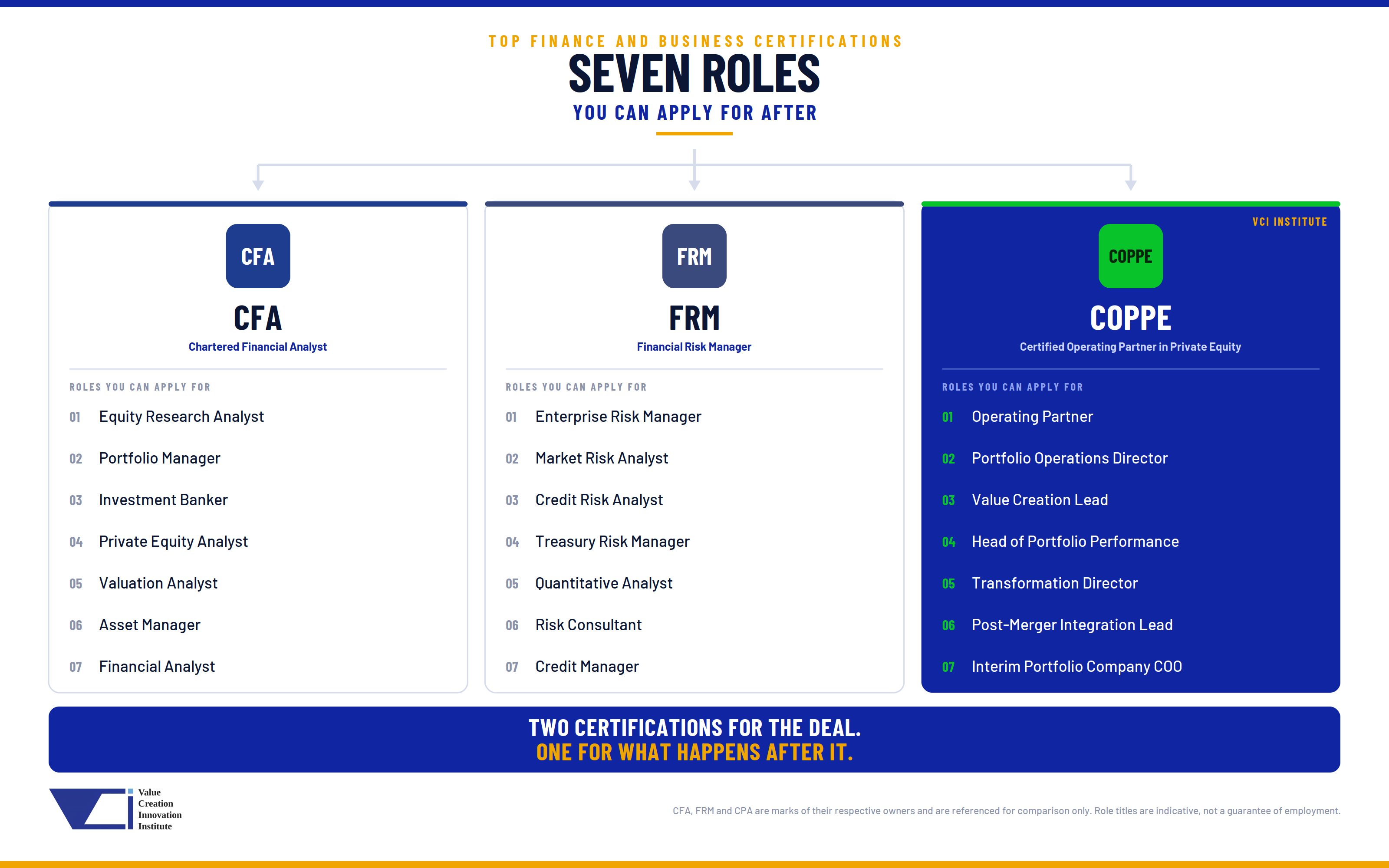
These are the operating roles the market actually posts, set against the paths the established finance credentials open. COPPE is the VCI Institute certification built for the same column.
The seven seats
CFA and FRM are built for the roles that price and protect a transaction. This is the column that owns what happens after it.
VCI Institute is a nonprofit dedicated to practical capability and shared standards for value creation in private equity, based in Mississauga, Ontario. It publishes the COPPE and CVCA certification ladders, the CEVP: Certified Exit Value Practitioner credential, the TVC: Total Value Creation programme, and a catalogue of masterclasses, and it is a joint venture partner in the PE Simulator. Its frameworks, including Total Value Creation and the Fruitful Five value-lever taxonomy, are the vocabulary this course teaches in.
The institute serves roughly 45,000 subscribers, 15,000 free library learners and 2,500 certified customers. It does not place candidates, does not take a fee from funds, and has no commercial interest in where anyone ends up working, which is the reason a course of this kind can afford to tell part of its audience not to buy it.
One payment. No subscription. Prices in US dollars.
This is a course with a Certificate of Completion. It is not a certification. Questions before you buy: [email protected]
No. It is a course and it awards a Certificate of Completion. COPPE: Certified Operating Partner in Private Equity is the certification, and the difference is stated inside the course as plainly as it is stated here. A completion certificate belongs on a profile under education or professional development, described accurately, with the artefacts it produced named alongside it. A partner who discovers that a claimed credential was a completion certificate will discount everything else on the page.
No, and the absence of it is the condition the course is written for. No prior fund-side experience, no carry experience and no transaction process exposure are all gaps funds routinely coach from their own bench. What the course does require is an operating record: profit and loss ownership at some scale for a generalist seat, or depth in a single value lever owned end to end in two separate businesses for a functional one. Module 2 tests that in the second module rather than in the eighth.
The reading is the smaller part. Forty module lessons and three front matter lessons of written material sit alongside eight artefacts you write yourself, and the artefacts dominate the time. The value creation track record document alone is built across four sittings, deliberately, with a gap between the third and the fourth while evidence is chased. Most of that work is the work you would have to do before a serious process regardless of whether a course existed. There is no deadline and no fixed pace. Lessons run from roughly 900 to 1,600 words each, and the total time depends far more on how much of the artefact work is genuinely done than on how fast the reading goes.
Yes. There are no cohort dates, no live sessions and no scheduled calls. Access runs for 12 months from purchase and every module is open from the moment you enrol, so you can go straight to the one that matches the conversation you are about to have. The final assessment is unlocked by the Module 8 capstone. The lessons are written rather than filmed, and carry exhibits, templates, worked examples and rubrics. That is a design choice, because written material is searchable, skimmable and returnable in a way video is not, and the artefacts are the practice component. Anyone who would rather learn by watching should know that before buying rather than after.
The Certificate of Completion is issued automatically when the course reaches 100 per cent completion, and it is emailed to you without you having to ask for it.
One thing worth knowing before you start: 100 per cent means every lesson in the product, not only the eight numbered modules. That includes Start Here, Bonus Material, Interactive Applications and the closing module. Candidates who finish Module 8, feel done and stop will not trigger the certificate, and the most common reason is a single unopened bonus lesson.
Every module is open from the moment you enrol, in any order, so you can go straight to the module that matches the conversation you are about to have and come back for the rest. The certificate simply waits until the whole product is marked complete.
Then Module 2 will say so, and it will say what closes the gap and roughly how long that takes: a real trading profit and loss is two to three years, a programme carried through a reset is one full programme cycle, temperament for working without line authority is twelve to eighteen months and only with honest feedback, and an unattributable record is about thirty days of disciplined writing. If the answer is that a different job comes first, the 7 day refund window is there for exactly that, provided the artefact templates have not been downloaded. Running a process against a disqualifier you already knew about is the most expensive mistake available in this market, because the same twenty or thirty funds are the ones still being approached in three years.
Mostly, with two honest caveats. The mechanisms, the interview structure, the terms and the cadence are not jurisdictional. The listing counts cited in Module 1 are United States counts, and Module 4 covers geography directly, including title conventions that differ by market, the gates that differ with them, and three tests that separate a genuinely scarce market from an absent one. The recurring worked examples are a mid market fund and a portfolio company set in the United Kingdom, with figures in pounds sterling, and the course's fund size bands are stated in United States dollars. Employment and contracting law differ everywhere and the engagement module says so: it is educational material, not legal advice.
There is no defensible public answer, and this course will not invent one. Module 1 covers operating partner economics by fund size, and it begins by showing the shape of the data gap rather than filling it. The most findable public figure, ZipRecruiter's aggregate for "operating partner private equity", shows an average of approximately $100,180 with a $69,000 to $120,000 band, and that bucket is polluted by junior operations roles carrying similar words. It is presented as evidence of a data gap and never as what the seat pays. Every economics figure in that lesson that cannot be sourced is flagged for verification rather than filled in. Module 7 then teaches carry mechanics, vesting and leaver treatment as a chain you can price yourself, which is more useful than a benchmark you cannot check.
Sourced: ZipRecruiter aggregate, captured 19 August 2026.
7 days from purchase, on request, provided the artefact templates have not been downloaded. This is the standard refund window across all VCI Institute courses. There is no job guarantee, no interview guarantee and no placement claim of any kind, because none of those can honestly be offered by anyone who is not doing the hiring.
Sequentially, in one direction. This course answers how a candidate competes for a first operating partner seat. COPPE Level 1 answers how the seat is run once held, and Level 2 answers how a value creation plan is owned from thesis to exit. Level 3: Intervention is the intervention credential, and it is available now at $499, requiring Level 1 and Level 2 in any order. Completing this course carries a credit toward Level 1, applied at enrolment.
No. Nothing in the $199 includes one-to-one time, feedback on your artefacts, or a review of your track record document. The rubrics are the substitute, and they are built for self-assessment: every pass condition is paired with the failure mode it catches, written as that failure actually appears rather than as its opposite.
Forty questions in 60 minutes, a 70 per cent pass mark, two attempts with a 48 hour cooling period between them. It unlocks on submission of the Module 8 capstone, which means the artefact work comes first and the assessment tests material you have already applied.
Different seat, different market, different evidence. The PE Career Accelerator covers the route into a fund-side role: analyst, associate, or a place on a value creation team, with its own recruiting calendar. This course covers the operating partner seat, which is entered laterally by senior operators rather than through a recruiting cycle. Anyone whose honest answer is that the fund side comes first should take that one, and it has its own page.
Eight artefacts, a 40 question assessment, and a Certificate of Completion. No job guarantee, on this page or anywhere else.
$199 · 12 months of access · 7 day refund · Certificate of Completion