
$53.1m
Enterprise value
What a buyer says the business is worth
VCI Institute · CEVP · Certified Exit Value Practitioner
CEVP, the Certified Exit Value Practitioner credential, is for practitioners who advise private company owners on what their business is worth, what it could be worth, and what stands between the two.
When an owner says the business is worth fifty three million dollars, they may mean what a buyer will pay, or what will reach their own bank account. Those are not the same figure.
$53.1m
Enterprise value
What a buyer says the business is worth
−$6.2m
Net debt
Settled at completion, not negotiable
−$12.7m
Costs and tax
Advisers, and the revenue authority
$34.2m
Net to the owner
The only figure they can actually spend
Roughly a third of the headline never arrives. An owner who has spent two years telling their family the business is worth fifty three million has been telling them something that was never true in the way they meant it. All figures in millions of dollars.
The idea the whole course turns on
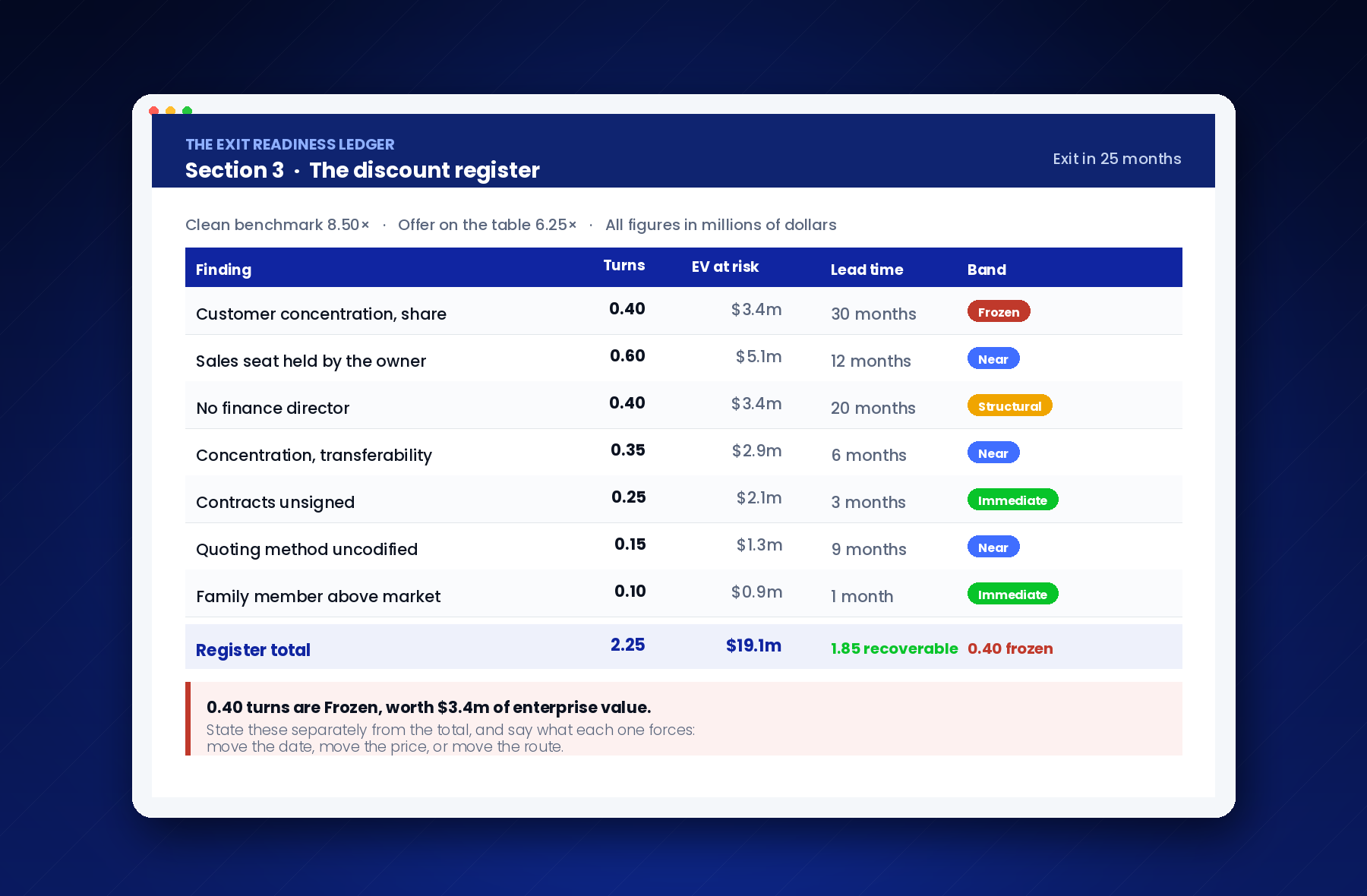
In the case this course follows, the largest finding is one that cannot be fixed at all inside the timeline. The finding with the least slack, the one lost entirely if it slips a single quarter, is fourth by size.
An owner working from a severity list starts with the biggest problem, spends eight months on it, and discovers in month twenty that the thing they could have fixed cheaply in month one is now out of reach.
What most advisers produce
Biggest problem first, smallest last. It is the natural way to write a diagnosis, and it is almost useless as a plan.
It tells the owner what is wrong. It does not tell them what to do on Monday.
What this course teaches
Ordered by how long each finding takes to clear against the owner's stated date, so the plan can be started rather than admired.
And those two orderings rarely agree.
A band is not a property of a finding. It is a property of a finding measured against a date. Move the date and the whole register re-bands.
Immediate
Starts now, finishes quickly. Usually costs nothing and buys credibility for everything that follows.
Near
Fits comfortably inside most timelines, and is where the largest recoverable finding usually sits.
Structural
Must start first regardless of size. This is the band owners defer, because it is expensive and shows nothing for a year.
Frozen
Forces a decision rather than a task: move the date, move the price, or move the route. Say it out loud, early.
Ashgrove Controls · a constructed case, every figure reconciles
You meet the owner in Module 1, two years from an exit she has not prepared for. You are still working on the same business in Module 10 as the process runs. All figures below are in millions of dollars.
Month 0, as found
$34.2m
net to the owner
Enterprise value $53.1m at 6.25×. A register of 2.25 turns nobody had written down.
Month 25, readiness alone
$56.7m
net to the owner
The plan produced $22.5m. Of the 2.25 turns identified, 1.85 were recoverable and 0.40 were not.
Month 33, process run well
$59.8m
net to the owner
The room produced the last $3.1m. Which is worth having, and is not worth two years.
The gap is $25.6m. Of that, $22.5m was available on the day she first sat down with an adviser. It was not available two years later, and nobody had told her. That sentence is the argument for the entire discipline.
Included with the course
The instrument you take to a client, not a worksheet you fill in for marking.
Included with your enrolment
Exit readiness is easiest to understand from the other side of the table. Your enrolment opens a gamified private equity simulator: choose a live mandate, run it across twelve quarters, and defend the result to a buyer who can tell how the earnings were made.
5
operating levers, each landing at a different speed
12
quarters, one budget that never stretches far enough
0
random events, so every outcome traces to a decision you made
Why it belongs in an exit certification
At exit the sandbox splits your equity gain into three columns: EBITDA growth, multiple change and debt paydown. Deleveraging returns capital without improving anything. Multiple expansion has to be earned, and it is bought years before a process starts. One mandate is an outpatient healthcare business where cost cutting damages the clinical product itself, which is the argument of this certification in miniature.
What it does for you
Exit readiness is one of the few advisory conversations an owner will pay for before there is a transaction, because the alternative is finding out during diligence when it is too late to act.
CEVP goes under your signature, on your profile and on a proposal. The certificate carries a named scope line stating exactly what was tested, so a client or an employer can read what you demonstrated rather than guess at it.
Owners approaching a sale need someone senior for two or three days a month across eighteen months. Exit readiness gives you a defined remit, a visible deliverable and a natural end date, which is the easiest kind of fractional role to sell.
You arrive before the mandate rather than competing for it. An adviser who has already priced the register and banded the plan is the obvious choice to run the process, and has spent a year building the trust that decision requires.
Being able to say what one turn of multiple is worth in dollars, and why a finding is Frozen rather than merely difficult, changes how you are treated in a meeting. You stop describing problems and start pricing them.
For accountants and business advisers, this converts an annual compliance relationship into a multi-year advisory one. The same client, a far larger remit, and a reason to be in front of them quarterly rather than once a year.
Exit readiness is the discipline private equity applies to every holding in its final two years. Demonstrating it is a credible way into an operating partner or portfolio value creation seat, and it pairs directly with COPPE.
The practical version. After CEVP you can sit opposite an owner, ask for three documents, and come back with a priced register, a banded plan and a defensible net proceeds figure. That is a piece of paid work with a defined scope and a deliverable, and it is the natural front end of everything else you sell. Most advisers cannot currently offer it, which is exactly why it is worth holding.
The exit-side roles this credential is built for, set against the paths the established credentials open.
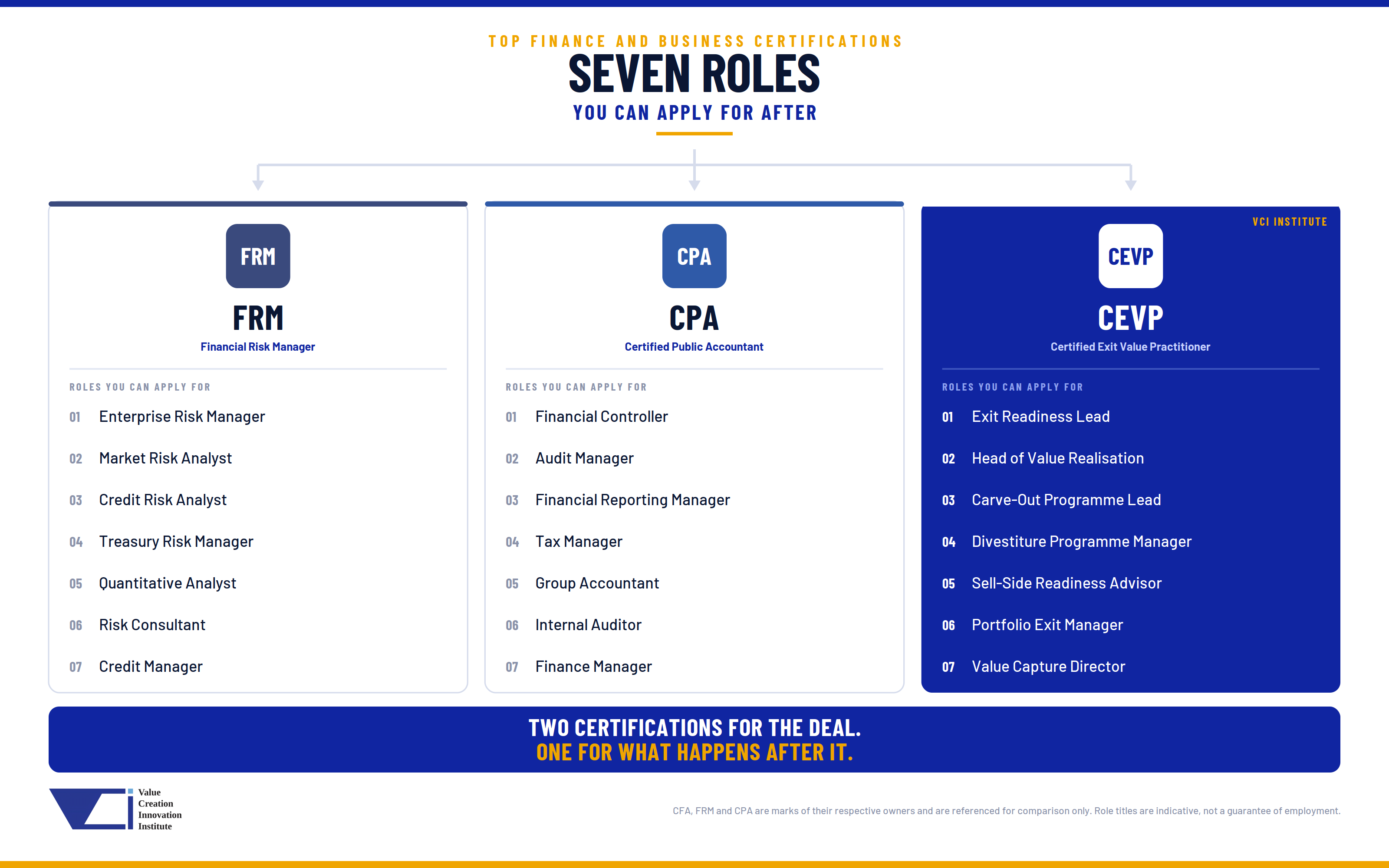
The seven CEVP roles
FRM and CPA are built for the roles that measure and report on a business. CEVP is built for the roles that get it ready to sell and make sure the value is actually captured.
Six beats, every time. And the scaffolding thins as you go: by Module 9 the guidance is gone, and by the capstone there is none at all.
01
A real document lands on your desk, of the kind you will actually be handed.
02
You commit to an answer before any instruction. This is the part most people want to skip.
03
The owner's view, then the buyer's, side by side and priced differently.
04
The arithmetic, line by line, with an instrument you build yourself.
05
A composite case where the same mistake went wrong in practice, and what it cost.
06
Where the owner stands before, and where they stand after. Always in net proceeds.
What you are actually buying
You can rebuild any number in a spreadsheet and get the same answer. If you find one that does not, we would rather hear about it than not. A course about defensible numbers that carries indefensible numbers has no standing to teach the subject.
87
lessons across 27 modules
17
instruments you build yourself
22
videocasts and audiocasts
120
questions, all with worked answers
Eleven modules and nine bonus units, in the order the variables bite. The bonus units hold the specialist corners so the spine stays clean.
Two required components and one optional. Not everyone passes, and that is what makes it worth holding.
70%
Your ledger applied to a company you choose, real and anonymised or entirely constructed. Marked on completeness, banding, arithmetic, route reasoning and the first conversation.
80%
Fifty questions drawn from a bank of seventy five, seventy five minutes, supervised. Weighted towards the modules that carry the arithmetic.
Optional
Forty five minutes, recorded, and it cannot fail you. For anyone who wants to test whether they can defend their own numbers out loud.
Why the file passes at the lower mark. Because it is the harder task, not the lesser one. A paper on material you have just studied should be answered correctly four times in five. Producing a defensible register on a company nobody has pre-digested for you is a different order of difficulty entirely.
How it compares
The established credentials are serious and assessed seriously. None of them examines exit readiness and value realisation.

The horizontal axis is how much of a curriculum covers post-deal operating value creation. The vertical axis is how far assessment goes beyond multiple choice, into written response, simulation, portfolio and defended capstone work. CFA, CPA, CAIA and CMA sit high on assessment demand and low on value creation content. CFP, FRM and FMVA sit lower on both. COPPE, CEVP and CVCA are the only three in the upper right, where the content is comprehensive and the assessment is demanding.
You do not need to have run a sale process before. You need to be the person an owner asks what the business is worth.
Practitioners who advise on sale readiness and want a method that survives the buyer's diligence rather than one that reads well in a proposal.
Anyone working with owner managed companies who is asked what the business is worth, and wants a better answer than a multiple from a table.
Value creation professionals working towards a defined exit, where the sequencing problem is the whole problem.
Founders and shareholders who want to know what a buyer will actually price, early enough that it can still be changed.
Around thirty to forty hours to work through properly. The eleven drills are what take the time, because you build each instrument from a blank state rather than reading a finished one. Access runs for twelve months, so most practitioners take it over six to ten weeks.
No. Start with the Placement Diagnostic in the Start Here section. Fifteen minutes, and it tells you which modules you can move through quickly and which you cannot.
Most practitioners are surprised by the result. Strong valuation mechanics do not predict strength at sequencing against a date, and people who find the arithmetic hard often have the best instinct for what an owner will actually do.
No. CEVP is a professional education credential, backed by VCI Institute and its faculty. It is not a licence or a regulated qualification, and it does not authorise the holder to provide legal, tax, investment or corporate finance advice.
The course is explicit about where a specialist is needed. Your role is to identify the item, price the exit consequence, and bring the specialist in early.
The Exit Readiness Ledger, and it is included. Enter a defensible earnings figure and every finding prices itself. Enter a lead time and the band assigns itself against your date, so anything that will not fit turns Frozen without you deciding it.
It checks that your bridge reconciles, warns you when nothing is Frozen (which usually means your lead times are optimistic), and exports a finished document you can send to a client.
They are constructed, and deliberately so. A real client engagement cannot be published, and a sanitised one loses exactly the detail that makes it teachable.
What matters is that every figure reconciles. You can rebuild any number in the course in a spreadsheet and get the same answer, and if you find one that does not, we would rather hear about it than not.
Full refund within seven days of purchase, no questions asked, provided you have not taken any assessment. Assessments means the Placement Diagnostic, the three checkpoints, the practice quizzes and the final examination.
Opening a lesson, watching a videocast, running a drill or reading a bonus unit does not affect your refund. Only taking an assessment does. After seven days the sale is final.
Twenty two and a half million of it came from the plan. Three point one came from the room. Learn to build the part that matters.
$399 · Twelve months of access · Seven day refund before any assessment is taken