
Instrument one
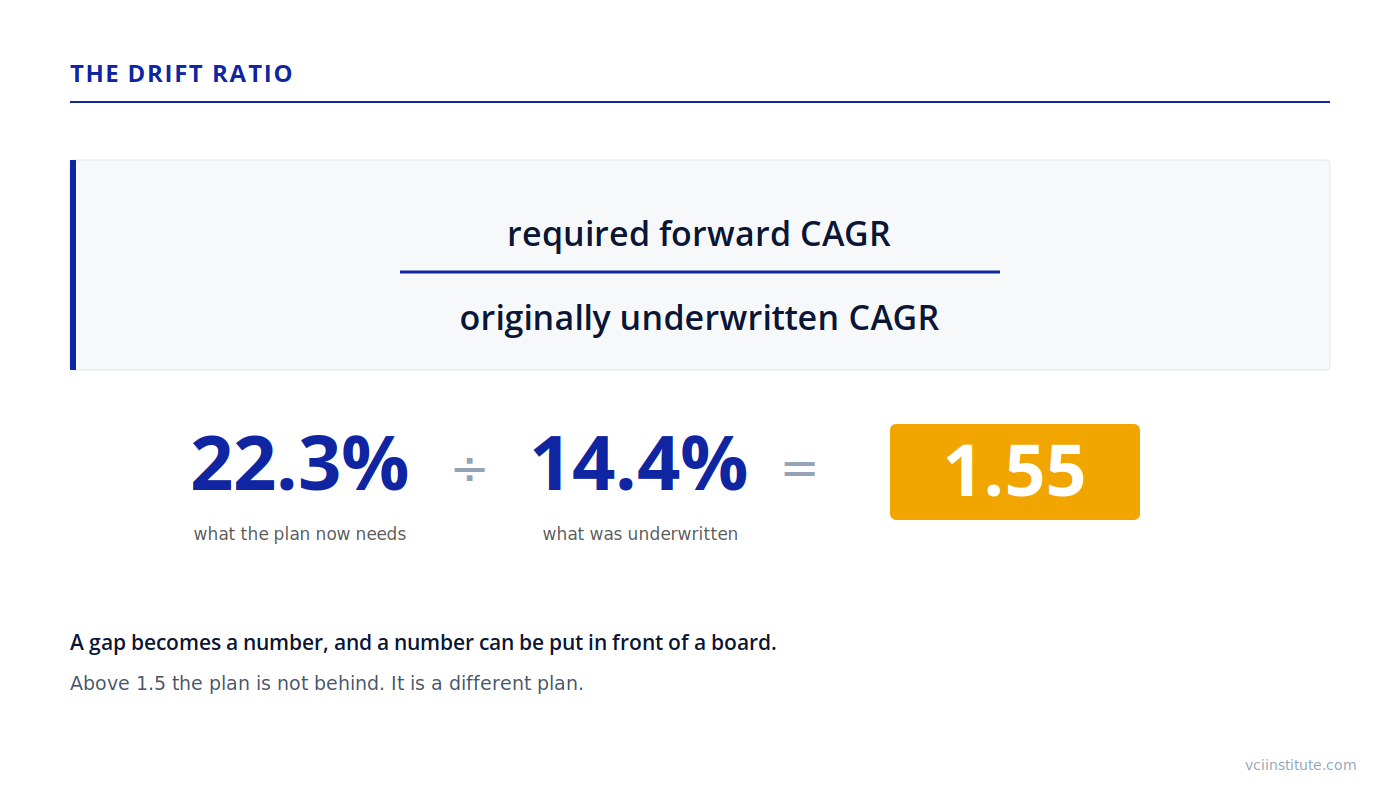
The Drift Ratio
How far the company has moved from the thesis it was bought on, measured rather than asserted. At Level 3 you act on it.
VCI Institute · COPPE Level 3 · Certified Operating Partner in Private Equity
You are appointed as operating partner to a portfolio company already off thesis. One situation, one corpus of roughly seventy documents, and no right answer. You diagnose the gap, establish what the capital structure will permit, decide, and defend that decision in front of a board.
499 US dollars. One payment. Seven day refund while the course is unused.
Boards argue about what to do next. They rarely establish, in a figure they would defend, how far the company has already travelled from what was underwritten.
The Drift Ratio measures that distance. Most files argue about the plan. Level 3 starts by measuring the gap.
There is no model answer and no clean set of facts. The documents disagree with each other. Some of what the file appears to say turns out, on verification, not to be what it says at all.
What is assessed is not the verdict you reach. Hold, exit and reset can all pass. What fails is a recommendation the file does not support.
Each one is built inside the case, not described in the abstract.
Instrument one
How far the company has moved from the thesis it was bought on, measured rather than asserted. At Level 3 you act on it.
Instrument two
What the capital structure will actually permit. A sweep, a covenant step and a springing guarantee decide more of the plan than the plan does.
Instrument three
An option that cannot clear its gates is not an option, however good it looks. You screen for affordability before you argue the case.
One for every module, plus the field instruments and both certification gates. They are visual explainers, built so the structure of an argument can be watched rather than read, and they work with the sound off.
Every module works the same corpus. Nothing is taught in the abstract and nothing resets between modules, so a mistake in Module 1 is still with you in Module 6.
Module 1
What has actually gone wrong, separated from what everybody says has gone wrong. You establish the drift before you propose anything.
Module 2
The cash sweep, the covenant step and the guarantee that springs. The capital structure decides which plans are even available to you.
Checkpoint
Modules 1 and 2, marked against the same standard as the certification examination so there are no surprises later.
Module 3
Who is load bearing and who merely has a title. The order you deal with people in is set by the structure, not by the org chart.
Module 4
Customer concentration, and the difference between a risk the file demonstrates and a risk the room has simply agreed on.
Checkpoint
Modules 3 and 4, marked against the same standard as the certification examination. It is where the people work and the concentration work are tested together for the first time.
Module 5
Hold, exit or reset. You screen the options for affordability first, then argue the one that survives.
Module 6
Saying it out loud to people who are not pleased to hear it, and holding the position when the room pushes back.
Checkpoint
Modules 5 and 6, the last checkpoint before the capstone. It asks you to decide and then defend the decision, which is what the capstone marks.
Three field artefacts and an optional library that converts into masterclass grants.
The screens and sequences you ran during the case, packaged to be run again on a live file.
The exact wording for the hard conversations. What to say when the number is bad and the room wants comfort.
One page. The whole method compressed to what you can hold in front of you in a meeting.
Optional. TVC Applied, Deal Structure Applied and Growth Leadership Applied. Each one ends in a free masterclass grant.
Passing one does not carry the other.
Establishes that you would do something sensible if you were dropped into a live file tomorrow.
It marks your process, not your verdict. Hold, exit and reset can all pass. What fails is a recommendation the file does not support.
Establishes that the instruments are yours rather than borrowed.
50 questions, drawn only from the six assessed modules. 75 minutes. The pass mark is 80 per cent, which is 40 of 50.
The Simulator and the capstone workspace both start when you activate them, not when you enrol. Activate each one when you are ready to use it. Activating early does not extend the term, and the fourteen days on the capstone workspace is the shortest clock in the course.
Built for
Probably not for you if
COPPE Levels 1 and 2. Level 3 assumes the instruments they build and does not reteach them.
Does not expire. There is no renewal fee and no continuing education requirement.
Seven days, while the course is unused. Opening a PE Simulator account, opening a capstone workspace, or starting any assessment ends the refund window.
No. Hold, exit and reset can all pass. The capstone marks how you reached the recommendation and whether the file supports it, not which of the three you chose.
No. Level 3 is asynchronous throughout. You start when you enrol and work at your own pace within the course access period.
No. Both start when you activate them. Course material runs for 365 days from enrolment; the Simulator runs for 90 days from the day its account is opened; the capstone workspace runs for 14 days from the day it is opened. Activating early does not extend the term.
No. Level 3 assumes the instruments taught at Levels 1 and 2 and does not reteach them.
Seven days from purchase, while the course is unused. The window closes as soon as you open a PE Simulator account, open a capstone workspace, or start any assessment. There is no minimum term because there is nothing recurring to cancel.
One situation, one corpus, and a decision you have to stand behind in front of a board.
499 US dollars. One payment. No subscription, no renewal fee.