
VCI Institute · Certification
Eleven AI proposals on the whiteboard. Three claims a buyer would pay for.
The certification for the person whose name sits next to the AI line in a value creation plan. Take one company from the close to the exit, price every AI claim, name the person accountable for each automated decision, and build a plan for a company you have never seen that holds up when people paid to doubt it take it apart.
349 USD, one payment · 365 days of access · seven-day refund window
The case, in one screen
Eleven lines went up on a whiteboard in Kenosha. Follow them to the exit.
Second Monday of January 2027. Eight from management, three from the head of IT, claiming 13.4 of 2031 EBITDA between them against a gap of 9.7. Run the hold and watch what a buyer's diligence does to them. Every figure is from the course's frozen case numbers, and you will do this work yourself, module by module.
2031 EBITDA, USD m
September 2031
Field service scheduling tool
Distributor discount tool
Predictive maintenance model, installed base
Customer-support assistant
Warranty claims classifier
AshgroveIQ attach targeting on service visits
Demand forecasting for parts inventory
Tender drafting assistant for utility bids
Data lake
ERP analytics layer
Security and identity upgrade
Three claims reach the September 2031 memorandum, each with a counterfactual, a dated document and a named person a buyer can question. What those three are worth to that buyer is the next piece of arithmetic.
See the value line ↓The finding we lead with
Most AI claims do not survive the walk from the whiteboard to the buyer.
On the case company, the eleven proposals claim more than the whole gap the plan has to close. The course walks each claim through five tests. What is left at the end is smaller, and it is the only part a buyer pays for.
A course that arranged its case so that AI saved the day would be training you to be believed rather than to be right. This one does the opposite, and shows every step of the arithmetic.
Why this certification is different
Built for the seat that answers for the number, not for the audience that admires the tools.
Most AI programmes for executives explain what the technology can do. This one asks what an AI initiative is worth in a value creation plan, who answers for it, and what survives a buyer's diligence.
Who it is for
For people who already carry a number, and have lately been handed an AI line to go with it.
Written for
- An operating partner or value creation lead asked which of a portfolio company's AI proposals deserve the fund's money
- A portfolio company CFO whose board wants an AI figure in the plan and a person prepared to stand behind it
- A senior executive in a sponsor-backed business, or an adviser to one, who owns an initiative with a number attached
- A technology leader moving to the value creation side of the table, who has never been asked what a capability is worth at an exit multiple
Not written for
- Anyone who wants to learn how models work, how to write prompts or how to build software
- Anyone who needs a licence, an accreditation or continuing education credit
- Anyone expecting a certificate for attendance: there are two gates, and both are marked by people against a published standard
- Anyone who cannot find roughly 170 hours inside a year
What the seat answers for
Every AI initiative is a claim about five things at once, whether the proposal says so or not. The course is organised around them.
Impact
What moves, in which line of the accounts, and by how much.
Modules 3, 4 and 5Landing
What share of the value arrives once real people use the tool on a real Tuesday.
Module 6Time
How long it is in the numbers before a buyer prices them.
Modules 2 and 9Cost
All eight lines of the cost of a tool, including the way out.
Modules 7 and 8Proof
What a buyer's diligence team will credit, and what it will discount.
Module 10The arithmetic
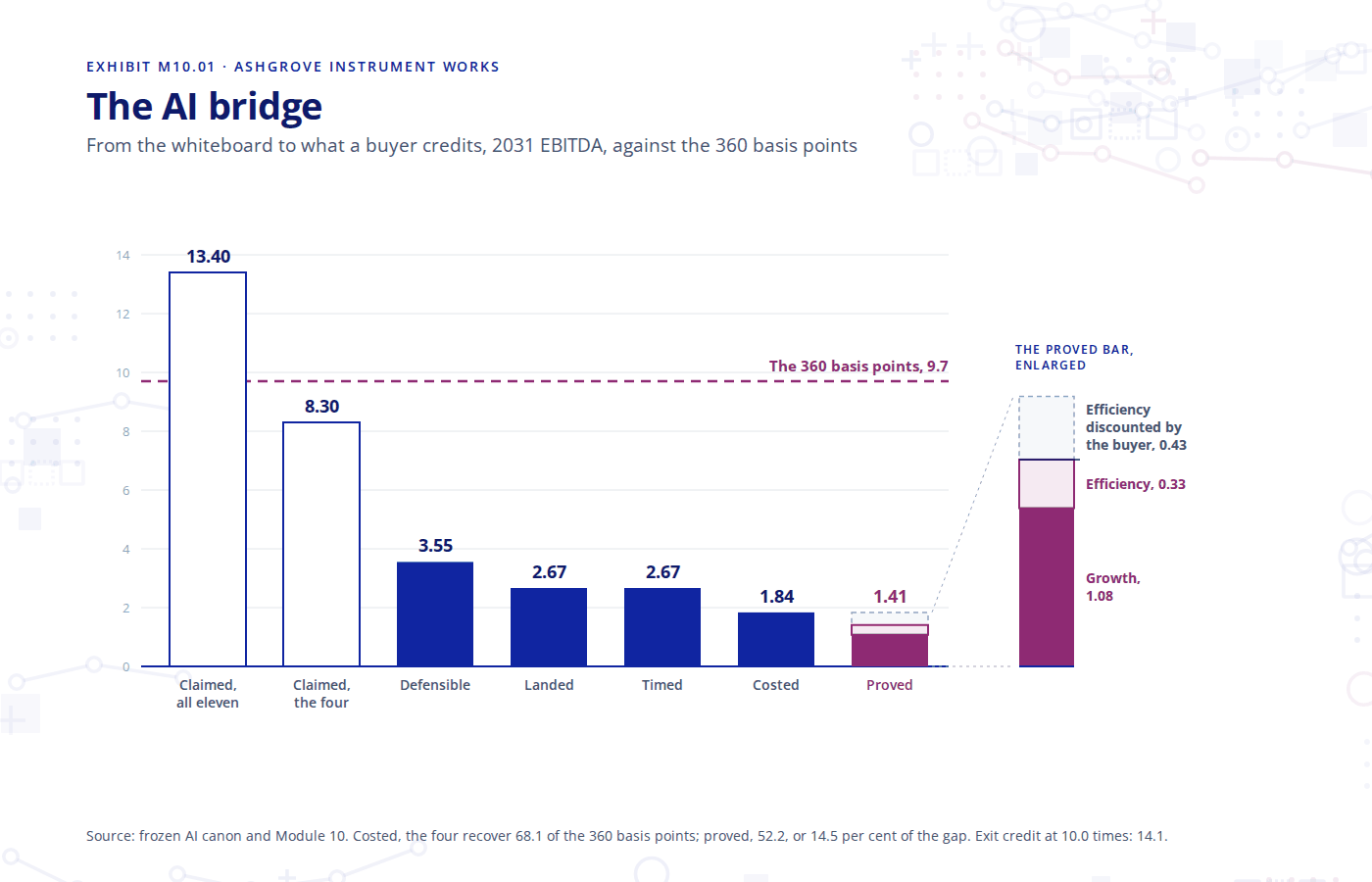
Thirteen point four claimed. One point four credited. Every step between them is a module.
This is the AI Value Line the course builds on the Ashgrove case, station by station, from the whiteboard to what a buyer's quality-of-earnings team actually paid for. Hover a bar for what happened at that station. Then rebuild it yourself below, one line at a time.
The AI bridge, 2031 EBITDA, USD millions
Frozen case numbers. Ashgrove Instrument Works is fictional.Now do it yourself
Price one claim the way the course does.
Load one of Ashgrove's four survivors and the arithmetic reproduces the course's own number for it. Then move one assumption and watch what a buyer pays for. The course's calculator runs a landing curve by year and an eight-line cost stack; this is the shape of it.
At the 10.0 times exit multiple that is 3.2 of enterprise value.
Teaching numbers on a fictional company. Load all four survivors in turn and the proved values sum to 1.41, the figure on the bridge above. The course asks you to build the whole line for a company you have never seen, and to defend every cell of it.
Run the hold yourself
Eleven AI proposals. Three ways to run the hold. One of them gets paid for.
Same company, same eleven lines, same team, same five years. All three teams reach almost the same run-rate by 2031. Watch what a buyer actually credits at the exit.
Exit value a buyer credits, USD m at 10.0×
Month 60 · December 2031 · the exit
Same eleven lines. Same run-rate, near enough. A buyer paid for one of them.
VCI Institute · Certified AI Operating Partner. Learn to run the plan, not just write it.
How it works. One engine, three rules. Every team has twelve units of management capacity a month, split across whatever is active, with a context-switching penalty of one fifth per extra live initiative. A line getting too little attention can stall for a quarter. When a line lands, its defensible value ramps in over six months and its run cost starts. The buyer's credit follows the course's two rules: nothing counts unless it was live by 1 January 2030 with two audited years to show, and of what does count, growth is credited in full, price and proved efficiency at half, unproved efficiency and risk controls at nothing, while every net cost counts. The canon figures for the four survivors are the CAIOP frozen numbers; the seven other lines carry modelled values, marked in the table.
Illustrative simulation on a fictional company. Figures are modelled, not measured, and not investment advice.
The course map
Ten modules, one company, one chain of numbers.
Each module hands its result to the next. About 170 hours at your own pace: six to nine hours for each module with its drill, and about thirty for the capstone.
The Seat
What the seat answers for, the gap it is hired into, and the carry test.
Reading: Fees Keep the Lights OnThe Hold
Where AI sits in a value creation plan, and how long each initiative is in the numbers before a buyer prices them.
Reading: The Most Expensive HandoffReading a Company for AI
Data, systems and people; twelve data sets sorted by the state they are really in.
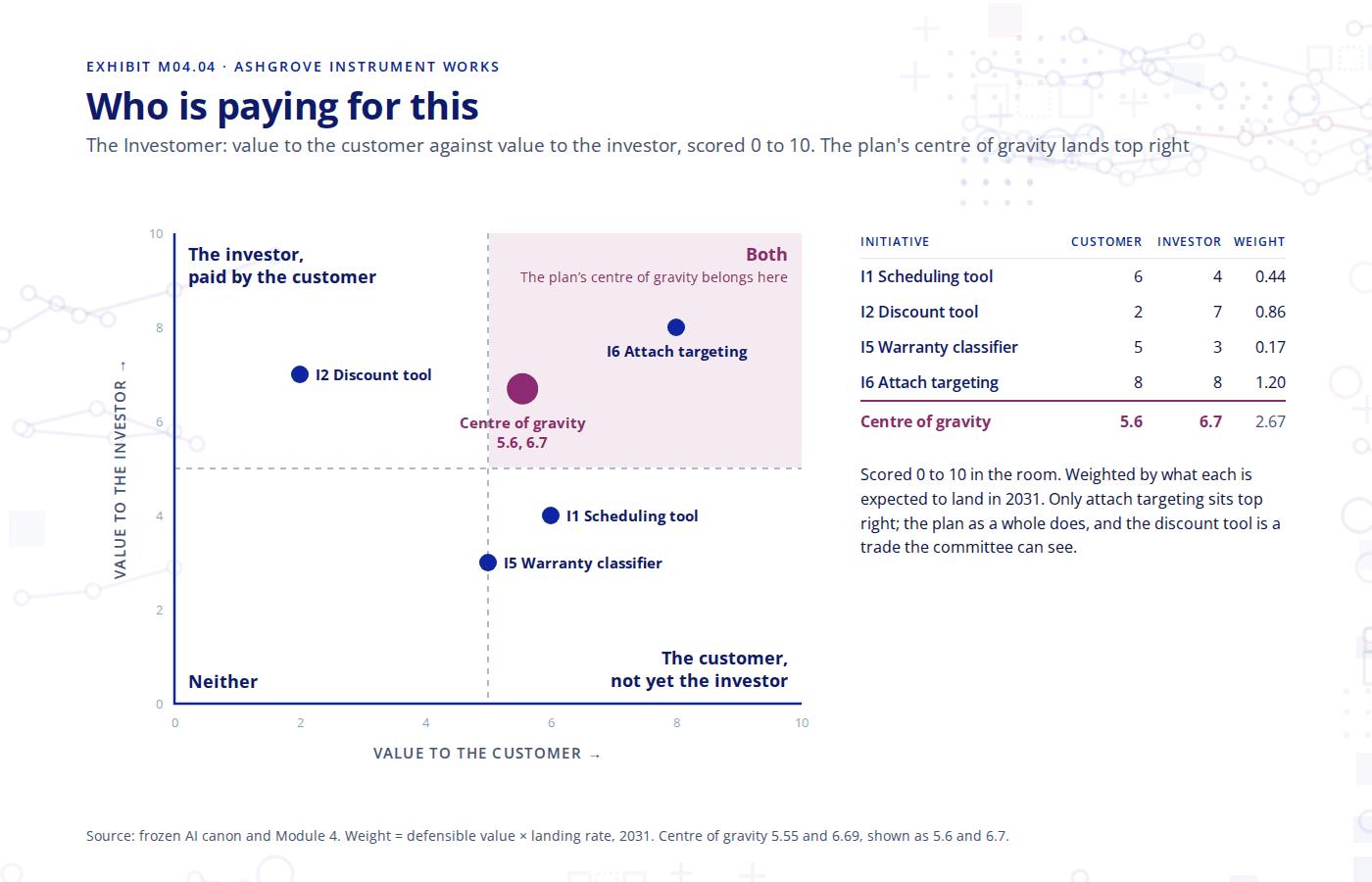
Reading: Turn It Off for a WeekThe AI Value Case
From a use case to a line a committee will accept: eleven claims cut to four. The signature module.
Reading: Who Is Paying for ThisThe Lever Map
Where AI moves a number, placed on the Institute's lever map.
Reading: The Wrong MapLanding
Adoption as a sequence, and a landing rate for each initiative with its reason.
Reading: And Then IT Walked InBuild, Buy, Partner
The full cost of a tool on eight lines, and one vendor choice made.
Reading: Above the Model Is RentedData and Accountability
Data as an asset and a liability, the seven seats, and one bad Friday.
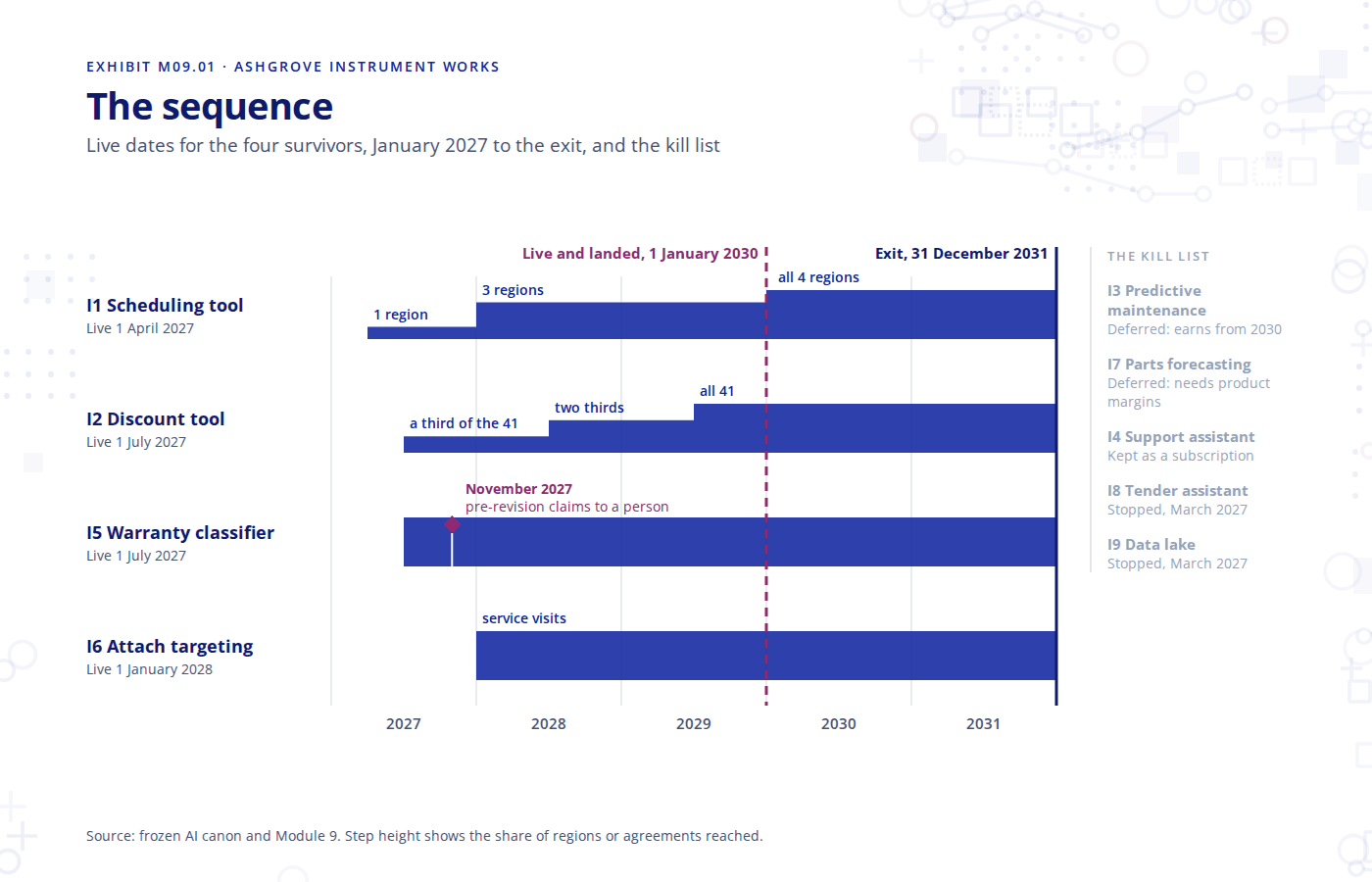
Reading: The Empty BoatSequencing the Hold
The first hundred days, the one thing shipped inside ninety, and the kill list.
Reading: Detection Without EscalationProving It at Exit
The AI bridge, closed against the gap, and the buyer's quality of earnings.
Reading: The Forty-First LetterOpen a module
Five of the nine parts of Module 4, word for word.
Every module follows the same nine parts, so that by the third one you stop noticing the structure. Rather than describe them, here are five from the signature module, unedited. This is the register the whole course is written in.
The other four parts of every module are the brief, the teaching, a formula card and a drill with one planted difficulty and a worked answer. The drills are not marked and count towards nothing, because a drill only teaches if you are free to walk into the trap.
The Refusal: “Industry benchmarks suggest”
It comes from the deal partner in April, reading the draft and finding the scheduling line at 15 per cent: “Industry benchmarks suggest these tools do far better than that. Why are we so far below them?”
It does not argue with the benchmark. It moves the claim above the underwriting line and gives the deal partner a date for the answer.
The Judgment
An AI value case is an argument, not a forecast. It must contain a claim against itself, and it must say who pays.
A forecast states a number and asks to be believed. An argument shows how the number was reached and what would make it wrong. The value case will be read by the committee, by the board and, in 2031, by a buyer's AI team, which will find the weakest point whether or not the seller names it.
Who disagrees, and their strongest point. The chief financial officer needs a number for the budget and the covenant model, and an argument cannot be typed into a cell. The deal partner's objection is sharper: a claim against yourself, written down, is a gift to every sceptic, and in 2031 a buyer will find it in the data room and cut the price with it. Both are right about the mechanism. The argument does produce a number, 3.55, and finance can enter it; the argument is what the number rests on. A buyer with its own AI people will find the weakness anyway, and one the seller named in 2027, with a record of how it was managed, costs less at the table than one the buyer discovers.
The Trap: adding up the use cases
Summing initiatives that share a base.
A diligent seat builds a careful line for each initiative, tested on its own evidence with its own owner, and then adds them up. Every step is sound and the sum is not, because the lines were built one at a time and the business will run them all at once.
The shared visit. Predictive maintenance and attach targeting both claim value from the same technician at the same instrument. The scheduling tool is sized on shorter days while attach targeting spends part of each visit on a conversation, so the visit is spent twice.
If every other line were switched off, what would this one be worth, and does any other line, or the plan itself, draw on the same base?
The Proof: eleven initiatives, four survive, the defensible line
From the frozen canon, with no step omitted.
Gap, 2031            269.8 × 3.60%                    =   9.7128, shown as 9.7
Claimed, all eleven  1.1 + 2.9 + 2.4 + 0.9 + 0.8 + 3.5
                     + 1.2 + 0.6 + 0.0 + 0.0 + 0.0    =  13.4
                     13.4 − 9.7128                    =   3.7 more than the gap

Leave the value line 2.4 + 1.2 + 0.9 + 0.6 + 0.0 × 3  =   5.1
Claimed, the four    13.4 − 5.1                       =   8.3

Defensible
  Scheduling         3.6 × 1.04^4 = 4.2115;  × 15%    =   0.6317
  Discounts          146.2 × 65% = 95.03;    × 1.2%   =   1.1404
  Warranty           0.4153 × 50% + 1.9737 × 8% × 50% =   0.2866
  Attach             2.2 × (78% − 10%)                =   1.4960
  Total                                                 =   3.5547, shown as 3.55
  Against the claim  3.5547 ÷ 8.3                       =  42.8%
  Against the gap    3.5547 ÷ 9.7128                    =  36.6%
Four initiatives survive, carrying a defensible 3.55: 42.8 per cent of what their owners claimed and 36.6 per cent of the gap, before a single landing rate, live date or cost. Module 1 promised that the case would not be arranged so that AI saves the day, and this is the first place that promise is kept in numbers.
The Line
“The claim you make against yourself is the one that makes the others believable.”
Each module ends on one sentence like this, and the Field Card collects all ten on one printable page. They are the ten things a seat should be able to say without looking anything up.
Instruments, not slides
Nothing is asked of you on trust without something to run it on.
Every exhibit is drawn from the case's frozen numbers. Every instrument runs in the page and stores nothing, so your work stays with you.
The AI Value Line Calculator
Landed, timed, costed and proved, per initiative and in total, against the gap in basis points.
The Seven Seats
A named person in each seat for an automated decision, then an incident day run against the seats you filled.
Drills and practice assessments
Ten drills with planted difficulties and worked answers; five practice assessments with every option reasoned.
The Entry Diagnostic
Twenty questions that route you to a starting point, and report no score.
The AI value plan workbook
A blank template built to the course's standard, and the case company filled in, with fourteen checks wired.
The Field Card
The seat on one printable page, and the ten lines worth remembering on the other.
The case
Ashgrove Instrument Works, from the whiteboard to the exit.
A fictional maker of industrial instruments, bought with a plan to take EBITDA from 29.4 to 50.0. Underneath a healthy margin, everything except its subscription product is worth minus 360 basis points: 9.7 of EBITDA, 97.1 of equity at the exit multiple.
You do the work yourself, module by module. Then the capstone puts you in front of a different company, with four planted difficulties that nobody flags for you.
Every figure comes from one frozen set of teaching numbers on a fictional company. They are not evidence of what AI does to a margin anywhere else, and the course says so whenever it matters.
- 31 December 2026The sponsor closes. The plan already assumes the decline.
- January 2027Eleven AI initiatives go up on the whiteboard, claiming more than the whole gap.
- April 2027The first tool goes live in one region, on day 80.
- November 2027A classifier declines a utility's claim, and nobody is sitting in the seat that could overrule it.
- 2028 to 2030Landing, costs, a comparison region and a kill list.
- September 2031The AI section of the sale memorandum is cut from eleven claims to three, each with a counterfactual, a dated document and a named person.
The credential
Two gates. Both required. Neither can make up for the other.
The capstone
Build an AI value plan for a company you have not seen, write a two-page investment committee paper, and both are marked by two assessors against the published rubric. The Institute may ask you for a conversation about your submission before it confirms the result.
- Marked
- By people, against a published rubric: five criteria, four bands
- Questions
- Where the Institute asks about a submission, the questions come from a published bank of eighteen, one always asked: who is accountable for the automated decision that most affects a customer
- Attempts
- One submission and one resubmission
The examination
Fifty questions drawn from a bank of one hundred, in ninety minutes, closed book, with no AI tools of any kind.
- Pass
- 40 of 50
- Attempts
- Two, at least fourteen days apart, on different questions
- Integrity
- Identity checked by a person; no software judges your face
What it does say is specific: that you took a company from a whiteboard to an exit, priced every claim, named the person accountable for each automated decision, and put the result in front of people paid to doubt it.
Plan the year before you buy it
Three hundred and sixty-five days is enough. It is not so much that you can ignore the calendar.
Both gates have to be recorded inside your access window, and two dates inside it matter more than the rest. Put in the day you would enrol and the hours you can find in a week, and the page draws your year. Nothing here is saved or sent anywhere.
Your 365 days
Navy is the taught material at your pace. Plum is the capstone. The markers are fixed by the Institute and do not move.
refund window closes
latest first capstone submission
latest first examination
access ends
The two published dates are the Institute's, and they are the same for everybody. What moves is your own pace, and the capstone is the part most easily underestimated. Plan it backwards from the day-235 date, not forwards from Module 10.
Before you enrol
Three minutes on fit
The course assumes a seat you already hold: five years or more at manager level or above, some value creation exposure, and something you have run. Eight questions compare your experience with that. Nothing is scored, saved or sent anywhere.
The check is advisory and the decision is yours. Whichever result you see, the standard of the certificate stays exactly where it is.
Certified AI Operating Partner
Is this certification for you?
The certification is for the person whose name sits next to the AI line in a value creation plan, and it assumes you have carried a number of your own. Eight questions, about three minutes, tell you how your experience compares with what the course assumes. The decision to enrol is yours.
What the course assumes
- Five years or more of professional experience, at manager level or above
- Some value creation exposure: a value creation plan, a transformation, a turnaround or an integration
- Something you have run: at least a team or project budget
- Time for the programme: roughly 170 hours, including a capstone and an examination
If your experience sits below this, the check will say so plainly and suggest a route. You may still enrol, on your own judgement. Your answers are not saved and nothing is sent anywhere.
Before your result
One confirmation
What we read from your answers
Your answers are not saved. If you write to us about enrolment, quote your reference and we will know what you told the check.
Questions
Who is CAIOP for?
Operating partners, value creation leads and portfolio CFOs. You take one company from the close to the exit and price the AI line a buyer will credit. Entry is open: the eligibility check on this page is advisory, and anyone may enrol on their own judgement.
How long does it take?
About 170 hours at your own pace: six to nine hours for each of the ten modules with its drill, and about thirty for the capstone. It is self paced, with no cohort dates.
How am I assessed?
Two gates, and you must pass both for the certificate. The first is a closed book examination of fifty questions drawn from a bank of one hundred, ninety minutes, with a pass mark of 80 per cent and two attempts at least fourteen days apart. The second is a capstone, marked by VCI Institute staff, in which you take a company you have not met before and produce a two page investment committee paper. One resubmission is allowed, with written feedback.
How much does it cost and what is the refund policy?
$349, one payment in US dollars. A full refund is available within seven days of purchase, until you start the examination or submit the capstone. Starting either ends the refund window.
Is CAIOP a regulated qualification?
No. It is a professional education credential issued by VCI Institute. It is not a licence and does not authorise the holder to give legal, tax or investment advice.
Nothing renews, and there is nothing further to buy on the way to the certificate.
- The whole course for 365 days: Start Here, The Doctrine, The Operating Partner Primer, ten modules, seven bonuses and ten readings
- The Entry Diagnostic, ten drills with worked answers and five practice assessments
- The AI Value Line Calculator, The Seven Seats, the Field Card and the plan workbook
- The examination, with two attempts
- The capstone, one resubmission, and written feedback on every criterion
- The certificate once both gates are recorded, with a credential number the Institute confirms to anybody who asks
VCI Institute is a nonprofit professional education institution. The fee is the same for every participant.
Access and refunds
365 days of access
The capstone, any resubmission and both examination attempts must be recorded inside the window, so it helps to plan backwards from the end date.
A seven-day refund window
Seven days from purchase. Two events end it early, and we define them precisely:
- Starting the examination ends it when the timed sitting begins. Registering and the identity step do not.
- Submitting the capstone ends it at the time stamp of the upload.
The Entry Diagnostic, the drills and the practice assessments never end it. To ask for a refund inside the window, write to [email protected] from the address you enrolled with.
Questions we are asked
Before you enrol
Is the certification accredited, or does it carry continuing education credit?
Is a technical background needed?
Is private equity experience needed?
How long does it take, and is it scheduled?
What happens after a first examination attempt below 40?
Are AI tools allowed?
Will the Institute interview me about the capstone?
What if the eligibility check says "a stretch"?
Is the case company real?
How does an employer verify the certificate?
One company, from the whiteboard to the exit.
If the check says the course fits, or you have weighed it and decided to enrol on your own judgement, enrolment takes a few minutes and Start Here is waiting at the other end.
Check your fit and enrol →349 USD, one payment. 365 days of access. Refund within seven days of purchase, ended by starting the examination or submitting the capstone. [email protected]