
A Practical Guide to Value Creation in Private Equity, Venture Capital, and Transformationusiness Transformation
Dec 03, 2025This vlog offers a concise, practitioner-focused overview of how value is engineered across the investment lifecycle. It outlines the core levers, the financial architecture behind them, and an operating cadence that turns intent into measurable outcomes.
1) The Financial Architecture (Why Levers Matter)
At exit, equity value is driven by a few variables:
-
Equity Value = (EBITDA × Multiple) – Net Debt
-
Value creation, therefore, occurs through a combination of:
(a) EBITDA growth, (b) multiple expansion (risk reduction and quality signaling), and (c) deleveraging. -
To make this visible, teams use valuation waterfalls/bridges, IRR/MOIC linkages, and cash discipline (e.g., 13-week cash and working-capital turns).
2) The Fruitful Five: Core Value-Creation Levers
A clear taxonomy helps prioritize effort. The Fruitful Five (used across VCII programs) keeps teams aligned:
-
Grow Revenue — pricing, mix, cross-sell/upsell, channel productivity, product cadence.
-
Expand Margins — cost-to-serve, procurement, SG&A efficiency, footprint/complexity reduction.
-
Execute Strategic Acquisitions — bolt-ons, integration synergies, shared services, harmonization.
-
Accelerate Debt Paydown — cash conversion cycles, capex discipline, asset monetization.
-
Expand the Exit Multiple — governance, recurring revenue/contract quality, digital maturity, risk reduction, ESG.
3) Operating Cadence: TVC Next Pillars (How Work Gets Done)
Execution quality often separates outcomes. The TVC Next model structures the work:
-
Strategic Clarity linking moves to EBITDA, WC, EV.
-
mVMS (Merit-driven Value Management System)—a dual layer of Drivers (direct value levers) and Enablers (capabilities, systems, culture).
-
Multiphase Roadmaps—100-day, 12-month, and 3-year flywheel.
-
Financial Integration—valuation bridges, IRR/MOIC math, KPI scorecards.
-
Digital & AI Activation—analytics, automation, data/BI tied to value.
-
Behavioral Alignment—coaching, incentives, culture reinforcement.
-
Exit-Back Design—build the exit narrative and buyer mapping early.
4) Measurement: From Leading Indicators to Cash
Useful, minimal metrics beat long lists. A practical set:
-
Revenue: win rate, pipeline coverage (× months), NRR/GRR, price realization.
-
Margins: contribution margin by SKU/channel, cost-to-serve, throughput/OEE.
-
Cash: DSO/DPO/DIO, CCC, capex-to-sales, unbilled/billable leakage.
-
Multiple Readiness: churn, concentration, audit/QoE issues, security/compliance posture, digital maturity signals.
-
Cadence: weekly lever reviews, monthly KPI packs, quarterly valuation bridge updates.
5) Decision Tools that Reduce Noise
Three tools commonly used in VCII programs:
-
Dynamic Lever Prioritization Grid—ranks initiatives by value (NPV/EBITDA impact) and feasibility (time/risk/capacity).
-
Exit Narrative Builder—articulates the buyer thesis, proof points, KPIs, and digital/operating premiums.
-
mVMS—connects front-line actions to P&L/cash and clarifies enabling capabilities (systems, talent, data).
6) Planning Milestones (Example)
100-Day Focus: stabilize cash, codify the value thesis, stand up governance, install the KPI pack, launch 3–5 high-yield levers.
12-Month Focus: institutionalize operating rhythms, scale successful levers, complete 1–2 platform plays (e.g., pricing program, procurement wave).
3-Year Flywheel: reinforce digital/AI enablers, expand into adjacencies, prepare the exit narrative with credible evidence.
7) Capability Building: Why Simulations and Diagnostics Help
-
Role-based simulations (CEO/CFO/CRO/CHRO) allow teams to pressure-test choices under constraints and see consequences in dashboards and valuation bridges.
-
Diagnostics & quizzes baseline skills, identify gaps, and tailor learning paths to the investment thesis.
-
Credentials as scaffolding:
-
COPPE (Certified Operating Partner in Private Equity) focuses on portfolio execution, lever sequencing, and exit-back design.
-
CVCA (Certified Value Creation Analyst) builds analytical fluency in bridges, KPI packs, and lever analytics.
-
The intent is not credential signaling but shared language and repeatable methods across teams.
8) Mini-Case (Illustrative)
A mid-market B2B manufacturer shows flat growth and tight liquidity.
-
Levers: (i) Pricing/mix and minimum order quantities; (ii) Throughput + scrap reduction; (iii) Payables normalization and slow-moving inventory policy.
-
Operating cadence: weekly cash huddles, monthly SKU/channel margin reviews, quarterly valuation bridge.
-
Outcomes (12 months): +220 bps margin, –14 days CCC, clearer exit narrative around resilient recurring revenue and stabilized gross margin.
9) Implementation Checklist
-
Define a single value thesis tied to EBITDA, cash, multiple.
-
Choose 3–7 levers with explicit owners, milestones, and analytics.
-
Stand up KPI packs and a 13-week cash view.
-
Align incentives/behavior with the value thesis.
-
Draft the exit narrative early; update quarterly.
10) Glossary (Selected)
-
EBITDA Bridge: attribution of period-over-period changes by driver (price, volume, mix, cost, etc.).
-
MOIC/IRR: multiple of invested capital; time-weighted return.
-
CCC: cash conversion cycle = DSO + DIO − DPO.
-
QoE: quality of earnings; adjustments that normalize earnings for comparability.
How VCII fits
VCII provides the scaffolding—shared taxonomy (Fruitful Five), operating model (TVC Next), decision tools (mVMS, prioritization grid, exit builder), and capability programs (simulations, diagnostics, COPPE/CVCA). The emphasis is on consistent methods, clear measurement, and disciplined cadence, not hype.
Next step
See where the value came from
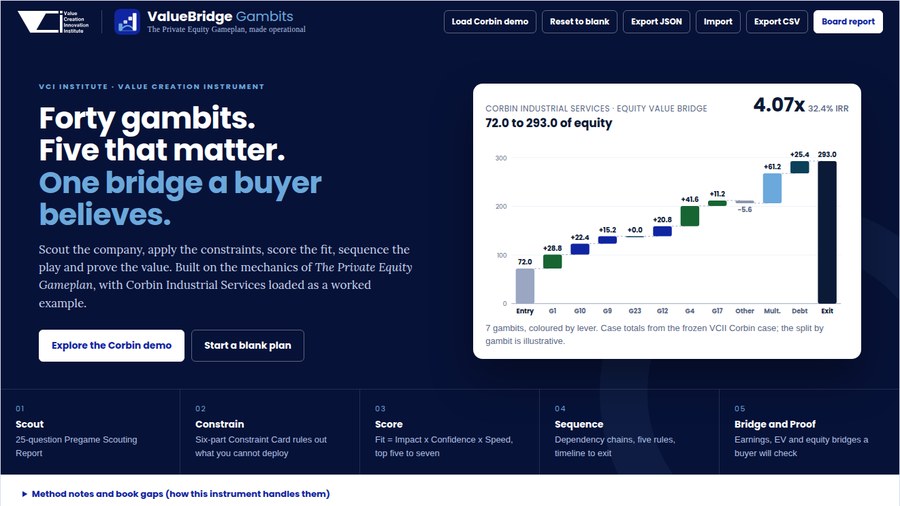
Break equity value gains into EBITDA growth, multiple change and debt paydown in one chart. Free. Open the Value Bridge chart
Related reading
We have many great affordable courses waiting for you!
Stay connected with news and updates!
Join our mailing list to receive the latest news and updates from our team.
Don't worry, your information will not be shared.
We hate SPAM. We will never sell your information, for any reason.




 Practice Platform