
Community-Linked Value Webs: Integrating Local Ecosystems for Growth
Dec 10, 2025
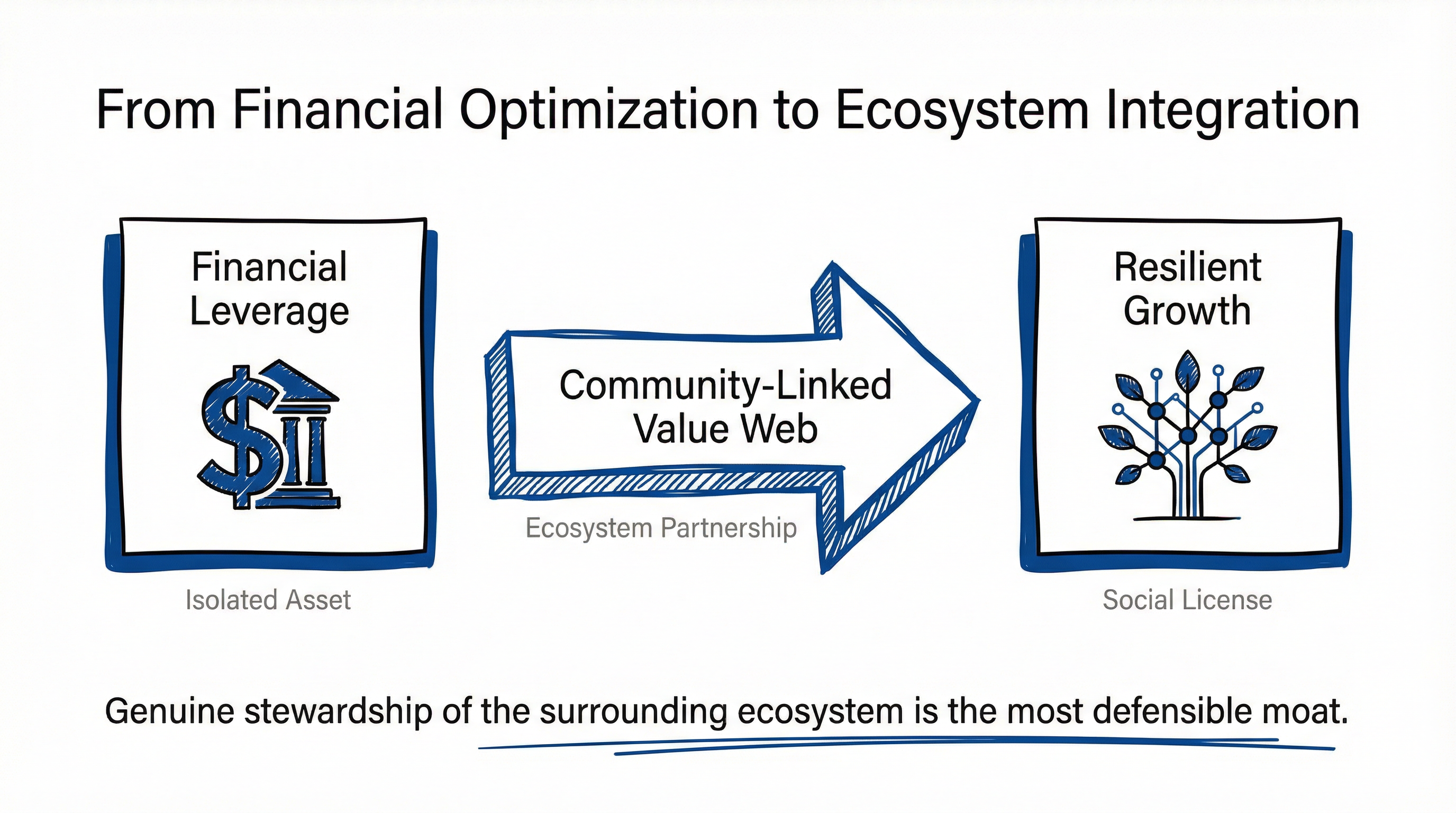
The pursuit of excellence in Private Equity is no longer confined to the relentless optimization of the income statement. The traditional metric for success—the ability to apply financial leverage and capture arbitrage—has proven brittle in an increasingly volatile and transparent world. Generating Operational Alpha now requires a deeper, more profound commitment to value creation that deliberately transcends the four walls of the portfolio company: it demands meaningful engagement with the communities in which these businesses operate.
The emerging model, centered on Community-Linked Value Webs, shifts the PE firm’s perception of its assets. A portfolio company is not merely a financial entity to be streamlined; it is an inseparable node within a local ecosystem. This shift is rooted in the uncomfortable truth that modern investment risks are often intangible and contextual. Social backlash, reputational damage, and local political friction—the kind that derails expansion plans or burdens operations—can erode enterprise value faster than a poor quarter. Firms are proactively mitigating these social risks by transitioning from being passive financial owners to active, empathetic community partners.
The Strategic Imperative: Crossing Wall Street to Main Street
The foundational necessity for building these value webs lies in bridging the cultural and experiential disconnect that often exists between sophisticated private capital and localized operations. For too long, the investment strategy was conceived in the high-rise boardrooms—a "Wall Street" playbook—and dictated to the "Main Street" operators who were expected to execute it. This top-down approach inevitably invites misalignment and resistance. The most dangerous factor slowing down value creation is the invisible weight caused by misfit hires or organizational inertia stemming from mistrust.
The Three Pillars of Community-Linked Resilience
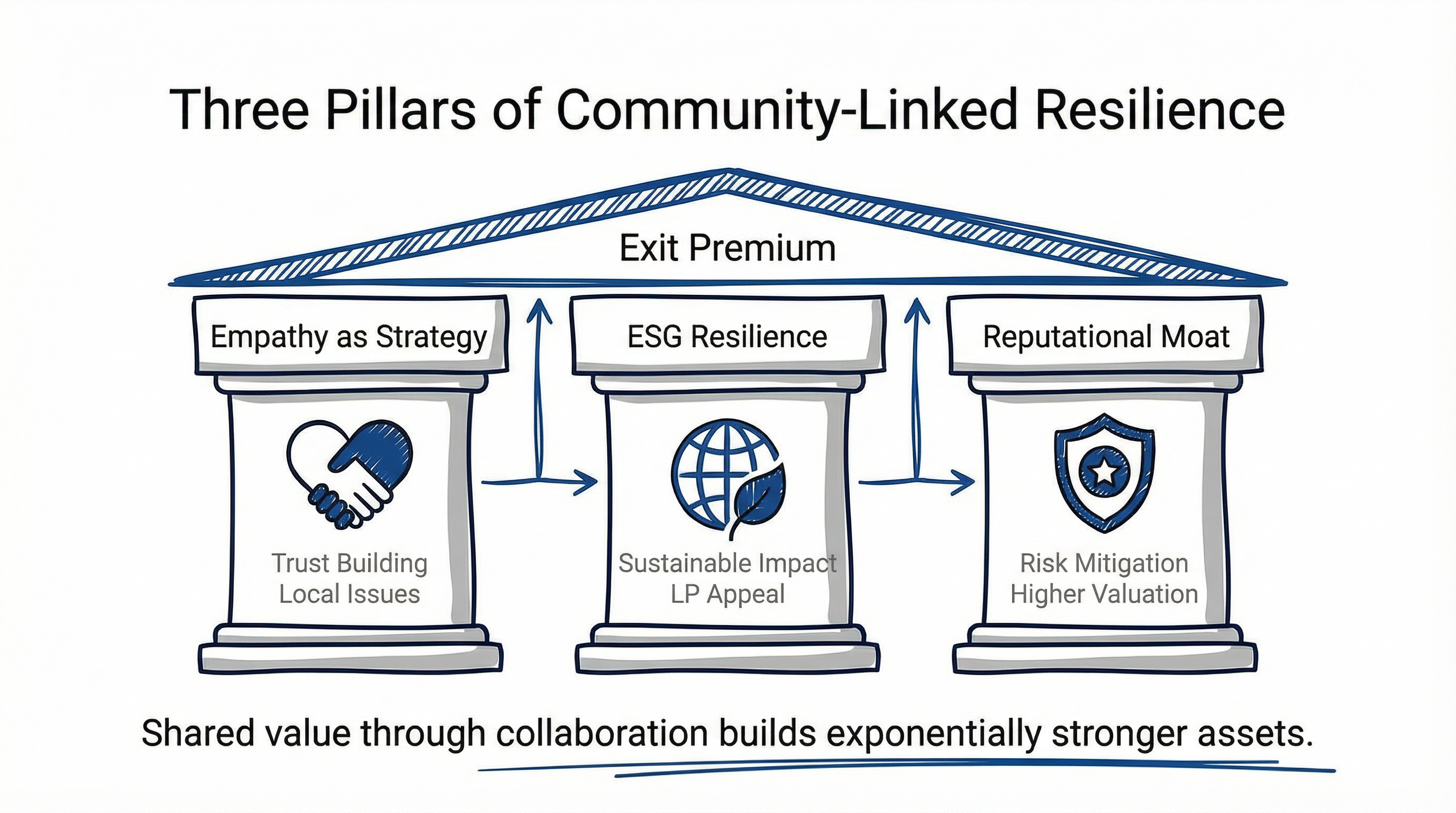
The creation of a Community-Linked Value Web represents a strategic choice to invest in the social infrastructure surrounding the asset. This integration creates resilience in three critical areas:
- Empathy as a Business Strategy: Leadership must embrace empathy not as a soft skill, but as a core component of sustainable success. Showing up as a partner and addressing the low-cost, local issues identified by acquired employees—such as improving breakroom facilities or sponsoring a local youth sports team—demonstrates trust and commitment faster than abstract financial promises. This level of grounded, strategic leadership helps rally teams and reduces the social friction that causes momentum loss.
- ESG as the Anchor of Resilience: Environmental, Social, and Governance (ESG) factors are no longer mere compliance checkmarks; they are core value creation drivers. Investing in local communities is an explicit function of social impact under the ESG framework. By transforming operational behavior to align with local needs—whether reducing the environmental footprint, investing in the local talent pipeline, or sourcing from local suppliers—PE firms build sustainable businesses that appeal to impact-focused Limited Partners (LPs).
- Reputational Moat and Exit Premium: Proactive ESG management mitigates reputational and social risk, protecting enterprise value. When the asset is presented for sale, businesses demonstrating strong ESG profiles are viewed as more resilient and better managed, leading directly to higher exit valuations. This is not just about avoiding negative headlines; it is about building a brand that customers, employees, and future buyers want to be associated with.
The Operational Engine: Fostering Co-Created Innovation
The functional expression of this community commitment—the true engine of the Value Web—is found in co-creation. By establishing mechanisms such as shared innovation labs, the portfolio company actively engages local expertise, transforming external knowledge into proprietary insight and new revenue streams. Instead of relying solely on internal R&D, the portfolio company sources solutions from its immediate ecosystem (local universities, municipal partners, community groups), circumventing the costly organizational inertia that often stalls innovation in established firms.
A Case Study in Co-Creation: The Manufacturing Turnaround
Consider a mid-market manufacturing company acquired by a PE firm. The company faced declining margins and a disengaged workforce. Instead of a top-down cost-cutting mandate, the new leadership established a Community Value Web. They partnered with a local engineering university to create a joint innovation lab focused on sustainable manufacturing processes. Students and faculty worked with company engineers to develop a new method for recycling industrial wastewater, drastically reducing utility costs and environmental impact. Simultaneously, the company launched an apprenticeship program with a local trade school, creating a direct pipeline of skilled labor and demonstrating a long-term commitment to the community. The result? Within two years, EBITDA margins improved by 250 basis points, employee turnover dropped by 40%, and the company won a major municipal contract, citing its strong local partnership as a key differentiator.
Measuring the Intangible: KPIs for Community Impact
To institutionalize this strategy, firms must move beyond traditional financial metrics and adopt Key Performance Indicators (KPIs) that measure community engagement and its impact on the business. These can include:
- Employee Net Promoter Score (eNPS): A direct measure of workforce morale and engagement.
- Local Sourcing Spend: The percentage of procurement budget allocated to local suppliers, demonstrating economic contribution to the community.
- Community Sentiment Index: Tracked through local media monitoring and surveys to gauge public perception of the company.
- Talent Retention and Promotion Rates: Metrics indicating the health of the internal talent pipeline and employee loyalty.
Orchestrating a Community-Linked Value Web is like weaving high-performance carbon fiber. You are taking distinct, individual strands and meticulously binding them together to create a composite material that is exponentially stronger and more resilient than any single component could ever be alone.
The shift toward Community-Linked Value Webs recognizes that profitability cannot be sustained in a vacuum. The firm that builds shared value through collaboration and local investment ultimately builds a stronger, more resilient asset that is poised for long-term outperformance. In an era where competitive advantage is scarce, genuine stewardship of the surrounding ecosystem is the most defensible kind of moat a private equity firm can build.
Next step
Practise before the deal is real
The PE Simulator lets you practise the full private equity deal lifecycle, from sourcing to exit. Start with the free 10-minute demo, no sign-up. Try the free PE Simulator demo
Related reading
We have many great affordable courses waiting for you!
Stay connected with news and updates!
Join our mailing list to receive the latest news and updates from our team.
Don't worry, your information will not be shared.
We hate SPAM. We will never sell your information, for any reason.






 Practice Platform