Race for Alpha: Human-Machine Value Co-Creation in Private Equity
Jan 12, 2026
A VCII framework for turning AI from “tools” into repeatable value realization at fund and OpCo levels.
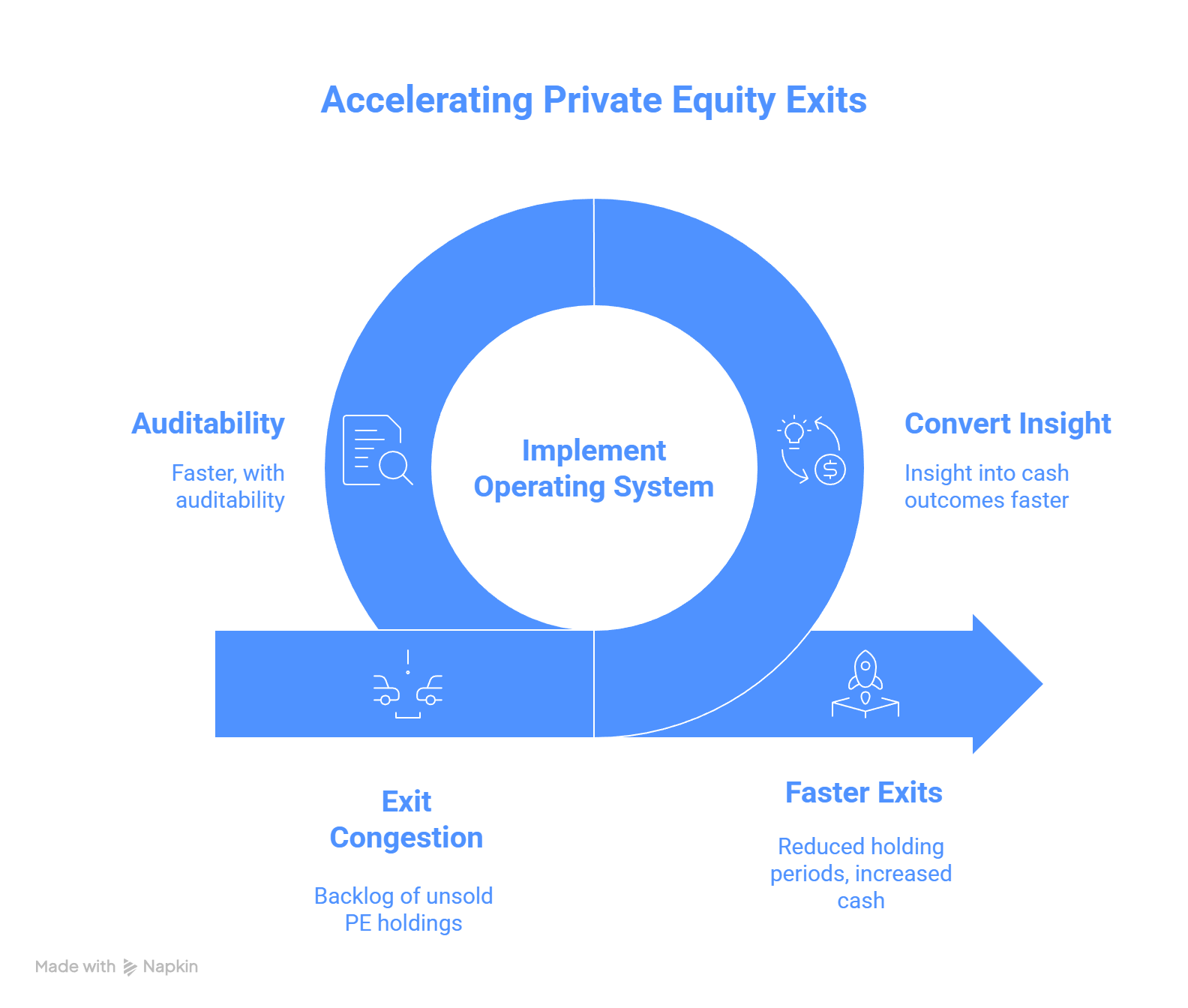
Private equity is entering a cycle where time to liquidity matters as much as underwriting skill. The constraint is not capital availability. It is realization capacity.
-
Exit congestion is structural: A growing backlog of unsold PE holdings has built up, with Reuters citing about 29,000 portfolio companies worth $3.6 trillion by end-2024.
-
Holding periods are stretching: Many managers are holding assets materially longer than traditional plans, and industry commentary increasingly frames this as an exit-market logjam, not a deal-sourcing problem.
-
Implication: The next edge is not “more dashboards.” It is an operating system that converts insight into cash outcomes, faster, with auditability.
This paper lays out a practical model for human-machine value co-creation: a two-layer architecture that compounds intelligence at the fund level and industrializes execution at the OpCo level.
1) The 2026 reality: Alpha is now constrained by time
The industry has plenty of “paper value.” The bottleneck is converting it into DPI.
What is changing:
-
Liquidity is the strategic constraint: fundraising, re-ups, and portfolio recycling all slow when exits slow.
-
Secondaries and continuation vehicles are growing largely because LPs want liquidity and GPs need tools that work in an imperfect exit window.
VCII takeaway: In this environment, the winning firm is the one that improves Cash Realization Velocity: the speed at which operational improvements become distributable outcomes.
2) What “human-machine value co-creation” actually means
This is not “use ChatGPT for memos.” It is a disciplined model:
The Two-Layer Architecture
Layer A: Fund Intelligence (GP + FundOps)
A shared system that compounds learning across deals: sourcing signals, diligence patterns, operating benchmarks, early warnings, and exit readiness evidence.
Layer B: OpCo Execution (Portfolio Value Factory)
A set of repeatable playbooks embedded into the operating rhythm: pricing, productivity, working capital, forecasting, talent upgrades, and digital proof.
Definition:
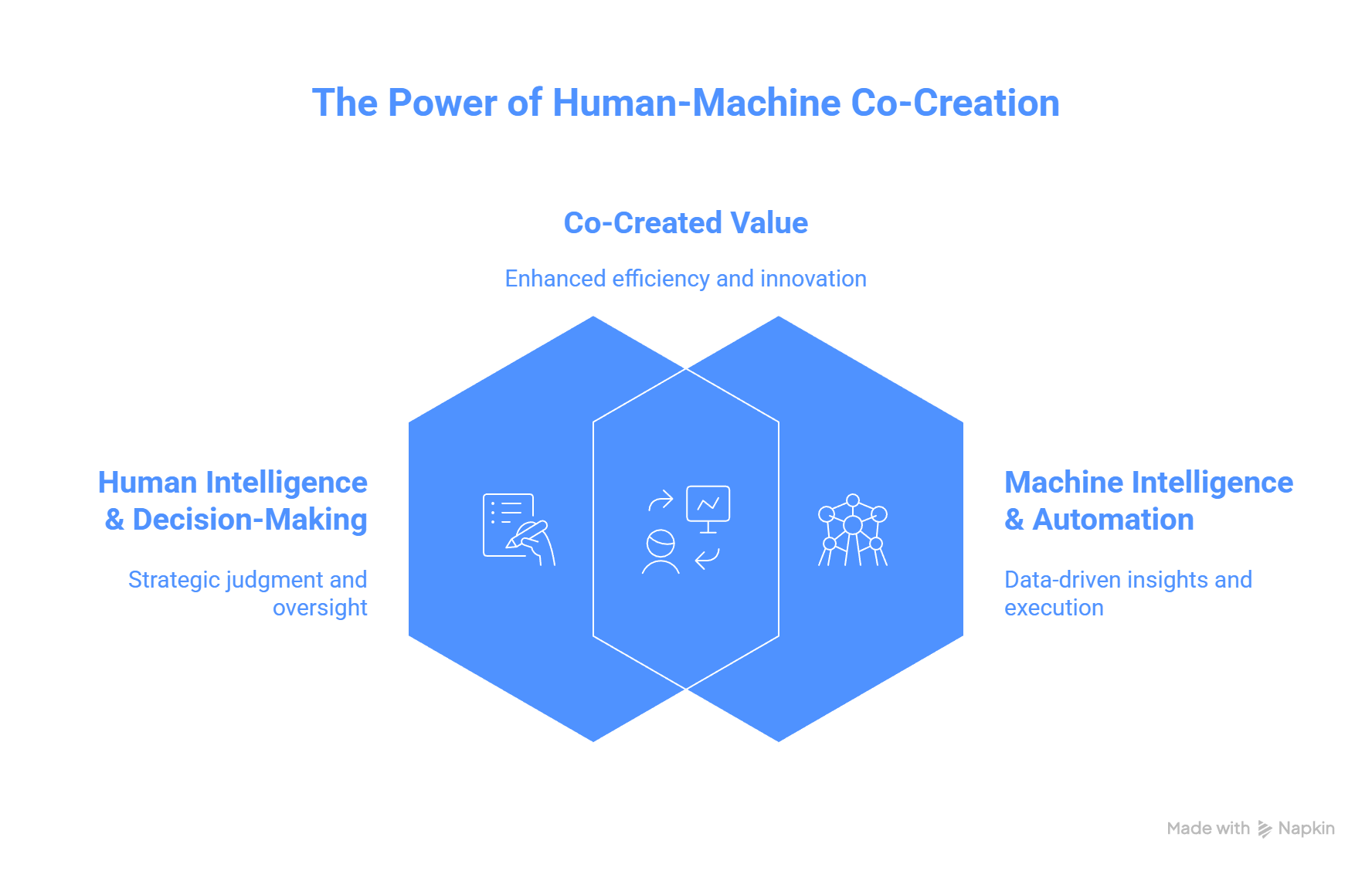
Human-machine co-creation is when humans keep decision rights and judgment, while machines provide continuous sensing, diagnosis, prioritization support, and workflow execution inside controlled boundaries.
3) Fund level: where AI actually moves the needle
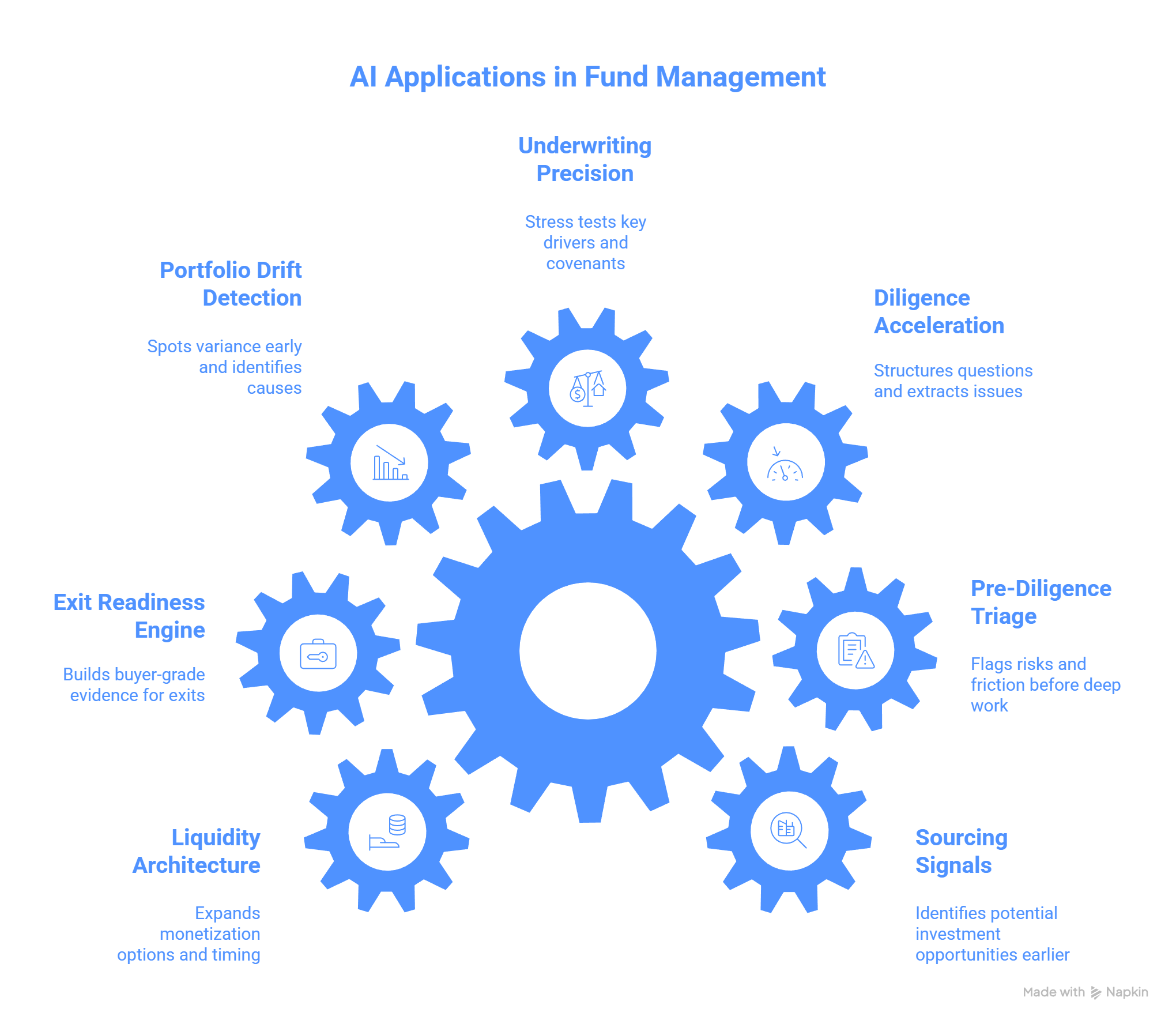
Below is the fund-level map designed for charting in Gamma.
Table 1. Fund-Level Use-Case Clusters (what to build, what it outputs, how to measure ROI)
| Cluster | What it does | Typical inputs | Outputs that matter | ROI metrics (examples) |
|---|---|---|---|---|
| Sourcing Signals | Finds thesis-fit patterns earlier | CRM, sector notes, news, filings | Better first calls, faster screening | Lead-to-IC conversion, time saved |
| Pre-Diligence Triage | Flags risk and friction before deep work | public docs, alt data, benchmarks | “Where to look” focus list | Diligence hours avoided |
| Diligence Acceleration | Structures questions, extracts issues | VDR index, Q&A logs, notes | Issue trees, clean summaries | Time-to-IC, miss rate reduction |
| Underwriting Precision | Stress tests key drivers | model drivers, covenants, comps | downside cases, covenant flags | Forecast error, downside capture |
| Portfolio Drift Detection | Spots variance early | KPI feeds, board packs | early warnings + likely causes | Variance lead time, surprise count |
| Exit Readiness Engine | Builds buyer-grade evidence | KPI lineage, initiatives, audit trails | diligence-ready “proof room” | diligence cycle time, data quality score |
| Liquidity Architecture | Expands monetization options | buyer maps, market signals | paths to DPI, timing options | DPI velocity, distribution timing |
VCII lens: Fund Intelligence is how you stop “reinventing diligence” each deal and start compounding a portfolio advantage.
4) OpCo level: convert levers into buyer-grade proof (VCII Fruitful Five)
Most “AI in portfolio” efforts fail because they automate tasks, not outcomes. The right unit of work is the value lever.
Table 2. OpCo AI playbooks mapped to the Fruitful Five
| VCII Lever | What to instrument | AI-enabled moves | Buyer-grade proof to produce |
|---|---|---|---|
| Grow Revenue | pipeline quality, win rates, churn | forecasting hygiene, segmentation, next-best action | clean cohort retention, pipeline conversion lift |
| Expand Margins | cost drivers, productivity, scrap, mix | variance detection, labor optimization, spend analytics | recurring run-rate savings with traceability |
| Execute Bolt-Ons | integration milestones, synergies | integration dashboards, synergy tracking | synergy realization by month with owners |
| Accelerate Debt Paydown | cash conversion cycle | AR/AP/inventory programs, 13-week cash discipline | working capital release evidence + durability |
| Expand Exit Multiple | digital maturity, control environment | data lineage, automated reporting, audit trails | faster diligence, lower perceived risk premium |
Principle: If it cannot be measured, traced, and defended in diligence, it does not count as “AI value.”
5) The governance question: why firms are banning AI in NDAs
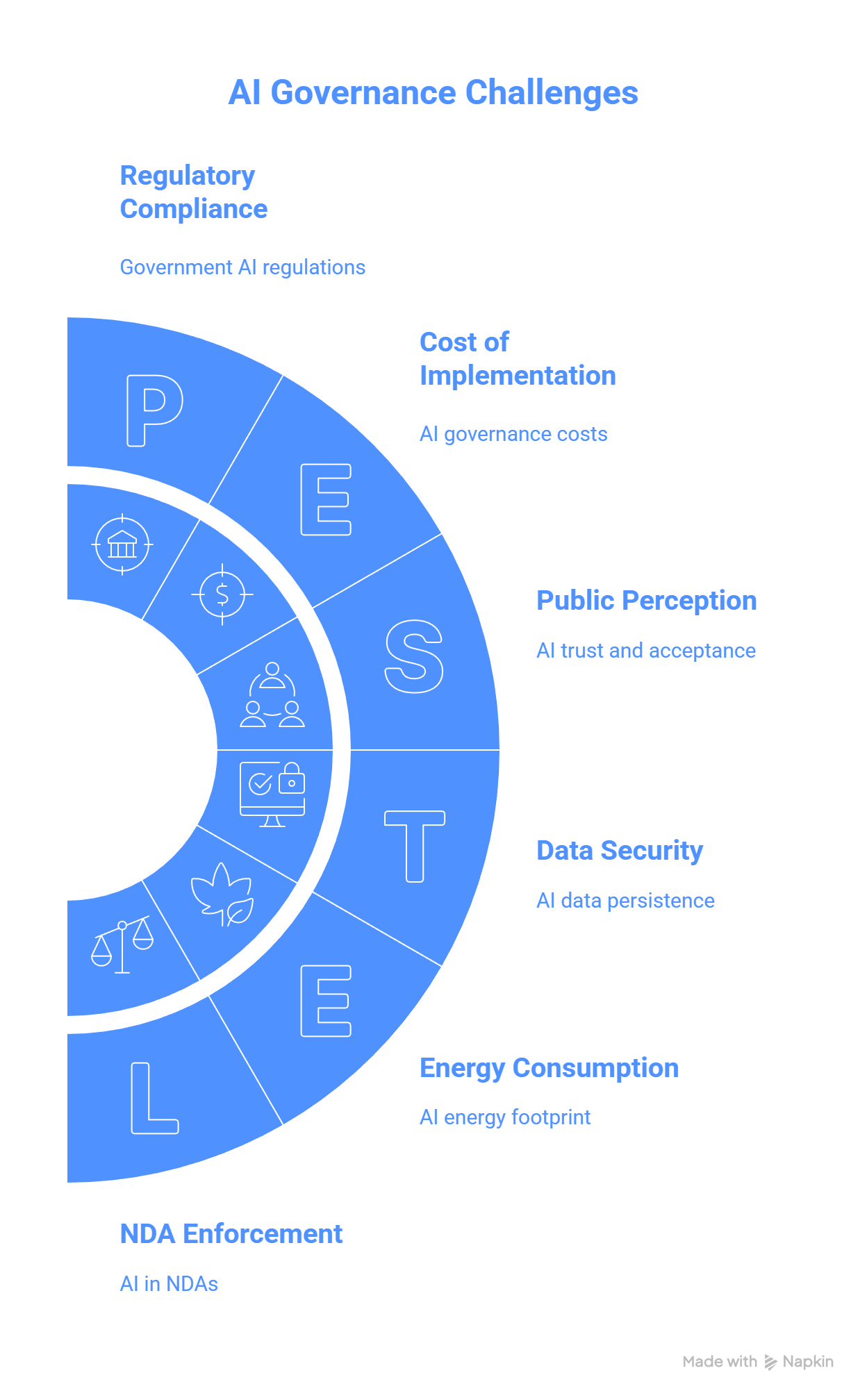
The rise of “no AI” clauses is rational. Many AI systems can create unintended persistence and propagation of confidential data through retention, third-party access, or shadow usage.
A practical governance frame is the NIST AI Risk Management Framework, which organizes AI risk work into four core functions: Govern, Map, Measure, Manage.
The VCII Trust Stack (use as a slide)
-
Data zoning: Green (public), Amber (sanitized), Red (confidential).
-
Approved tools only: enterprise controls, no-training commitments, logging.
-
DLP and access control: least privilege, watermarking, audit trails.
-
Human decision rights: AI proposes, humans approve on material decisions.
-
Policy that matches reality: manage “shadow AI” with training + monitoring, not hope.
Conclusion
The next generation of PE outperformance comes from industrializing execution and compounding intelligence, not adding more tools. Human-machine co-creation is the operating model that makes that real.
In a world where exits are harder and hold periods are longer, the winning platform is the one that turns every deal and every portfolio action into a reusable asset, and then converts that asset into faster DPI.
Next step
Practise before the deal is real
The PE Simulator lets you practise the full private equity deal lifecycle, from sourcing to exit. Start with the free 10-minute demo, no sign-up. Try the free PE Simulator demo
Related reading
We have many great affordable courses waiting for you!
Stay connected with news and updates!
Join our mailing list to receive the latest news and updates from our team.
Don't worry, your information will not be shared.
We hate SPAM. We will never sell your information, for any reason.
 Practice Platform