
The AI-Augmented Private Equity Firm: A VCII Whitepaper on Fund-Level and OpCo-Level AI Integration
Jan 12, 2026
As of January 2026, private equity (PE) is undergoing a profound evolution, propelled by artificial intelligence (AI) from experimental pilots to an embedded operating system. This whitepaper, produced by the Value Creation Innovation Institute (VCII), synthesizes insights from industry assessments, including a comprehensive September 2025 study evaluating 24 AI use cases across eight functional domains, alongside recent data from PwC, EY, Accenture, and others. The analysis reveals measurable benefits: time savings of 35-85% in diligence, accuracy rates exceeding 95% in select tasks, and EBITDA uplifts of 7-25% through targeted levers. VCII's framework emphasizes that true augmentation arises not from tool proliferation but from integrating AI into repeatable processes, enhancing speed, accuracy, governance, and scalability across the fund and portfolio companies.
Global PE deal value climbed to $1.75 trillion in 2024, up from $1.45 trillion in 2023, with AI/ML deals tripling to $140.5 billion (8% of total). By 2026, two-thirds of firms anticipate allocating over 25% of budgets to AI, with nearly half investing 25-50% and a third committing $50-100 million. This surge reflects a "perfect storm" of AI maturity, data proliferation, talent constraints, and exit pressures, compelling firms to underwrite precisely, execute swiftly, report credibly, and scale without proportional headcount.
Key Insights on AI-Augmented Private Equity Firms
Research suggests that AI integration is transforming private equity from opportunistic pilots to a core operating model, with evidence leaning toward significant gains in speed, accuracy, and value creation when deployed systematically at fund and portfolio levels. It seems likely that firms prioritizing tested, phased implementations will outperform, though challenges like data governance and talent gaps add complexity.
- AI adoption in PE is accelerating, with two-thirds of firms expecting to allocate over 25% of budgets by 2026, driven by generative and agentic AI for transformative impact.
- Fund-level AI enhances decision quality and scalability, potentially reducing diligence times by 35-85% while improving governance.
- At portfolio companies, AI ties to value levers like revenue growth and margins, with examples showing 7-25% improvements in procurement, pricing, and forecasting.
- A two-track strategy—transversal and specialized tools—avoids fragmented implementations, emphasizing integration for repeatability.
- While promising, AI risks like ethical concerns and over-reliance require balanced approaches, with 82% of firms prioritizing responsible AI.
The Core Shift to Augmented PE
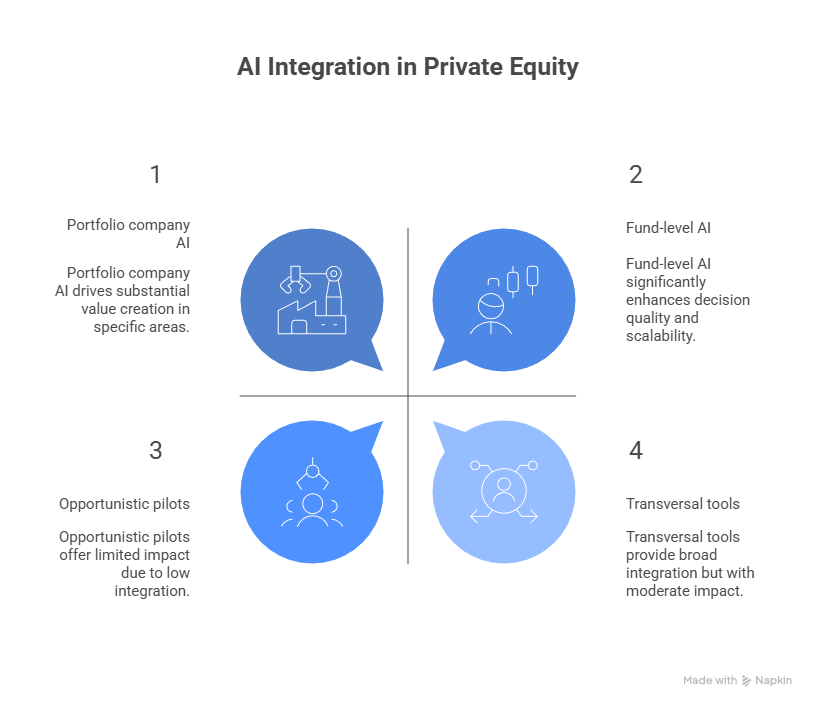
The AI-augmented PE firm operates as a dual-layer system: fund-level for precision and scalability, and OpCo-level for execution and proof. This model addresses pressures like extended holds (now 6.4 years) and LP demands for credible reporting.
Proven AI Capabilities
Tested assessments show AI excels in document-heavy tasks, achieving 90-95% accuracy in legal reviews and 5-10x faster processing, but success varies by vendor (60-95%).
Implementation Roadmap
A phased 90-day rollout, starting with evidence-based tool selection, can embed AI into workflows, yielding measurable ROI like productivity gains and faster exits.
Executive Summary: The Paradigm Shift
Private equity's winners in 2026 and beyond will be those redesigning their operating models around AI augmentation. The September 2025 assessment, corroborated by PwC's July 2025 survey of 514 executives (including 132 PE), demonstrates that generative and agentic AI are prioritized by 54% for transformative impact over three years. Benefits include 5-10x faster document processing, 90%+ accuracy in legal workflows, and productivity gains of 35-85% in diligence. However, success hinges on avoiding "use case syndrome"—disconnected pilots—and instead linking AI to value creation plans (VCPs) for differentiated growth. VCII's "Augmented PE" model, a two-layer system, institutionalizes this, turning AI into a competitive baseline amid extended holds (6.4 years) and fundraising declines (35% since 2023).
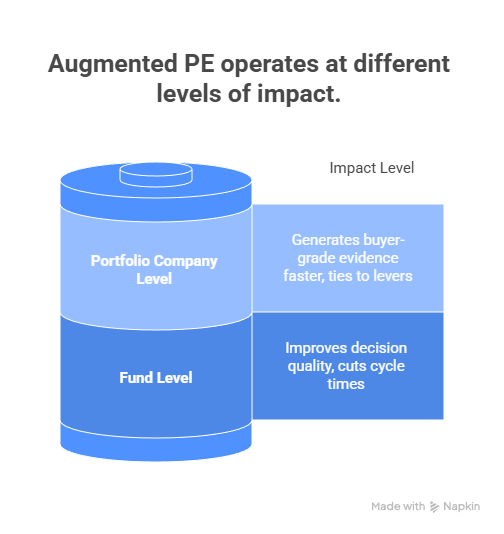
The Core Idea: Augmented PE as a Two-Layer System
VCII defines "Augmented PE" as a dual architecture: fund-level (GP + FundOps) for decision enhancement and OpCo-level for value acceleration. This aligns with Accenture's view of agentic AI as an orchestrator, sensing, deciding, and acting in real-time.
Layer A: Fund Level (GP + FundOps) Aims to boost decision quality, cut cycle times, and ensure repeatability. Key applications include faster screening (e.g., AI scanning datasets for patterns), diligence synthesis (simulating theses), LP reporting (automated narratives), knowledge management (searchable memory), and scalable operations. PwC notes AI as a "non-voting IC member" to challenge biases, shortening processes from months to weeks.
Layer B: Portfolio Company Level (OpCo Value Engine) Focuses on generating buyer-grade evidence faster, tying AI to VCII's Fruitful Five levers. Roland Berger examples show 7% procurement savings, $5M margin uplift from pricing, and 25% forecast error reduction. BDO highlights AI in portfolio monitoring for fraud detection and reporting.
What AI Actually Does Well in PE: Tested Patterns
The September 2025 assessment, echoed in PwC and EY data, confirms production-ready generative AI for document tasks (95%+ accuracy), 5-10x processing speed, and 90%+ legal review precision. Success rates vary (60-95%), underscoring tested performance over hype. EY reports 68% ROI in efficiency, 66% in advantage. VCII concludes: Adoption alone isn't strategy; integration is.
The Perfect Storm: Forces Driving Augmentation
AI maturity + data + talent shortages + exit scrutiny = mandatory augmentation. CohnReznick notes AI as an acceleration tool, not replacement, amid rebounding deals ($310B Q3 2025). Accordion highlights AI as finance backbone for forecasting and insights. IQ-EQ predicts AI divergence in operations, with Moonfare analysis showing 71% exit value from revenue growth.
The Fund-Level Blueprint: High-Impact Domains
FundOps stack includes risk, analysis, reporting, screening, knowledge, and legal. Priorities: smart reporting, contract management, market watch.
| Fund Workflow Area | AI Use Case Examples | Primary Output | Value Created | Maturity Signal |
|---|---|---|---|---|
| Deal Screening | Sector monitoring, reputational screening, KYC | Shortlists + risk flags | Faster pipeline decisions | Emerging to mature |
| Due Diligence | Data extraction, synthesis, issue spotting | Diligence packs, red flags | Higher coverage, 35-85% time savings | Production-ready |
| IC/IR Reporting | Report population, narrative drafting | IC memos, LP reports | Speed + consistency | High maturity |
| Legal Docs | Template checks, gap ID, reviews | Issue lists, redlines | Cycle-time reduction, 90%+ accuracy | Proven in tests |
| Knowledge Management | Q&A, training generation | Searchable memory | Reuse, standardization | High maturity |
| Portfolio Monitoring (New) | Fraud detection, KPI tracking | Alerts, dashboards | Quality decision-making | Emerging |
Accenture adds agentic AI for proactive origination via sentiment scanning.
The OpCo-Level Blueprint: Mapping to Value Levers
AI instruments VCII's Fruitful Five, with agentic systems optimizing pricing (3.9/5 confidence) and working capital.
| Value Lever (VCII) | AI-Enabled Moves | KPI Proof Expected |
|---|---|---|
| Grow Revenue | Sales enablement, pipeline hygiene, proposal automation | Conversion rate, ACV, win rate, velocity |
| Expand Margins | Pricing analysis, procurement analytics, waste detection | Gross margin, price realization (e.g., 7% savings) |
| Accelerate Debt Paydown | Cash forecasting, AR prioritization | DSO, inventory turns (25% error reduction) |
| Execute Strategic Acquisitions | Integration tracking, synergy measurement | Synergy capture, milestones |
| Expand Exit Multiple | Digital premium evidence, KPI instrumentation | KPI reliability, audit readiness |
| Predictive Maintenance (New) | Downtime reduction | 18% OpEx cut |
Roland Berger case: 18% downtime reduction in industrials.
The Operating Model: Two-Track Strategy and Risks
September 2025 recommends transversal (multi-department) and specialized tools to avoid siloed truths. Risks: 31% struggle attributing gains; ethical issues (82% prioritize responsible AI). Mitigations: Governance, human oversight, data security.
Practical 90-Day Roadmap: VCII Playbook
Phase 1 (Weeks 1-4): Evidence First Test 2-3 tools on real documents, focusing on reporting, contracts, retrieval. Set 90%+ thresholds, human sign-off.
Phase 2 (Weeks 5-8): Workflow Lock-In Embed into IC templates, legal reviews; implement governance.
Phase 3 (Weeks 9-12): Portfolio Rollout Standardize KPIs, target 1-2 levers per OpCo, build exit proof.
Case Studies and Future Outlook
- Roland Berger: $5M margin from pricing in one quarter.
- Accenture: AI agents for disaster recovery in finance.
- Outlook: AI backbone investments (e.g., data centers) surge, with PE committing $200B since 2020. By 2030, data centers may consume 9% of U.S. electricity. VCII envisions AI as self-optimizing, but warns of divergences without governance.
VCII Bottom Line
The AI-augmented PE firm is a repeatable system: fund-level for consistent decisions, OpCo-level for proof, overall for scalability. For VCII resources like SuperSim simulations, visit www.vciinstitute.com.
Key Citations
- PwC: How Private Equity Survives AI (Nov 2025)
- EY: Beyond Implementation - PE's AI Evolution (2025)
- BDO: 2026 Private Equity Predictions
- CohnReznick: 2026 Private Equity Outlook
- Accenture: Agentic AI Redefining Private Equity (Dec 2025)
- Accordion: 7 Trends Reshaping Value Creation (Dec 2025)
- IQ-EQ: Global Private Markets Predictions 2026 (Dec 2025)
- Roland Berger: Unlocking AI's True Potential in PE (Aug 2025)
We have many great affordable courses waiting for you!
Stay connected with news and updates!
Join our mailing list to receive the latest news and updates from our team.
Don't worry, your information will not be shared.
We hate SPAM. We will never sell your information, for any reason.

 Practice private equity like a pilot trains