The Missing Seat in Private Equity: Who Owns the Value Creation Analysis?
Aug 15, 2026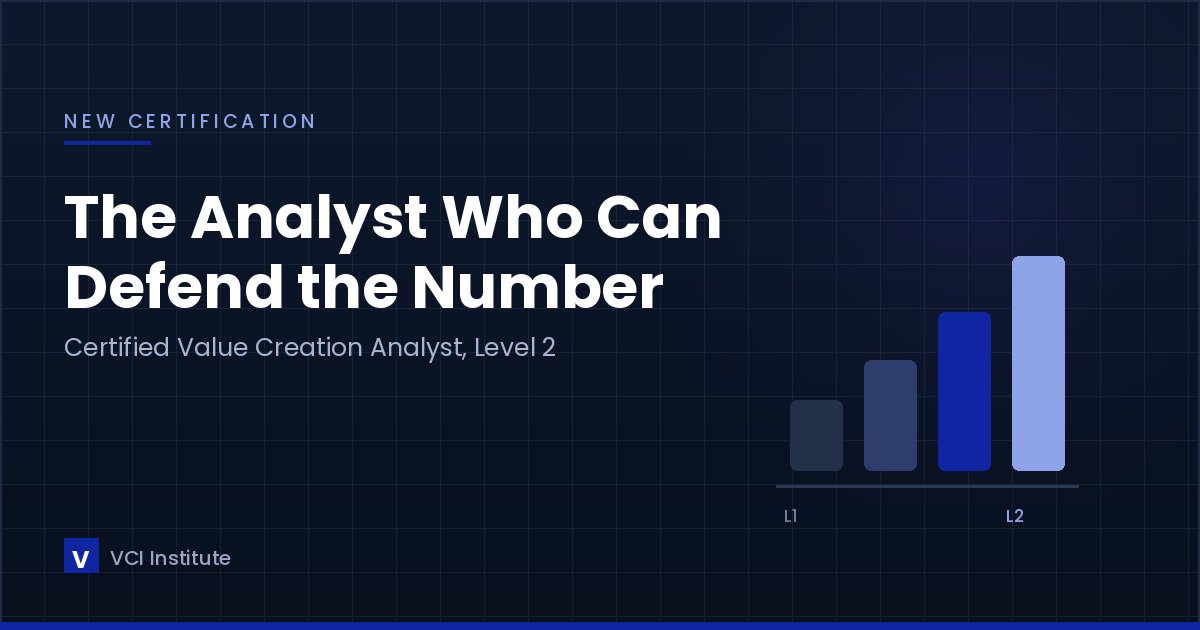
Ask a room of investment professionals who builds the value creation analysis, and you will get a shrug. Somebody does it. It is rarely one person, it is almost never a defined role, and it is usually whoever had capacity that week.
This is strange when you consider what the analysis decides. Whether a deal clears the committee. Whether a plan is credible or merely ambitious. Whether the operating team is chasing the lever that matters or the lever that is easiest to describe.
Every other consequential function in the industry has a defined seat. Deal execution has one. Portfolio operations has one. Fund finance has one. The analysis that connects an initiative to enterprise value does not, and the absence shows up in predictable ways.
What the missing seat costs
You can see the gap in three recurring failures.
Bridges that do not close. A return decomposition is presented, the components are listed, and the total does not tie back to the equity proceeds. Nobody checks, because checking is somebody else's job and the deck has already moved on.
Scenarios that differ in optimism rather than in assumptions. The downside case is the base case with the growth rate reduced. That is not a downside case. It is the same forecast wearing a different label, and it tells the committee nothing about what would actually go wrong.
Findings that collapse under questioning. The analysis is sound and the person presenting it cannot say what evidence would overturn their own conclusion. The moment somebody senior pushes, the number is abandoned rather than defended, and everyone quietly decides to trust instinct instead.
None of these are modelling failures. They are role failures. The work was done by somebody whose actual job was something else.
Building the analysis and owning it are different skills
This is the distinction that matters, and it is the one most training misses entirely.
Building an analysis is a technical skill. You learn the structure of a bridge, the conventions for attributing value, the mechanics of a scenario, and with practice you can produce competent work.
Owning an analysis is something else. It means knowing where your own work is weakest before anybody else finds it. It means being able to state, in one sentence, what would change your mind. It means presenting a finding in a form that survives a senior person disagreeing with it, which is a different craft from presenting one that sounds convincing.
Most analysts are taught the first and left to acquire the second by being wrong in public a few times. That works, eventually, at considerable cost to the analyst and occasionally to the fund.
The habit that separates the two
If you take one thing from this article, take this.
Before you present any conclusion, write down the single piece of evidence that would overturn it.
If you cannot name that piece of evidence, you do not yet understand your own analysis well enough to defend it. You understand the output. You do not understand what the output depends on, and those are not the same thing.
It takes about two minutes. It is uncomfortable the first several times, because it forces you to look directly at the weakest joint in your own work rather than at the part you are proud of. It is also, in our experience, most of what separates an analyst people trust from one they quietly double check.
Why this needed a certification
We built the Certified Value Creation Analyst programme because the seat exists in practice even where it does not exist on an organisation chart, and because nobody was training for it.
Level 1 builds the analysis. Value driver bridges that connect an initiative to earnings, working capital and enterprise value. Lever scoring, so you can rank what to do first when everything looks urgent. Scenario comparison built on assumptions rather than on mood. Evidence summaries that show the reader what would change your mind. Twelve lessons across fifty subsections, each with a case where you make the call before you see how it resolved.
Level 2 is now available, and it addresses the second skill. It makes you accountable for whether the analysis is right, not only for producing it. That means finding the weakness in your own work, stating what would change your conclusion, and presenting a finding in a form that holds up when someone senior disagrees.
It is the less comfortable of the two levels, deliberately. The material is far more useful applied to work you are responsible for than to a case you are not, which is why we ask you to bring something real to it.
The analyst track
CVCA Level 1 and Level 2 are both open now
Level 1 builds the analysis. Level 2 makes you accountable for whether it is right. Either order works, and the two together are the full track. Twelve months of access, self paced, no start dates.
If you are not sure this is your seat
It may not be. The analyst track suits people who build the work that others rely on. If you are accountable for a company delivering its plan rather than for the analysis of whether it will, the operating partner track is the better fit and we would rather say so.
Our Certification Path Finder is eight questions, free, and captures nothing while you answer. It will tell you which programme fits and, more usefully, which one you should not buy yet.
And if you would rather test the arithmetic before committing to anything, the LBO Returns Calculator runs free. Put in a deal, get the attribution, and see whether the bridge closes. It is the same calculation the certification builds properly, and it will tell you quickly whether this is territory you want to go deeper into.
Published by VCI Institute. The Institute produces certification programmes, books and tools for operating partners, deal teams and portfolio company executives.
Related reading
We have many great affordable courses waiting for you!
Stay connected with news and updates!
Join our mailing list to receive the latest news and updates from our team.
Don't worry, your information will not be shared.
We hate SPAM. We will never sell your information, for any reason.

 Practice private equity like a pilot trains