
The New Rules of Thought Leadership in Private Equity
Nov 16, 2025
Thought leadership in private equity now operates under the same principles as capital allocation: diversification, measured returns, and strategic rebalancing. Based on 85 high-performing LinkedIn posts generating 50,000+ engagements (Mar–Nov 2025), the most effective communicators don’t just “post more”—they construct influence portfolios balanced across three asset classes: Reach, Authority, and Trust.
Core finding: Top performers achieve engagement rates up to 25× higher than the LinkedIn professional average by allocating content capital intentionally—not by increasing volume alone.
Introduction: Influence Behaves Like Capital
Attention has become a measurable asset class. As PE firms deploy capital across risk–return profiles, modern thought leaders allocate content capital across distinct strategies and each with its own yield, volatility, and duration.
Our Research Foundation
-
Timeframe: Mar–Nov 2025
-
Sample: 85 high-performing posts (froma sample of 1,000+) across seven voice archetypes
-
Data: 50,000+ engagements (likes, comments, shares)
-
Goal: Quantify how the most effective communicators balance Reach, Authority, Trust to produce durable influence
Result: A consistent pattern: consitency and credibility outperforms one-note broadcasting.
1) The Market Has Matured
LinkedIn has displaced conferences and newsletters as PE’s primary, continuous knowledge marketplace. Dispersion is significant—and instructive.
Performance Benchmarks
-
Baseline: LinkedIn professional engagement ≈ 0.7%
-
PE Median (top voices): 2.4% (≈ 3.4× baseline)
-
Peak: 18.3% (≈ 26× baseline)
Conclusion: This dispersion reflects a competitive market for ideas. “Post and hope” is obsolete; strategic allocation is mandatory.
2) From Playbook to Portfolio: The Three Asset Classes
Traditional corporate comms = single broadcast playbook. Modern influence = diversified content portfolio.
The Content Capital Framework
| Asset Class | Primary Return | Risk Profile | Duration | Representative Voice Archetypes | Strategic Function |
|---|---|---|---|---|---|
| Volume Assets (Reach) | High visibility, rapid engagement | High volatility | Short-term | Content educators, model/tool publishers | Lead generation, audience growth |
| Authority Assets (Brand Equity) | Durable credibility | Low volatility | Long-term | Academic/research voices | Reputation anchoring, citations, invites |
| Trust Assets (Relationship Capital) | Deep loyalty, repeat engagement | Moderate volatility | Cumulative | Executives, leadership mentors/coaches | Community retention, referrals |
Concentration risk: Over-indexing on any single class (e.g., only templates, only theory) suppresses total return on credibility.
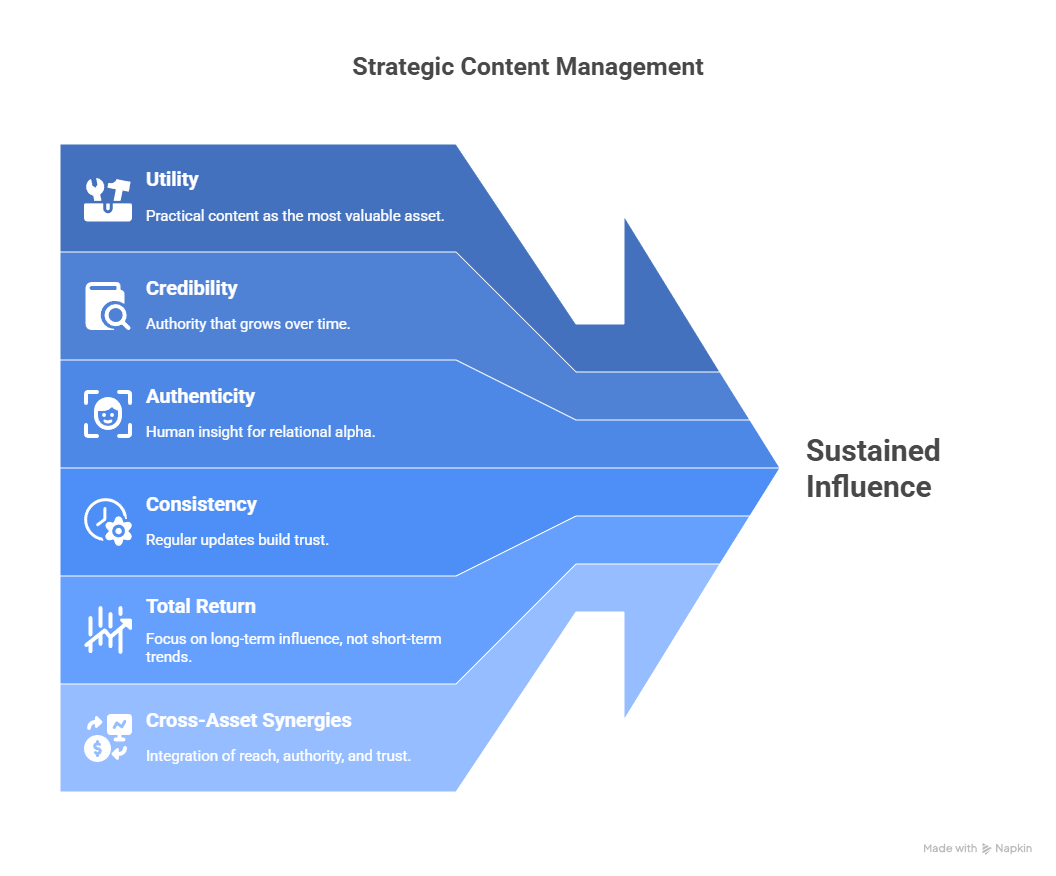
The Six Rules of Content Portfolio Management
Rule #1 — Allocate for Utility (Your Highest-Yield Asset)
Principle: Utility is the new liquidity.
Actionable resources behave like cash-flowing instruments: fast, scalable, and measurable.
Performance Evidence (illustrative bests in sample)
| Resource Type | Engagement | Rate | |
|---|---|---|---|
| Project finance handbook/model | 4,446 | 4.0% | |
| “Linking the 3 statements” tutorial | 3,751 | 3.3% | |
| Multifamily DCF model | 2,585 | 2.3% | |
| Advanced LBO case/model | 1,785 | 1.6% |
Allocation guidance: 40–50% to practical resources (templates, frameworks, checklists, visual explainers).
Rule #2 — Compound Through Credibility (The Bond Strategy)
Principle: Authority assets appreciate slowly but anchor reputation.
Academic/research-backed posts deliver steadier returns, longer discussion tails, and repeated citations.
Performance Evidence
-
Book/research announcements: ~1.5–2.7% engagement
-
Teaching/lecture highlights: ~1.0–1.5%
-
Comment-thread duration: ~3× longer than event promos
Allocation guidance: 25–30% to evidence-based insights (research summaries, data analyses, peer-reviewed frameworks, practitioner-academic collabs).
Rule #3 — Diversify with Authenticity (Relational Alpha)
Principle: Values-anchored, first-person reflections create relationship capital that compounds.
These reach different segments than tools or research—and often outperform the same author’s technical posts.
Performance Evidence
-
Values/holiday reflection: ~1.5–1.8%
-
Career/leadership lessons: ~1.5–2.8%
-
Deeper comment-to-like ratios indicate higher intent and loyalty
Allocation guidance: 15–20% to personal narrative (values, lessons, setbacks, leadership moments).
Rule #4 — Rebalance Frequently (Consistency = Trust Signal)
Principle: Without cadence, engagement decays—algorithmically and humanly.
Frequency Impact (rolling averages)
-
Posting every 1–2 weeks: baseline (100%)
-
Posting every 2–4 weeks: ~2–3× higher rolling average
-
>15 posts/month: diminishing marginal returns (fatigue, suppression)
Cadence guidance: 2–3 substantive posts/week beats sporadic bursts or high-volume noise.
Rule #5 — Measure Total Return, Not One-Day Pops
Principle: Optimize for durable influence.
Just for fun we are using a new RoC:
VCII ROC (Return on Content):
Patterns: Lower volume + higher depth often yields higher ROC than high volume + shallow engagement.
Track quarterly: engagement rate, follower growth, comment depth, repost ratio, and topic-level ROC.
Rule #6 — Leverage Cross-Asset Synergies (Integrated Portfolio)
Principle: The strongest systems sequence asset classes to reinforce each other.
The Virtuous Cycle
-
Operator/practitioner insights (contrarian, execution) → spike Reach
-
Educator translation (templates, tools) → sustain Reach + build Authority
-
Executive reflections (leadership narratives) → deepen Trust
-
Academic validation (data/research) → lock in Authority over time
Design calendars around thematic arcs, not isolated posts (e.g., Insight → Tool → Reflection → Research).
Strategic Implications
For PE Firms — Manage Content Like Portfolio Capital
-
Enable multi-voice participation: Operating Partners, CFOs, CHROs, functional leaders. Diversified voices were associated with ~35% broader engagement diversity.
-
Budget and measure like investors: instrument dashboards (type-by-type engagement rate, comment depth/sentiment, repost ratio, ROC).
-
Balance yield and duration: quick-win utility attracts; long-duration authority and trust retain.
For Individual Professionals — Build Your Allocation Plan
-
Suggested mix: 50% Utility / 30% Insight / 20% Authenticity
-
Operational discipline:
-
Publish evidence (numbers, frameworks, mini-cases) over generic opinions
-
Quarterly audits: reallocate toward formats and topics with superior ROC
-
Consistency > intensity: two thoughtful posts weekly outperform monthly bursts
-
The Capital Discipline of Credibility
This VCII study confirms that thought leadership in private equity functions as an allocation discipline, not a broadcast. Attention—like capital—must be deployed deliberately across Reach (liquidity), Authority (stability), and Trust (goodwill). Practitioners and firms that engineer this balance create influence that endures beyond viral cycles and compounds into a structural advantage in the industry’s shared knowledge economy.
All Rights Reserved © VCII 2025
Methodology: 85 posts across seven voice archetypes (Mar–Nov 2025); 50,000+ engagements; promoted content excluded.
We have many great affordable courses waiting for you!
Stay connected with news and updates!
Join our mailing list to receive the latest news and updates from our team.
Don't worry, your information will not be shared.
We hate SPAM. We will never sell your information, for any reason.


 Practice private equity like a pilot trains