The Liquidity Logjam: How Private Equity Is Redefining Value in a Slow-Exit World
Dec 15, 2025
Private equity is confronting one of the most structurally complex environments in its history. The long-standing model of “buy low, lever up, and sell high” has been fundamentally disrupted by persistent inflation, higher capital costs, and investor caution. Exit activity has slowed considerably, creating what many describe as a liquidity logjam. This challenge is forcing firms to reinvent how value is both created and realized, as the industry moves from financial engineering toward operational mastery.
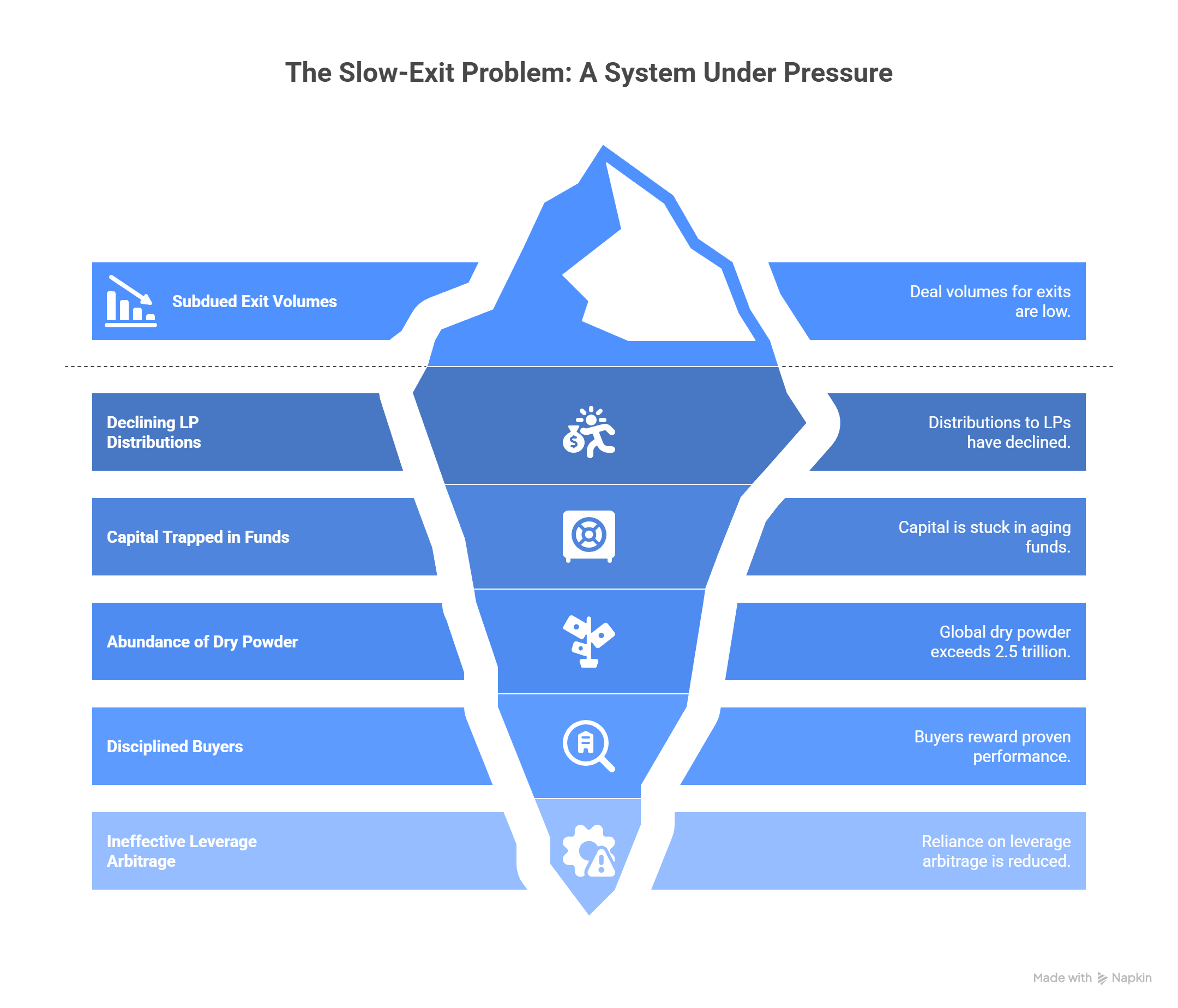
The Slow-Exit Problem: A System Under Pressure
Deal volumes for exits, whether through IPOs, trade sales, or secondary sales, have remained subdued. Distributions to Limited Partners (LPs) have declined materially, creating a liquidity shortage and leaving substantial capital trapped in aging funds. With global dry powder now estimated to exceed 2.5 trillion dollars, the industry faces a contrasting reality of abundance and constraint.
Buyers in today’s market are more disciplined and less speculative. They reward proven performance rather than narratives about future potential. As a result, the traditional reliance on multiple expansion and leverage arbitrage has lost much of its effectiveness.
The End of the Old Playbook
The structural shift away from cheap capital has rendered the legacy model insufficient. Competitive advantage now hinges on a firm’s ability to achieve operational excellence and drive measurable transformation within portfolio companies. This marks a new era in which value creation depends less on market timing and more on repeatable, verifiable performance improvement.
Longer hold periods have become the norm. Funds are managing assets over extended durations, leading to inflated Assets Under Management (AUM) and a greater focus on sustained operational resilience. Private equity is now defined as much by its ability to manage time as by its ability to manage capital.
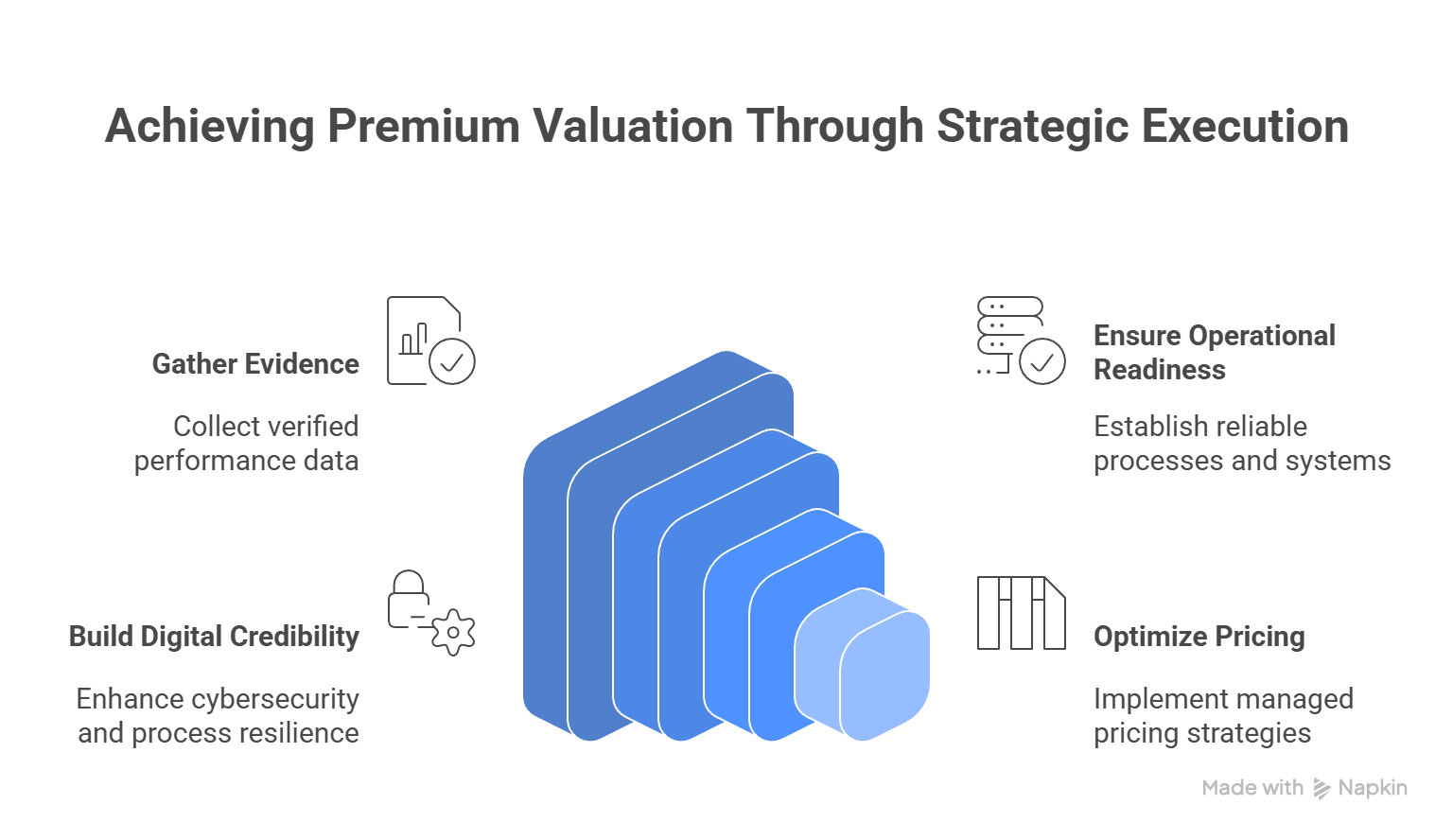
The DPI Imperative: Designing Liquidity
In a constrained exit environment, the central challenge is converting Total Value to Paid-In Capital (TVPI) into actual Distributed to Paid-In Capital (DPI). This is driving the emergence of new liquidity architectures that allow firms to realize value beyond a traditional binary exit.
Two mechanisms are leading this evolution:
-
Secondary transactions: LPs transfer their interests in a fund to new investors, allowing liquidity without the need for an underlying asset sale.
-
Continuation funds: General Partners (GPs) move selected high-performing assets into new vehicles, providing existing LPs the choice to realize liquidity or reinvest alongside new entrants.
These models represent a structural innovation in the private equity ecosystem, giving firms the flexibility to manage ownership horizons in a more dynamic and transparent manner.
An additional and underutilized lever for liquidity generation lies within portfolio operations. Optimizing working capital can release significant amounts of trapped cash without compromising growth or supplier reliability. Managing working capital effectively strengthens balance sheets and protects exit pricing by ensuring that cash generation aligns with diligence-ready financial narratives.
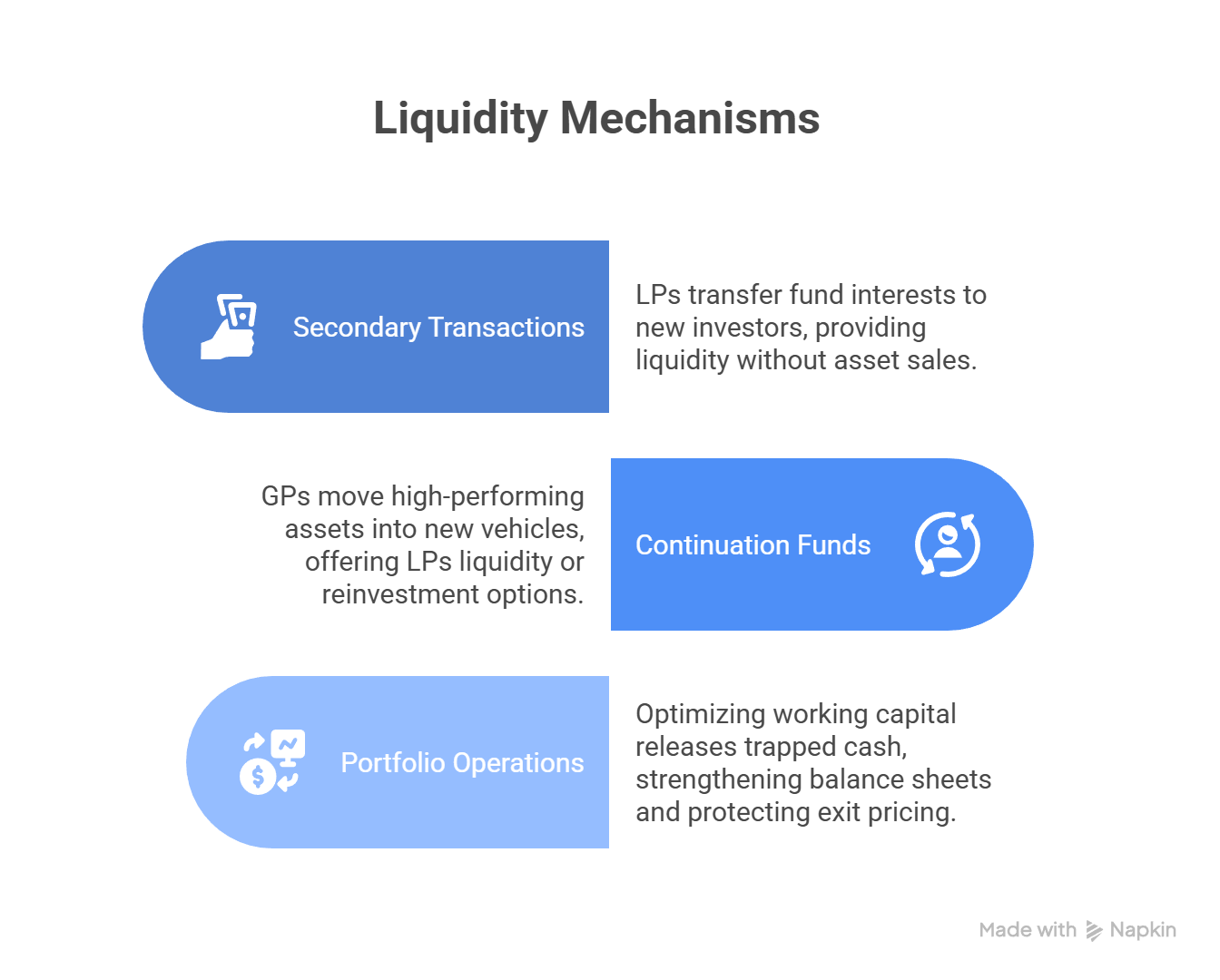
The Exit-Back Playbook: Earning the Multiple
In the current environment, buyers demand evidence, not assertions. To meet this expectation, leading firms are adopting what VCI Institute refers to as the Exit-Back Playbook. This approach requires defining the endgame at the moment of acquisition.
Rather than building a narrative late in the life cycle, the GP identifies the most likely buyer, specifies what that buyer will require as proof, and then runs the business accordingly. This creates a direct alignment between daily execution and the ultimate exit objective.
Key principles of this approach include:
-
Evidence over aspiration. Buyers pay for verified performance improvement, not projections.
-
Operational readiness. Reliable data, disciplined processes, and system stability are critical to supporting credibility during diligence.
-
Digital and analytical credibility. Predictable revenue, cybersecurity assurance, and process resilience influence the premium a business can command.
-
Pricing excellence. Treating pricing as a managed production system often yields rapid, quantifiable EBITDA growth and enhances valuation certainty.
Fundraising Friction: Selectivity and Scrutiny
The liquidity gap has created a challenging fundraising landscape. With limited cash distributions and constrained commitments, LPs have become more selective and more focused on realized performance. Only firms that can demonstrate consistent DPI conversion and visible operational improvement are succeeding in raising new funds. In this context, transparent liquidity planning and credible governance have become as important as returns themselves.
The New Private Equity Imperative
The current liquidity logjam is not a transient cycle but a structural turning point. The easy-money era has ended, and with it, the assumption that leverage and timing can generate sustainable returns. The future will favor firms that combine operational sophistication, disciplined liquidity design, and empirical value creation.
In an environment where proof has replaced promise, private equity’s next chapter will be written by those who can demonstrate performance with precision and deliver cash without chaos.
VCI Institute | www.vciinstitute.com
We have many great affordable courses waiting for you!
Stay connected with news and updates!
Join our mailing list to receive the latest news and updates from our team.
Don't worry, your information will not be shared.
We hate SPAM. We will never sell your information, for any reason.


 Practice private equity like a pilot trains