
Translation, Not Transfer: Why Corporate Executives Struggle in PE
Oct 05, 2026
Every year, accomplished corporate executives decide private equity is the natural next chapter. Smaller companies. Faster pace. Greater impact. Bigger upside.
On paper, they look ideal. Brand-name employers. Large teams. Complex P and Ls. Transformation experience. Polished decks. Polished references.
Most of them never make the jump. Of those who do, a meaningful portion are quietly exited within twelve to twenty-four months.
The short answer
Private equity is not harder than corporate. It is a different dialect, and the skills translate rather than transfer. Five translations have to happen in roughly ninety days. Scope becomes relevance. Authority becomes pattern recognition. Completeness becomes directional correctness at speed. Performance becomes the exit story. And audience becomes partnership. Corporate rewards depth in one lane. Private equity rewards adequate breadth across several at once. The executive who arrives still speaking the old dialect is not corrected by the board. They are repriced.
The standard explanation is that PE is harder. That explanation is wrong.
PE is not harder than corporate. It is different. The skills that earned the corporate seat do not transfer cleanly. They translate, with friction, and the friction is what kills the transition. Operators who understand the difference between transferring and translating make the jump. Operators who do not, do not.
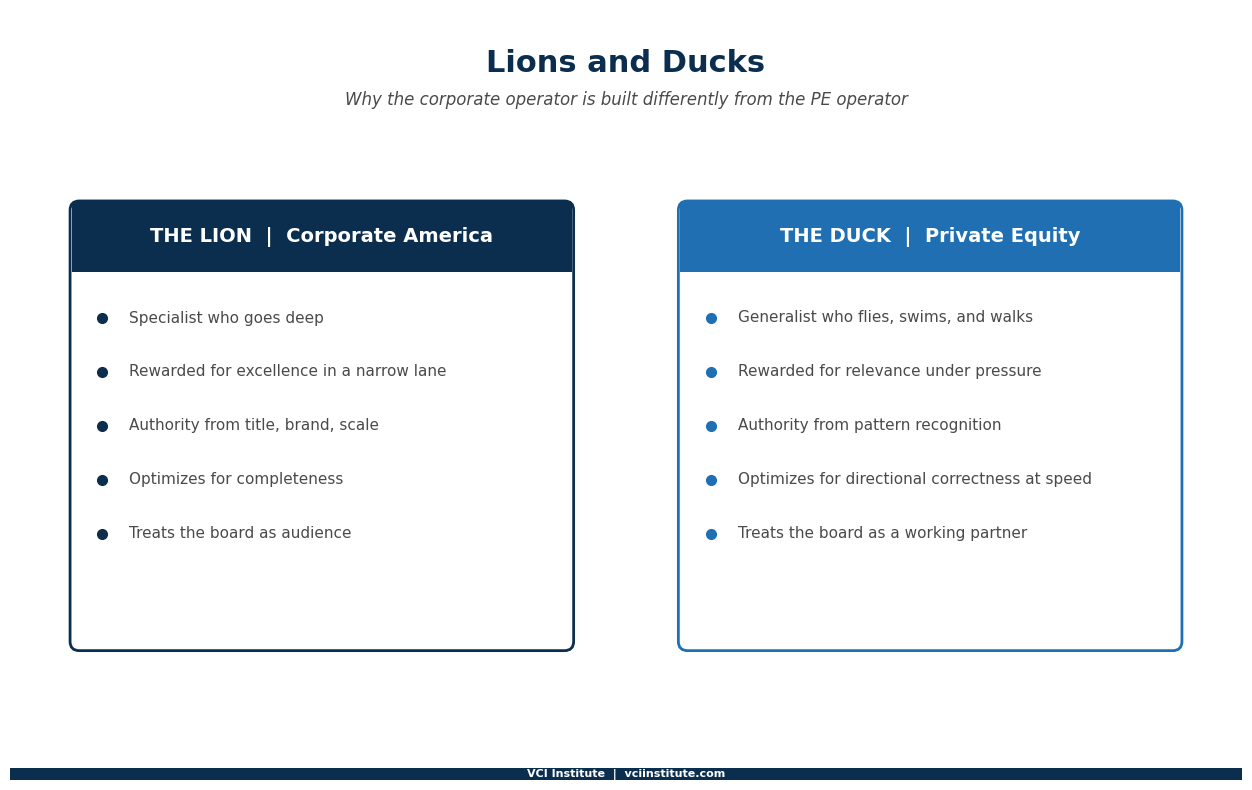
We have been using a different lens to think about this. Corporate America runs on lions. Specialists who go deep, build franchises, and are rewarded for excellence in a narrow lane. The lion is the head of supply chain at a Fortune 100. The lion is the segment president running a four billion dollar division. The lion is the CFO who has spent twenty years owning a particular kind of P and L.
Private equity does not pay for lions, at least not at the operator level. PE pays for ducks. Generalists who fly, swim, and walk, all imperfectly, but all simultaneously. The duck is the CEO who can sit with the head of supply chain on Monday, the CRO on Tuesday, and the CFO on Wednesday, and contribute meaningfully to each conversation without pretending to mastery in any of them.
The corporate executive walks into PE confident, because they have been good at one thing for twenty years. The duck has been good at three things, badly, for the same period. The duck has the seat, because PE is not a one-thing job.
The translation, not transfer, frame starts here. The corporate executive does not need to become a different person. They need to translate the depth they have into the breadth that PE requires, and they need to do it in months, not years. The clock is tighter than most arrivals expect, and it is described precisely in the 45-day math.
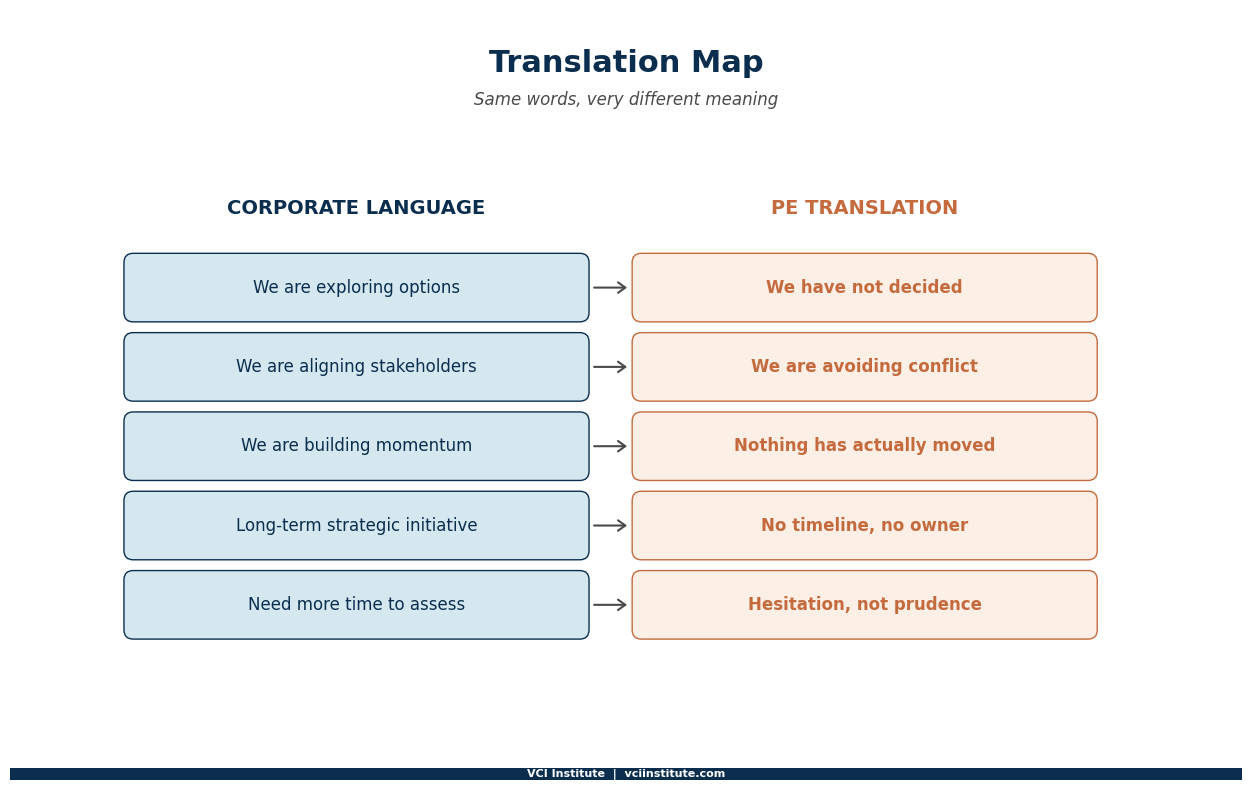
Corporate language is polished and aspirational. PE language is compressed and outcome-driven. Phrases like we are exploring options, we are aligning stakeholders, and we are building momentum mean specific things in corporate environments. They translate badly into PE.
We are exploring options translates as we have not decided. PE reads it as indecisiveness.
We are aligning stakeholders translates as we are avoiding conflict. PE reads it as conflict avoidance.
We are building momentum translates as nothing has moved. PE reads it as a stall.
The corporate executive is not lying. They are using the dialect they were trained in. PE is not unfair. They are using the dialect they pay for. The translation is the executive's responsibility, not the board's. Boards do not translate downward. They reprice. The first place this gets priced is the negotiation itself, which is why what sponsors actually hear in compensation discussions is worth reading before the offer arrives rather than after.
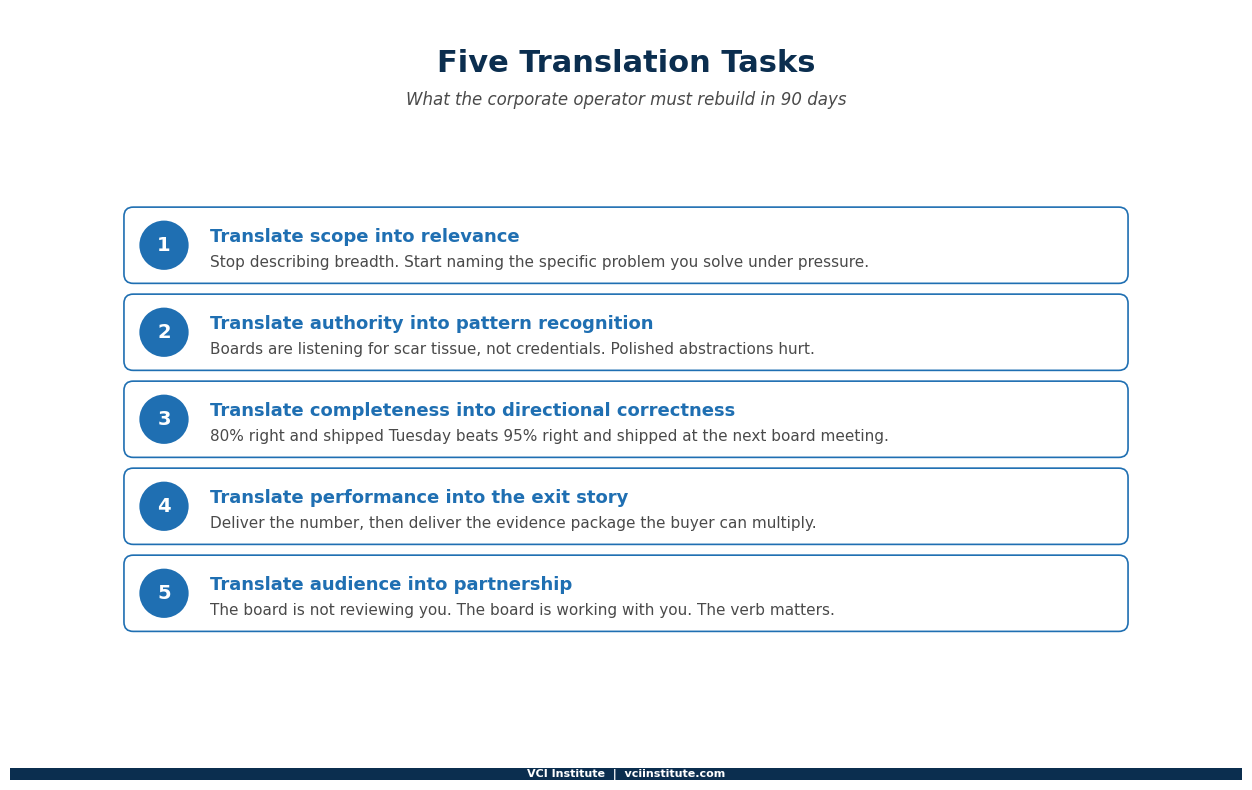
There are five translation tasks the corporate executive has to complete in roughly the first ninety days, in roughly this order.
Translate scope into relevance. The corporate executive describes themselves by breadth. Revenue managed. Headcount led. Industries covered. PE listens for relevance. What problems do you solve under pressure. When are you most valuable, before, during, or after disruption. In what situations are you a clear fit. The relevance statement is short and specific. I solve this problem, in this kind of company, at this size range, especially when this signal appears. Operators who cannot deliver that statement in three sentences do not get the second meeting.
Translate authority into pattern recognition. Corporate authority is reinforced by title, brand, and scale. PE is unimpressed by all three. PE deal teams are silently asking whether this person has seen this movie before. They are listening for scar tissue. Judgment under pressure. The ability to name the second-order effect of a decision quickly. Frameworks do not substitute for lived experience in this audience. The corporate executive who delivers polished abstractions when the room is listening for pattern recognition produces the wrong signal at the worst moment.
Translate completeness into directional correctness. Corporate environments reward correctness. The deck has to be right. The plan has to be defensible. The decision has to be supported by the data. PE rewards directional correctness at speed. The plan that is 80 percent right and shipped Tuesday beats the plan that is 95 percent right and shipped at the next board meeting. The cost of waiting is read as risk aversion. The corporate reflex of waiting for confidence is the most expensive habit the executive carries. It is also the reflex that produces the hire's characteristic failure mode, which is installing structure for problems the company does not yet have.
Translate performance into the exit story. The corporate executive optimizes for performance. PE optimizes for exit valuation. The two overlap, but not entirely. A 9 percent organic growth year that is invisible to a buyer is worth less than a 6 percent organic growth year that is documented, system-supported, and demonstrably repeatable. The corporate reflex is to deliver the number. The PE move is to deliver the number with the evidence package that lets the buyer multiply it. That evidence package is what the six demand-side drivers describe in detail.
Translate audience into partnership. Corporate boards are formal. PE boards are working. The corporate executive over-prepares the deck and under-prepares the conversation. The PE board does not want a presentation. They want a partner. The board meeting is not a status report. It is a working session about prioritization, capital allocation, and risk. Executives who treat the board as an audience produce respectful silence. Executives who treat the board as a partner produce a different relationship that compounds. The board's side of that redesign is set out in PE boards that actually work.
The translation is harder than it sounds, because the corporate executive is not aware of the dialect they are using. The dialect was air. They breathed it for twenty years. PE pulls the air out of the room, and the executive notices the absence first as discomfort, then as a series of mistakes they did not know they were making.
There is one frame that helps. PE does not reward reinvention. It rewards relevance under pressure. The corporate executive does not need to become a different operator. They need to take the operator they already are and re-express that operator in a language the new audience speaks.
Most do not. The transition feels like translation should not be necessary. They have been successful for two decades. The skills are real. The translation feels like a demotion, when it is closer to an upgrade.
The operators who make the jump cleanly do three things differently. They acknowledge that the rules are different before they are corrected by the rules. They invest in pattern recognition early, often by spending time with operators already in PE seats, listening more than talking. And they redefine independence. Not as isolation, which is the corporate default. As accountability supported by perspective, which is the PE default.
The hardest truth in this transition is the one corporate executives resist longest.
PE is not corporate America, but smaller and faster. It is a different book.
The lion who walks in still a lion does not last. The lion who quietly translates into a duck does. The translation does not feel good. It produces a different kind of operator. It produces the operator PE actually pays for.
The duck thesis is not a dismissal of depth. It is a recognition that depth is no longer the moat it was thirty years ago, and that the operators who add adaptability on top of depth are the ones whose careers compound through this cycle. PE is just the most concentrated version of the bet, in the operator class with the shortest reaction time.
For the corporate executive considering the move, the question is not whether you are good. The question is whether you are willing to translate.
COPPE Level 1
The translation, done before you take the seat
Ninety days is not long enough to learn a dialect while being judged in it. COPPE Level 1 covers what changes under sponsor ownership: the value creation levers, the hundred day structure, the governance relationship with a portfolio company chief executive, and the language a sponsor expects in a board pack. Twelve lessons, each with a written lesson, a Visual Companion, an audiocast and a videocast. Self paced, no start dates.
VCI Institute in collaboration with Mohamad Chahine
Published 5 October 2026
Related reading from the VCI Institute
Founder, Hire, Incumbent
The three operators PE underwrites, and the failure mode waiting for the corporate hire.
The 45-Day Math
Why PE onboarding is shorter than you think, and the clock the translation has to beat.
What Sponsors Actually Hear
The first place the dialect gets priced, before the executive has taken the seat.
About the VCI Institute
The VCI Institute is a nonprofit dedicated to building practical capability and shared standards for value creation in private equity. The Institute publishes operator-grade frameworks and runs certification programmes for operating partners, portfolio company executives, and value creation analysts. You can see what each programme actually covers before deciding. Analysis published here draws on the Institute's certification curricula and on structured review of mid-market transaction patterns rather than on any single proprietary dataset. Where a figure is directional rather than measured, it is described as such.
Further material is available in the Institute's Insights library and its free resource library of templates, checklists, and case snapshots.
© 2026 VCI Institute. All rights reserved. The frameworks, terminology, and analysis presented in this article are the intellectual property of the VCI Institute. Reproduction or derivative use without written permission is prohibited. Citation with proper attribution is welcomed.
We have many great affordable courses waiting for you!
Stay connected with news and updates!
Join our mailing list to receive the latest news and updates from our team.
Don't worry, your information will not be shared.
We hate SPAM. We will never sell your information, for any reason.


 Practice private equity like a pilot trains