What Sponsors Actually Hear in PE Compensation Negotiations
Sep 28, 2026
Most executives think the compensation negotiation is about compensation.
It is not. It is about behavior. The dollars are real, but the dollars are downstream of a question the sponsor is silently asking on the other side of the table. Will this person behave like an owner when something is on fire, or will they behave like a well-paid employee.
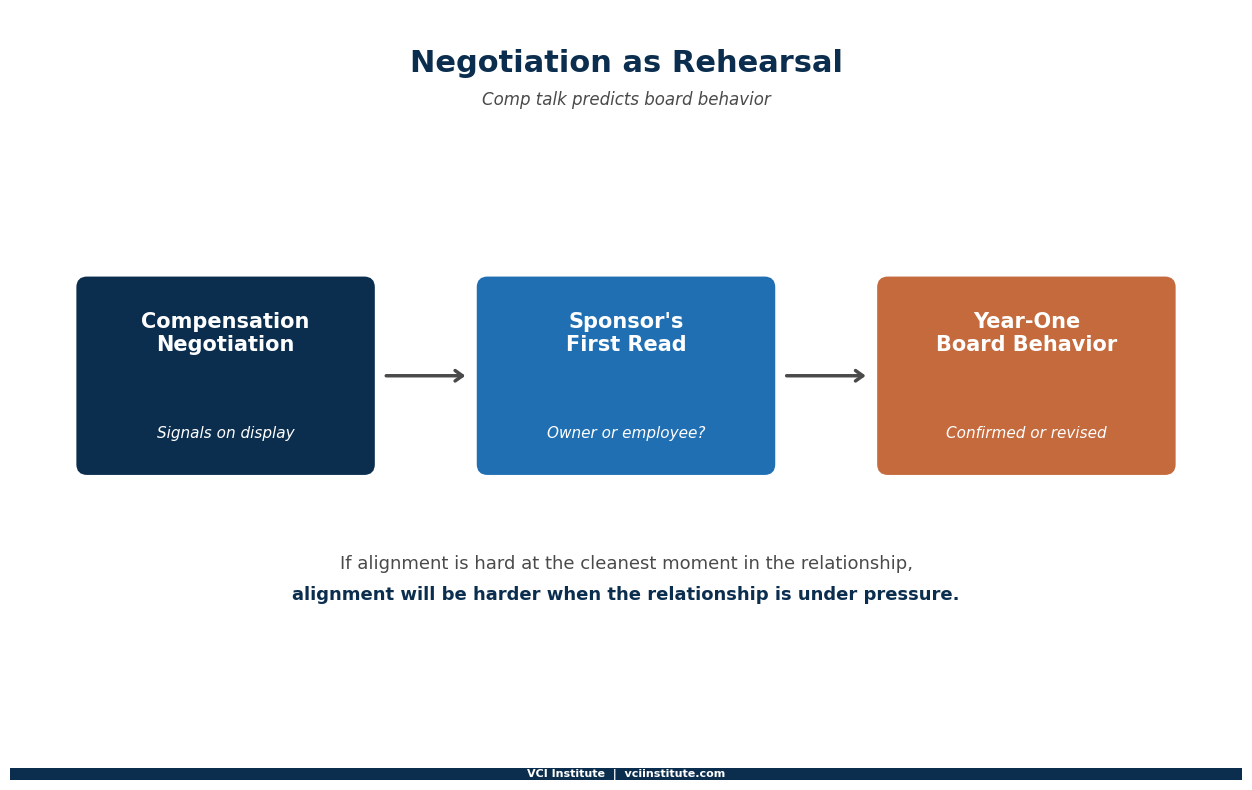
The negotiation is the first rehearsal of the answer.
The short answer
Sponsors listen for four signals. Whether the executive asks how value gets created before asking how they get paid. Whether they will put pay at risk in proportion to the upside they claim to believe in. Whether they are fluent in the mechanics, meaning MOIC, vesting acceleration, ratchets, and dilution in add-ons. And whether they negotiate inside the sponsor's real constraint set of LPs, hold period, hurdles, and portfolio fairness norms. The mirror-image red flags are fixation on base salary, equity discussed as a number rather than as a function of exit scenarios, asymmetric risk allocation, and any attempt to negotiate the uncertainty away.
Sponsors who underwrite executive comp are not trying to optimize fairness. They are trying to engineer alignment under pressure, in a setting where leverage is real, the timeline is compressed, and the margin for error on key decisions is small. Compensation is one of the few mechanisms that can be precisely shaped to bias behavior in those conditions. The structure of the package matters. The conversation about the structure matters more.
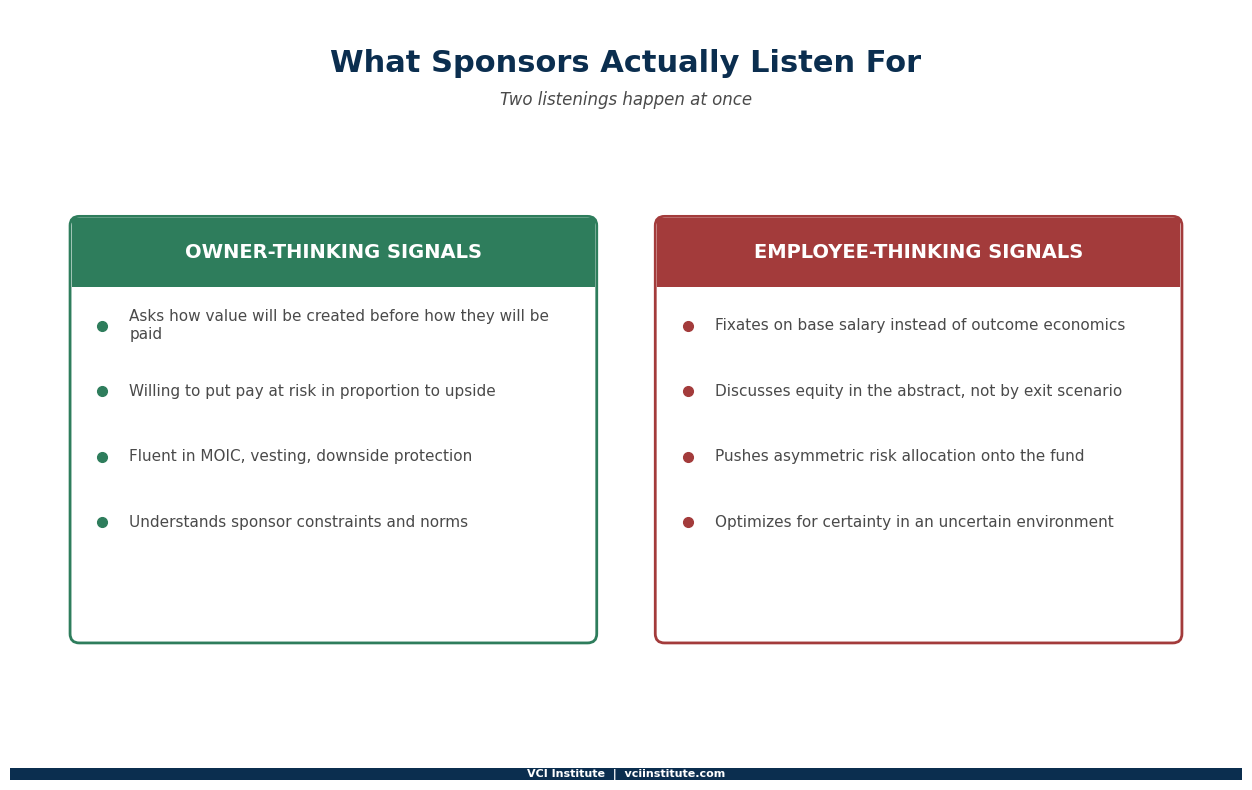
There are two listenings happening in the room.
The executive is listening for the size of the package, the protection of the downside, and the certainty of the upside.
The sponsor is listening for evidence of an ownership mindset. Specifically, four signals.
Signal one. Does the executive ask how value will be created before they ask how they will be paid? The order matters. Executives who lead with the value creation plan signal that they have already made the mental switch from operating a company to stewarding an investment. Executives who lead with base salary signal that the switch has not happened, and will probably not happen by close.
Signal two. Are they willing to put compensation at risk in proportion to the upside they believe in? Sponsors do not expect operators to take reckless risk. They do expect them to share it. An operator who fights hard for the equity ladder and harder for the cash floor is signaling a degree of confidence in their own thesis that the sponsor will price.
Signal three. Are they fluent in the mechanics? MOIC, vesting acceleration, downside protection, ratchet structures, dilution treatment in add-ons. An operator who has to be walked through the basics of how the equity actually works is signaling that they have not yet spent the time to understand the bet they are being asked to make. That is information. The sponsor will wait, but the wait is priced.
Signal four. Do they understand the sponsor's constraints? The fund has LPs. The fund has a hold period. The fund has internal hurdles. The fund has fairness norms across the portfolio. Operators who negotiate as if the sponsor has unlimited optionality are usually new to PE. Operators who negotiate inside the sponsor's actual constraint set are signaling that they have already started thinking like a partner, before the partnership has formally begun. The constraint that dominates most sponsor conversations in 2026 is liquidity, which is why the DPI reckoning is worth understanding before walking into the room.
There is a parallel set of red flags that move conviction in the opposite direction.
Fixation on base salary instead of outcome economics. PE does not pay corporate base salaries, and operators who push hardest there are usually pricing certainty into a setting that does not reward certainty. The sponsor reads the push as risk aversion, not as discipline.
Equity discussed in the abstract. Executives who talk about equity as a number rather than as a function of MOIC under specific exit scenarios are revealing that they have not modeled the bet. The sponsor reads this as a lottery ticket framing, which is the opposite of an ownership framing.
Asymmetric risk allocation. Executives who try to engineer downside protection with no corresponding upside concession are revealing the position they will take when the company hits the inevitable hard quarter. The sponsor will not say this in the room. They will remember it.
Optimization for certainty in an uncertain environment. Private equity is not certain. The sponsor knows this. The operator knows this. An operator who tries to negotiate the uncertainty away is signaling that they will not handle the actual uncertainty well when it shows up. If alignment is hard at the cleanest moment in the relationship, alignment will be harder when the relationship is under pressure.
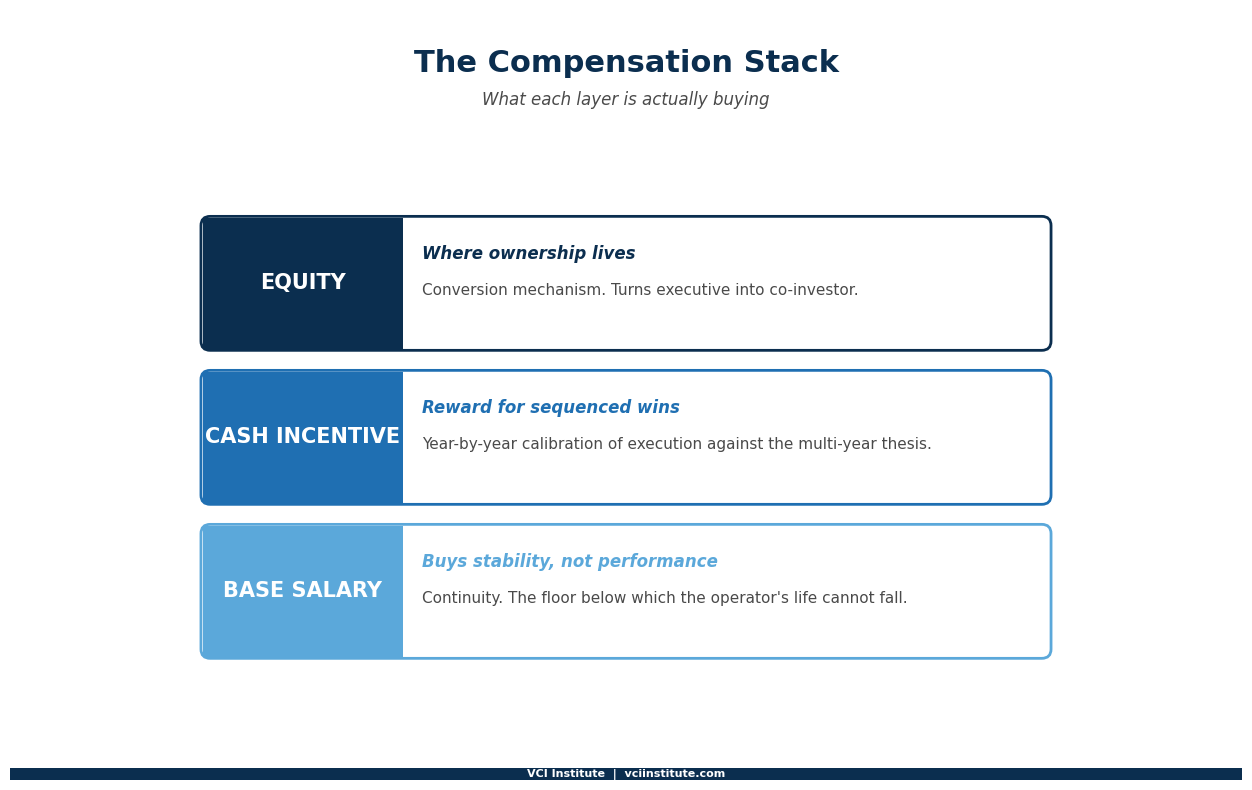
The compensation stack itself does work the operator does not always see. Base salary is not paying for the role. It is buying continuity, which is the floor below which the operator's life cannot fall during a tough quarter. Cash incentives are not rewarding the year. They are calibrating year-by-year execution against the multi-year thesis. Equity is not additional compensation. It is the conversion mechanism that turns an executive into a co-investor of their own time and reputation.
The strongest operators we watch in the negotiation room do three things differently.
They anchor compensation to the value creation plan, not to a comp survey. They open the conversation with a point of view on which valuation drivers their seat actually moves, and where they are willing to bet on themselves, before the package is on the table. The package then gets engineered around that point of view, not against an external benchmark. That point of view is more credible when it traces to the underwriting logic, which is the discipline described in the Thesis Operating System.
They proactively propose structures that balance risk and reward. The best operators arrive with a counter that is more elegant than the one the sponsor would have offered. Not more aggressive. More elegant. They propose a structure that protects the sponsor's downside while concentrating the operator's upside in the scenarios that matter most. Sponsors price elegance. It signals the operator already thinks the way the sponsor thinks.
They demonstrate fluency in capital, not just in their own career. The conversation includes references to MOIC, IRR, hurdle, dilution, and acceleration that are casually correct. The operator is not performing fluency. They are using the vocabulary because they have already done the work to understand the bet.
There is a quieter truth underneath all of this.
Compensation is not a concession extracted by talent. It is a governance tool deployed by capital. The operators who understand this stop negotiating pay and start negotiating alignment. The package that emerges is usually larger than the one they would have negotiated transactionally, because the conversation produces conviction, and conviction prices.
Sponsors notice. They notice in the way they describe the operator to the deal partner after the meeting. They notice in the way the comp committee describes the package to the LPs. They notice most of all in the way they communicate during the inevitable hard quarter, because trust set in the negotiation room compounds through the hold and decompounds quickly when it was not set well. What the room reveals about the operator is largely a function of which archetype is sitting in it, which is the diagnostic in Founder, Hire, Incumbent.
The negotiation is the first board meeting in disguise. The dollars are downstream. The behavior is the underwriting. It is also the natural moment to write down how the working relationship will run, which is the argument for the operating partner and CEO compact being drafted alongside the package rather than months after it.
If you are a sponsor, the question we keep returning to is what you are listening for in compensation discussions, and whether your team is calibrating against those signals consistently across the portfolio.
If you are an operator, the question is whether you are negotiating in the language sponsors actually use, or in the language you used at the last corporate seat. The two are different. The price of the difference is real, and it is paid for years.
COPPE Level 1
The language sponsors actually use
Fluency is not something to acquire in the room. COPPE Level 1 covers the value creation levers, the hundred day structure, the governance relationship with a portfolio company chief executive, and the language a sponsor expects in a board pack. Twelve lessons, each with a written lesson, a Visual Companion, an audiocast and a videocast. Self paced.
If the mechanics are the gap, COPPE Level 2 is where MOIC, the debt schedule and the exit bridge get built rather than described.
VCI Institute in collaboration with Mohamad Chahine
Published 28 September 2026
Related reading from the VCI Institute
Founder, Hire, Incumbent
The three operators PE underwrites, and how each one behaves in the negotiation room.
The 45-Day Math
Why PE onboarding is shorter than you think, and what the operator is signing up to build.
The DPI Reckoning
Why distributed-to-paid-in is now the metric that matters, and the constraint shaping every sponsor conversation.
About the VCI Institute
The VCI Institute is a nonprofit dedicated to building practical capability and shared standards for value creation in private equity. The Institute publishes operator-grade frameworks and runs certification programmes for operating partners, portfolio company executives, and value creation analysts. You can see what each programme actually covers before deciding. Analysis published here draws on the Institute's certification curricula and on structured review of mid-market transaction patterns rather than on any single proprietary dataset. Where a figure is directional rather than measured, it is described as such.
Further material is available in the Institute's Insights library and its free resource library of templates, checklists, and case snapshots.
© 2026 VCI Institute. All rights reserved. The frameworks, terminology, and analysis presented in this article are the intellectual property of the VCI Institute. Reproduction or derivative use without written permission is prohibited. Citation with proper attribution is welcomed.
We have many great affordable courses waiting for you!
Stay connected with news and updates!
Join our mailing list to receive the latest news and updates from our team.
Don't worry, your information will not be shared.
We hate SPAM. We will never sell your information, for any reason.

 Practice private equity like a pilot trains