
The Operating Partner and CEO Compact: Why It Has to Be Written
Aug 24, 2026
The most important relationship in any private equity portfolio company is between the operating partner and the CEO. It is more important than the relationship between the deal partner and the CEO, more important than the relationship between the board and the CEO, and more important than the relationship between the CEO and any individual member of the management team. It is also, in too many deals, the relationship that gets the least deliberate construction.
The operating partner arrives at close with assumptions about what the CEO needs. The CEO arrives at close with assumptions about what the operating partner will provide. Neither set of assumptions is usually written down. Both sets are usually slightly wrong. The gap between them grows quietly over the first six months, surfacing eventually as friction over decisions that neither party realized the other expected to control.
The short answer
The operating partner and CEO compact is a one to two page written agreement, drafted in the first thirty days after close, covering five dimensions: strategic decision rights, talent decision rights, operating cadence, escalation and disagreement, and information sharing. It takes roughly three hours to build and is reviewed annually. Its purpose is not to constrain either party. It is to make the boundaries explicit before circumstances test them, so that disagreements stay structural rather than becoming personal.
A written compact between the operating partner and the CEO solves most of this. The compact is not a legal document. It is a one-page articulation of how the two will work together, what each will own, what each will defer to the other on, and how disagreements will be resolved when they arise. It takes about three hours to construct properly. It saves many months of friction over the course of a hold.
Why the Implicit Compact Fails
The default approach is to leave the working relationship implicit. The operating partner and the CEO begin working together at close, develop habits over time, and figure out the boundaries through trial and error. This approach has two large weaknesses.
The first weakness is that trial and error is expensive. Each time a decision surfaces a boundary that has not been agreed, the resolution costs time and political capital. A pricing decision that the CEO makes unilaterally that the operating partner believed was a joint call. A talent decision that the operating partner expects to be consulted on that the CEO treats as a CEO prerogative. A capital allocation decision that the operating partner expects to escalate to the board that the CEO had assumed could be made at the management level. Each of these is recoverable individually. Cumulatively, they produce a relationship where each party is uncertain about the other's expectations, and the uncertainty itself becomes a constraint on speed and trust.
The second weakness is that the implicit compact tends to drift toward the comfort zone of one party or the other, rather than toward the optimal allocation of decision rights. CEOs who are protective of authority gradually accumulate decision rights that an outside operating partner might have shaped differently. Operating partners who are interventionist by temperament gradually intrude on decisions that should remain with management. Neither drift is consciously chosen. Both produce outcomes that neither party would have agreed to in advance if they had been articulated clearly. In founder led businesses the drift is sharper in both directions, which is one reason the founder speed tax shows up most often where no compact was written.
The written compact prevents both drifts. It forces explicit conversation about who owns what, before circumstances produce decisions that test the boundaries.
The Five Dimensions of the Compact
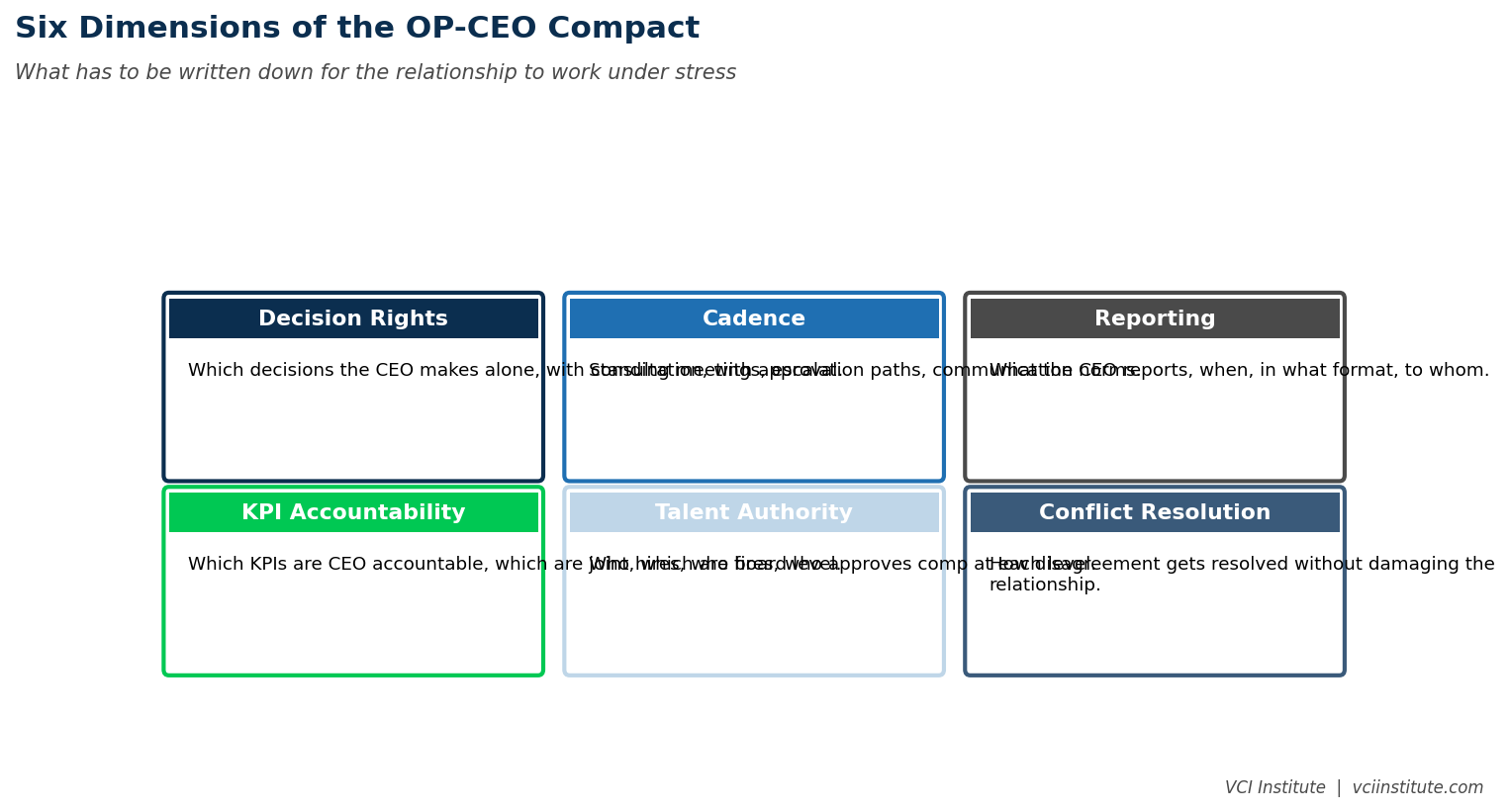
A useful compact covers five dimensions. Each one addresses a category of decision that recurs across deals and that benefits from explicit definition.
The first dimension is strategic decisions. What constitutes a strategic decision in this business. Who has primary authority over them. What is the role of the operating partner. What is the role of the board. The compact specifies, for example, that pricing strategy is owned by the CEO with operating partner consultation, that major customer decisions are owned by the CEO with operating partner notification, that geographic expansion decisions are joint between CEO and operating partner with board approval, and that platform M and A decisions are board level with CEO and operating partner recommendation.
The specifics will vary by business. The discipline of having the conversation produces clarity that absence of the conversation does not. Pricing is a useful test case, because a real pricing program requires sustained joint commitment and is exactly the kind of initiative that stalls when authority is ambiguous.
The second dimension is talent decisions. Who has authority over hires at each level. Who has authority over promotions. Who has authority over compensation changes. Who has authority over performance issues. CEOs vary substantially in how they want to engage with operating partners on talent. Some welcome the engagement. Some treat it as encroachment. The compact specifies, for example, that the CEO has primary authority over the management team with operating partner consultation on the top three reports, that the operating partner has consultative input on senior level hires, and that the CHRO reports through the CEO with periodic check-ins to the operating partner. The CFO upgrade question is the first live test of this dimension in most deals, and it arrives faster than the compact usually does.
The third dimension is operating cadence. How often do the operating partner and CEO meet. What is the format. What is the agenda. Who attends. The compact specifies, for example, weekly thirty minute one-on-ones, monthly two-hour operating reviews with the management team present, quarterly board preparation sessions, and an annual strategic planning offsite. The cadence is not arbitrary. It is calibrated to the rhythm the business needs and the bandwidth each party can sustain.
The fourth dimension is escalation and disagreement. When the operating partner and CEO disagree, how is the disagreement resolved. Who has the final call on what kinds of decisions. When does the disagreement go to the board. The compact specifies, for example, that on operational matters within the business, the CEO has the final call after operating partner input, that on capital allocation matters above a defined threshold, the operating partner can escalate to the board, and that on board level strategic matters, the disagreement is presented to the board for resolution.
The fifth dimension is communication and information sharing. What information does the operating partner expect to receive, and how. What information does the CEO expect to provide, and on what cadence. What is shared with the board, the deal partner, the LPs. The compact specifies, for example, weekly operating reports of a defined format, monthly financial reports with variance commentary, quarterly board packs with strategic context, and annual LP reports with the operating partner's voice on value creation. This dimension collapses quickly if the company cannot agree with itself on the numbers, which is why the single source of truth audit is often a precondition rather than a follow-on.
Each of these five dimensions becomes a section of the written compact. The full document is one to two pages, written in plain language, signed by both the operating partner and the CEO, and reviewed annually.
The Construction Process
The compact should be drafted within the first thirty days after close. The process matters as much as the document.
The draft starts with a working session between the operating partner and the CEO, scheduled deliberately rather than fitted into a busy day. The session takes two to three hours. The agenda is to walk through the five dimensions and articulate, for each, how the two see the working relationship. The conversation is sometimes difficult, because it surfaces differences in assumptions that neither party had voiced. The discomfort is the point. Issues that surface during this conversation are issues that would have surfaced anyway, in worse circumstances, later in the relationship.
The draft is then reviewed by the deal partner, who has interest in how the operating partner and CEO will work together but does not draft the compact directly. The deal partner's role is to ensure that the compact is consistent with the broader value creation plan and the firm's expectations of its operating partners. The deal partner's input is consultative, not authoritative.
The compact is then committed to writing, signed, and shared with the board. The board does not approve the compact in any formal sense, but understands its content because the compact shapes how decisions will flow to the board for resolution. Putting the compact in front of the board also creates accountability, because both the operating partner and the CEO know they have committed publicly to a way of working.
What Goes Wrong When the Compact Is Skipped
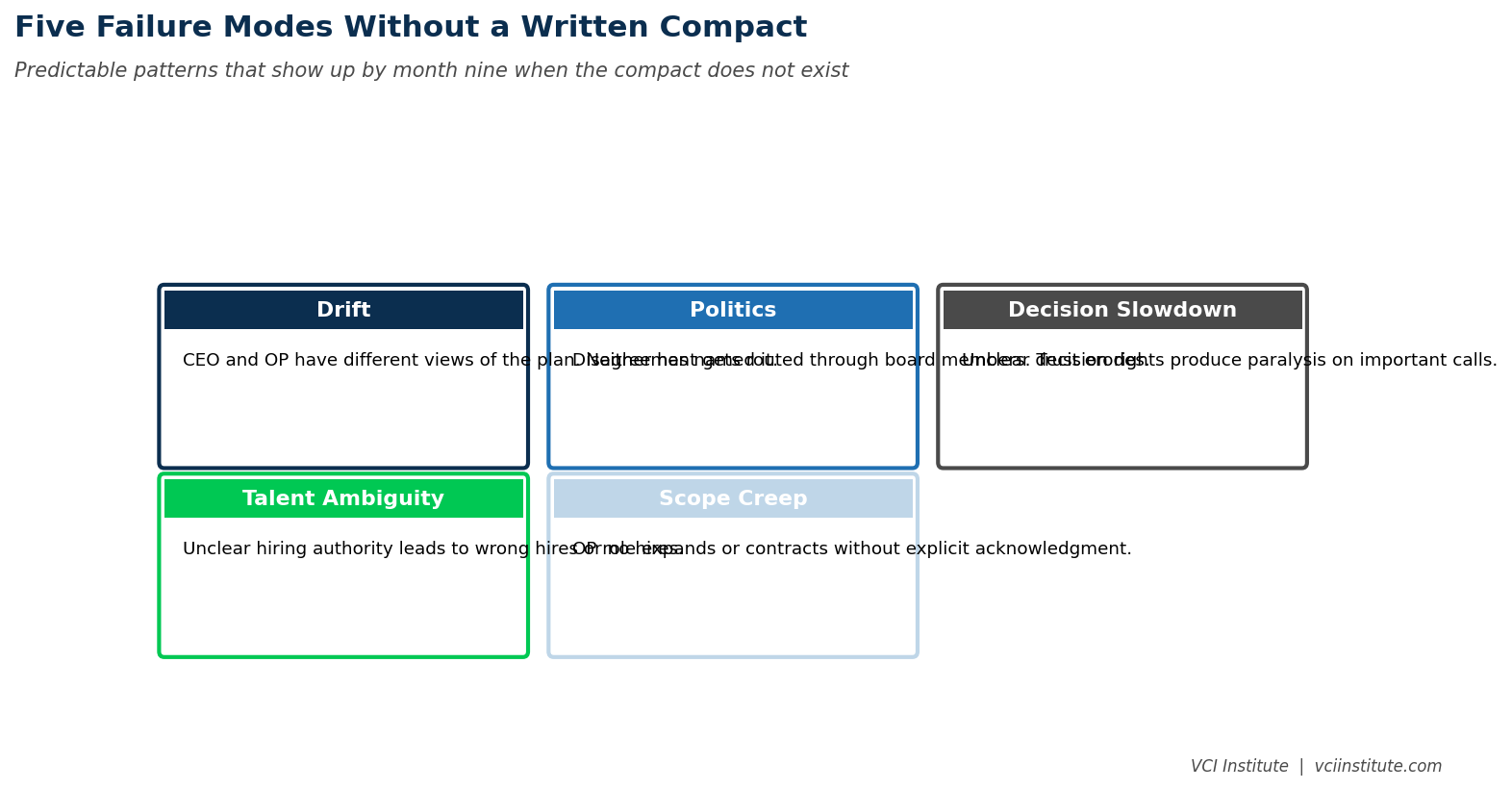
The patterns of failure when the compact is skipped are predictable.
Operating partners and CEOs disagree about pricing strategy in month four, with each having assumed they had the lead. The disagreement is resolved through escalation to the board, which both parties find embarrassing because the resolution should have been at their level if they had agreed how to resolve it.
A senior hire is made without operating partner consultation, and the operating partner discovers the hire through the company's announcement. The hire is fine on its merits, but the operating partner now has to retroactively assert engagement on senior talent decisions, which produces friction with the CEO who reasonably believed the hire was within their authority.
A bolt-on acquisition opportunity emerges that the CEO wants to pursue. The operating partner has reservations about the cultural fit. Without an explicit framework for how M and A decisions get made, the disagreement becomes personal rather than structural, and the relationship suffers regardless of how the specific decision is resolved.
In each of these patterns, the underlying disagreement is not always avoidable. The damage to the relationship from the disagreement is. A clear compact tells both parties how to handle the disagreement when it occurs, which removes much of the personal friction.
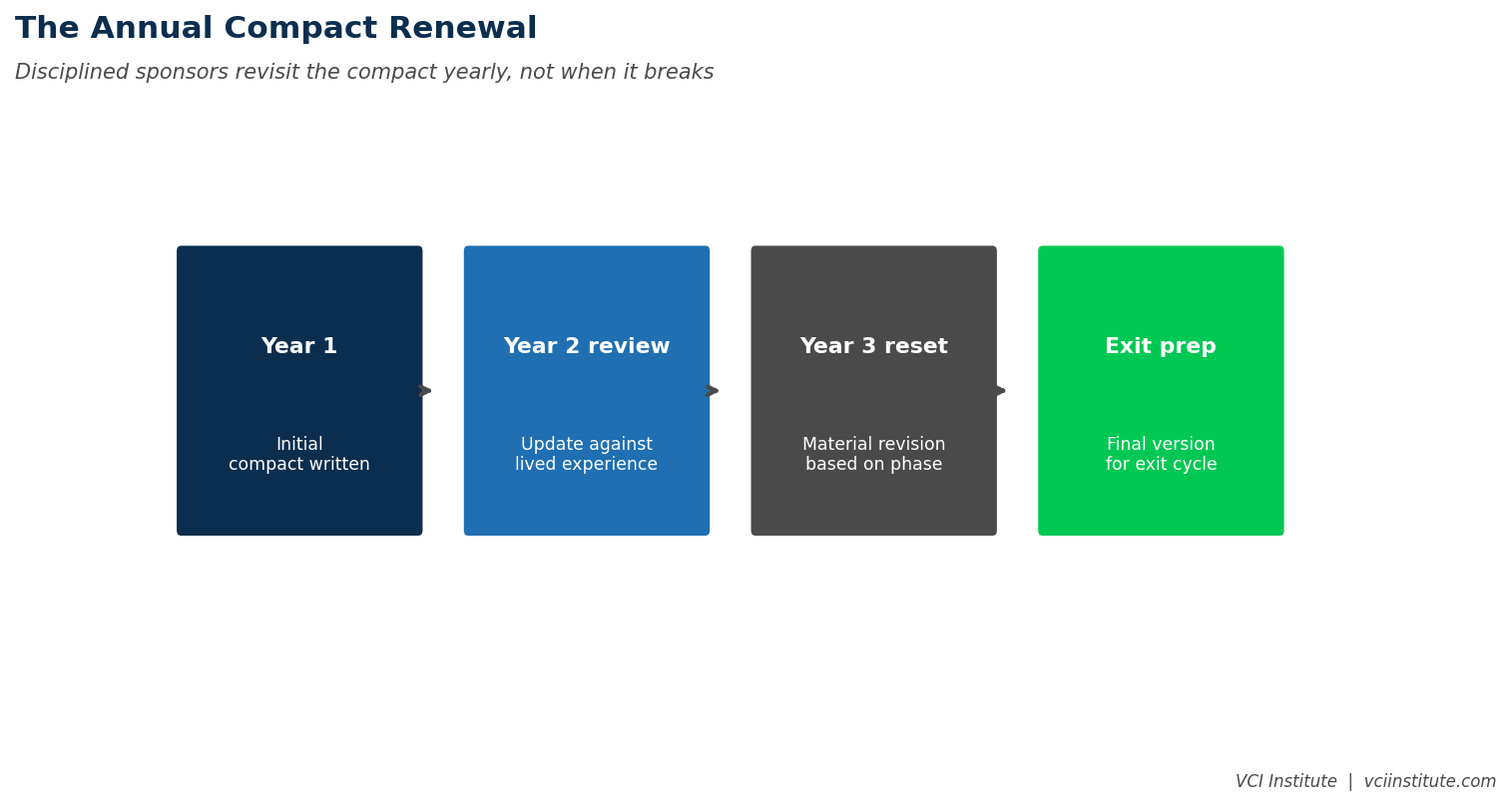
The Annual Renewal
The compact is not a static document. The business evolves, the value creation plan progresses, and the relationship between the operating partner and CEO matures. The compact should be reviewed annually, with explicit conversation about whether each of the five dimensions is still working as defined.
The renewal conversation typically produces small adjustments rather than wholesale changes. A boundary that was set conservatively at close might be moved as trust is established. A cadence that was set tightly at close might be relaxed as the operating rhythm becomes routine. A communication norm that proved cumbersome might be simplified. The renewal keeps the compact current and ensures that the relationship adapts as conditions change.
The renewal also serves a quieter purpose. It provides a structured moment for the operating partner and CEO to reflect together on how the working relationship is going, beyond the operating issues of the moment. The conversation is sometimes the only point in the year when the relationship itself is the subject of discussion rather than the work the relationship enables.
The Underrated Discipline
The operating partner and CEO compact is not a glamorous discipline. It does not feature in IC presentations. It is not the kind of intervention that gets celebrated when value is created at exit. And yet, the operating partners who consistently use it find that their portfolio relationships are healthier, their decisions are made faster, and their conflicts are resolved more cleanly.
For sponsors that are building or refining their operating capability, the compact is one of the most leveraged investments they can institutionalize. It costs almost nothing. It produces clarity that compounds over the hold period. It distinguishes operating partners who work as productive partners to their CEOs from operating partners who work as overseers, intruders, or absent friends. The starting point for the conversation is usually an honest read of what the company can currently sustain, which is what an operating maturity diagnostic provides.
The CEO did not necessarily ask for the compact. The CEO will, however, value it once it exists. Most CEOs in private equity owned companies are operating with implicit assumptions about what the operating partner will and will not do. The explicit version of those assumptions, agreed and written, is a form of respect and a foundation for trust. It is also one of the most reliable predictors of which operating partner and CEO pairings will produce strong value creation outcomes and which will produce friction that the deal absorbs as wasted energy.
The compact is the thing that does not need to exist until it does. The sponsors that learn this lesson early end up with operating partner and CEO relationships that look easy from the outside. The sponsors that learn it late end up with relationships that produce avoidable conflict and the operating partners who work in them learn to be guarded rather than generative. The difference is real, and it shows up in returns over the hold.
COPPE Level 1
The operating partner craft, taught properly
The value creation levers, the hundred day structure, the governance relationship with a portfolio company chief executive, and the language a sponsor expects in a board pack. Twelve lessons, each with a written lesson, a Visual Companion, an audiocast and a videocast. Self paced.
Already working as an operating partner? COPPE Level 2 carries the same practitioner through a full hold period on one company, from entry model to exit bridge.
VCI Institute in collaboration with Mohamad Chahine
Published 24 August 2026
Related reading from the VCI Institute
The CFO Upgrade Question
The first live test of the talent dimension, and why the failure mode is deciding late rather than deciding wrong.
The Founder Speed Tax
When professionalization kills the business you bought, and where the boundary drift usually starts.
The Operating Maturity Index
A diagnostic to run before you intervene, and a useful input to the first compact conversation.
About the VCI Institute
The VCI Institute is a nonprofit dedicated to building practical capability and shared standards for value creation in private equity. The Institute publishes operator-grade frameworks and runs certification programmes for operating partners, portfolio company executives, and value creation analysts. You can see what each programme actually covers before deciding. Analysis published here draws on the Institute's certification curricula and on structured review of mid-market transaction patterns rather than on any single proprietary dataset. Where a figure is directional rather than measured, it is described as such.
Further material is available in the Institute's Insights library and its free resource library of templates, checklists, and case snapshots.
© 2026 VCI Institute. All rights reserved. No part of this article may be reproduced or transmitted in any form without prior written permission of the VCI Institute.
We have many great affordable courses waiting for you!
Stay connected with news and updates!
Join our mailing list to receive the latest news and updates from our team.
Don't worry, your information will not be shared.
We hate SPAM. We will never sell your information, for any reason.


 Practice private equity like a pilot trains