Pricing Power as the First-Order Lever: The Margin Question Most Models Miss
Aug 17, 2026
Of all the value creation levers private equity firms can pull on a portfolio company, pricing power is the most consistently underweighted in underwriting models and the most consistently underestimated in execution.
The reason is partly cultural. Private equity firms grew up in the era when value creation meant cost reduction, operational efficiency, and capital structure optimization. The cost levers were measurable. The operational levers were quantifiable. The financial levers had clean models. Pricing, by contrast, was treated as a function of the market, something the business inherited rather than something it controlled. The result is that pricing power, when it exists, is treated as a positive narrative element rather than as a quantified value creation initiative with its own forecast and execution plan.
The short answer
Pricing power is the ability to raise price without losing enough volume to offset the gain. It is not premium positioning, price leadership, or high margin, all of which can exist without it. Standard diligence tests it three ways that all fall short: historical price moves, competitor benchmarking, and management opinion. A real pricing program has three parts, segmentation by price tolerance, a communication and implementation strategy, and an analytics layer that measures realized price. Run over a three year hold, disciplined pricing typically compounds to ten to twenty percent cumulative price gain, which on a twenty percent margin business is roughly a fifty percent EBITDA improvement.
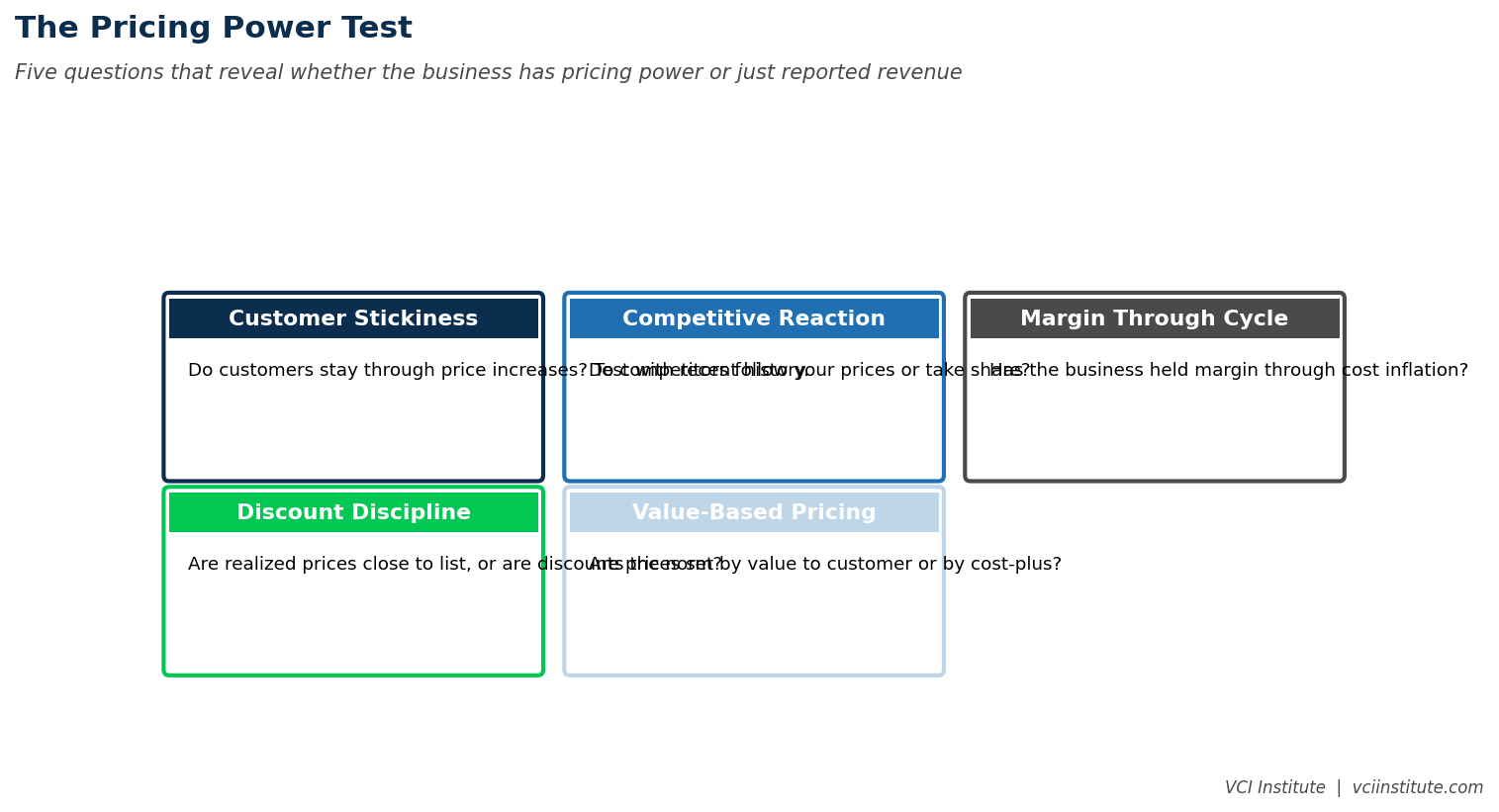
This treatment is wrong, and the cost of it is large. In businesses that have genuine pricing power and have not exercised it, a deliberate pricing program can produce two to four hundred basis points of margin improvement, sustained, with relatively limited customer churn. Translated into EBITDA, this is often the largest single value creation lever available in the business. Translated into enterprise value at exit, it is among the highest return interventions a private equity owner can execute.
The issue is that not every business has pricing power, and the businesses that do not have it do not gain it through pricing initiatives. Distinguishing the two is the diligence question. Capturing the value when the power exists is the operating question. Most private equity firms underinvest in both, and the LP returns reflect the gap.
What Pricing Power Actually Is
Pricing power is the ability to raise prices without losing volume to a degree that offsets the price gain. The definition is simple, but its implications are subtle. Pricing power is not the same as price leadership. It is not the same as having premium positioning. It is not the same as having strong margins. Each of these can be present without genuine pricing power, and pricing power can be present in businesses that do not have any of these features.
The actual test is what happens when prices are raised. A business with pricing power can take a meaningful price increase, three to seven percent in a single move, with churn or volume loss substantially below what the price gain produces. The net effect on revenue is positive. The net effect on margin, given that variable costs are largely fixed, is significantly positive. The business can repeat this exercise periodically, capturing additional pricing each cycle, until customer behavior shifts in response.
The factors that produce pricing power are well understood in principle. High switching costs. Differentiated product or service. Position in customer workflow that makes them dependent on the supplier. Lack of comparable alternatives at scale. Strong brand or quality reputation that justifies premium. Each factor produces some willingness on the part of customers to absorb price increases rather than switch suppliers. When several factors are present together, the business has pricing power.
What confuses the diagnosis is that businesses often look as if they have pricing power when they do not, and look as if they do not when they do. A high margin business may simply be operating in a generally favorable industry. A business with strong customer relationships may simply have customers who are operationally tied in but would defect if pricing were tested. A business with low margins may have actual pricing power that has never been tested because management has been focused elsewhere.
The only way to know for certain is to test it. Pricing programs in private equity portfolio companies typically reveal more pricing power than the management team believed they had, because the management team has been calibrating prices to a long held assumption about customer sensitivity that has not been validated.
How Underwriting Misses It
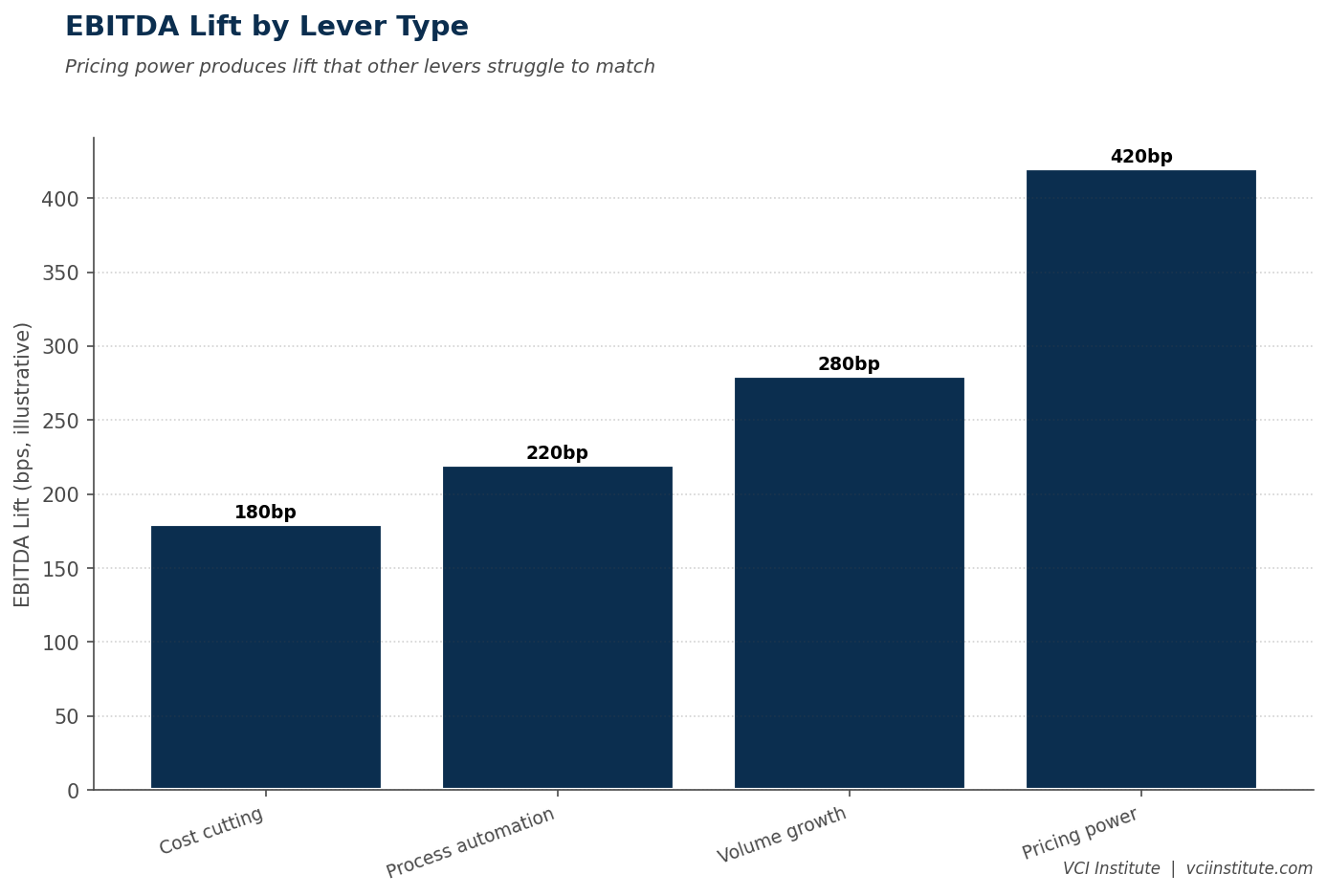
Diligence processes typically address pricing in three ways, all of which fall short of an actual pricing power assessment.
The first way is to look at historical pricing patterns. Has the business taken price increases in the past, and what has happened to revenue and customer count. The data is informative but limited. Historical pricing increases were often calibrated to be small enough not to test the limit. The fact that prior increases did not produce churn does not establish where the actual ceiling is.
The second way is to benchmark against competitors. Where does the business price relative to peers. If pricing is below comparable competitors, there is presumably room to move toward parity. The benchmarking is useful but incomplete. Competitor pricing reflects the same caution about testing limits that the company has shown. The whole peer set may be underpricing the actual willingness of customers to pay.
The third way is to ask management what they think pricing power looks like. Management opinions are interesting but biased. Sales leaders worry about churn from price increases. Product managers identify with the value proposition and assume customers do too. Owners or founders carry the institutional history of past pricing decisions that may or may not still be relevant. The management view is rarely a reliable assessment of true pricing power.
What is missing in most diligence is direct customer research that probes willingness to absorb price increases without naming the supplier or signaling that the inquiry is on behalf of a private equity buyer. Methods range from blind survey work to indirect interview protocols to analytic studies of competitive dynamics. Each method produces information that the standard approaches do not. Each is rarely commissioned because it is expensive, time consuming, and outside the standard diligence scope. It is worth noting that the same customer base that carries the pricing question also carries the concentration question, and the standard concentration analysis obscures which accounts can actually absorb a price move.
The diligence firms that have built genuine pricing power assessment capabilities, and the private equity firms that consistently use them, produce underwriting cases that are calibrated to actual pricing power rather than to its proxies. Their portfolios show pricing performance that the standard diligence community does not match.
What A Pricing Program Actually Looks Like
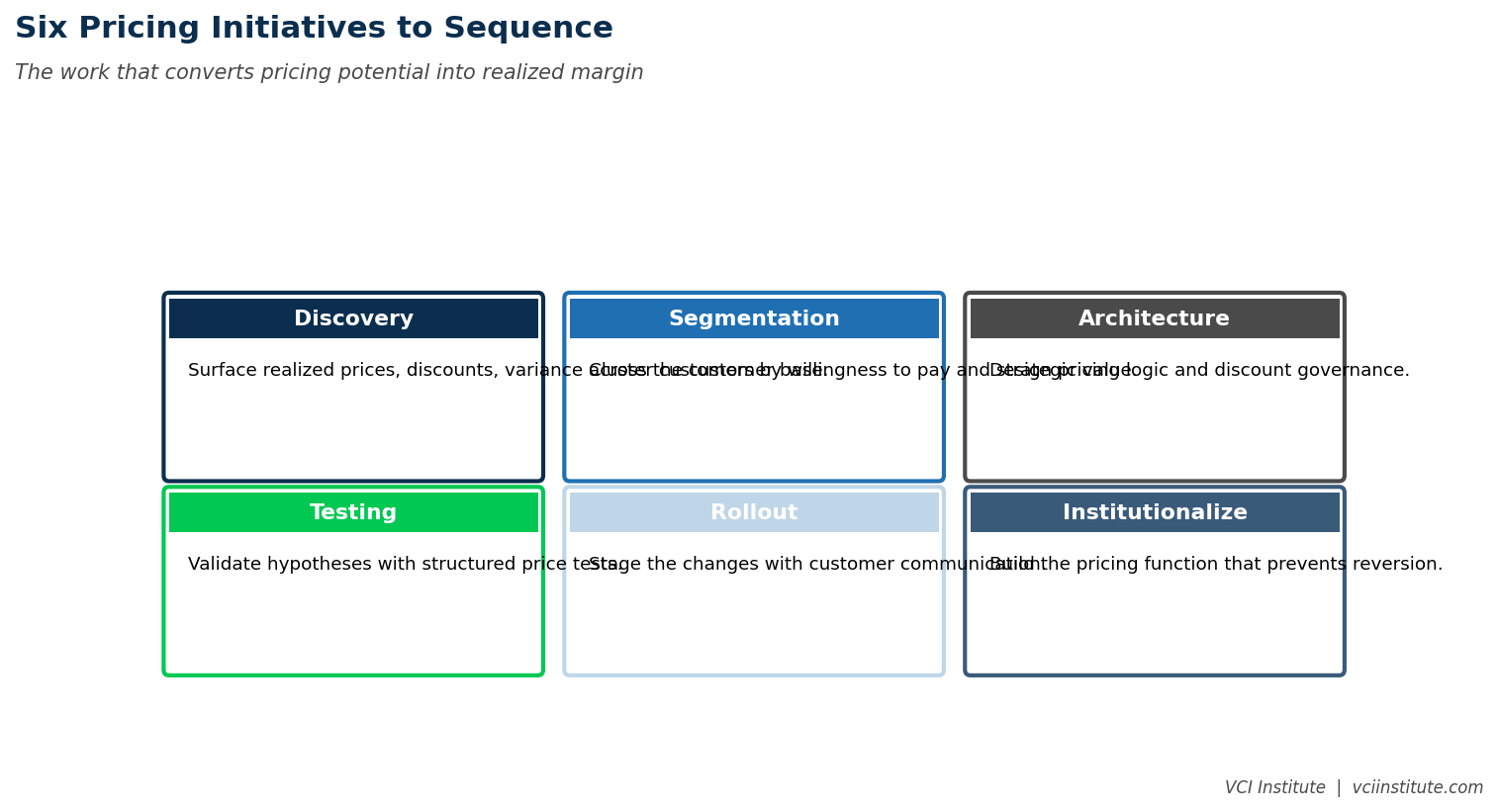
When a portfolio company has genuine pricing power that has not been exercised, a real pricing program is one of the cleanest value creation interventions an operating partner can lead. Three components are essential.
The first component is segmentation analysis. Customers do not all have the same price sensitivity. Some customers, in some segments, will absorb significant price increases without disruption. Others will react sharply. The segmentation analysis identifies, by customer cohort, the realistic price increase tolerance. The pricing program is then calibrated to take more price where the tolerance is high and less price where the tolerance is low. This avoids the standard error of pricing programs, which is to apply uniform increases that maximize churn at the price sensitive end of the customer base while leaving value uncaptured at the price tolerant end.
The second component is the implementation strategy. How are increases communicated. When are they implemented. What concessions, if any, are offered. The implementation matters substantially. Increases communicated with adequate notice, justified with reference to value rather than cost, and implemented with grace usually produce less churn than increases communicated abruptly or framed defensively. Operating partners who lead pricing programs often find that the implementation discipline matters as much as the pricing strategy itself.
The third component is the analytics infrastructure that captures actual response. What is the realized price by customer after the increase. What is the volume change. What is the customer response. The data produced by the first phase of the program informs the calibration of subsequent phases. Pricing programs that do not have this analytics layer often capture less value than they should because subsequent decisions are made on intuition rather than evidence. In most mid-market companies this is the binding constraint, and it is worth running a single source of truth audit before building the pricing dashboard rather than after.
Where The Power Compounds
When pricing power is exercised systematically over a hold period, the compounding effect is significant. Most businesses can take some additional pricing each year without substantial volume loss. The increases compound. Three years of disciplined pricing programs typically produce ten to twenty percent of cumulative price gain, depending on the starting position and the underlying pricing power.
The margin impact is roughly proportional to the price gain, because variable costs typically do not increase in proportion to price. The EBITDA impact is therefore substantial. On a business with twenty percent EBITDA margin and ten percent cumulative price gain, the EBITDA improvement is approximately fifty percent of the original EBITDA. The enterprise value impact at exit, assuming similar multiples, is approximately fifty percent on the EBITDA base attributable to pricing alone.
This calculation, applied honestly, makes pricing the largest single value creation lever in many businesses. It is also the lever that requires the least capital and the shortest payback. Yet it is consistently underweighted relative to other initiatives that absorb more management attention and produce smaller returns.
The Discipline Question
If pricing power is so valuable, why is it not the central focus of more private equity value creation plans. The answer is that it requires a discipline that many firms do not have.
Pricing programs require sustained management attention over multiple cycles. They produce pushback from sales teams who carry the customer relationship anxiety. They produce occasional customer departures that look bad in the moment even when they are net positive in aggregate. They require analytics infrastructure that mid-market companies often do not have. They require management willingness to accept some short term volume disruption in exchange for medium term margin gain.
Operating partners who lead pricing programs successfully invest in the discipline rather than treating pricing as a tactical adjustment. They build the segmentation analysis. They train the sales team to defend pricing rather than discount in response. They install analytics that surface realized price discipline at the rep and customer level. They report pricing as a board level metric. They make pricing a continuing operating discipline rather than an episodic initiative.
Whether the company can absorb that discipline at all is a separate question, and one worth answering first. An operating maturity diagnostic will usually tell you whether the pricing program is a twelve month project or a thirty month one.
Done this way, pricing programs deliver value year after year, with each year's gain compounding the prior years' gains. The cumulative effect by exit is among the largest single contributions to the value creation case.
Done casually, with periodic increases that are not analyzed and not sustained, pricing produces some value but far less than the actual power of the business would support. The gap between the two outcomes is the operating discipline applied to a lever that the business already has the underlying power to support.
The Question Worth Asking
The next time a portfolio company board reviews the value creation plan, ask one question. What pricing program have we run, what was the realized price gain, what was the customer response, and what does the program look like in the next twelve months. If the answer is comprehensive, with specific numbers and a clear program structure, the company is capturing the lever. If the answer is a vague reference to recent price increases without supporting data, the lever is being underexercised, and significant value is being left in the business that could be captured with relatively modest operating discipline.
Most portfolio companies fall in the second category. The opportunity is large. The capability to capture it is not exotic. The discipline to install it is what separates the firms that consistently lead in pricing performance from the firms that talk about pricing but do not run it as the structured value creation program it deserves to be.
VCI Institute in collaboration with Mohamad Chahine
Published 17 August 2026
Related reading from the VCI Institute
Customer Concentration Theatre
How diligence reports disguise the real risk, and which accounts can actually absorb a price move.
The Digital EBITDA Bridge
Pricing technology investments into enterprise value, and defending the number at IC.
The Operating Maturity Index
A diagnostic to run before you intervene, so the program matches what the company can absorb.
About the VCI Institute
The VCI Institute is a nonprofit dedicated to building practical capability and shared standards for value creation in private equity. The Institute publishes operator-grade frameworks and runs certification programs for operating partners, portfolio company CEOs, and value creation analysts, including COPPE and CVCA. Analysis published here draws on the Institute's certification curricula and on structured review of mid-market transaction patterns rather than on any single proprietary dataset. Where a figure is directional rather than measured, it is described as such.
Further material is available in the Institute's Insights library and its free resource library of templates, checklists, and case snapshots.
© 2026 VCI Institute. All rights reserved. No part of this article may be reproduced or transmitted in any form without prior written permission of the VCI Institute.
We have many great affordable courses waiting for you!
Stay connected with news and updates!
Join our mailing list to receive the latest news and updates from our team.
Don't worry, your information will not be shared.
We hate SPAM. We will never sell your information, for any reason.


 Practice private equity like a pilot trains