The Operating Maturity Index: A Diagnostic Before You Intervene
Jun 22, 2026
Most operating partners intervene before they diagnose. They arrive at a portfolio company with a playbook in their head, a set of standard interventions they have run successfully before, and a presumption that the new business is broadly similar to the last business. They install their standard governance structure. They roll out their standard reporting template. They run their standard hundred day plan. By month three, they discover that some of their interventions are working, some are doing nothing, and some are actively hurting a business that did not need them.
The short answer
Score the business on five dimensions before choosing a single intervention: commercial, financial, operational, technology, and talent maturity. The shape of the pattern matters more than any individual score. Three shapes recur. The founder business is commercially strong and infrastructurally thin, and breaks if you add process first. The corporate carve-out has inherited infrastructure and no commercial engine, and breaks if you strip the infrastructure. The rolled-up platform is inconsistent across acquired entities and needs coherence before optimisation. Two weeks of diagnostic saves the sixty days most sponsors spend running the wrong intervention and the political capital they spend restarting.
The error is structural. Operating partners spend much of their career executing interventions, which is what they are paid to do. They spend almost none of it diagnosing the maturity of the business they are about to operate on. The diagnostic exists implicitly, in the operating partner's head, as a sense of what is broken. It rarely exists explicitly, as a written assessment that the deal team and the management team can engage with.
The cost of skipping the diagnostic is the cost of the wrong intervention. Adding governance to a business that needed acceleration. Adding rigor to a business that needed simplification. Adding talent in a function that needed structural redesign rather than additional headcount. Each of these errors burns three to six months of value creation runway and produces conflict between the operating function and the management team that did not know what was coming.
The Five Dimensions of Operating Maturity
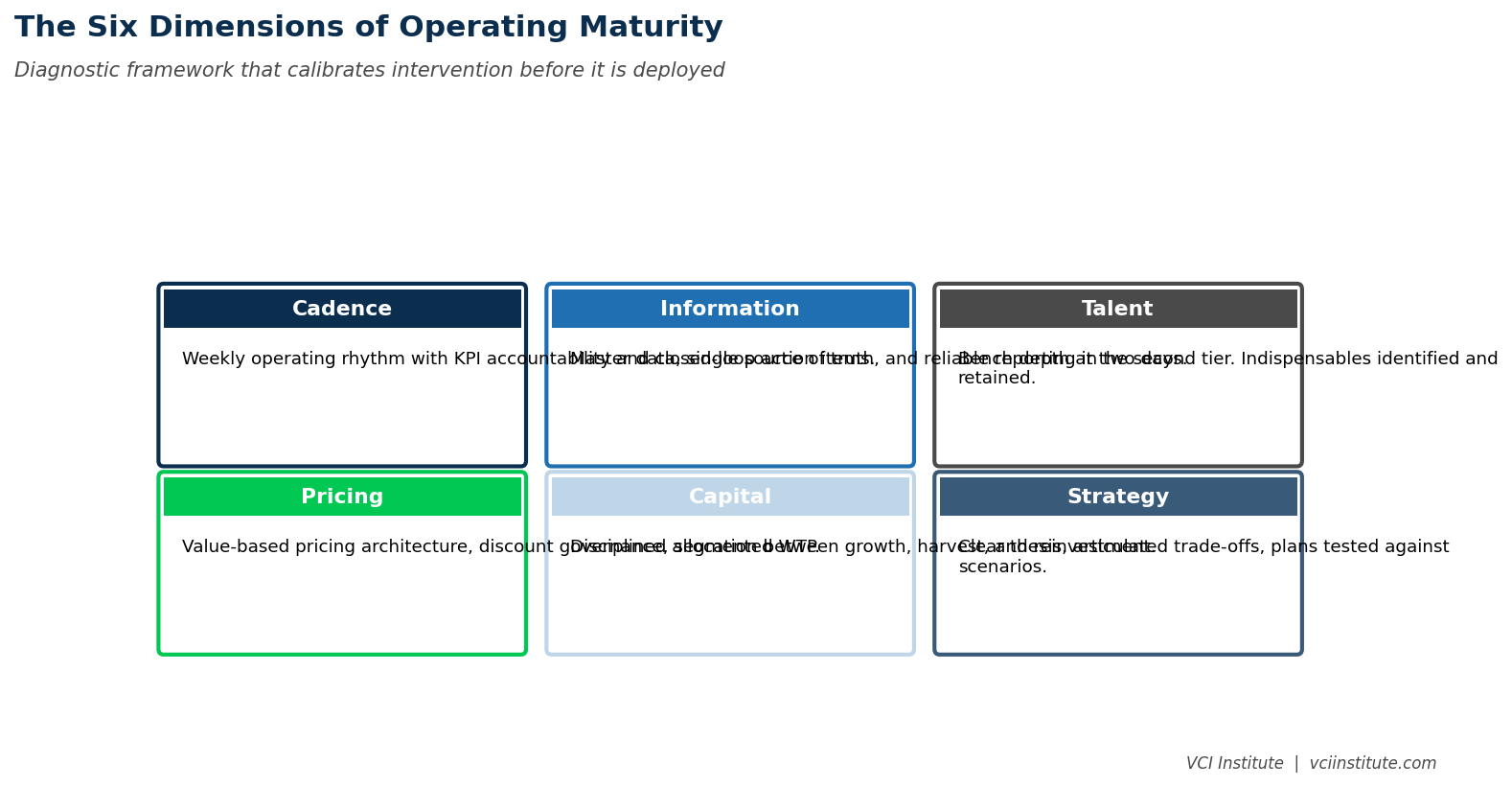
A practical operating maturity index covers five dimensions. Each one can be assessed quickly, scored on a simple scale, and used to calibrate the intervention plan. None of them are deeply original. The discipline is in using them systematically rather than relying on intuition.
The first dimension is commercial maturity. Does the business have a documented sales process. Are pipeline stages defined and consistently used. Is there meaningful sales productivity data by rep and by segment. Are conversion rates measured and reported. A commercially immature business runs sales as personal relationships and ad hoc effort. A mature business runs sales as a process with measurable inputs and outputs. The intervention required for one is fundamentally different from the intervention required for the other.
The second dimension is financial maturity. Does the business close its books on a predictable monthly cadence. Are budgets and forecasts used as operating tools rather than as compliance documents. Is there meaningful variance analysis. Is working capital actively managed. A financially immature business runs on a basic accounting system and a CFO who is mostly a controller. A mature business runs on integrated planning, regular forecasting, and working capital discipline. Whether that gap is closed by developing the incumbent or replacing them is a separate judgement, worked through in the CFO upgrade question.
The third dimension is operational maturity. Does the business have documented core processes. Are KPIs defined and tracked at the workstream level. Is there a continuous improvement function. Is capacity planned in advance of demand. An operationally immature business firefights every day. A mature business has codified its operations to the point where most days are predictable and exceptions are flagged early.
The fourth dimension is technology maturity. Does the business run on a coherent set of integrated systems, or on a sprawl of legacy tools, spreadsheets, and shadow IT. Is there a CTO or CIO with strategic authority. Are data flows automated where they should be. A technologically immature business is one where most management attention is consumed by reconciling systems that do not talk to each other. A mature business is one where the systems are largely invisible because they are working. The fastest read on this dimension is to ask three functions for the same number and compare the answers, which is the single source of truth audit in its compressed form.
The fifth dimension is talent maturity. Is the second tier of management actually capable of running their functions, or is the founder still doing most of the operational work. Is succession planning explicit. Are hiring and development processes serious. Is performance managed systematically. A talent immature business depends on a small number of irreplaceable people. A mature business has built bench depth and is no longer a single point of failure. Identifying exactly who those irreplaceable people are, before anything is reorganised around them, is the exercise in the post-close talent density map.
How to Score the Dimensions
The scoring matters less than the discipline of doing it. A simple five point scale works well. One indicates basic existence of the function. Three indicates a competent professional baseline. Five indicates institutional excellence. Most mid-market businesses score between two and three on most dimensions when they enter a private equity portfolio. The pattern of strengths and weaknesses across dimensions is what shapes the intervention plan.
The scoring conversation should involve the operating partner, the deal team, and the management team. Each side has visibility into different dimensions. The deal team often has the cleanest read on financial maturity from diligence. The operating partner often has the cleanest read on commercial and operational maturity from initial conversations with the second tier. The management team has the cleanest read on talent and technology maturity, because they live with both daily.
The disagreements are productive. When the deal team scores commercial maturity at four and the operating partner scores it at two, the conversation that follows reveals which signals each was reading. Usually, the deal team was reading top line growth and inferring commercial discipline. The operating partner was reading process gaps and inferring commercial fragility. Both can be true. The combination produces a more accurate picture than either view in isolation.
That disagreement is more useful before signing than after. A structured operating read that can actually change the terms, rather than one that arrives as a fait accompli in week one, is the argument in the pre-close operating veto.
What the Pattern Tells You
The shape of the maturity pattern is more important than any individual score. Three patterns appear repeatedly.
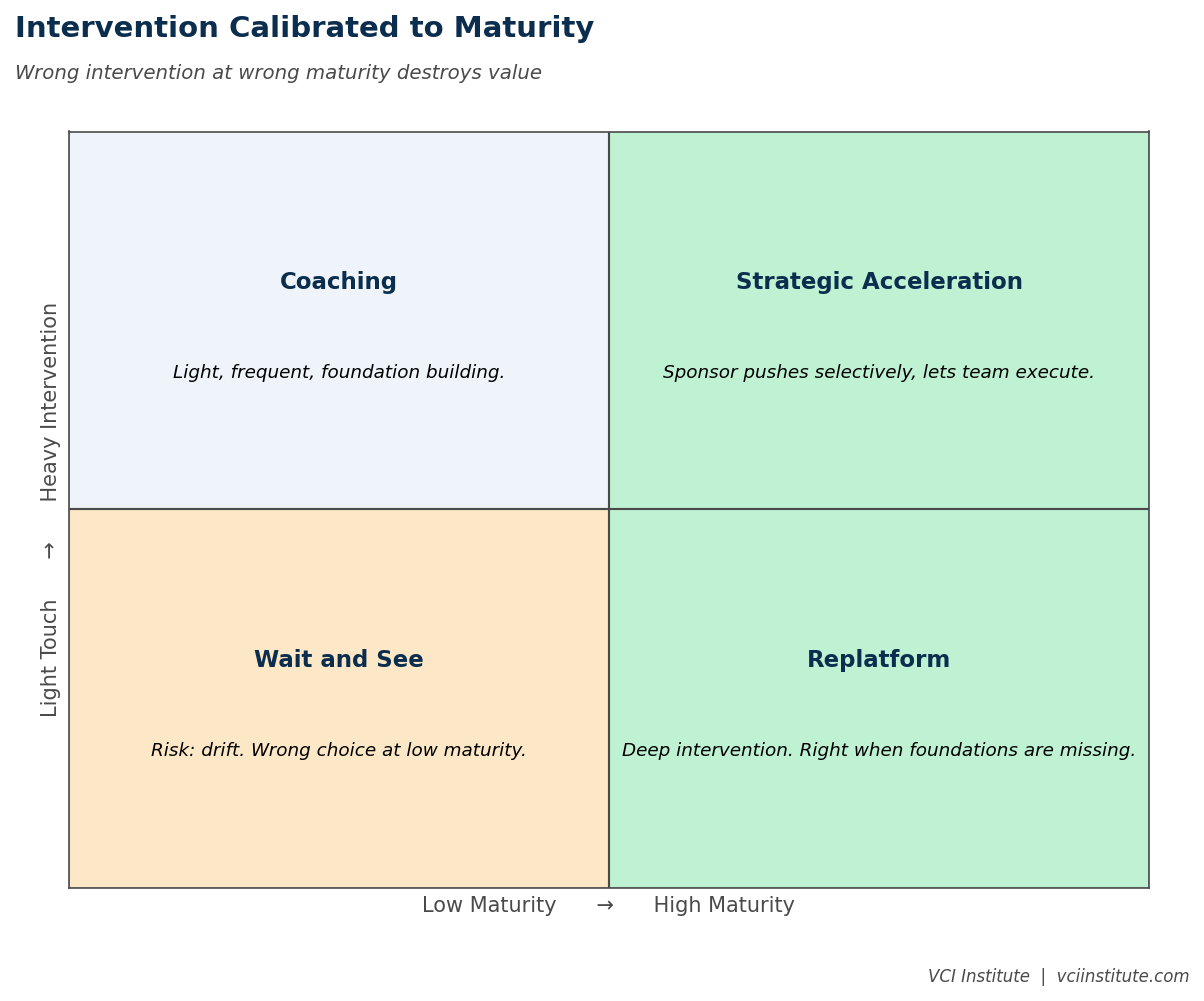
The first pattern is the founder business profile. High commercial maturity, low operational maturity, low financial maturity, low technology maturity, and high but concentrated talent maturity. This profile says the business has been driven by founder energy and personal customer relationships. The intervention plan needs to focus on building infrastructure underneath the existing commercial engine, while protecting the engine itself from process damage. This is the profile most likely to produce the founder speed tax if mishandled.
The second pattern is the corporate carve out profile. High financial maturity, high technology maturity, moderate operational maturity, low commercial maturity, and moderate talent maturity with significant gaps. This profile says the business inherited corporate infrastructure but never had to compete on its own. The intervention plan needs to focus on building commercial engine and entrepreneurial culture, while preserving the infrastructure inherited from the parent. The risk here is the opposite of the founder business risk. Operating partners with founder business instincts often dismantle infrastructure that the carve out actually needs. The wider set of ways this deal type disappoints is set out in the carve-out underperformance pattern.
The third pattern is the rolled up platform profile. Inconsistent maturity across dimensions and across acquired entities. Some parts of the business are professionally managed, others are still running as they did before acquisition. Common processes, definitions, and systems are missing. The intervention plan needs to focus on integration rather than improvement. The first eighteen months should produce coherence across the platform. Performance optimization comes after coherence. Operating partners who try to optimize before integrating produce noise that the management team cannot interpret.
These three patterns cover most of the mid-market private equity portfolio. Each one calls for a different sequencing of interventions, a different cadence of governance, and a different set of capabilities from the operating partner.
Why Most Sponsors Skip This
Private equity firms skip the maturity diagnostic for the same reasons they skip most diagnostic work. It feels like delay. It does not produce immediate visible action. It requires admitting that the firm does not yet know what it is going to do. The investment committee wants to hear about the plan, not about the assessment that will produce the plan.
The cost of skipping shows up later. The wrong intervention runs for sixty days before someone notices it is not working. The right intervention is then started from scratch, with a management team that has now learned to be skeptical of operating partner initiatives. The hundred day plan is rebuilt against the actual maturity of the business, twelve weeks later than it should have been, with political capital that has been spent. That specific failure sequence is traced in the 100-day autopsy.
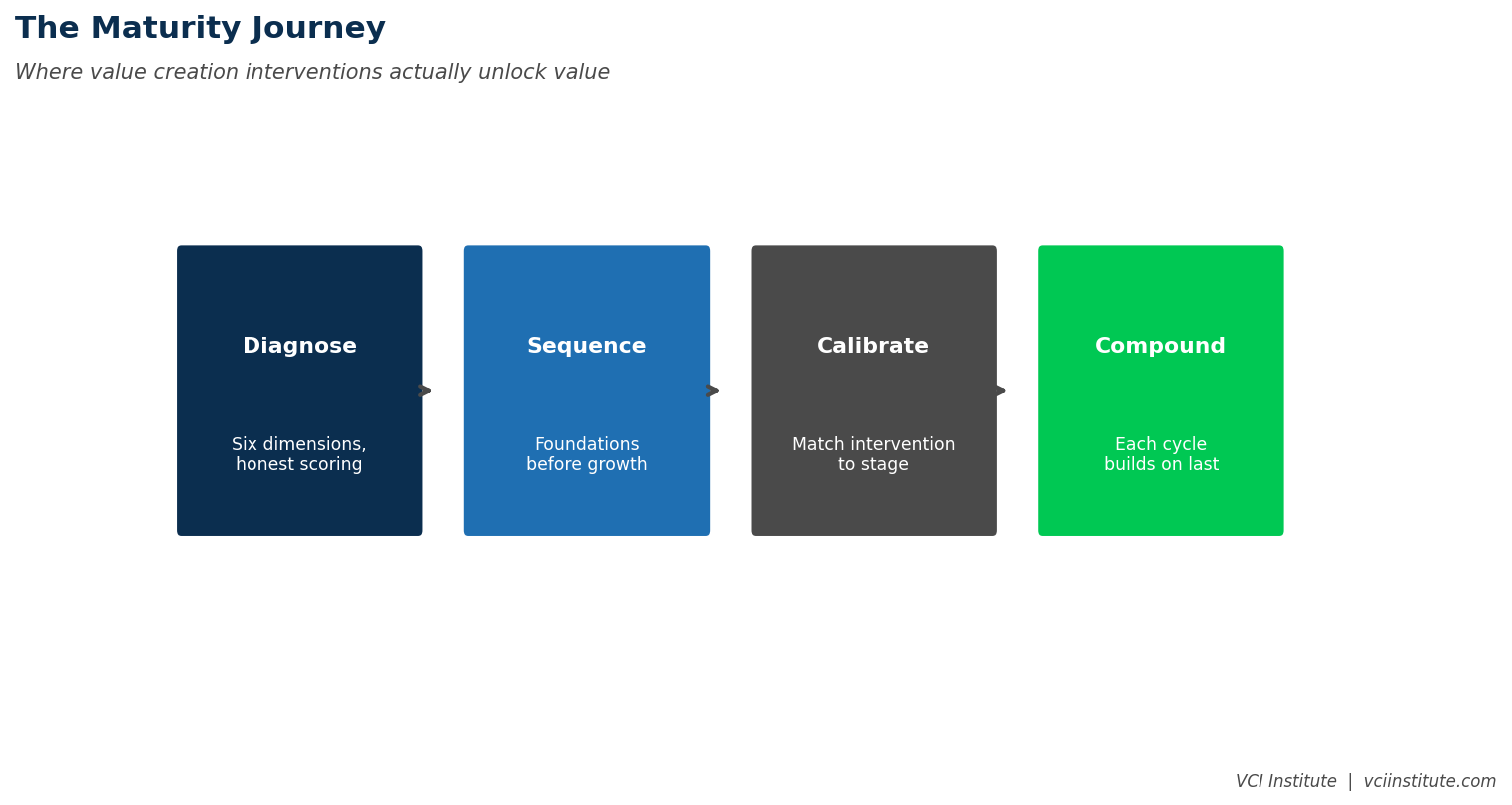
A simple two week diagnostic at the front of the engagement saves this entire cycle. The deliverable is a written maturity assessment, scored across the five dimensions, agreed by the operating partner, the deal partner, and the management team. The intervention plan is then built explicitly off the assessment, with each intervention tied to a specific gap identified in the diagnostic. The conversation with management shifts from why are you imposing this on us to we agreed this is what is needed.
The Compounding Benefit Across the Portfolio
Sponsors who run maturity diagnostics consistently across their portfolio accumulate a benefit that single deals cannot capture. Patterns emerge. Some sectors consistently produce founder business profiles. Some sourcing channels consistently produce carve out profiles. Some acquisition strategies consistently produce rolled up platform profiles. The firm starts to be able to predict, before close, what kind of intervention plan will be required, based on the early signals from sourcing and diligence.
This becomes a real institutional capability. Not just a methodology applied to individual deals. A way of thinking about the portfolio that calibrates investment decisions, deal sourcing, and operating capacity allocation. Firms that do this for several fund cycles develop a level of operating sophistication that shows up in their performance dispersion. Their good deals are similar to everyone else's good deals. Their bad deals are less bad, because the diagnostic prevented at least some of the wrong interventions that turn an underperforming deal into a disaster.
The Day One Discipline
Operating partners who want to install this discipline can do it on their next deal without firmwide infrastructure. The materials are simple. A one page maturity scoring template. A two week diagnostic plan that includes interviews with the management team, observation of operating cadences, review of recent reporting, and conversations with key customers and key employees. A written assessment delivered to the deal partner and the management team in week three. An intervention plan derived from the assessment in week four.
This is unglamorous work. It does not feature in the IC memo. It does not produce a quick win for the sponsor team to celebrate. It does, however, produce intervention plans that survive contact with reality, management teams that engage rather than resist, and value creation outcomes that more reliably match the underwritten case.
The most underrated skill in private equity operations is not the ability to execute. It is the ability to diagnose accurately before executing. The operating partners who develop this skill are the ones who, deal after deal, deliver value creation outcomes that reflect what the business needed rather than what the playbook recommended. They are also, not coincidentally, the ones who tend to be invited back into deals after their original engagement ends. Diagnosis is the discipline that makes execution credible. Skip it, and execution becomes guesswork dressed up as expertise.
VCI Institute in collaboration with Mohamad Chahine
Published 22 June 2026
Related reading from the VCI Institute
The 100-Day Autopsy
What happens when the intervention plan is built before the diagnosis.
The Founder Speed Tax
The specific failure mode of the founder business profile, in detail.
The Pre-Close Operating Veto
Running this read before signing, when it can still change the terms.
About the VCI Institute
The VCI Institute is a nonprofit dedicated to building practical capability and shared standards for value creation in private equity. The Institute publishes operator-grade frameworks and runs certification programs for operating partners, portfolio company CEOs, and value creation analysts, including COPPE and CVCA. Analysis published here draws on the Institute's certification curricula and on structured review of mid-market transaction patterns rather than on any single proprietary dataset. Where a figure is directional rather than measured, it is described as such.
Further material is available in the Institute's Insights library and its free resource library of templates, checklists, and case snapshots.
© 2026 VCI Institute. All rights reserved. The frameworks, terminology, and analysis presented in this article are the intellectual property of the VCI Institute. Reproduction or derivative use without written permission is prohibited. Citation with proper attribution is welcomed.
We have many great affordable courses waiting for you!
Stay connected with news and updates!
Join our mailing list to receive the latest news and updates from our team.
Don't worry, your information will not be shared.
We hate SPAM. We will never sell your information, for any reason.


 Practice private equity like a pilot trains