The Founder Speed Tax: When Professionalization Kills the Business You Bought
Jun 18, 2026
Private equity has a recurring blind spot. It pays a premium for founder-led businesses because they grow faster, decide faster, and convert customers faster than their corporate equivalents. Then it spends the first year of ownership systematically dismantling the operating mechanisms that made the business attractive in the first place.
The short answer
Sponsors pay a premium for founder businesses because of operating tempo, then install a governance template that removes it. The tax does not appear in any line item. It accumulates across hundreds of decisions that each take twice as long as they used to. The calibration test is to ask, of every new process, what speed cost it imposes. Reporting, master data, and month-end close have low speed cost and should go first. Approval matrices, planning cycles, and layered customer service have high speed cost and should wait until the business has genuinely outgrown its current model. Customers notice first, employees second, the market third, and by then the deal is eighteen months in.
We call this the founder speed tax. It is the cumulative cost of replacing founder instinct with process theatre. The tax shows up in every dimension that mattered to the original investment thesis. Decision speed slows. Customer responsiveness fades. Sales velocity drops. Innovation cycles lengthen. By the time the new operating model is fully installed, the business has acquired the operating tempo of an early stage corporate, and the buyer is wondering why the growth rate is no longer what it was at signing.
This is not because professionalization is wrong. It is because professionalization done badly extracts more value than it creates.
What Founders Actually Do Differently
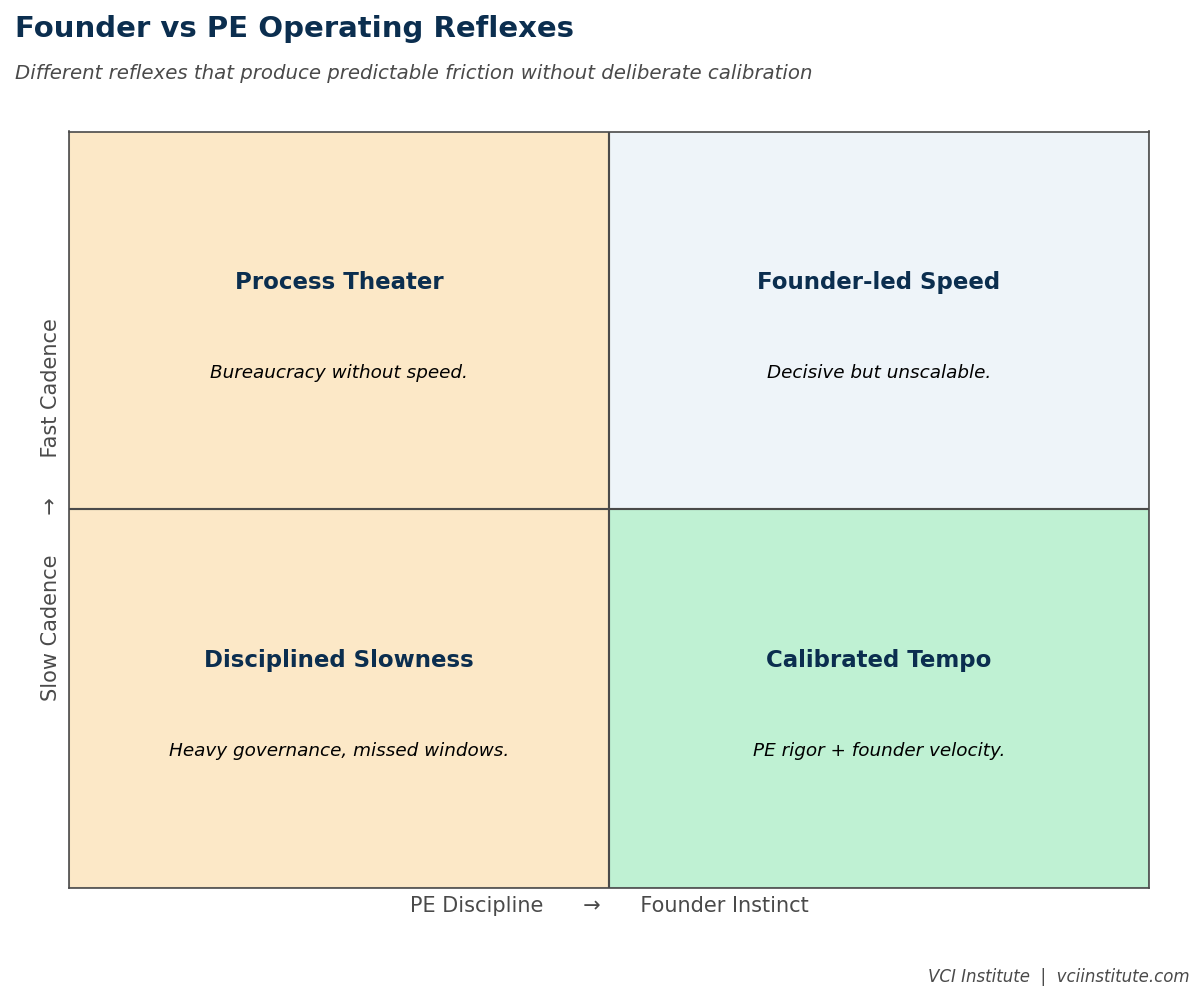
To understand the speed tax, it helps to be precise about what founders do that professional managers often do not. The cliche is that founders are entrepreneurial and managers are bureaucratic. That is not quite right. The actual difference is structural.
Founders carry full context in their head. They know the customers personally. They know the people. They know which numbers matter and which numbers are noise. They know which problems will resolve themselves and which problems are existential. This context lets them make decisions in seconds that a professional manager would need a meeting and a deck to make. The decisions are not always right, but they are made fast enough that the business can adjust quickly when they turn out to be wrong.
Founders also have personal authority. When they decide something, the team knows the decision is final. There is no committee to convene, no consensus to build, no political coalition to maintain. This collapses the time between idea and action in ways that professional governance models structurally cannot match.
Founders finally have skin in the game in a visceral way. The business is their identity. They will work weekends to fix what is broken. They will personally call a customer who is unhappy. They will overrule a department head who is being slow. The energy that founders put into their businesses is qualitatively different from the energy a professional manager puts into a job, and it shows up in operating tempo.
There is a cost side to this that the sponsor is right to notice. Context held in one person's head is not documented anywhere, which makes the business fragile in exactly the way described in the post-close talent density map. The founder is frequently all three indispensable archetypes at once. The correct response is to build redundancy around that dependency, not to eliminate the person creating it.
What Professionalization Adds, And What It Subtracts
When private equity buys a founder business, it usually arrives with a thesis about professionalization. The business needs better systems, better reporting, better governance, better controls, and better second tier management. All of these things are usually true. The business probably does need them.
The problem is not the additions. The problem is what gets subtracted in the process.
The new committee structure removes the founder's personal authority over decisions. The new approval thresholds slow down spending decisions that used to happen in conversation. The new reporting cadence consumes management bandwidth that used to be spent on customer issues. The new strategic planning process replaces real time market response with quarterly review cycles. The new HR policies replace direct hiring with recruiting processes that take three times as long to fill a seat.
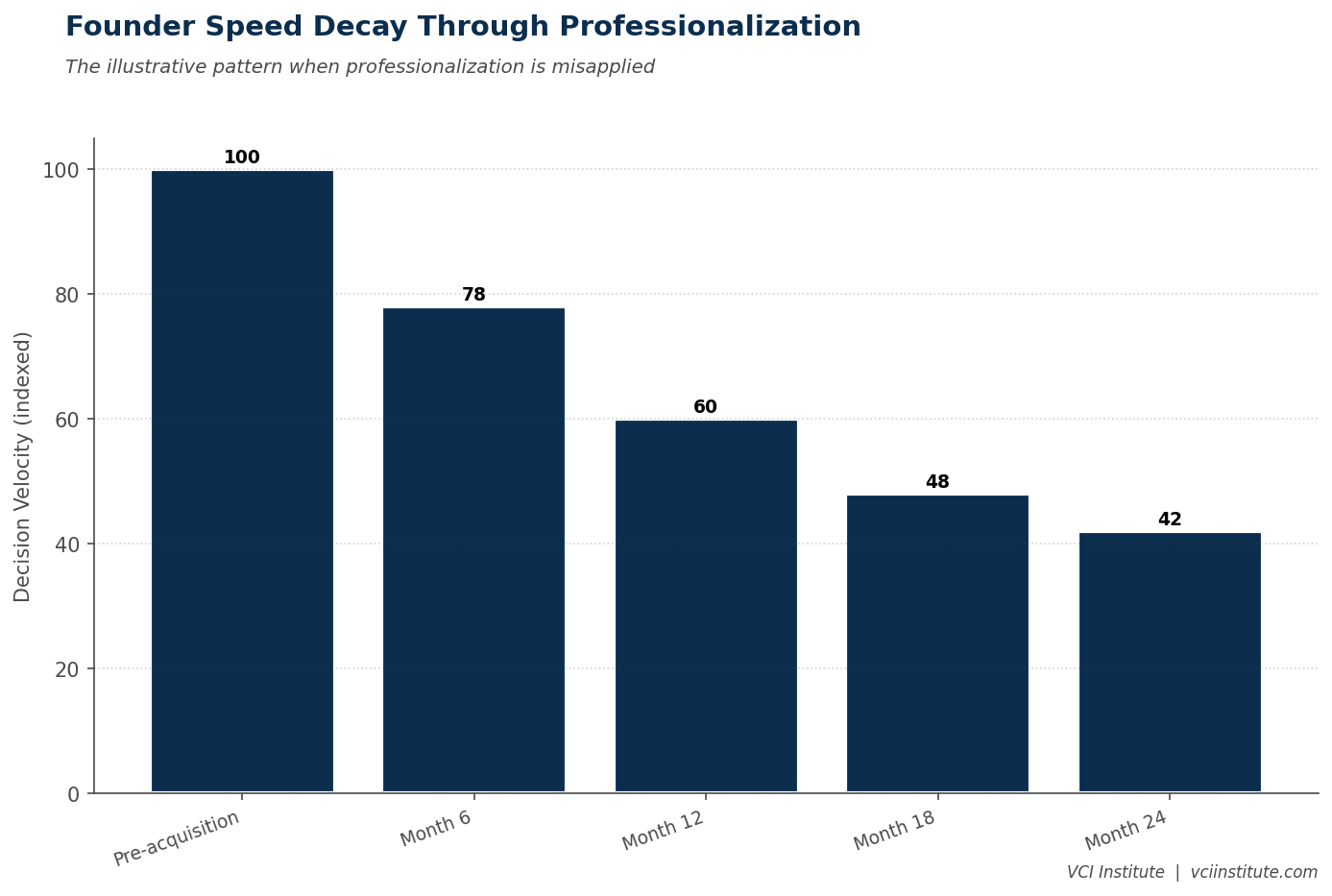
Each individual addition is sensible. The cumulative effect, in too many cases, is that the business loses three to five months of operating tempo per year. Decisions that used to happen on Monday now happen on Wednesday. Hiring that used to take three weeks now takes ten. Pricing changes that used to happen in real time now require a quarterly committee. Customer issues that used to be resolved by the founder personally now route through a service organization that does not yet have the authority to act.
This is the speed tax. It does not appear in any single line item. It accumulates across hundreds of small decisions, each one slower than it would have been before, each one slightly less responsive to what the business actually needs in the moment. In commercial functions the cost is directly measurable, because response time converts to revenue on a known curve, which is the argument in speed-to-lead economics.
When the Tax Becomes Material
The tax becomes material when it crosses a threshold where customers, employees, and the market begin to notice. Customers notice first. The founder used to take their call. Now they get routed to a customer success representative who needs to consult internally and follow up. The follow up takes two days. The customer's problem could have been solved in two minutes. They notice. They tell other customers.
Employees notice second. The high performers who joined a founder business expecting fast moving, low bureaucracy environments find themselves in monthly reviews and quarterly planning cycles. The decisions they used to make personally now require approvals from people who do not understand the business as well as they do. They start updating their LinkedIn profiles. The good ones leave first.
The market notices third. The growth rate that justified the entry multiple was a function of operating tempo. As tempo slows, growth slows. The pipeline conversion rate, which depended on speed, drops. New product introductions, which depended on rapid iteration, take longer. By the time the market notices, the deal is twelve to eighteen months in, and the operating partner is trying to explain to the deal partner why the underwritten growth case is no longer realistic.
The Calibration Problem
The fix is not to skip professionalization. Founder businesses do genuinely need better systems and stronger governance. The fix is to calibrate which professionalization adds value and which subtracts it.
A useful test is to ask, for any new process being introduced, what speed cost it will impose on the business. Some processes have low speed cost. Better financial reporting. Cleaner master data. More rigorous month end close. These add capability without slowing decision making.
Other processes have high speed cost. Multi step approval matrices for spending decisions. Strategic planning cycles that consume management bandwidth without producing operational change. Recruiting processes that filter for credentials over capability. Customer service organizations that interpose layers between the customer and the people who can actually fix the problem.
A disciplined operating partner introduces the low cost processes early and resists the high cost ones until the business has clearly outgrown its existing model. The decision matrix is not what does our portfolio playbook say to install. The decision matrix is what does this specific business need, given its current operating tempo and growth trajectory. Establishing that baseline before the first intervention is the purpose of the operating maturity index, and the founder business profile it identifies is precisely the one most exposed to this tax.
This requires resisting the institutional pull of the playbook. Most private equity firms have a default professionalization template. Same governance committees. Same reporting structures. Same approval thresholds. The template is comfortable because it is consistent across the portfolio. It is also, in many cases, value destructive when applied to founder businesses that are still in their high growth phase.
What Founders Need from Sponsors
Founders who sell to private equity make a specific trade. They give up control in exchange for capital and partnership. They expect, often correctly, that the partnership will help them professionalize without crippling the business. When the partnership delivers crippling professionalization instead, the founder either fights it, which produces conflict, or stops caring, which produces drift. Neither outcome serves the value creation plan.
Sponsors who handle founder businesses well do three things differently.
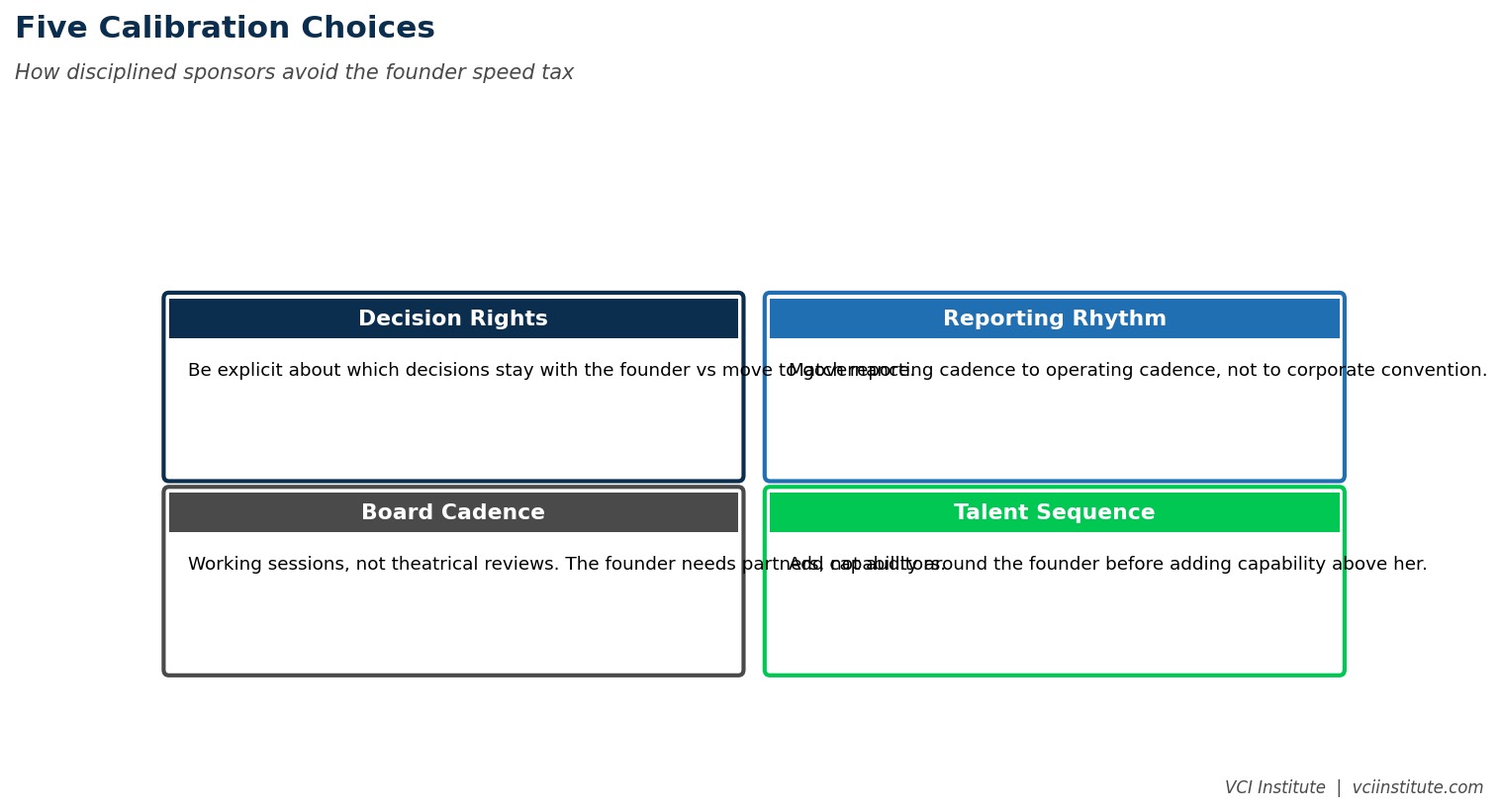
They preserve the founder's personal authority over the decisions where speed matters most. Customer escalations. Strategic pivots. Talent decisions in the top tier. Pricing decisions in fast moving segments. The founder retains the ability to act without committee. The committee structure exists for the decisions where deliberation adds value, not for every decision in the business. Which decisions fall on which side of that line should be written down rather than discovered through conflict, which is the case made in the operating partner and CEO compact.
They invest in the founder's capacity rather than replacing it. Coaching. Strategic advisory. Functional support that lets the founder focus on what only the founder can do. The business learns to run without the founder for the things that should not require founder attention, while preserving the founder's involvement for the things that should.
They sequence professionalization deliberately. Not everything in year one. Reporting and financial controls go first because they carry low speed cost. Governance and committee structures come later, after the business has been instrumented to support them, and only at the level the business genuinely requires. The temptation to install the full institutional template at close is resisted in favor of a phased model that preserves operating tempo while building capability.
The Quiet Test
The simplest test of whether the speed tax is being well managed is to ask the founder a question, twelve months into ownership, and listen carefully to the answer. The question is, are you able to run the business the way you used to. If the answer is yes but with better support, the partnership is working. If the answer involves a long pause and then a careful description of all the new processes, the speed tax has begun to accumulate.
A second useful test is to ask the management team beneath the founder the same question. Are you able to do your jobs the way you used to. The honest answer reveals whether professionalization has been calibrated to the business or imposed against it.
A third test is to look at decision velocity directly. Pick three decisions the business made in the past six months. Trace how long each one took from initial recognition to action. Compare to the equivalent decision the business would have made before close. If the time has tripled, the speed tax is real. If the time has doubled with no offsetting quality improvement, the speed tax is real. If the time has roughly held while quality has improved, the partnership has earned its keep.
The Bigger Pattern
The deepest version of this problem is not about specific processes. It is about whether private equity firms understand what they actually bought when they bought a founder business. The premium they paid was for the operating tempo, the customer responsiveness, the speed of iteration, and the personal authority that come with founder leadership. These things are real assets. They depreciate when mishandled. They cannot be reconstituted by adding back authority after it has been delegated to a committee.
The most successful sponsors of founder businesses understand this and build their operating model around preserving what they bought. They add capability without subtracting tempo. They build infrastructure without dismantling the operating instincts that drive the business. They become partners to the founder rather than supervisors of the founder. The result, two to three years in, is a business that has retained its growth profile while accumulating the institutional capability the next phase of growth will require.
The least successful sponsors arrive with a template and apply it. They get a professionalized business. They lose a high growth one. They wonder, three years later, why the exit multiple is lower than the entry multiple, and they explain it to their LPs as market conditions. It is not market conditions. It is the tax they imposed on the business they bought, levied in slow committees and fast departures.
VCI Institute in collaboration with Mohamad Chahine
Published 18 June 2026
Related reading from the VCI Institute
The Operating Maturity Index
How to identify the founder business profile before you start installing anything.
The Three People You Cannot Lose
The individual-level version of the same tax, and how quickly it collects.
The Operating Partner and CEO Compact
Writing down which decisions stay with the founder, before the conflict starts.
About the VCI Institute
The VCI Institute is a nonprofit dedicated to building practical capability and shared standards for value creation in private equity. The Institute publishes operator-grade frameworks and runs certification programs for operating partners, portfolio company CEOs, and value creation analysts, including COPPE and CVCA. Analysis published here draws on the Institute's certification curricula and on structured review of mid-market transaction patterns rather than on any single proprietary dataset. Where a figure is directional rather than measured, it is described as such.
Further material is available in the Institute's Insights library and its free resource library of templates, checklists, and case snapshots.
© 2026 VCI Institute. All rights reserved. The frameworks, terminology, and analysis presented in this article are the intellectual property of the VCI Institute. Reproduction or derivative use without written permission is prohibited. Citation with proper attribution is welcomed.
We have many great affordable courses waiting for you!
Stay connected with news and updates!
Join our mailing list to receive the latest news and updates from our team.
Don't worry, your information will not be shared.
We hate SPAM. We will never sell your information, for any reason.


 Practice private equity like a pilot trains