
The CFO Upgrade Question: When the Person Who Got You Here Is Not the One Who Gets You There
Aug 20, 2026
The first major talent decision in most private equity deals is what to do about the CFO. The decision is not always conscious. It is sometimes triggered by a clear signal from the management team that the existing CFO is not up to the new ownership reality. It is sometimes deferred until month six or eight, by which point the gap between what the role requires and what the incumbent delivers has become impossible to ignore. It is sometimes avoided entirely, with the operating partner working around the existing CFO rather than addressing the underlying mismatch.
The avoidance is the most common and the most expensive of the three. A CFO who was effective for the prior owner is not necessarily effective for a private equity owner. The reporting requirements are different. The cadence is different. The strategic role is different. The relationship with the lender is different. The participation in deal making is different. A CFO who was the best person available to a founder owner running a closely held business may struggle when the same role is reframed as deal team partner, lender liaison, board reporting authority, exit preparation lead, and operating partner counterpart, all at once.
The short answer
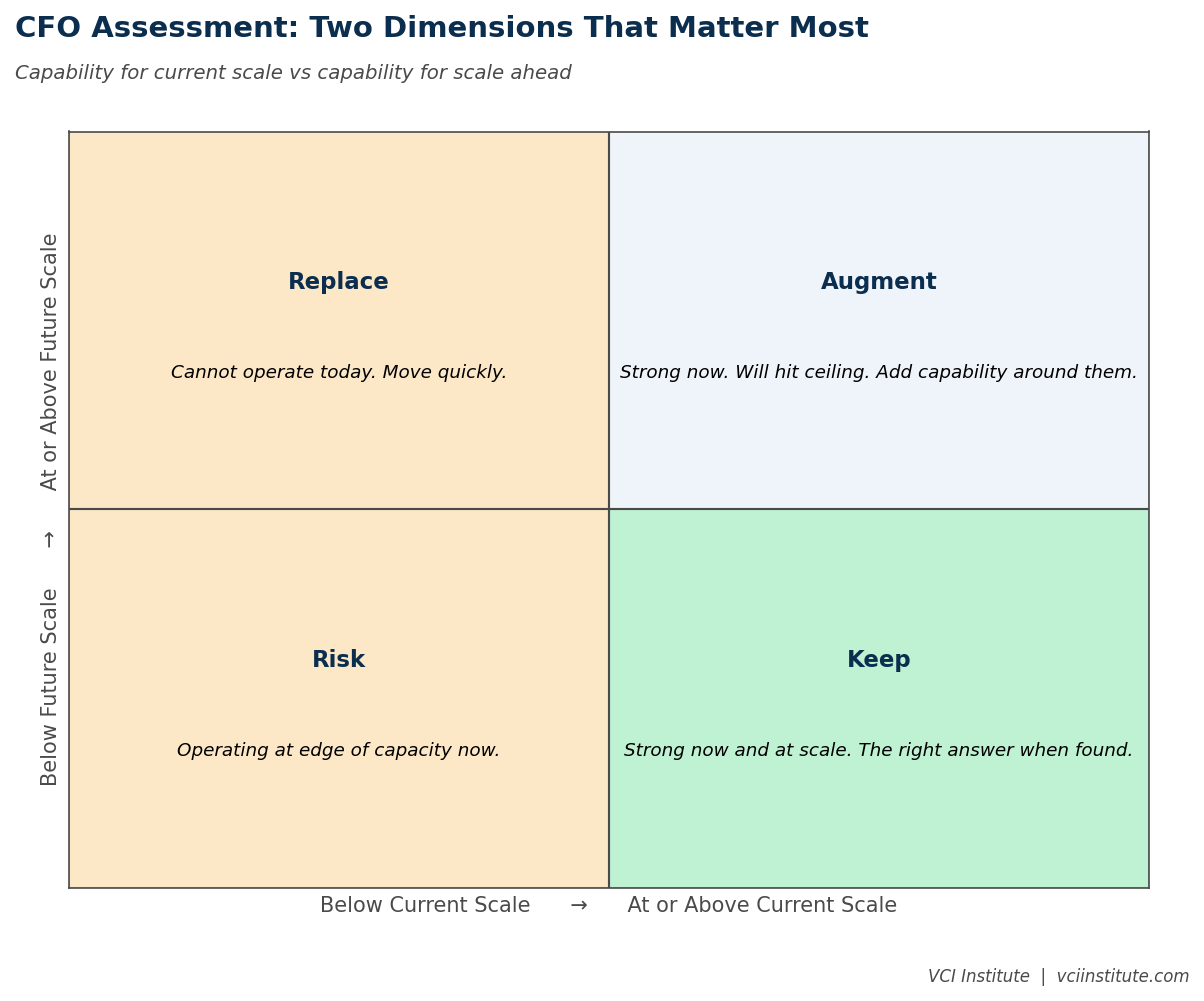
The private equity CFO role now requires five capabilities: reporting maturity, FP and A as an operating discipline, capital markets fluency, M and A engagement, and exit preparation. Most CFOs at acquisition have two or three. There are three responses, invest, augment, or replace, and the failure mode is almost never choosing wrong. It is choosing late. Assess by day sixty, decide by day ninety, execute by day one hundred and twenty.
What the Role Actually Requires Now
The CFO role in a private equity owned mid-market company has expanded substantially over the past decade. Five capabilities are now table stakes for the role, and a CFO who is missing any one of them tends to become a constraint on the value creation plan rather than an enabler.
The first capability is reporting maturity. The ability to produce a clean, predictable monthly close, with variance commentary that is genuinely analytical rather than descriptive. Many CFOs at mid-market companies before private equity acquisition have not been operating at this cadence. The transition is harder than it looks because it requires not just personal capability but also building or directing the team that produces the work. It also requires that the numbers agree with each other across functions, which is why the single source of truth audit usually lands on the CFO's desk whether or not it was assigned there.
The second capability is FP and A as an operational discipline. The ability to use forecasting, planning, and scenario analysis as tools to drive operating decisions, not just as exercises that produce documents for the board. CFOs who treat FP and A as a compliance exercise rather than a strategic capability tend to get out of step with what their CEO and operating partner actually need.
The third capability is capital markets fluency. The ability to engage with lenders, understand covenant structures, manage refinancing processes, and be a credible counterpart to the fund's debt advisory team. CFOs who came up through controllership often find this dimension uncomfortable, and the discomfort shows up in important moments. The instruments themselves have become more varied, and a CFO who cannot hold a conversation about NAV facilities or dividend recapitalisations is a passenger in decisions that shape the equity outcome.
The fourth capability is M and A engagement. The ability to be a working partner in due diligence, integration, and bolt-on execution. M and A heavy strategies require a CFO who can hold the financial discipline of the deal process while also being a constructive partner to the deal team. CFOs who have not done this before tend to either be too cautious or too accommodating, both of which produce friction.
The fifth capability is exit preparation. The ability to ready the company for sale, including the cleaning of financial reporting, the preparation of dataroom materials, the management of buy-side diligence, and the credible articulation of the financial story to potential acquirers. This dimension only matters in the last twelve to eighteen months of the hold, but when it matters, it matters intensely. It is also the phase where the CFO's work is read most adversarially, because the buyer on the other side is reading the CIM between the lines.
A CFO who has all five is a strong fit for the role. Most CFOs at acquisition have two or three. The question is whether the missing capabilities can be developed in the time available, or whether the upgrade decision needs to be made.
The Three Paths
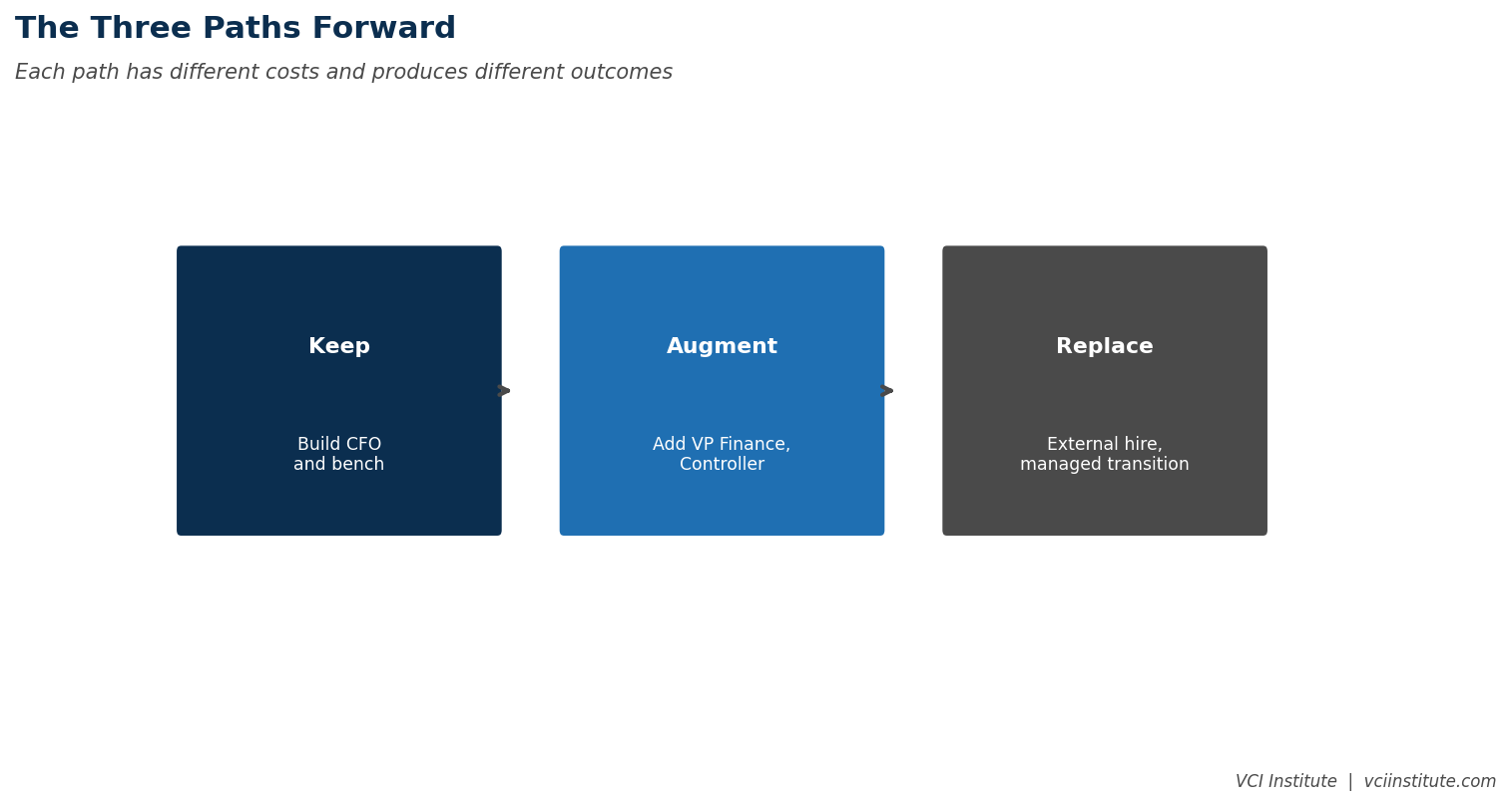
When the gap between what the role requires and what the incumbent delivers is identified, the sponsor has three paths.
The first path is investment. Develop the existing CFO into the role. Provide coaching, training, and exposure that builds the missing capabilities. Pair the CFO with senior advisors who can backstop weaker areas while development occurs. This path works when the CFO is genuinely capable, willing to grow, and the gap is in skill rather than in fundamental fit. It typically requires twelve to eighteen months and produces a CFO who has earned the role through development rather than been replaced for not having it.
The second path is augmentation. Add a senior FP and A leader, a treasurer, a head of M and A, or a deputy CFO who fills the specific gaps the existing CFO has. The existing CFO retains the title and the relationship with the CEO but operates with a stronger team underneath. This path works when the CFO is good at the parts of the role that involve internal financial management but weak at the parts that involve external engagement, or vice versa. It is structurally elegant when it works but can produce ambiguity about who actually owns the role.
The third path is replacement. Bring in a CFO with the full capability set the role requires, transition the existing CFO out with appropriate respect and severance, and accept the disruption that the change creates. This path is the most expensive in the short term but often the most productive over the hold period. It works when the gap is too large to close through development or augmentation, or when the existing CFO is not committed to the new ownership context.
The decision among the three paths should be made deliberately, not by default. Sponsors that default to replacement tend to underestimate the institutional cost of the disruption. Sponsors that default to investment tend to underestimate the time cost of attempting development that does not succeed. Sponsors that default to augmentation tend to create structural ambiguity that becomes a problem later. The right answer is specific to the situation, the CFO, and the trajectory of the business. It also depends on what the organisation around the CFO can currently support, which is what an operating maturity diagnostic is built to surface.
The Timing of the Decision
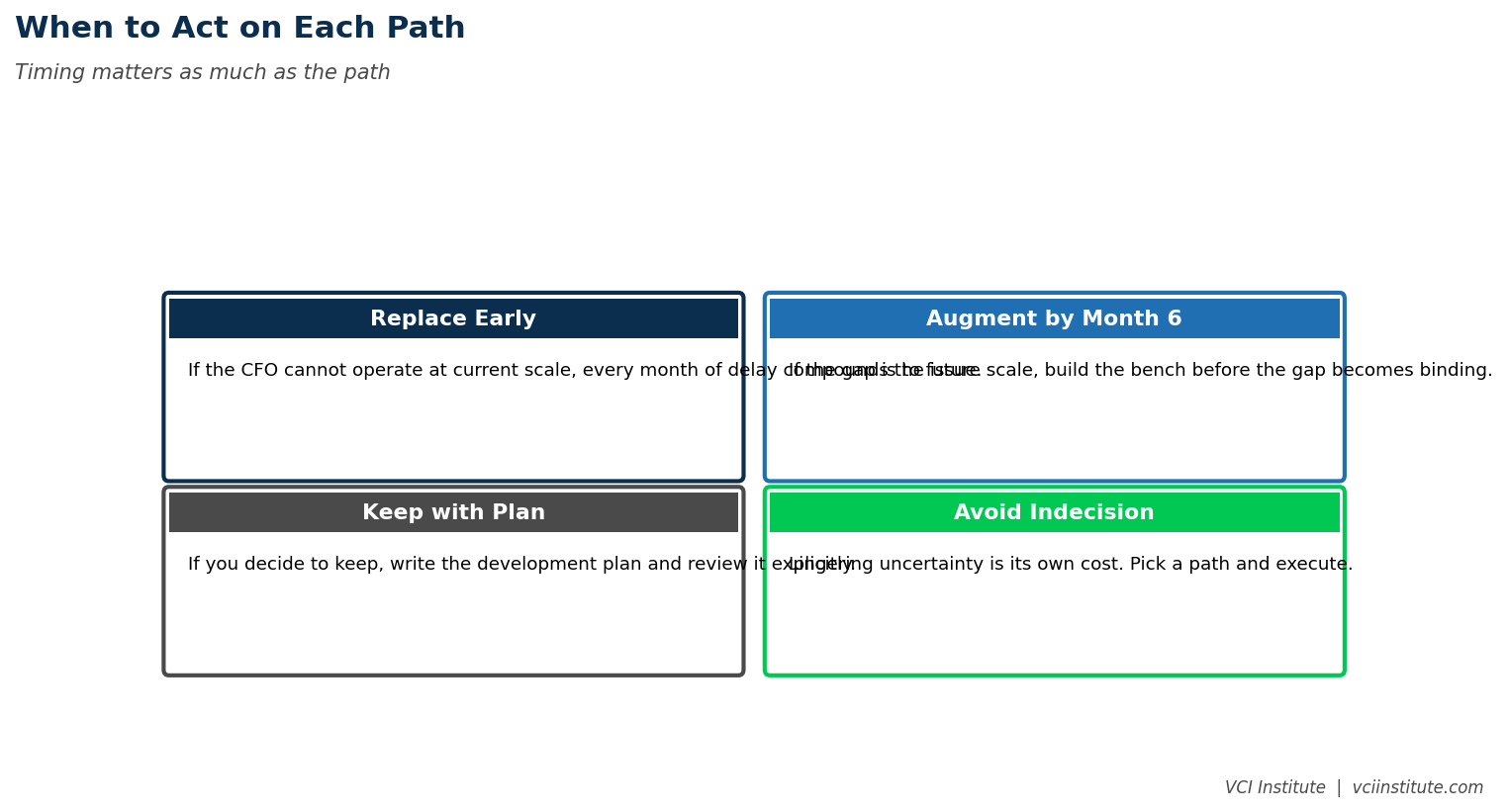
The single biggest mistake sponsors make on the CFO question is timing. The decision is too often deferred, in the hope that the CFO will grow into the role naturally. The hope is rarely realized within the time the value creation plan can absorb. By the time the decision is made, six or nine months have been lost, and the new CFO inherits a position that is now further behind than it was at acquisition.
The discipline is to make the assessment within the first sixty days, make the decision by day ninety, and execute by day one hundred and twenty. Beyond that, the cost of the delay starts to compound, both in the productive work the role is not doing and in the credibility cost when the change finally happens.
The assessment within sixty days does not require dramatic intervention. It requires structured observation. How does the CFO handle the first month-end close under the new owner. How does the CFO engage with the lender during the first refinancing conversation. How does the CFO present to the board, not just on what happened but on what should happen. How does the CFO partner with the operating partner on the value creation plan financial dimensions. How does the CFO engage with their own team. Each interaction provides signal. The aggregate of the signals reveals whether the CFO is a fit, a developable candidate, or a structural mismatch.
The Conversation Most Sponsors Avoid
The most uncomfortable conversation in the CFO upgrade scenario is the one where the operating partner has to be honest with the CFO about the gap. The temptation is to make the change without making the conversation, to manage out the existing CFO through accumulated friction rather than through direct engagement.
This is rarely the right approach, even though it is the easiest. CFOs in mid-market companies often have institutional knowledge, customer and lender relationships, and team loyalty that matter to the business in ways that go beyond their individual capability. Managing them out without honest conversation typically produces collateral damage that the value creation plan absorbs. It is worth checking the post-close talent density map before moving, because the people who leave in sympathy are often more costly than the person who was replaced.
The honest conversation, conducted respectfully and clearly, gives the CFO the chance to either commit to the development required, accept the augmentation that fills the gaps, or transition with dignity into a different role or out of the company. None of these outcomes is comfortable. All of them are better than the alternative of letting the situation drift until the gap becomes operationally visible to the rest of the organization.
Operating partners who handle this conversation well tend to develop reputations that make subsequent CFO recruits easier. CFOs in the market hear about how operating partners treat the people they replace. Sponsors that have a pattern of clean, respectful transitions find that strong CFO candidates are willing to work with them. Sponsors that have a pattern of letting situations drift until they become acrimonious find that their reputation in the CFO market becomes a constraint on their ability to recruit.
The Replacement Profile That Actually Works
When the decision is to replace, the profile that produces the strongest outcomes is more specific than the standard CFO search would suggest.
The candidate has prior experience as CFO of a private equity owned mid-market company at similar scale. The experience does not have to be at exactly the same scale, but the operating cadence and reporting expectations need to be familiar. CFOs coming from much larger companies often struggle with the hands-on dimension of the mid-market role. CFOs coming from much smaller companies often struggle with the reporting and capital markets dimensions.
The candidate has a track record of partnering effectively with deal teams and operating partners, as evidenced by reference conversations rather than by self-reporting. The mid-market private equity CFO role requires a temperament for collaboration with people who have authority but are not the candidate's direct boss. Some technically strong CFOs do not have this temperament, and they tend to underperform regardless of their financial capability.
The candidate has demonstrated capability in at least one full exit cycle. The exit dimension of the role is too important to be learned on the job in a private equity context. CFOs who have run exits successfully tend to make the next one easier. CFOs who have never run an exit tend to need disproportionate support during the most critical phase of the hold.
The candidate has the cultural fit to work with the existing CEO. This dimension is sometimes underweighted because it is harder to assess in interviews. The cost of getting it wrong is the highest of any factor on the list, because a CEO and CFO who do not work well together produce dysfunction that the rest of the organization absorbs. References that include the CEO of the prior owner are more valuable than references that include the prior board.
A candidate who has all four of these features is a strong replacement. A candidate who has three of four can usually be made to work. A candidate who has two of four is a risk that should be mitigated through more rigorous diligence before the hire is made.
The Decision That Reveals the Fund
How a sponsor handles the CFO upgrade decision is, in some sense, a microcosm of how the sponsor handles talent decisions generally. Sponsors that are decisive, respectful, and clear in their assessments tend to produce strong CFO outcomes and, by extension, strong outcomes across the broader talent agenda. Sponsors that are indecisive, indirect, or political about the assessment tend to produce a pattern of CFO churn that weakens the credibility of the firm in the talent market.
The CFO upgrade is not the most important value creation lever in any specific deal. It is, however, one of the highest leverage talent decisions, because the CFO interacts with so many of the other levers. Pricing decisions depend on financial visibility. Capital allocation decisions depend on financial discipline. Exit timing decisions depend on financial readiness. A strong CFO accelerates all of these. A weak CFO constrains all of them. The pricing lever in particular is unavailable to a company that cannot measure realized price by customer.
The decision deserves the deliberate, structured, respectful treatment that other major decisions in the deal lifecycle receive. Operating partners who give it that treatment, consistently across the portfolio, end up with a portfolio of stronger CFOs and a track record of more reliable value creation. Operating partners who treat it as a secondary issue end up with a portfolio of compromised finance leadership and a track record of value creation plans that ran into avoidable financial constraints.
The first ninety days set the tone. The CFO who is right for the deal makes the next four years easier. The CFO who is wrong becomes a constraint that compounds across every other initiative. The decision is worth making well, even when it is uncomfortable to make.
COPPE Level 2
Sizing a decision like this one, and defending the number
Level 1 taught the language. Level 2 teaches the arithmetic. Nine quantitative modules on one company held from entry to exit, a supervised certification examination, and three months of PE Simulator access. Self paced, no start dates.
If you would rather start with the analytical side, the free VCII toolkit includes working calculators for return attribution and covenant headroom, both of which sit squarely in the CFO's remit.
VCI Institute in collaboration with Mohamad Chahine
Published 20 August 2026
Related reading from the VCI Institute
The Three People You Cannot Lose
A post-close talent density map, and why the loudest titles are rarely the critical ones.
The Single Source of Truth Audit
Data hygiene before dashboards, and the reporting problem that lands on every new CFO.
The Operating Maturity Index
A diagnostic to run before you intervene, including on the finance function itself.
About the VCI Institute
The VCI Institute is a nonprofit dedicated to building practical capability and shared standards for value creation in private equity. The Institute publishes operator-grade frameworks and runs certification programmes for operating partners, portfolio company executives, and value creation analysts. You can see what each programme actually covers before deciding. Analysis published here draws on the Institute's certification curricula and on structured review of mid-market transaction patterns rather than on any single proprietary dataset. Where a figure is directional rather than measured, it is described as such.
Further material is available in the Institute's Insights library and its free resource library of templates, checklists, and case snapshots.
© 2026 VCI Institute. All rights reserved. No part of this article may be reproduced or transmitted in any form without prior written permission of the VCI Institute.
We have many great affordable courses waiting for you!
Stay connected with news and updates!
Join our mailing list to receive the latest news and updates from our team.
Don't worry, your information will not be shared.
We hate SPAM. We will never sell your information, for any reason.

 Practice private equity like a pilot trains