Reading the CIM Between the Lines: What Sellers Are Telling You Without Saying It
Aug 03, 2026
The Confidential Information Memorandum is the most carefully written document any seller produces during a sale process. Every word is chosen. Every chart is selected. Every metric is framed. Every phrase that could prompt skepticism is either pre-empted or omitted. It is, by design, the most polished representation of the business that the seller can credibly assemble.
This is also why the CIM is one of the richest sources of information about a target, if you know how to read it. Not because of what it says directly. Because of the patterns that emerge when you read what was emphasized, what was understated, what was structured to deflect attention, and what was simply not addressed at all.
The short answer
A CIM is a structured argument, not a description. It is engineered to do three things: make the financial trajectory maximally credible, anchor the buyer's multiple expectation, and disclose enough to interest without inviting the questions the seller cannot answer well. Read it for structure rather than content. Section length asymmetry shows where the anxiety sits. Metric selection shows what has been left out and why: revenue retention without gross retention, pipeline without conversion, customer count without active customer count. And the absences matter most. Build the question list from what the document declined to address.
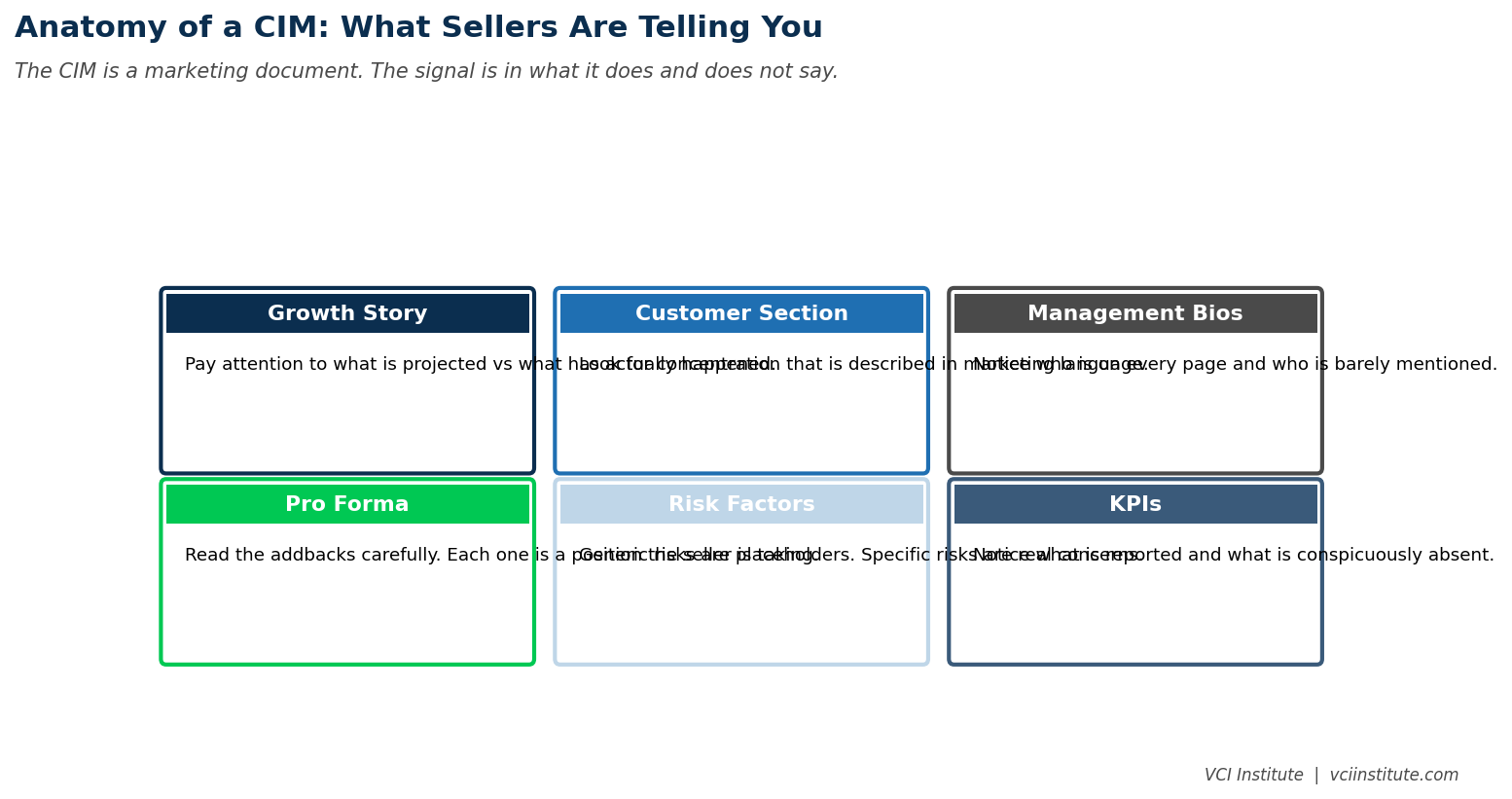
Operating partners who read CIMs only for what they say miss most of their value. Operating partners who read CIMs for what their structure reveals about the seller's strategy can identify, before any data room, what the seller is most worried about and what the buyer should investigate first.
The Three Things Every CIM Is Trying To Do
A CIM has three functional objectives. Understanding them is the first step in reading any specific CIM with appropriate skepticism.
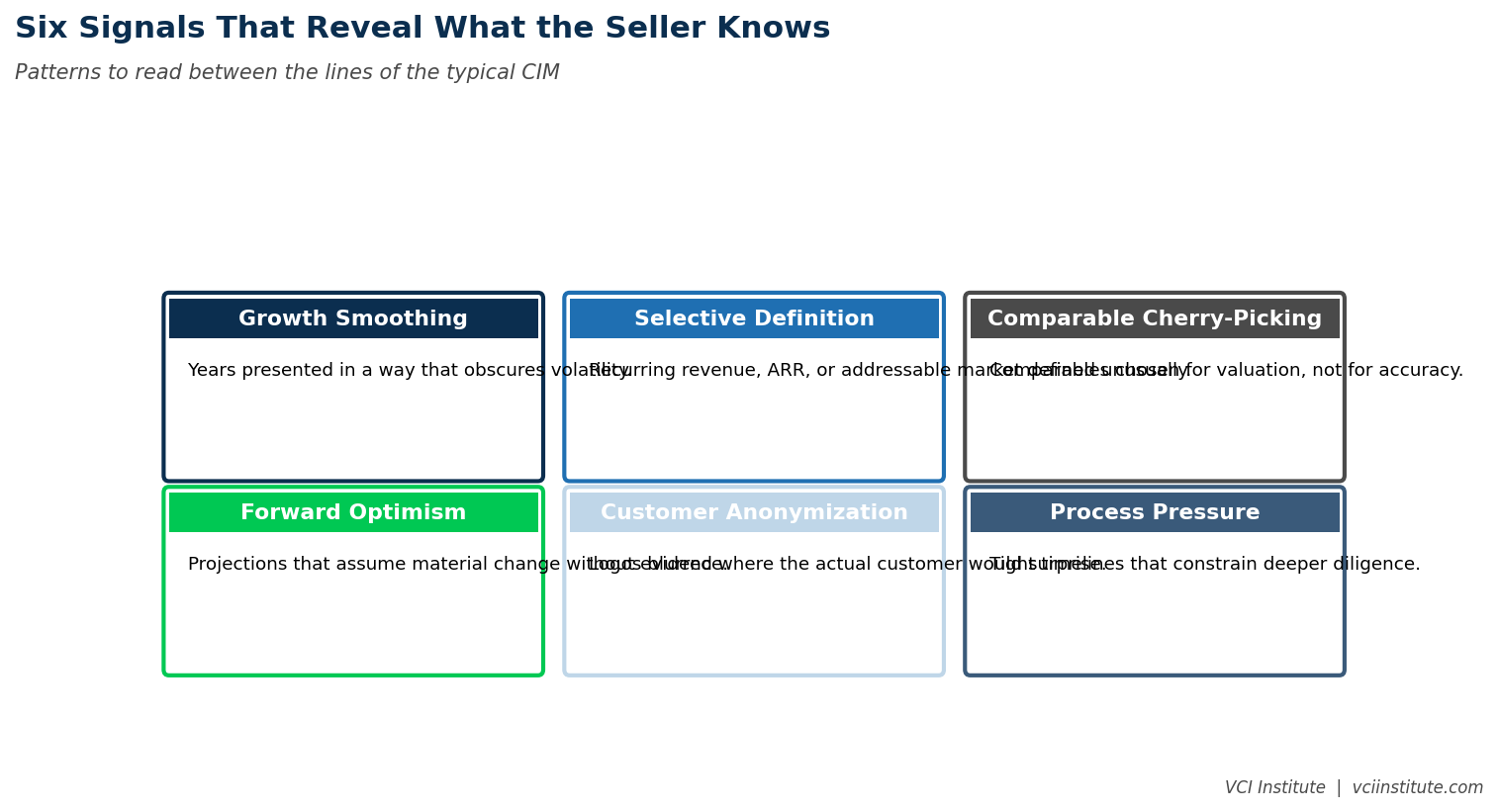
The first objective is to maximize the credibility of the financial trajectory. Revenue charts will start at the lowest point of recent history and end at the highest. EBITDA will be presented in adjusted form, with adjustments that emphasize favorable items and downplay less favorable ones. Forward projections will reflect best case assumptions presented as realistic ones. The trajectory looks compelling because compelling is what the document is engineered to produce.
The second objective is to anchor the buyer's expectation of multiple. Comparable transactions will be selected to support the seller's preferred range. Strategic narrative will be constructed to position the business in whichever category trades at the highest multiples. Industry context will be presented in ways that suggest tailwinds at the buyer's back. The framing nudges the buyer toward a multiple expectation that benefits the seller.
The third objective is to manage information disclosure such that the buyer has enough to be interested but not enough to ask the questions the seller does not want to answer. The CIM is selectively detailed. Some areas receive extensive treatment. Other areas, often the ones that matter most, receive cursory mention or are deferred to later phases of diligence. The selective detail is itself information about where the seller's vulnerabilities lie.
All three objectives are pursued more skilfully when the seller is a private equity firm rather than a family owner, which is one reason sponsor to sponsor processes carry a sharper information asymmetry than any other deal source.
Reading the Structure
The structure of a CIM tells the diligent reader where to look for the seller's anxieties. Three structural patterns recur.
The first pattern is the section length asymmetry. Areas that the seller is confident about receive treatment proportional to their importance. Areas that the seller is concerned about receive either disproportionate treatment, designed to overwhelm questions, or surprisingly thin treatment, designed to discourage them. A document that spends thirty pages on customer overview and four pages on the operations section is signaling something about which area the seller would prefer the buyer to dwell on.
The second pattern is the metric selection. The metrics presented are the metrics the seller can defend most strongly. The metrics not presented are often the metrics the seller would rather the buyer not focus on. A CIM that presents revenue retention but not gross retention is signaling that gross retention is weaker than the seller wants to highlight. A CIM that presents pipeline but not pipeline conversion is signaling that conversion is a sore point. A CIM that presents customer count but not active customer count is signaling that active customers may be a smaller number than total customers.
The third pattern is the management description. CIMs typically include biographies of senior management. The biographies are written carefully. Long tenured executives are emphasized when continuity is the message. New hires are emphasized when fresh leadership is the message. Conspicuous absence of someone who should be in the management section, the head of operations in an industrial business, the head of sales in a commercial business, is itself a signal that something has changed in the role recently or that the seller is not eager to expose that area to scrutiny. The second tier is where the real exposure usually sits, and CIMs almost never describe it, which is why the post-close talent density map is an exercise the buyer has to run independently.
The Five Things to Look For
A disciplined CIM read examines five specific dimensions. Each one yields signals that supplement the explicit content of the document.
The first dimension is the revenue narrative. How is recent revenue performance described. Is the language of growth used directly, or is it qualified with phrases like normalized, adjusted, or pro forma. Does the recent quarterly trajectory align with the headline growth rate. Are there gaps in the time series, recent quarters not shown, that suggest weak periods being de-emphasized. Strong revenue trajectories tend to be presented simply. Complicated presentations usually mask complications in the underlying performance.
The second dimension is the customer concentration disclosure. CIMs are required to disclose customer concentration to varying degrees. Pay attention to how the disclosure is framed. If concentration is mentioned briefly with normalizing language about strategic relationships, the buyer should investigate whether the strategic narrative actually holds. If concentration is not mentioned, it may either be genuinely low or have been omitted because mentioning it would be unflattering. Either way, this is among the first questions to ask in formal diligence, and the standard top ten chart is the wrong unit of measurement in any case.
The third dimension is the EBITDA bridge. Adjusted EBITDA in private equity diligence is almost never reported EBITDA. The bridge from one to the other is informative. Each adjustment item should be evaluated for its character. Genuine one time items, an unusual settlement, a single discontinued product line, a transition cost from a system implementation, are usually defensible. Recurring or normalized adjustments, ongoing executive compensation that the seller asserts will be reduced, recurring restructuring charges that have appeared in multiple years, owner perquisites that may or may not actually be replaceable, are softer. The composition of the bridge tells the buyer how aggressive the seller has been with its EBITDA presentation. Technology spend deserves particular attention here, because it is routinely presented as one time when it is structural, and the honest version of that argument is the digital EBITDA bridge.
The fourth dimension is the strategic positioning. How does the CIM categorize the business. Is it presented as a recurring revenue platform, a market consolidator, a digital native, a high growth disruptor. The categorization is engineered to align with the comparables the seller wants the buyer to anchor on. If the categorization seems aspirational relative to the operating reality, the comparables will likely overstate the multiple the business should command. If the categorization is conservative relative to operating reality, the buyer may have an opportunity to underwrite a stronger thesis than the seller is presenting. AI positioning is the current version of this, and the gap between claimed capability and absorbed capability is described in the AI ceiling.
The fifth dimension is the operating disclosure. How much is shared about the operating discipline, the systems, the talent depth, the process maturity. Strong businesses are usually willing to share operating detail because it supports their case. Businesses with operating fragility tend to keep operating disclosure thin and redirect attention toward financial performance. The volume and specificity of operating disclosure is often a leading indicator of operating quality, and it is worth scoring formally against something like an operating maturity index rather than by impression.
The Pages Most Buyers Skim
Operating partners reading a CIM usually focus on the financial section, the customer section, and the management section. Three other sections deserve more attention than they typically receive.
The first is the legal and regulatory section, often near the back of the document. It contains disclosures about ongoing litigation, compliance matters, and regulatory exposure. The presentation is usually neutral and brief. Buyers who skim this section often miss material risks that show up later in confirmatory diligence and become friction points in negotiation.
The second is the human capital section, when it exists. Beyond the management biographies, this section may include information about workforce composition, attrition rates, union exposure, and benefits structure. Workforce dynamics are increasingly material to operating performance, and CIMs that handle this section thinly may be deflecting attention from real issues.
The third is the IT and systems section, often consolidated into a brief operational summary. CIMs rarely lead with technology disclosure. The presentation tends to be reassuring rather than detailed. Buyers underwriting digital transformation theses should read this section with particular skepticism, because operating reality often diverges meaningfully from the CIM's reassurance. The specific thing to test is whether the company can produce the same number twice from two different functions, which is the single source of truth question.
The Questions to Ask First
A productive way to use the CIM read is to assemble, before formal diligence begins, the list of questions the CIM has prompted but not answered. The questions should be specific. What is gross customer retention by cohort over the past three years. What share of EBITDA adjustments represents items that were also adjusted in prior periods. What is the second tier management retention rate. What is the actual customer concentration including indirect concentration through channel partners. How much of the working capital is concentrated in a small number of customer relationships.
These questions become the priority list for the data room and the management presentation. They reflect what the CIM has revealed by what it has omitted or framed carefully. They prevent the diligence team from spending time on questions the CIM has already answered convincingly while overlooking the areas where the CIM is weakest.
The Discipline of Skepticism
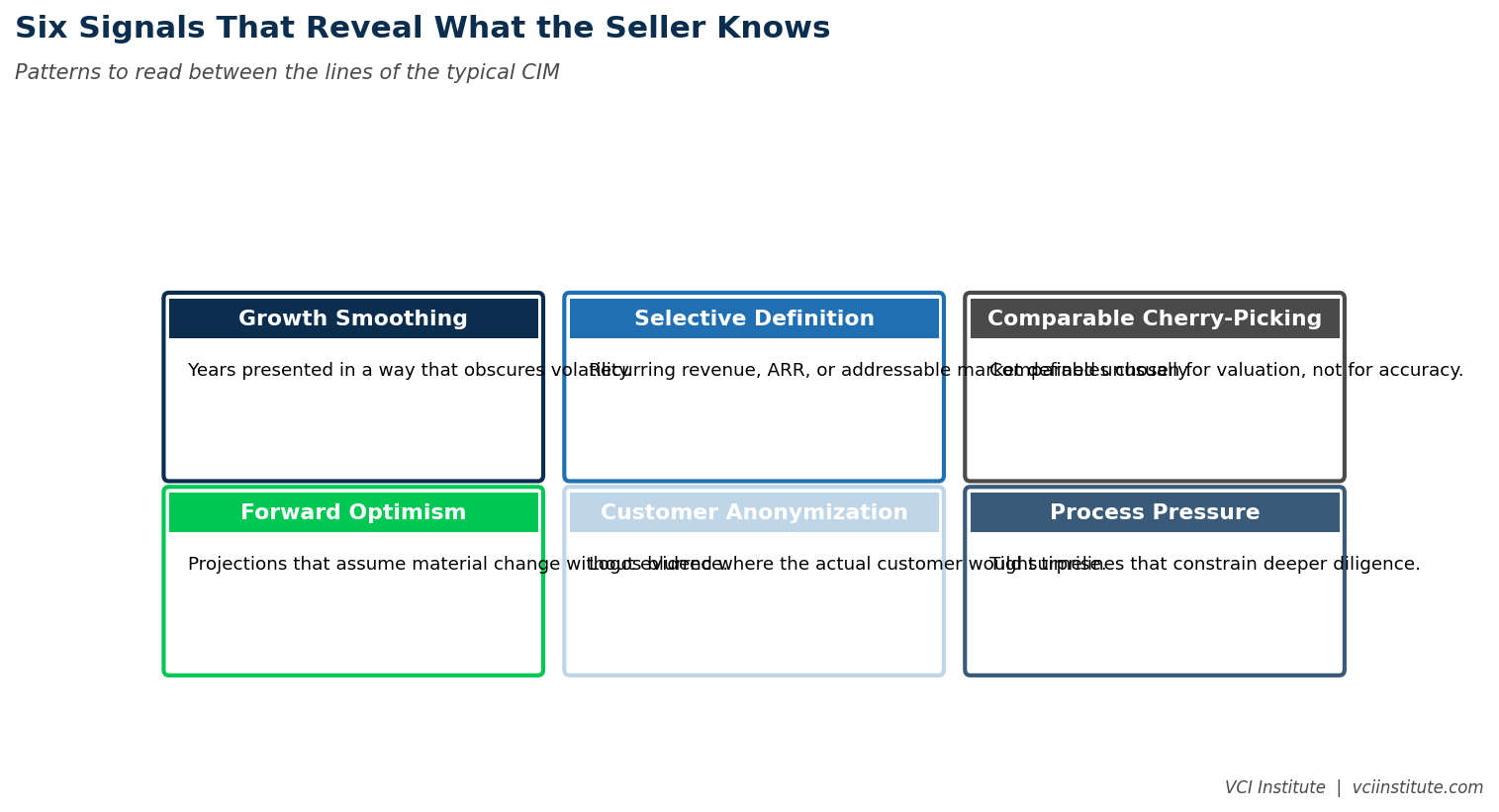
The CIM is, fundamentally, a marketing document. It is created by sellers and their advisors specifically to maximize the apparent attractiveness of the business. There is nothing wrong with this. It is what the document is for. The buyer's job is to read it for what it is, extract the genuine information it contains, and recognize the patterns that reveal what is being de-emphasized.
Operating partners who treat the CIM as a fair representation of the business and base their initial reactions on its surface message tend to be surprised in confirmatory diligence by issues that were, in retrospect, visible in the CIM if read more carefully. Operating partners who treat the CIM as a structured argument and read it for both content and structure are usually less surprised, because they have already identified, before formal diligence, where the seller's vulnerabilities are likely to be.
This is not an exercise in cynicism. The seller's job is to present the business well. The buyer's job is to verify what is presented. Reading the CIM for structural signals is part of that verification. The patterns are consistent enough across deals that an experienced reader can identify, in roughly an hour with a CIM, the three or four areas that warrant the most rigorous diligence attention.
What the CIM Does Not Say
In the end, the most important things the CIM tells you are the things it does not say at all. Items completely absent from the document are sometimes the items most worth investigating. The competitive landscape that is treated as supportive without naming specific competitors. The growth strategy that does not address the obvious counterargument. The financial performance that does not include any commentary on volatility, cyclicality, or seasonality. Each absence is a place to push.
One absence recurs more than any other. Founder-led businesses are almost never described in terms of how much of the operating system depends on the founder personally, because that disclosure would price directly against the seller. The buyer has to construct that picture independently, and the cost of not doing so is the founder speed tax arriving in month nine.
CIMs are written by people who know what they are doing. The structure, the emphasis, the omissions are all deliberate. Reading them carefully is one of the higher leverage diligence activities available, and it costs nothing beyond an hour and a disciplined eye. Operating partners who develop this skill find that their initial diligence priorities are sharper, their confirmatory diligence findings are less surprising, and their underwriting cases are more robust to the issues that surface during sign and close.
The CIM is not the truth about the business. It is the seller's argument about the business. Read it as an argument, identify the gaps in the argument, and start your own argument from there.
VCI Institute in collaboration with Mohamad Chahine
Published 3 August 2026
Related reading from the VCI Institute
The Sponsor-to-Sponsor Trap
Why the information asymmetry is sharpest when the seller writes CIMs for a living.
The Operating Maturity Index
A diagnostic to run before you intervene, and a way to score operating disclosure rather than sense it.
The Three People You Cannot Lose
The second tier the CIM will never describe, and the exercise the buyer has to run alone.
About the VCI Institute
The VCI Institute is a nonprofit dedicated to building practical capability and shared standards for value creation in private equity. The Institute publishes operator-grade frameworks and runs certification programs for operating partners, portfolio company CEOs, and value creation analysts, including COPPE and CVCA. Analysis published here draws on the Institute's certification curricula and on structured review of mid-market transaction patterns rather than on any single proprietary dataset. Where a figure is directional rather than measured, it is described as such.
Further material is available in the Institute's Insights library and its free resource library of templates, checklists, and case snapshots.
© 2026 VCI Institute. All rights reserved. The frameworks, terminology, and analysis presented in this article are the intellectual property of the VCI Institute. Reproduction or derivative use without written permission is prohibited. Citation with proper attribution is welcomed.
We have many great affordable courses waiting for you!
Stay connected with news and updates!
Join our mailing list to receive the latest news and updates from our team.
Don't worry, your information will not be shared.
We hate SPAM. We will never sell your information, for any reason.


 Practice private equity like a pilot trains