The Sponsor-to-Sponsor Trap: When Buying From Another PE Firm Costs More Than It Should
Aug 06, 2026
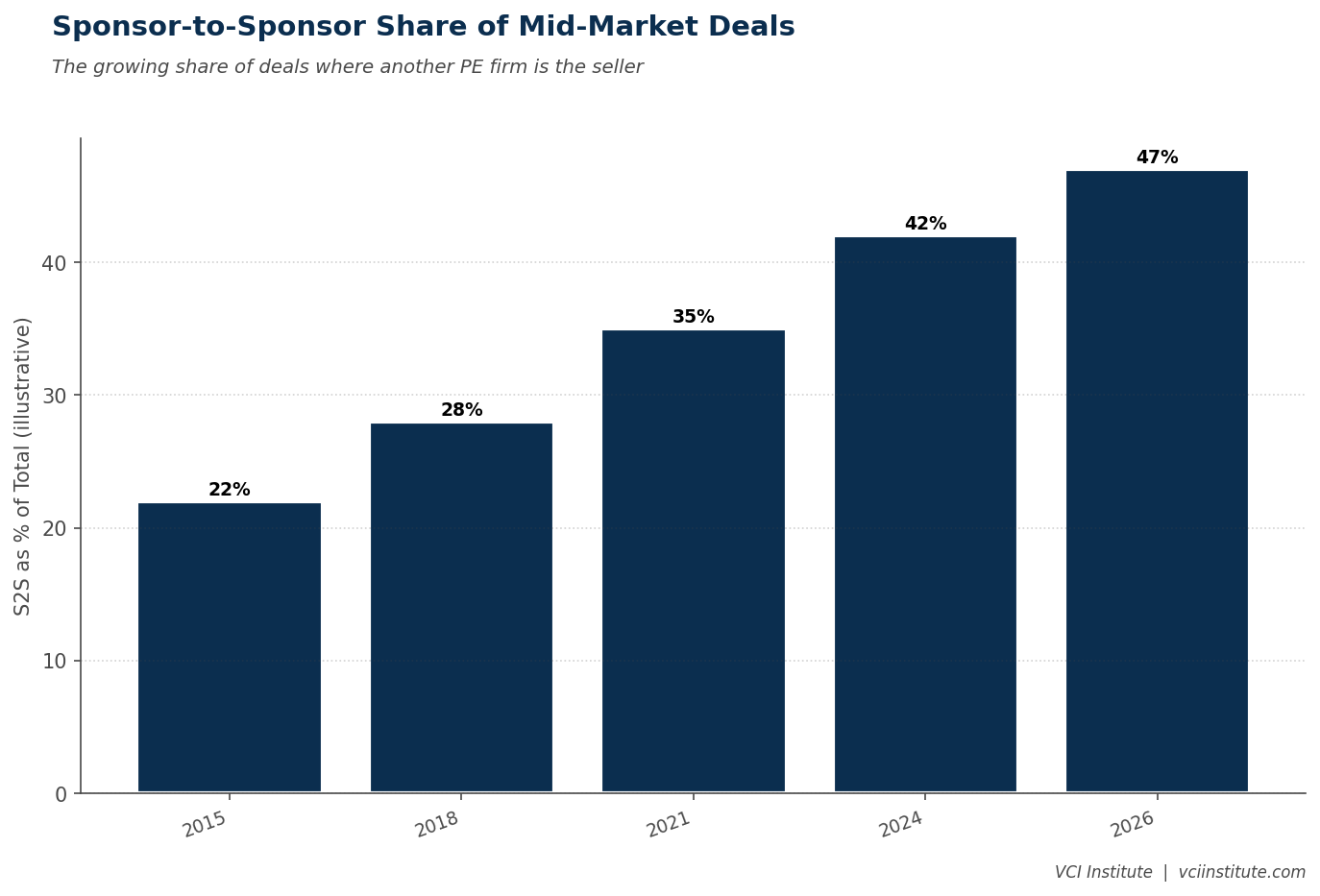
Roughly half of mid-market private equity transaction volume in 2026 is sponsor to sponsor. The buyer is a private equity firm. The seller is a private equity firm. The asset has been through one or more prior private equity ownership cycles and is now changing hands again. The dynamic has become so common that it is essentially a defining feature of how mid-market deal flow works.
This is also a problem.
The short answer
Sponsor to sponsor deals underperform in aggregate because the buyer inherits a business whose easiest improvements have already been taken. Operational step changes, capital structure optimisation, the attractive add-ons, and the management professionalisation were all executed in the prior hold. Three conditions distinguish the ones that work: the new buyer brings a genuinely different capability, the category supports compounding value creation across multiple cycles, and the price reflects the remaining runway rather than a repeat of the last one. The useful test is whether you can articulate the third hold thesis. If you cannot, be sceptical of the second.
Sponsor to sponsor deals, in aggregate, underperform deals sourced from family owners, founders, and corporate carve outs. The underperformance is not large enough to make sponsor to sponsor deals a categorical mistake. It is significant enough to deserve more attention than it typically receives. Buyers who win sponsor to sponsor processes by paying full or premium prices, and then expect to capture similar returns to deals sourced more attractively, often discover that the value creation runway is shorter than the underwriting case assumed.
Why Sponsor To Sponsor Has Grown
The growth of sponsor to sponsor deal flow is the result of several reinforcing trends. Private equity capital under management has expanded significantly faster than the supply of newly available businesses from non-private equity sellers. Many of the more attractive private businesses have already passed through one or more sponsor cycles. The hold periods for funds, while extended in some cases, are still bounded by fund life, producing a continuous flow of assets needing exit.
The result is a market where private equity firms are both buyers and sellers more often than they are buyers from other channels. The transactions move assets between sponsors with increasing frequency, and each transition involves a buyer who has paid for the value creation captured by the seller and is responsible for finding new value in the next hold.
The pressure to transact at all is itself worth naming. With distributions lagging and LPs pressing, the exit decision is often made on liquidity grounds rather than value grounds, which is the dynamic behind the DPI reckoning. A seller under distribution pressure and a buyer under deployment pressure make an unusually poorly matched pair.
This is not inherently problematic. Mature assets can continue to be improved. New ownership can bring fresh strategy, capital, or operational capability. The fact that an asset has been through prior private equity ownership does not preclude continued value creation. The question is whether the buyer is appropriately disciplined about how much value remains to be captured and what is required to capture it.
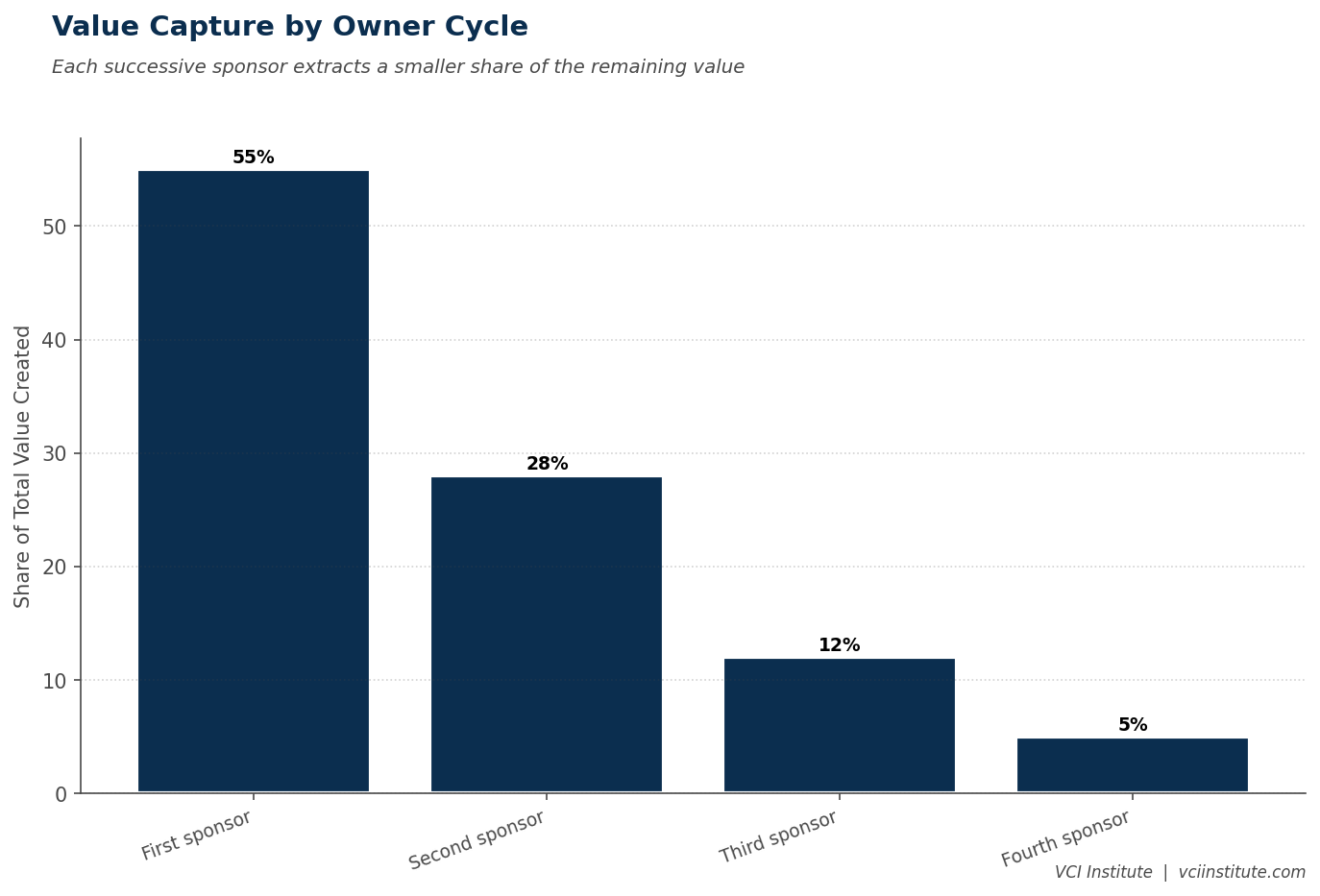
What The Prior Sponsor Already Did
The structural challenge of sponsor to sponsor deals is that the value creation moves the buyer would naturally pursue have often already been executed by the seller. This pattern recurs across multiple categories of value creation activity.
Operational improvements that produce step changes in EBITDA are usually the first targets of any private equity ownership. Procurement consolidation. SKU rationalization. Working capital tightening. Pricing discipline. Sales productivity. These initiatives, once executed, produce substantial first wave EBITDA improvement that flows through to the seller. The next buyer inherits a business that has already been through that improvement cycle. The same playbook will not produce the same magnitude of effect.
Capital structure optimization usually happens early in private equity ownership. The original capital structure is established at acquisition. Refinancing optimization, working capital improvement, and debt structure refinement happen in the first two years. By the time the asset is sold, the capital structure is typically near optimal for the business in its current state. The next buyer cannot expect material additional value from capital structure work alone. It is worth checking whether the prior sponsor has already taken cash out through a dividend recapitalisation, because that changes both the leverage picture and the seller's incentives in the process.
Strategic repositioning, M&A activity, and platform building usually happen across the middle phase of the prior hold. Add-on acquisitions have already been executed. New geographies have already been entered. New product lines have already been launched. The buyer of a mature platform may continue M&A activity, but the easier targets and the more attractive add-ons have likely been pursued in the prior hold.
Management upgrades, governance improvements, and reporting infrastructure are usually completed in the prior hold. The buyer is acquiring a business that has been professionalized. The first generation of professional management has been installed and tested. The reporting cadence is in place. The board structure is established. The opportunities for incremental improvement in these areas are smaller than they were at the prior acquisition. This is genuinely different from buying a founder-led business, where the professionalisation gap is the thesis rather than a closed opportunity, and where the risk runs the other way as the founder speed tax.
The cumulative effect is that the new buyer is acquiring a business that has been through one or more cycles of the standard private equity playbook. The remaining value creation has to come from initiatives that are either harder, more capital intensive, or fundamentally different in character from what the prior sponsors pursued. This is not impossible, but it requires a sharper thesis than many sponsor to sponsor underwriting cases reflect.
When Sponsor To Sponsor Deals Work
Despite the structural challenges, some sponsor to sponsor deals produce strong returns. The pattern across these successful deals is consistent. Three conditions tend to be present.
The first condition is that the new buyer brings a genuinely different operating capability or strategic insight than the prior owner. A sector specialist taking a business from a generalist sponsor. An operationally focused firm taking a business from a financially focused sponsor. An international platform taking a business that has not yet expanded beyond its home market. The differential capability creates new value creation runway that the prior owner could not have captured. Establishing whether the gap is real, rather than assumed, is what an operating maturity diagnostic is built to answer.
The second condition is that the business is in a category that genuinely supports continuing value creation through additional cycles. Some industries support compounding value creation almost indefinitely. Software businesses with strong product moats. Specialty services platforms with scalable operating models. Asset light businesses with high return on invested capital. Other industries are more cyclical or more mature, with limited additional value to extract after one or two cycles. The category matters significantly.
The third condition is that the price reflects the realistic remaining value creation runway rather than a presumption that the next hold will produce returns comparable to the prior one. Sponsor to sponsor processes are usually competitive auctions where multiple credible buyers participate. Pricing pressure is real. The buyer that disciplines itself to walk away when the price exceeds what the remaining runway can support tends to win the deals where value creation is genuinely possible. The buyer that wins by paying highest pays for value already captured by the seller.
The Discipline Of The Disciplined Bidder
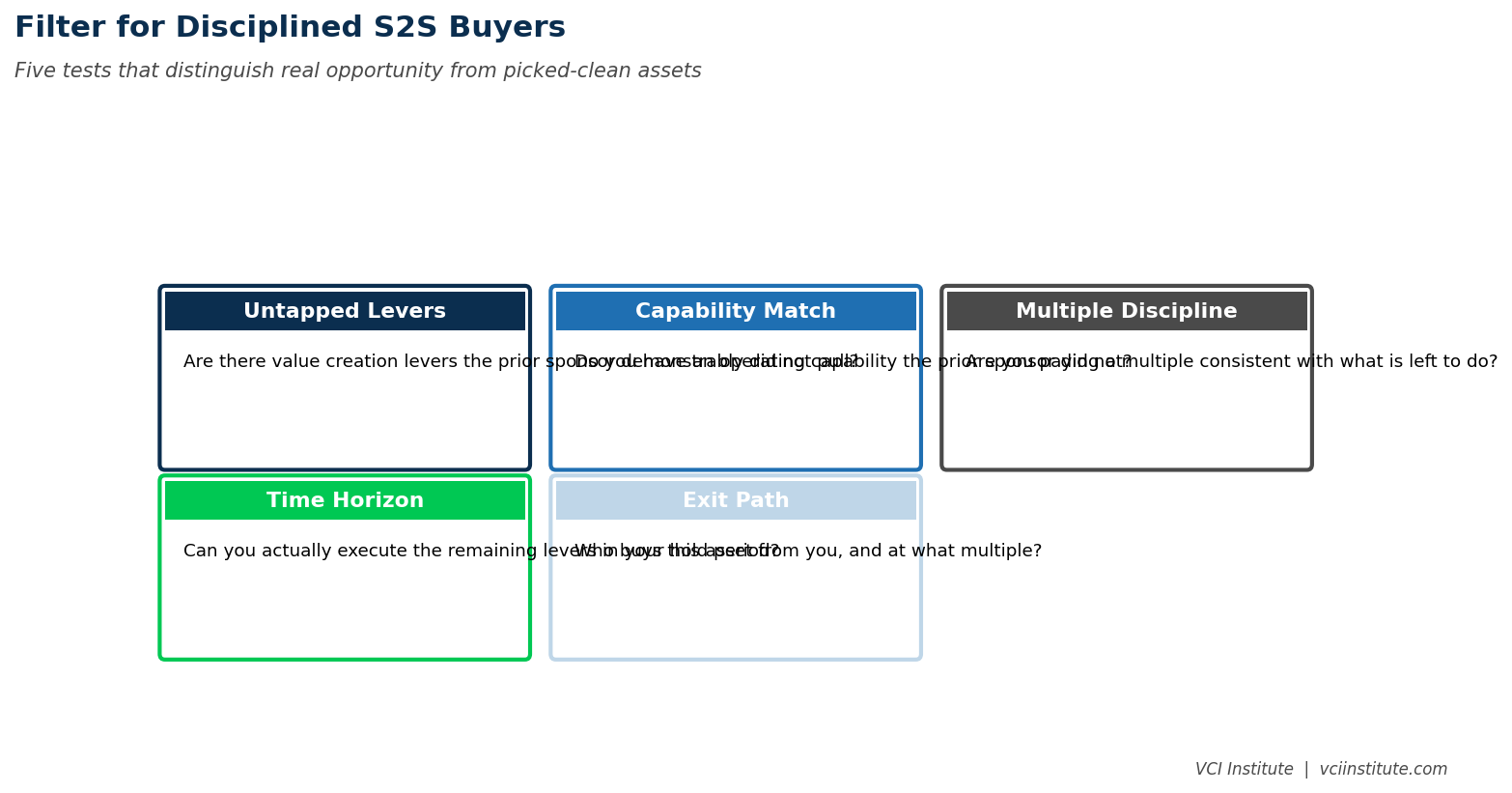
Operating partners who lead value creation in sponsor to sponsor deals develop a specific discipline around bid construction.
They underwrite the remaining runway honestly. The model does not assume the same magnitude of EBITDA improvement that the prior hold achieved. It identifies, specifically, the value creation initiatives that have not yet been executed and sizes them realistically. If the list of remaining initiatives is short or modest in impact, the underwriting reflects that. If the list is substantial and the buyer's capability is well matched to it, the underwriting can support a stronger case. Technology initiatives are the most frequently overstated line in this exercise, which is the argument for pricing them explicitly through a digital EBITDA bridge.
They evaluate the cost of operational improvements that the prior sponsor did not pursue. Sometimes the prior sponsor passed on an initiative because it required capability they did not have. Sometimes the initiative was deferred because it required capital the prior fund's late hold position did not justify. Sometimes the initiative was simply missed. Each of these has different implications for the new buyer's expected execution and cost.
They distinguish between continuing the prior strategy and pivoting to a new one. Continuing what is working at the seller's pace produces incremental value. Pivoting to a different strategy is harder, riskier, and sometimes destroys value. Buyers who clearly identify which approach they intend, and price accordingly, produce more consistent outcomes than buyers who let the strategy emerge during the hold.
They walk away from auctions when the price exceeds the disciplined valuation. This is the hardest discipline. In a competitive process, walking away means losing the deal to a less disciplined competitor. The walk away discipline pays off across many deals, not on any individual deal. Firms that consistently apply it produce better fund level returns than firms that participate to win every process they entered.
The Information Disadvantage
Sponsor to sponsor deals have an information dynamic that buyers should explicitly account for. The seller has lived with the asset for several years. The seller knows where the operational fragilities are, where the customer relationships are vulnerable, where the talent risks are concentrated. The buyer has weeks of diligence access. The information asymmetry is structural and significant.
The asymmetry is sharper here than in other deal types because the seller is a professional. A family owner writes an imperfect document. A sponsor writes a deliberate one. Every omission is a choice, which is why reading the CIM between the lines matters more in a sponsor process than anywhere else.
This is not a reason to avoid sponsor to sponsor deals. It is a reason to invest in diligence in ways that mitigate the asymmetry. Operational diligence that goes beyond what the data room reveals. Customer reference calls that probe relationships rather than confirm headlines. Talent assessments that examine the second and third tier rather than just the C suite. Each of these investments produces information that partially offsets what the seller knows and the buyer does not. The second and third tier assessment is the one most often skipped and most often regretted, and it is the exercise laid out in the post-close talent density map.
Buyers who skimp on diligence in sponsor to sponsor deals because the asset has been institutional for years often discover, in the first six months of ownership, issues that were visible to the prior management but not surfaced in the data room. The cost of these surprises is much larger than the cost of more rigorous diligence would have been. Reporting is a common example. An asset can look institutional at the board pack level and still fail the single source of truth test one layer down.
The Reframe Worth Considering
A useful reframe for sponsor to sponsor deal evaluation is to ask, what is this asset worth in its third hold rather than its second. The question forces explicit thinking about the runway that remains after the buyer's own hold. If the asset will be valuable to a future buyer in three to five years, the current acquisition has continuing value creation runway. If the asset will be approaching the end of its private equity lifecycle, the acquisition has limited remaining runway.
The reframe matters because it disciplines the underwriting. Buyers who can clearly answer what the third hold thesis would be can usually defend strong returns in the second hold. Buyers who cannot answer this question should be skeptical that the second hold will produce the returns the model implies.
Some sponsor to sponsor deals genuinely have strong third hold theses. Others do not. The ability to distinguish the two is one of the more valuable capabilities a private equity firm can develop in the current market environment.
The Path Forward
Sponsor to sponsor deal flow will continue to grow as a share of mid-market private equity transactions. The structural drivers, capital concentration, fund cycles, the maturation of mid-market assets, are not reversing. The asset class will continue to recycle assets between sponsors at increasing frequency.
The firms that produce strong returns in this environment will be the ones that develop genuine discipline around sponsor to sponsor underwriting. Honest assessment of remaining value creation runway. Differentiated capability that justifies the next hold. Disciplined pricing that walks away from auctions when the value creation case does not support the bid. Investment in diligence that offsets information asymmetry.
The firms that do not develop this discipline will continue to participate in sponsor to sponsor processes, occasionally winning, often paying full prices, and producing returns that disappoint LP expectations. The aggregate underperformance of sponsor to sponsor deals will become more visible to LPs over time, and firms that consistently fall on the wrong side of the underperformance will find their fundraising more difficult.
The trap is real. Avoiding it requires explicit work. The work is worth doing because the alternative, paying full prices for value already captured, is the most predictable way to underperform a fund commitment that has been made on a different basis.
VCI Institute in collaboration with Mohamad Chahine
Published 6 August 2026
Related reading from the VCI Institute
Reading the CIM Between the Lines
What sellers are telling you without saying it, and why a sponsor-written document is a deliberate one.
The DPI Reckoning
The liquidity pressure putting assets into the market for reasons other than value.
The Operating Maturity Index
A diagnostic to run before you intervene, and a test of whether the capability gap is real.
About the VCI Institute
The VCI Institute is a nonprofit dedicated to building practical capability and shared standards for value creation in private equity. The Institute publishes operator-grade frameworks and runs certification programs for operating partners, portfolio company CEOs, and value creation analysts, including COPPE and CVCA. Analysis published here draws on the Institute's certification curricula and on structured review of mid-market transaction patterns rather than on any single proprietary dataset. Where a figure is directional rather than measured, it is described as such.
Further material is available in the Institute's Insights library and its free resource library of templates, checklists, and case snapshots.
© 2026 VCI Institute. All rights reserved. The frameworks, terminology, and analysis presented in this article are the intellectual property of the VCI Institute. Reproduction or derivative use without written permission is prohibited. Citation with proper attribution is welcomed.
We have many great affordable courses waiting for you!
Stay connected with news and updates!
Join our mailing list to receive the latest news and updates from our team.
Don't worry, your information will not be shared.
We hate SPAM. We will never sell your information, for any reason.


 Practice private equity like a pilot trains