
The DPI Reckoning: Why Distributed-to-Paid-In Is Now the Metric That Matters
Jul 20, 2026
For most of the modern private equity era, IRR was the metric that defined fund performance. It was reported on the cover page of every quarterly update. It was the headline statistic in every fundraising deck. It was the number that LPs ranked sponsors on. IRR, supplemented by MOIC, told the story of whether a fund was performing.
Both metrics have lost their authority over the past three years. The reason is straightforward. Both can be flattering to funds that have not yet returned meaningful capital to their investors.
The short answer
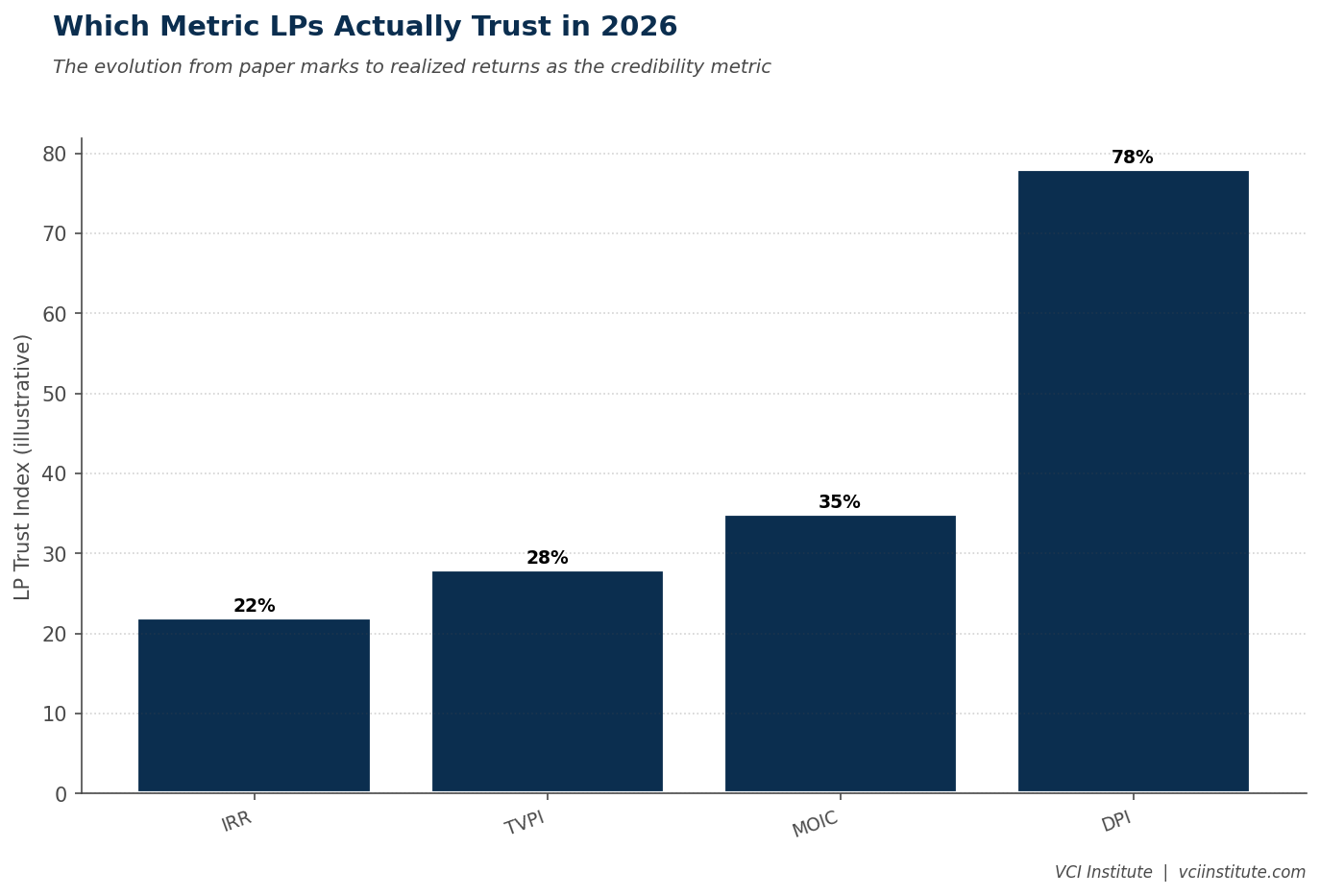
IRR and MOIC can both be flattering to a fund that has returned nothing, because both depend on marks that have never been tested by a sale. DPI cannot. Either the cash was distributed or it was not. LPs have shifted to it in three visible places: first-meeting fundraising questions, LPAC challenges to flat marks, and allocation decisions for the next cycle. Sponsors are responding with faster exit decisions, more selective use of NAV lending and continuation vehicles, and earlier exit readiness work. LPs increasingly distinguish organic DPI from engineered DPI, and price the difference.
A fund can produce a strong IRR by holding a small number of high mark portfolio companies and reporting paper appreciation. A fund can produce a strong MOIC by carrying portfolio company valuations at levels that have not been tested by an actual sale. Neither metric requires the fund to have actually returned capital to its investors. In a market where exits are slow and marks are increasingly questioned, both metrics can show numbers that look defensible while the LPs continue to wait for distributions that have not yet arrived.
DPI, the ratio of distributions to paid-in capital, does not have this property. DPI is exactly what it sounds like. The amount of money the fund has actually returned to LPs, divided by the amount of money the LPs put in. There is no judgment in it. There are no marks. There is no spreadsheet manipulation. Either the cash has been distributed or it has not.
The Reckoning Has Started
LPs have, quietly but decisively, shifted to DPI as the metric they actually use to evaluate sponsor performance. The shift is visible in three places.
The first place is in fundraising conversations. Sophisticated LPs now ask about DPI in the first meeting, not the third. They want to understand what the GP has actually returned across prior funds, not just what the marks suggest. The conversation about IRR happens after the DPI conversation, and it is calibrated against the DPI baseline. A fund with strong IRR and weak DPI is now treated with skepticism that was rare five years ago. A fund with moderate IRR and strong DPI is treated with respect that was also rare.
The second place is in LPAC meetings. LPs serving on advisory committees are pressing for explanations of weak DPI in active funds. They are asking about exit pipelines, asset readiness, and timing. They are challenging marks that have stayed flat through years that should have produced movement in either direction. The patience that LPs showed during the 2021 to 2022 period, when many marks were optimistic, has been replaced by a more pointed inquiry into what marks actually mean.
The third place is in allocation decisions for the next fund cycle. LPs are explicitly using DPI as a sorting criterion when deciding which GPs to commit to. Sponsors with strong DPI track records across multiple funds are seeing oversubscribed fundraises. Sponsors with weak DPI, even when supplemented by attractive IRR or MOIC, are struggling to close at the targets they set, and some are quietly delaying or downsizing their fundraises. Some of the largest LPs have responded by negotiating directly for liquidity terms through fund-of-one structures rather than accepting standard commingled terms.
Why DPI Is Suddenly Decisive
The shift to DPI as the dominant metric is partly a function of market conditions and partly a function of LP sophistication.
The market conditions are obvious. Public market valuations are uneven. M&A activity has been weaker than the 2021 highs. IPO windows have been narrow. Strategic buyers have become more selective. The result is that exits have slowed across the industry, and the ratio of fund age to distributions has stretched. LPs that planned cash flows around historical exit patterns have found themselves capital constrained. They want distributions, and they are willing to use distribution metrics as a primary evaluation tool because that is the metric that affects their actual operations.
The LP sophistication is less obvious but more durable. Over the past decade, institutional LPs have built far more rigorous internal evaluation frameworks for private equity performance. They benchmark IRR and MOIC against industry medians. They normalize for vintage and strategy. They look at attribution to understand what is driving performance. The accumulated sophistication has produced a clearer view of which metrics are easier to manipulate and which are not. DPI, being purely transactional, is harder to manipulate than the others.
The combination of difficult market conditions and sophisticated LP analysis has elevated DPI from one metric among several to the metric that matters first. The shift may persist beyond the current market cycle. Even when exits accelerate, LPs are unlikely to abandon a metric that provides cleaner accountability than its alternatives.
What This Means for Sponsor Behavior
The DPI reckoning is changing how sponsors behave at multiple stages of the deal lifecycle. Three patterns are emerging.
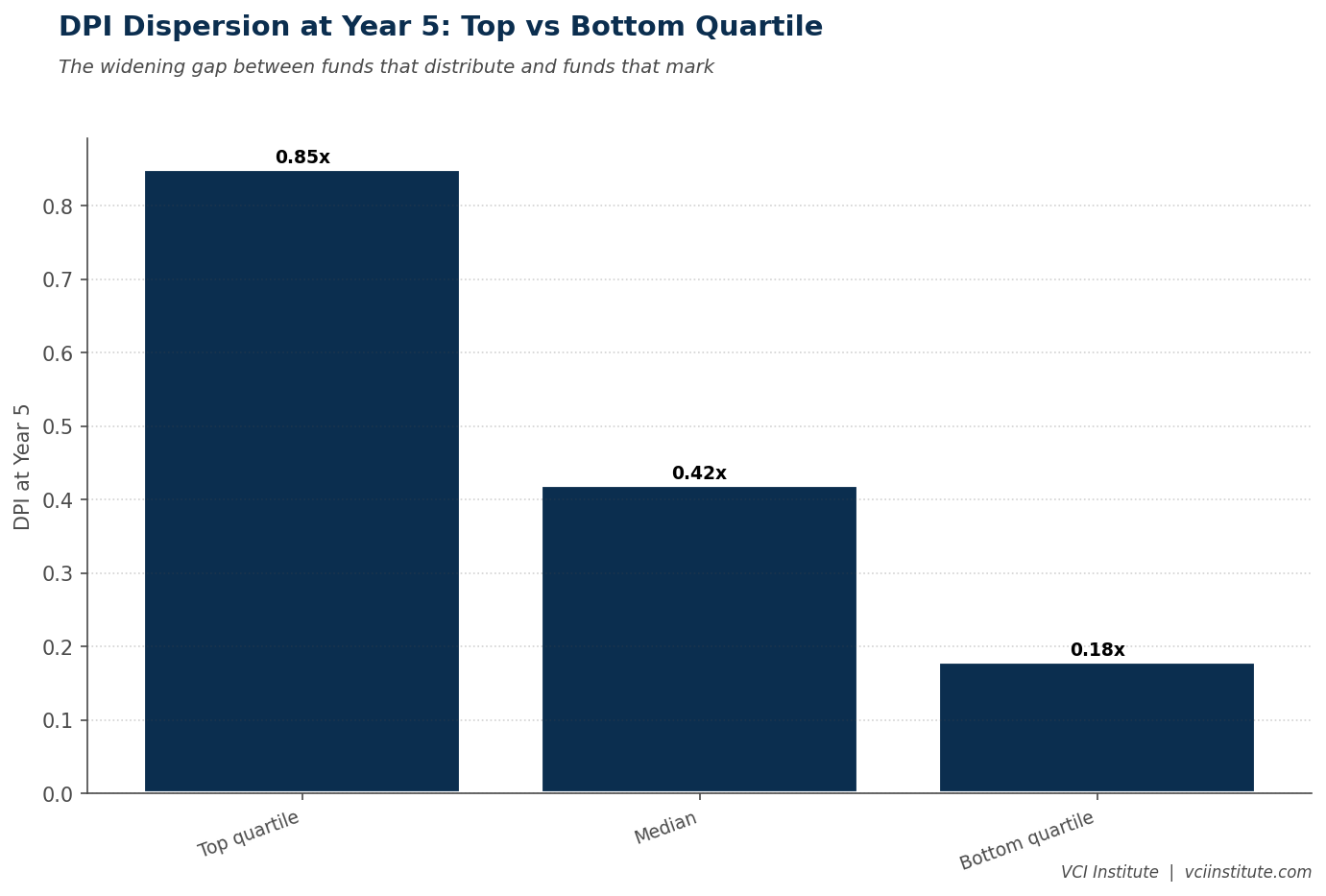
The first pattern is faster exit decision making. Sponsors are now considering exit opportunities earlier and accepting valuations that they might have rejected eighteen months ago. The reasoning is straightforward. A timely exit at a fair price contributes to DPI, which is what the next fundraise will be evaluated on. An aspirational hold for a higher price that may or may not materialize, while waiting on an uncertain market, does not contribute to DPI. The DPI calculus is pushing some sponsors toward more disciplined exit timing, which on balance is healthy for the industry. It is also feeding the volume of sponsor to sponsor transactions, where a seller under distribution pressure meets a buyer under deployment pressure.
The second pattern is more selective use of NAV lending and continuation vehicles. Sponsors are recognizing that distributions financed through fund level borrowing or through continuation transactions, while they may produce DPI in the short term, do not always produce the kind of DPI that LPs respect. LPs are increasingly differentiating between organic DPI from real exits and engineered DPI from financial structures. The latter is treated as less valuable in the next fundraise, and sponsors are calibrating their use accordingly. The mechanics of that trade-off are set out in NAV lending reconsidered, and the portfolio company equivalent in dividend recaps reconsidered.
The third pattern is more rigorous portfolio company readiness work in the eighteen to twenty four months before planned exits. Sponsors are investing in exit readiness earlier and more deliberately. Audit quality. Reporting maturity. KPI clarity. Customer concentration management. The investments take time and produce no immediate IRR benefit, but they produce exits that close at expected valuations rather than dragging or breaking. Reliable exits produce reliable DPI, which is what the LPs are now grading on.
What This Means for Operating Partners
Operating partners are, increasingly, the people who determine whether a portfolio company exits successfully. Their work in the eighteen months before sale shapes whether the buyer can underwrite the asset at the price the sponsor needs. The DPI reckoning has elevated the importance of this work, even though the visibility of the operating partner role in the fund's metrics is indirect.
A useful reframe is that operating partners contribute to DPI by ensuring that exits actually close at the valuations the sponsor team is targeting. The deal team designs the exit. The operating partner makes it possible to execute. When the operating partner has prepared the company well, the exit closes at price. When the operating partner has not, the exit either drags or closes at a discount. Both outcomes weaken DPI.
This is putting pressure on operating partners to deliver exit readiness as a discrete deliverable, distinct from value creation during the hold. The work includes ensuring that audited financials are clean and timely, that key contracts are in order, that customer relationships are documented and stable, that critical talent has retention agreements, that the management team can stand up to buy side diligence, and that the value creation story is supported by data the buyer can verify.
Two pieces of that list carry more weight than the rest. Reporting that survives buy side scrutiny depends on the company agreeing with itself on its own numbers, which is the single source of truth audit. And critical talent retention depends on knowing who is actually critical, which is the exercise in the post-close talent density map. Both take longer than eighteen months to fix if they were never started.
Operating partners who deliver this consistently across deals are becoming the most valued members of the firm. Operating partners who are strong on value creation during hold but weaker on exit readiness are finding themselves in a more challenging position, because the DPI reckoning has made the exit moment more important than the hold period activity.
The Quiet Reset of Industry Standards
The DPI reckoning is also producing a quieter reset in industry expectations. Funds that traditionally targeted twenty five percent gross IRR with strong MOIC are recalibrating around target DPI levels that LPs will respect. The conversation is shifting from peak IRR potential to reliable DPI delivery.
This is not a downgrade of ambition. It is a recognition that the metric LPs actually grade on has changed, and the industry standard has to follow. Funds that report strong IRR with weak DPI are increasingly viewed as having unfinished work, regardless of how strong the marks look. Funds that report moderate IRR with strong DPI are viewed as having delivered, even when their headline numbers are less impressive.
Over time, this is likely to produce a broader shift in how sponsors describe their performance to LPs. The narrative of value creation and growth, illustrated through marks and IRR, is being supplemented by a narrative of returned capital, illustrated through DPI and demonstrated exit history. The latter narrative is harder to construct because it requires actual exits. It is also more credible because it requires actual exits.
One structural response is to remove the exit deadline entirely. Vehicles without a defined fund life do not have a DPI problem in the same sense, because capital is meant to compound rather than return on a schedule. That trade-off, and what it costs, is the subject of permanent capital vehicles.
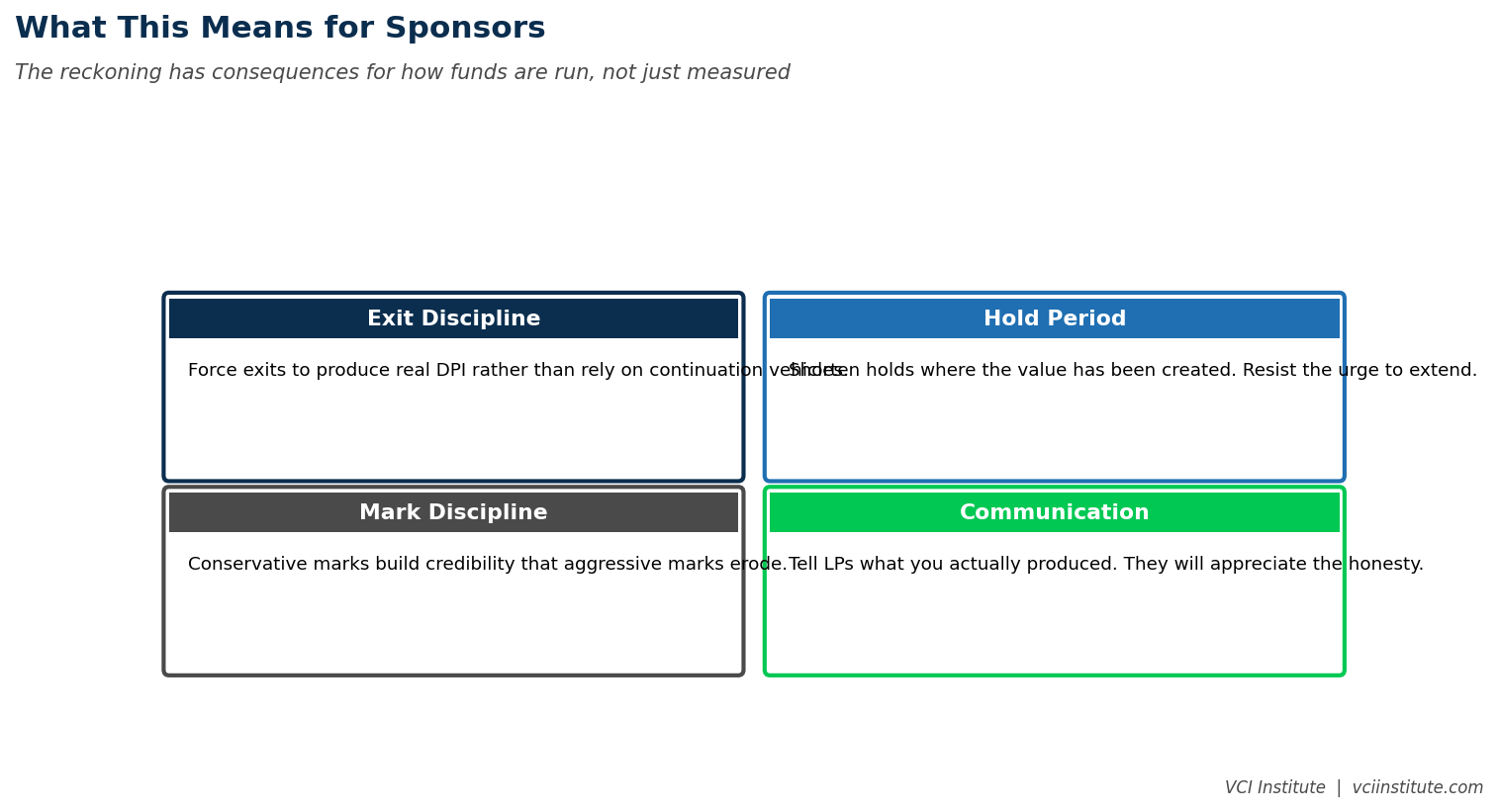
What LPs Are Going to Ask
The questions LPs are going to ask in the next fundraising cycle, that they may not have asked as pointedly in the prior cycle, are predictable. What is your DPI in your most recent fund. How does it compare to your prior funds. What has driven the variance. What is the exit readiness of your remaining portfolio. What is your projected DPI trajectory over the next two years. What share of your DPI in your prior fund was organic and what share was engineered. How does your firm think about the trade off between holding for higher exit prices and delivering DPI on a predictable timeline.
Sponsors that have answers to these questions, supported by data and a coherent narrative, will find the fundraising conversation more straightforward than they expect. Sponsors that do not have answers, or that have answers they prefer not to share in detail, will find the conversation more difficult than they hoped.
The DPI reckoning is not a fad. It is a structural shift in how private equity is evaluated, driven by market conditions and LP sophistication that are unlikely to reverse. The firms that adapt to it will be the firms that build durable LP relationships through the next cycle. The firms that do not will discover, over the course of the next two fund cycles, that the metric they relied on has stopped carrying the weight it once did.
The discipline required is not new. Return capital. Demonstrate exits. Build portfolios that actually produce distributions on a recognizable cadence. The metric just got more honest about whether it is happening or not.
VCI Institute in collaboration with Mohamad Chahine
Published 20 July 2026
Related reading from the VCI Institute
NAV Lending Reconsidered
A tool that solves one problem and creates another, and the clearest source of engineered DPI.
Dividend Recaps Reconsidered
The portfolio company equivalent, and the three tests that separate discipline from expedience.
Permanent Capital Vehicles
The structural response that removes the exit deadline, and what that trade-off costs.
About the VCI Institute
The VCI Institute is a nonprofit dedicated to building practical capability and shared standards for value creation in private equity. The Institute publishes operator-grade frameworks and runs certification programs for operating partners, portfolio company CEOs, and value creation analysts, including COPPE and CVCA. Analysis published here draws on the Institute's certification curricula and on structured review of mid-market transaction patterns rather than on any single proprietary dataset. Where a figure is directional rather than measured, it is described as such.
Further material is available in the Institute's Insights library and its free resource library of templates, checklists, and case snapshots.
© 2026 VCI Institute. All rights reserved. The frameworks, terminology, and analysis presented in this article are the intellectual property of the VCI Institute. Reproduction or derivative use without written permission is prohibited. Citation with proper attribution is welcomed.
We have many great affordable courses waiting for you!
Stay connected with news and updates!
Join our mailing list to receive the latest news and updates from our team.
Don't worry, your information will not be shared.
We hate SPAM. We will never sell your information, for any reason.






 Practice Platform