
Permanent Capital Vehicles: The Patient Money Reshaping the Mid-Market
Jul 23, 2026
The structure that used to define private equity, a closed end fund with a five to seven year hold mandate and a defined exit pressure, is no longer the only structure in the market. Over the past five years, permanent capital vehicles have grown from a niche feature of certain credit and infrastructure strategies to a substantial presence in mid-market buyout. Family offices, evergreen funds, holding companies, and certain insurance backed structures now collectively command meaningful capital allocated to control investments without the artificial pressure of a defined exit window.
This shift has consequences that extend well beyond fund finance. Permanent capital changes how sponsors evaluate deals, how they price them, how they hold them, and how they create value during ownership. It changes the kinds of management teams that fit. It changes the operating partner playbook. It changes the calculation of when, whether, and how to sell.
The short answer
Permanent capital removes the defined exit window, and three things follow. The value creation horizon lengthens, so investments that fail a five year hurdle but compound over a decade become viable. The sell decision becomes a function of relative opportunity rather than fund mechanics. And the sponsor can credibly offer a partnership of indefinite duration, which is worth ten to twenty percent of price to certain founders. Traditional funds still win on speed of execution, aggressive transformation playbooks, and premium pricing on quality assets. The operating partner playbook is genuinely different, not a variation of the same one.
For sponsors operating in markets where permanent capital is increasingly active, understanding the differences is no longer optional. Either the sponsor can articulate why traditional fund structure produces a better outcome for management teams and selling owners, or the sponsor will lose deals to competitors whose hold flexibility resonates with sellers who care about something beyond price.
What Permanent Capital Actually Changes
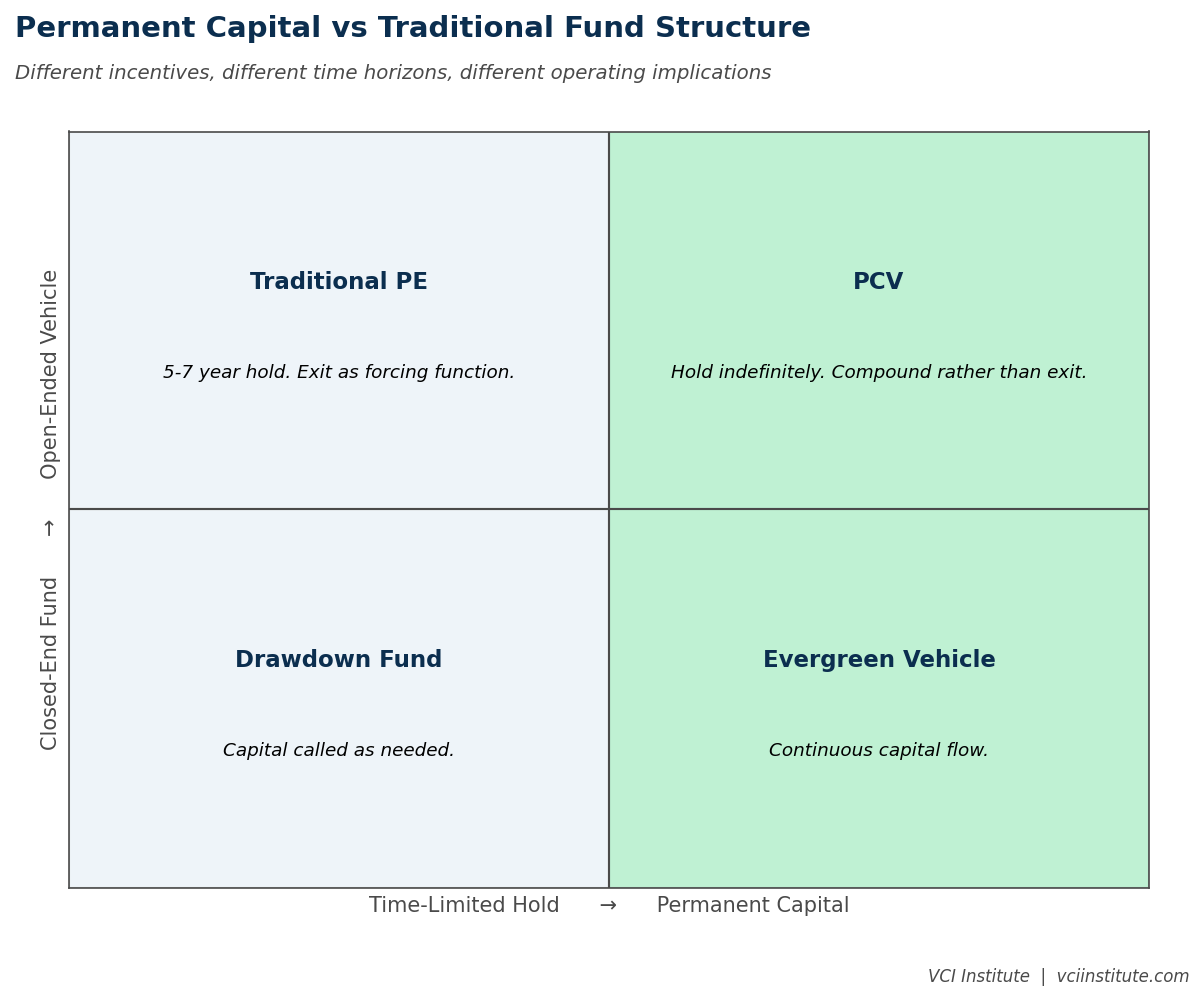
The naming is loose. Permanent capital is used to describe a range of structures that share one common feature. They do not have a defined fund life that requires assets to be sold within a particular window. The capital is allowed to compound through ownership rather than be returned through exit.
The implications run in several directions.
First, the time horizon for value creation lengthens. A traditional fund that holds for five years is making investment decisions, talent decisions, and operational decisions that pay back inside that window. A permanent capital vehicle can make decisions whose payback extends well beyond five years, because the capital is not under exit pressure. This permits investments in capability, technology, talent, and infrastructure that would not clear a traditional fund's hurdle rate but that compound over a decade into substantial enterprise value. Technology is the clearest example, because the honest case for it rarely fits a five year window, which is the problem the digital EBITDA bridge exists to solve.
Second, the calculation of when to sell changes. A traditional fund must sell when the value creation thesis has been substantially executed. Holding longer means tying up LP capital and producing weaker IRR. A permanent capital vehicle holds while the asset continues to compound. The sell decision becomes a function of relative opportunity, not of fund mechanics. If the asset is still producing strong returns, the vehicle keeps it. This sidesteps the distribution pressure that has come to dominate traditional fund behaviour, described in the DPI reckoning, though it replaces it with a different discipline, since a vehicle that never sells never proves its marks.
Third, the negotiating posture with management teams shifts. Traditional fund sponsors offer a partnership of finite duration. The management team will, at some point, work with a different owner. Permanent capital vehicles can credibly offer a partnership of indefinite duration, which appeals to founders and management teams that have lived through previous private equity cycles and have come to dislike the change of ownership cadence. This is a real differentiator in deal sourcing.
The Sourcing Edge
The deal sourcing implications of permanent capital are significant in the mid-market. Founders selling closely held businesses, where the business is the family legacy and the management team is personally invested in the long term outcome, have started to actively prefer permanent capital buyers over traditional fund sponsors. The price difference required to convince such a founder to choose a traditional sponsor over a permanent capital buyer can be meaningful, sometimes ten to twenty percent.
This is creating a structural pricing gap in certain mid-market segments. Permanent capital vehicles can win deals at prices traditional sponsors find difficult to justify, because the sourcing advantage compresses the implied multiple. Traditional sponsors that compete head to head against permanent capital in these segments are increasingly finding that they either lose the deal or pay up to win it. The alternative is to source where permanent capital does not compete, which pushes more volume into sponsor to sponsor processes with their own structural disadvantages.
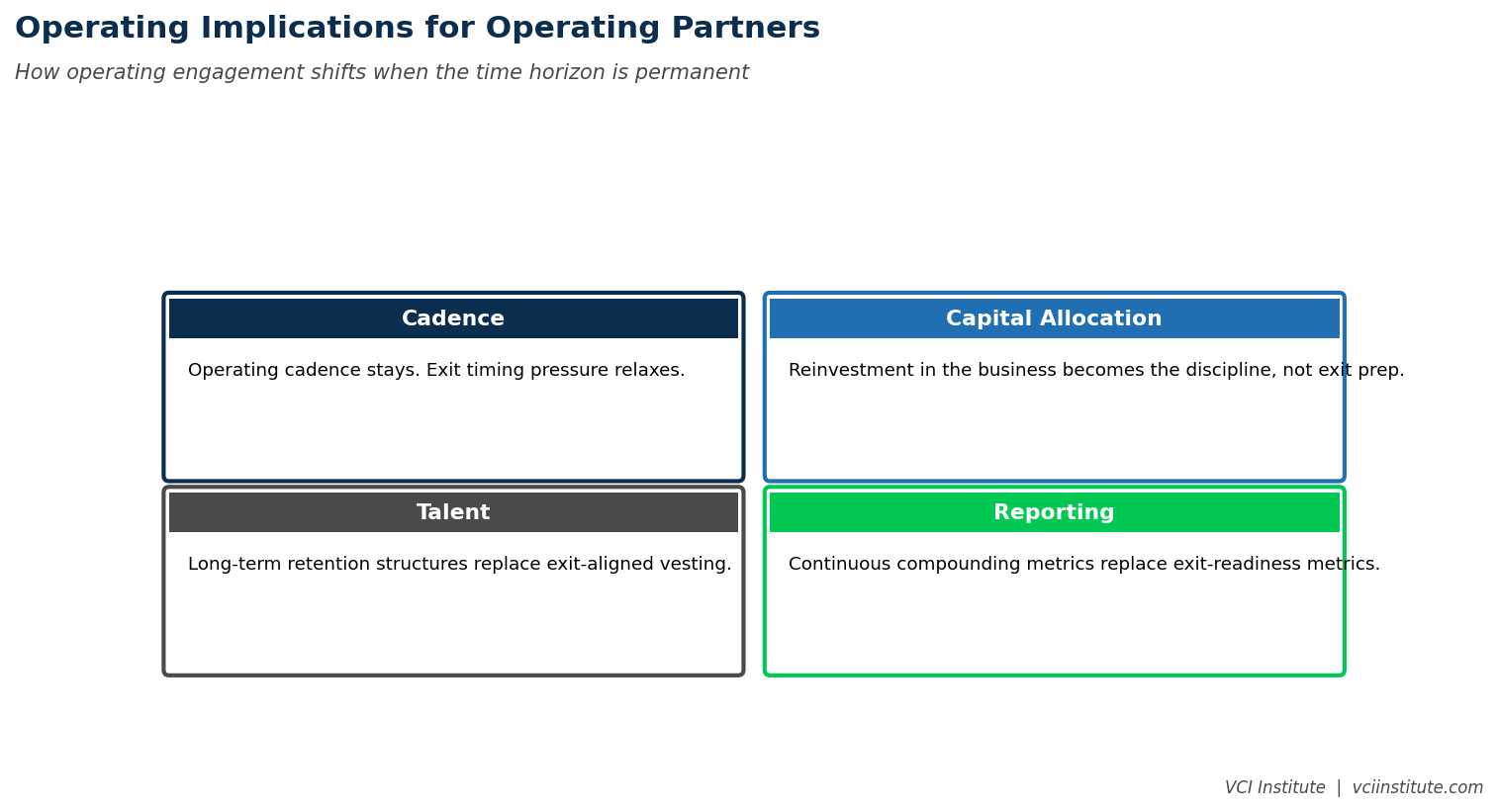
There are mid-market segments where this dynamic is particularly visible. Specialty industrial businesses with multi-decade operating histories. Family owned services businesses with strong regional positions. Niche distribution operations with embedded supplier relationships. Health care and education businesses with mission orientation. In each of these segments, sellers care about who buys the business, not just at what price, and permanent capital structures resonate with sellers who do not want to subject their business to another sale process in five years.
Where Traditional Funds Still Win
The competitive picture is not one sided. Traditional closed end funds retain advantages that permanent capital structures cannot match in certain situations.
Speed and certainty of execution remain a strength of established traditional sponsors. Permanent capital vehicles, particularly newer ones, often have less developed deal teams and slower diligence processes. Founders who want a quick close still prefer traditional sponsors with the institutional infrastructure to move fast.
Aggressive value creation operating playbooks tend to produce stronger initial returns than the more patient approaches favored by permanent capital. A traditional sponsor that can credibly commit to a focused five year transformation may produce more value in the early years than a permanent capital vehicle that prefers to hold and compound. For management teams that want to execute a defined transformation, the traditional sponsor can sometimes be a better partner.
Premium pricing on quality assets, where the sponsor expects significant multiple expansion, remains traditional fund territory. Permanent capital vehicles are typically more disciplined on entry pricing, because they need to compound returns over time rather than capture them at exit. A seller who wants to maximize price now will often find a higher bid from a traditional sponsor than from a permanent capital buyer.
The most thoughtful traditional sponsors are now articulating their case explicitly. They make the speed argument, the playbook argument, and the price argument, calibrated to the specific deal. They acknowledge the permanent capital alternative rather than pretending it does not exist. This is more effective than competing on price alone, because the seller's preference for permanent capital is rarely just about price.
The Operating Partner Implications
Operating partners working with permanent capital vehicles operate under a different set of expectations than those working in traditional fund structures.
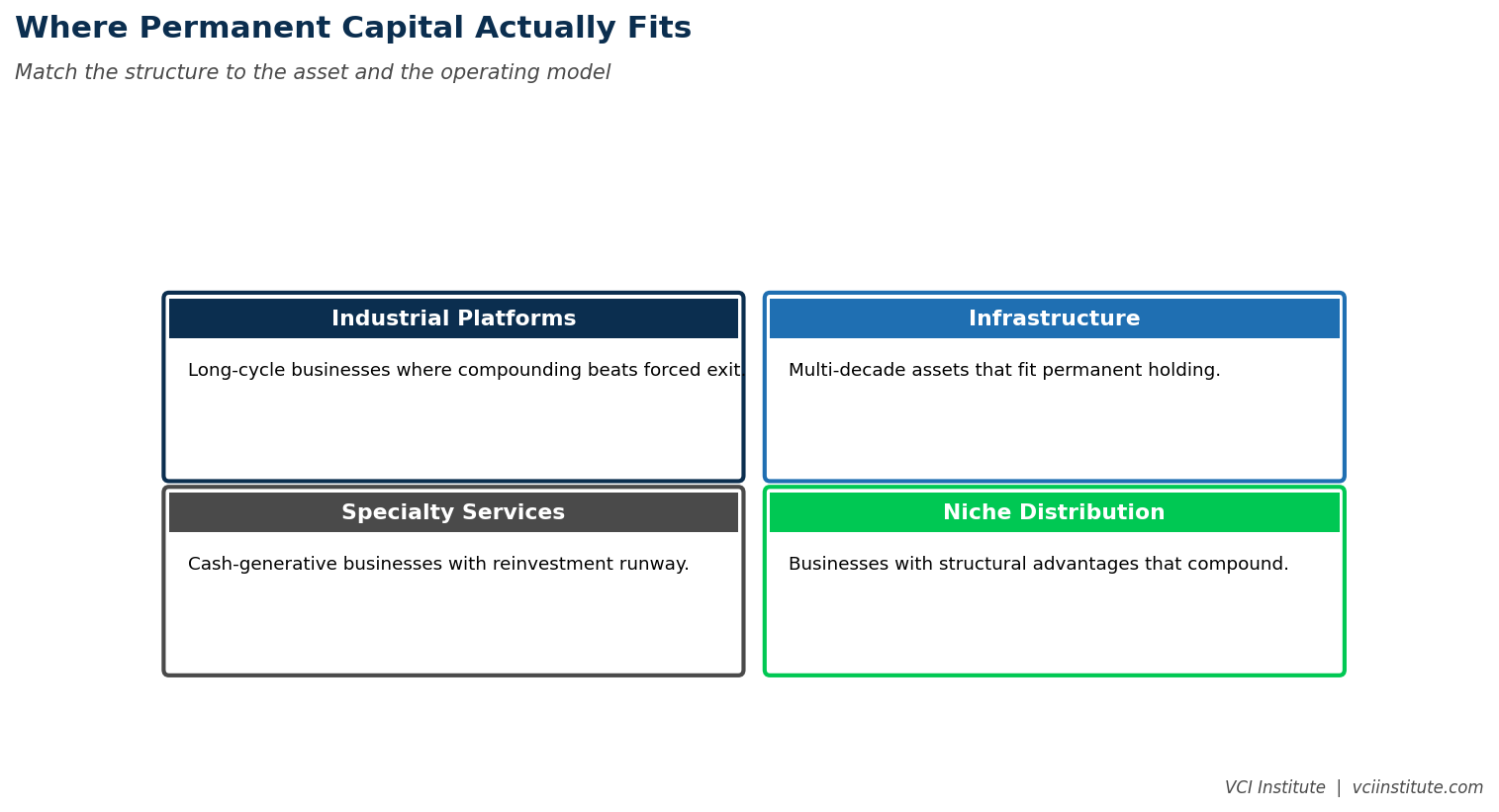
The hundred day plan logic changes. There is no exit eighteen months out that has to be optimized for. The plan can prioritize foundational investments that pay back over a longer horizon. Master data infrastructure. Talent pipeline development. Governance maturation that builds long term capability rather than dressing the company for sale. These investments may have been deferred in a traditional fund context because their payback was outside the hold window. In permanent capital, they become priority investments. The single source of truth audit is the canonical example of work that is chronically deferred under exit pressure and obviously correct under permanent capital.
The talent strategy changes. The five year management team that fits a traditional fund may not be the right team for permanent capital ownership. Permanent capital favors leaders who think about ten and fifteen year compounding, who invest in their teams without the rotation that some private equity playbooks produce, and who treat the business as an institution rather than as a transaction. Operating partners need to evaluate management teams against the actual time horizon of the ownership rather than against a generic profile. Founder-led businesses fit this model unusually well, which is also why the risk of the founder speed tax is lower here than under a compressed transformation mandate.
The KPI selection changes. Traditional funds tend to focus on metrics that translate into exit valuation. Permanent capital can prioritize metrics that build long term capability and competitive position, even when they do not show up in next year's EBITDA. Customer lifetime value. Employee retention. Capability investment as a percentage of revenue. R and D pipeline depth. The dashboards look different.
The governance rhythm changes. Permanent capital boards meet less frequently and focus on more strategic questions than traditional fund boards. The detailed monthly performance reviews that characterize traditional fund governance become quarterly conversations focused on multi-year trajectory rather than quarter to quarter tracking. This is a more demanding governance model in some ways, because the operating partner cannot rely on frequent intervention to course correct. The investments need to be right the first time, which raises the value of an honest baseline read such as an operating maturity diagnostic before capital is committed.
What This Means for Sponsors Considering the Hybrid Path
A growing number of traditional sponsors are exploring hybrid structures that combine traditional fund vehicles with permanent capital sleeves. The motivation is to be able to compete in deal contexts where permanent capital appeals to sellers, while maintaining the traditional fund infrastructure that the rest of the business runs on.
The hybrid path is genuinely useful but introduces complexity that should not be underestimated. The investment thesis for a permanent capital deal is different from the investment thesis for a traditional fund deal, and trying to use the same diligence framework, the same hundred day plan, and the same operating cadence for both produces predictable confusion. Sponsors that operate both structures successfully tend to have separate teams, separate processes, and separate operating playbooks calibrated to each. This is the same fragmentation cost that shows up with fund-of-one structures, and it compounds when a firm runs both.
The capital allocation question between the structures requires explicit governance. Without clear rules, the most attractive deals end up in whichever structure has the most available capital at any given moment, regardless of fit. This produces structural mismatches that hurt returns over time. Sponsors that have figured out the hybrid approach typically have a deal classification framework that places each deal in the right structure based on its long term value creation profile rather than on capital availability.
The Mid-Market Realignment
The aggregate effect of permanent capital growth is a quiet realignment of the mid-market private equity landscape. Certain segments are increasingly characterized by competitive dynamics where permanent capital vehicles have an advantage. Other segments remain firmly the territory of traditional funds. The segments are not always intuitive, and sponsors that map their portfolios against this segmentation will find it more useful than blanket strategies.
The realignment is also producing a slow shift in how operating partners think about their craft. The skills that produce strong outcomes in five year transformations are not always the skills that produce strong outcomes in ten year compounding. Operating partners who can do both, who can move between the playbooks based on the structure they are working in, become more valuable. Those who can only do one become more constrained.
For sponsors and operating partners alike, the rise of permanent capital is not a temporary phenomenon. It is a structural addition to the market that changes how deals get done in segments where the sellers' time horizon, mission orientation, or family legacy considerations make duration of ownership a real factor in their decision. Understanding when and where permanent capital wins, and how to compete or coexist with it, is becoming a basic competency for traditional fund sponsors operating in the mid-market.
The competitor who does not exist on your traditional pitch deck may be the one who quietly took the deal you thought you would win. Permanent capital is not a fringe phenomenon. It is the patient money reshaping how private equity actually gets done in the segments where founders care about more than just price.
VCI Institute in collaboration with Mohamad Chahine
Published 23 July 2026
Related reading from the VCI Institute
Fund-of-One Structures
Customization at the cost of standardization, and the fragmentation cost of running multiple vehicles.
The DPI Reckoning
The distribution pressure permanent capital sidesteps, and the discipline it replaces it with.
The Single Source of Truth Audit
The foundational work that gets deferred under exit pressure and funded under permanent capital.
About the VCI Institute
The VCI Institute is a nonprofit dedicated to building practical capability and shared standards for value creation in private equity. The Institute publishes operator-grade frameworks and runs certification programs for operating partners, portfolio company CEOs, and value creation analysts, including COPPE and CVCA. Analysis published here draws on the Institute's certification curricula and on structured review of mid-market transaction patterns rather than on any single proprietary dataset. Where a figure is directional rather than measured, it is described as such.
Further material is available in the Institute's Insights library and its free resource library of templates, checklists, and case snapshots.
© 2026 VCI Institute. All rights reserved. The frameworks, terminology, and analysis presented in this article are the intellectual property of the VCI Institute. Reproduction or derivative use without written permission is prohibited. Citation with proper attribution is welcomed.
We have many great affordable courses waiting for you!
Stay connected with news and updates!
Join our mailing list to receive the latest news and updates from our team.
Don't worry, your information will not be shared.
We hate SPAM. We will never sell your information, for any reason.






 Practice Platform