
Fund-of-One Structures: Customization at the Cost of Standardization
Jul 27, 2026
A decade ago, separately managed accounts and fund-of-one structures in private equity were rare exceptions, used mostly for the largest sovereign wealth funds and a small number of strategic LPs that wanted bespoke economics. Today, they are increasingly common features of the institutional fundraising landscape, and most established mid-market and large-cap sponsors now have multiple such arrangements alongside their traditional commingled funds.
The growth has been quiet because the structures themselves are quiet. They sit alongside the main fund. They appear briefly in fundraising disclosures. They do not generate the headline metrics that anchor the firm's brand. And yet, for the operating partners and deal teams that have to actually execute against them, they introduce a layer of complexity that many sponsors have underestimated.
The short answer
LPs get three things from a fund-of-one: bespoke fee economics worth one to two points of net IRR, governance and reporting built to their institutional requirements, and investment scope shaped to their preferences. Sponsors pay in operating consistency, resource allocation complexity, and lost cross-deal learning. Three questions decide whether a given structure is worth accepting. Is the LP genuinely strategic or simply price sensitive. How large is the vehicle relative to the main fund, because at fifty percent it is a parallel firm requiring near-duplicate infrastructure. And does the investment scope diverge, because execution complexity scales with divergence.
The basic structure is straightforward. An LP commits a substantial amount of capital, often two hundred million dollars or more, in a single LP arrangement that has its own governance, its own economics, its own investment criteria, and its own reporting requirements. The LP gets bespoke terms in exchange for the size of the commitment. The sponsor gets capital that is more durable than typical fund commitments and that often comes with more flexibility on use of proceeds, hold periods, and operational discretion.
What LPs Get
The appeal to LPs is genuine and rests on three features that traditional commingled funds do not offer.
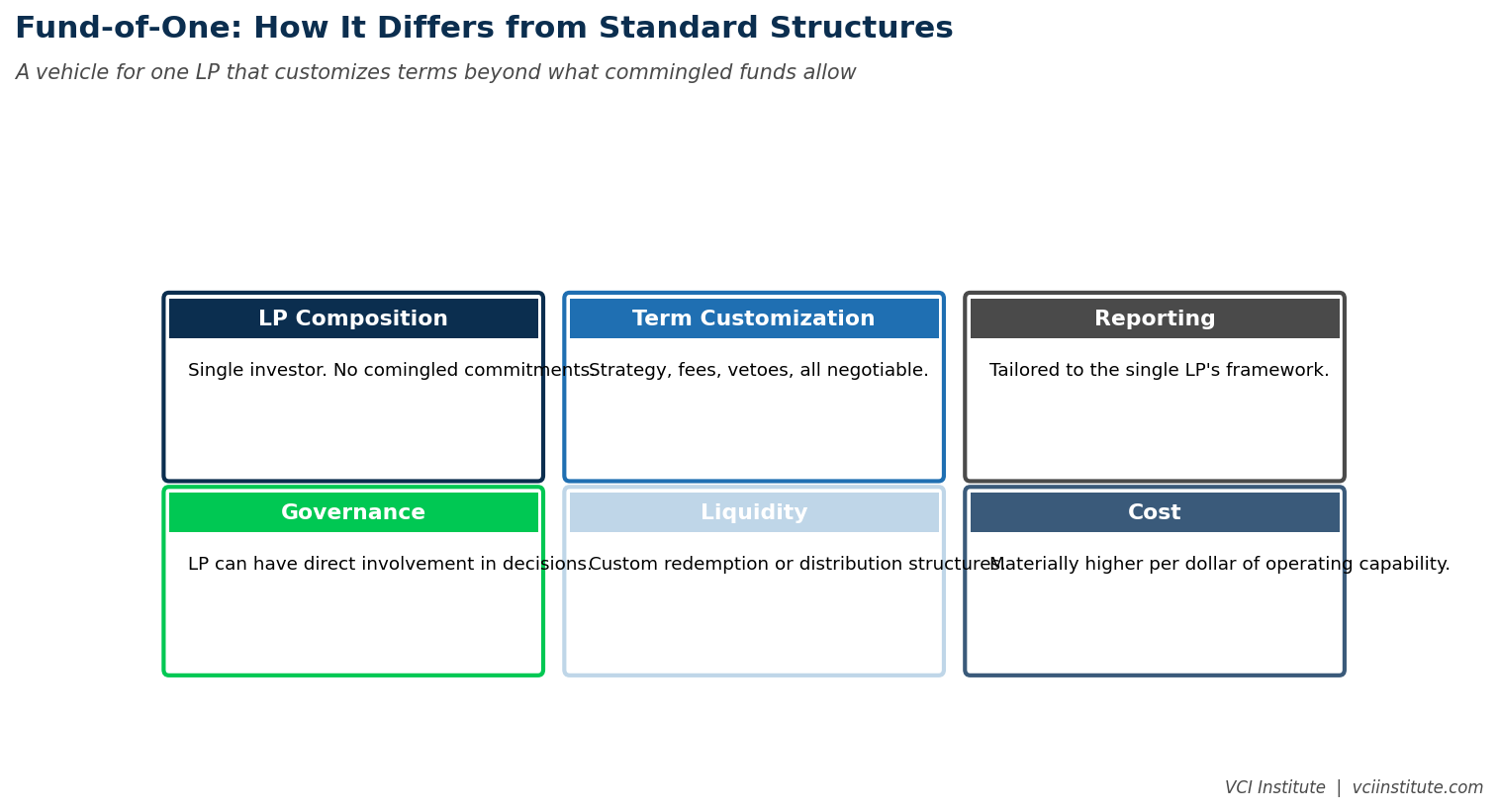
The first feature is bespoke fee economics. Large LPs that commit substantial capital can negotiate management fees, carry structures, and waterfall mechanics that meaningfully improve their net returns relative to standard LPA terms. Over a typical hold period, the difference can be one to two percentage points of net IRR, which on substantial commitments produces real money.
The second feature is governance and reporting customization. Sophisticated LPs have specific requirements for how they monitor exposure, how they evaluate performance, how they integrate private equity into their broader portfolio reporting, and how they engage on ESG, geographic, or sector preferences. Commingled funds use a one size fits all model that is acceptable to most LPs but rarely optimal for any specific one. Fund-of-one structures allow each LP to specify the governance and reporting model that fits its institutional needs.
The third feature is investment scope flexibility. LPs that have specific exposure preferences, geographic restrictions, sector focus, or strategic considerations can shape the fund-of-one mandate to match these preferences. A sovereign wealth fund that wants to focus capital on its home region. A pension fund that wants to avoid certain sectors. A strategic LP that wants exposure to a specific operational thesis. All of these are difficult to accommodate in a commingled fund and natural in a fund-of-one structure.
The combination is genuinely valuable to large LPs and explains why the market for these structures has grown. It also sits inside a broader shift in what LPs are optimising for. With distributions lagging, the ability to shape liquidity terms directly has become as important as the fee line, which is the dynamic described in the DPI reckoning.
What Sponsors Pay
What is less discussed is the cost to the sponsor of operating across multiple fund-of-one structures alongside a commingled fund. The cost shows up in three areas.
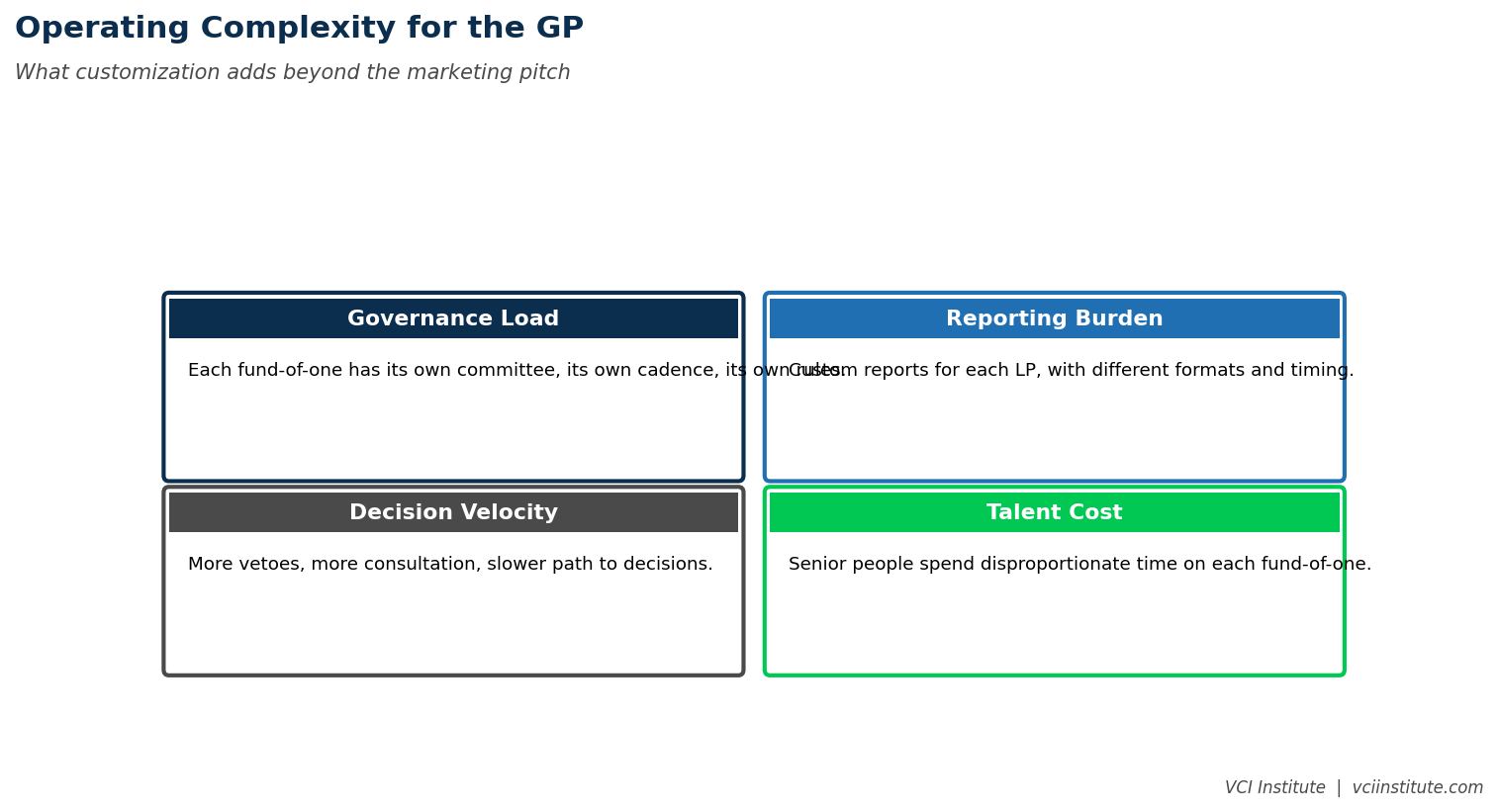
The first area is operating consistency across the portfolio. Each fund-of-one has its own governance terms, its own LPAC composition, its own reporting cadence, and sometimes its own restrictions on use of capital or hold period. When portfolio companies sit inside different fund structures, the operating cadence for each company is shaped by the structure it sits in rather than by its own operational needs. The operating partner who runs across the portfolio finds herself navigating slightly different governance models for different deals, which compounds into a real overhead burden.
The second area is talent and resource allocation. Operating partners and functional resources are typically deployed across the portfolio based on need. When the portfolio includes deals with different governance and reporting requirements driven by different LP structures, the resource allocation becomes more complex. A specific operating partner might need to spend disproportionate time on a fund-of-one deal because the LP requires a particular cadence of engagement, even when the deal is performing within expectations.
The third area is institutional knowledge management. Sponsors typically develop institutional knowledge about what works across their portfolio. Pricing strategies that succeeded in similar businesses. Operating cadences that produced good outcomes. Talent profiles that matched specific transformation challenges. When the portfolio fragments across multiple structures with different governance, the cross-deal learning becomes harder to capture and harder to apply. Knowledge stays inside individual deal teams rather than circulating across the firm.
This third cost is the one most often missed at the point of decision, because it does not appear in any model. Pattern recognition across a portfolio is the compounding asset that separates firms with genuine operating capability from firms with a roster of contacts, and it degrades quietly when the portfolio fragments. A shared diagnostic language, such as an operating maturity index applied consistently across every deal regardless of the vehicle it sits in, is one of the few practical defences.
The Operating Partner Reality
For operating partners specifically, fund-of-one structures introduce two practical complications that deserve more attention than they typically receive.
The first complication is scope creep in LP engagement. LPs in fund-of-one structures, having paid for customization, often expect more direct engagement with the operating side of portfolio companies than commingled fund LPs would. They may want briefings on specific portfolio companies. They may want to attend operating reviews. They may want to engage directly with management teams on strategic questions. The expectations can be reasonable in moderation. They can become disproportionate in aggregate, particularly when the operating partner has multiple fund-of-one LPs across the portfolio with different but cumulatively heavy engagement requirements.
The second complication is timing and exit pressure misalignment. Commingled funds have an aggregate exit pressure that drives portfolio level decisions. Fund-of-one structures sometimes have different exit pressures, more flexible in some cases, more constrained in others. When a portfolio company sits inside a fund-of-one with a different exit horizon than the commingled fund's typical pace, the operating partner has to calibrate to a different timeline than the rest of the portfolio. The flexibility is good in principle. The execution complexity is real in practice. Where the horizon extends far enough, the vehicle starts to behave less like a fund and more like permanent capital, which changes the operating brief materially.
When Fund-of-One Makes Sense for Sponsors
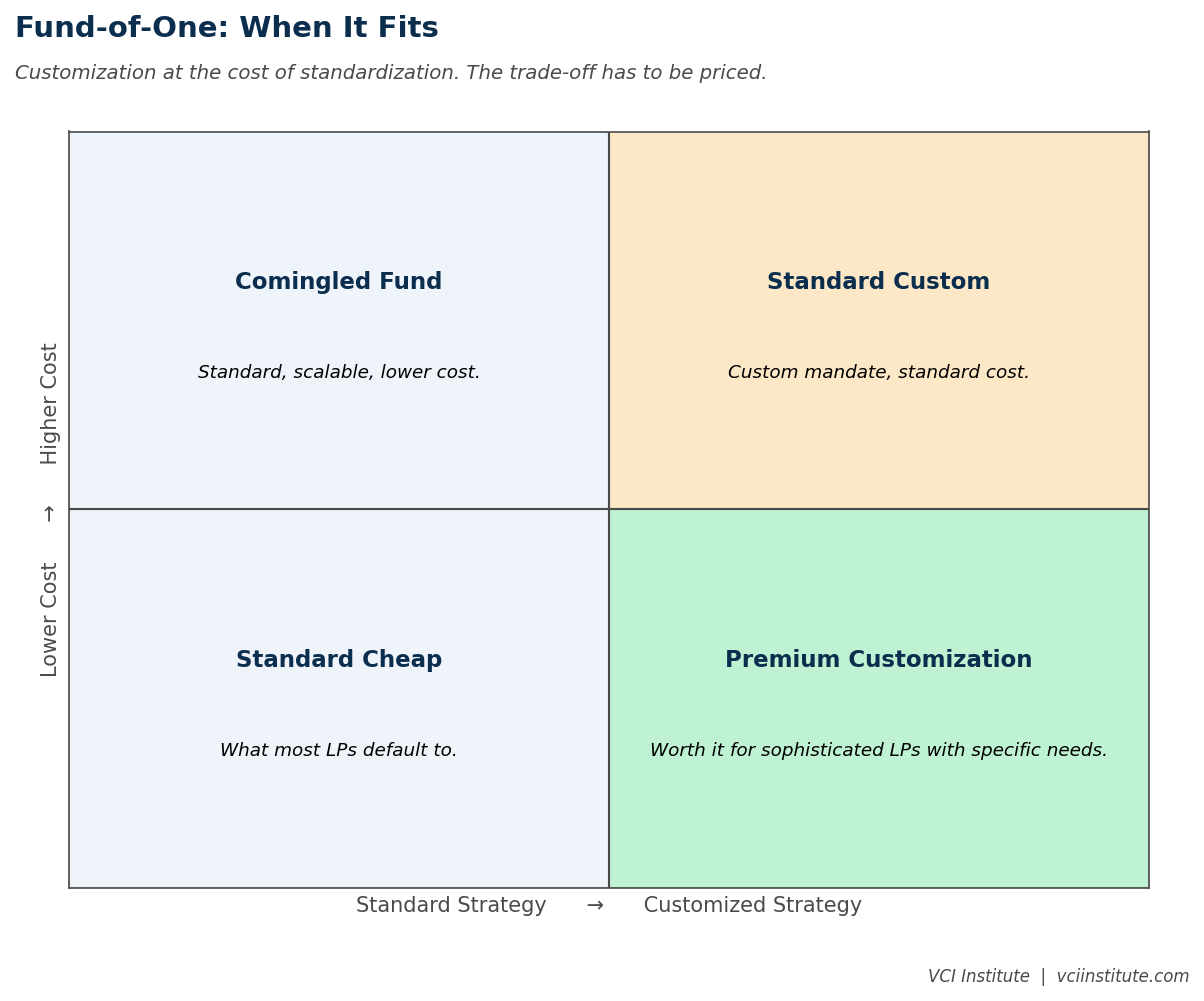
The question is not whether to accept fund-of-one capital. The question is when to accept it and on what terms. Three considerations help calibrate the decision.
The first consideration is whether the LP is genuinely strategic. A fund-of-one with an LP that brings sourcing, sector expertise, geographic access, or operational capability that the sponsor does not otherwise have is a different proposition than a fund-of-one with an LP that simply wants better economics. The former is a strategic relationship that justifies the operational cost. The latter is a financial relationship that should be priced more carefully.
The second consideration is the size of the fund-of-one relative to the commingled fund. A fund-of-one that is fifteen percent of the size of the main fund is a manageable additional structure. A fund-of-one that is fifty percent of the size of the main fund is a parallel firm that requires near duplicate infrastructure to manage well. The economics of accepting a particular fund-of-one need to account for the operational scale required to run it properly.
The third consideration is the alignment of investment scope. A fund-of-one with the same investment scope as the commingled fund can be operated relatively efficiently because most decisions apply to both. A fund-of-one with materially different scope requires separate sourcing effort, separate diligence calibration, and sometimes separate operating capability. The execution complexity scales with the divergence in scope, and the economics need to reflect this.
Sponsors that have been disciplined about these three considerations have built fund-of-one businesses that are accretive to the firm's overall economics and capability. Sponsors that have accepted fund-of-one capital opportunistically have, in some cases, found themselves operating two or three quasi-firms inside one organization, with the operational overhead exceeding the economic benefit.
The Disclosure and Governance Implications
The growth of fund-of-one structures alongside commingled funds is producing governance complexities that some sponsors have underestimated.
Conflict of interest management becomes more demanding. When an opportunity arises that fits both the commingled fund's mandate and a fund-of-one's mandate, the allocation decision affects multiple LP groups simultaneously. The decision frameworks for these allocations need to be explicit, documented, and consistently applied. Without rigor here, sponsors expose themselves to LP disputes that can harm the firm's reputation and its ability to fundraise.
Disclosure to commingled fund LPs about the existence and operation of fund-of-one structures is also a developing area. Some sophisticated commingled fund LPs are beginning to ask whether the existence of fund-of-one capital affects their own returns through allocation decisions, operating partner attention, or strategic priorities. Sponsors that anticipate these questions and have clear answers are in a stronger position than those that have not thought through how to articulate the relationship. The same questions are being asked, from the other end of the market, about the structures being built for the mass affluent, which is the subject of the analysis of fund level borrowing and the liquidity engineering it supports.
The Larger Pattern
The proliferation of fund-of-one structures is part of a broader fragmentation of private equity capital structures. The era when a sponsor's business consisted of a single fund family with predictable cadence and standardized terms is largely over for most established firms. The contemporary sponsor operates across commingled funds, fund-of-one structures, continuation vehicles, co-investment programs, and sometimes permanent capital vehicles, each with its own economics and governance.
This fragmentation has costs and benefits. The benefits, in capital flexibility and LP relationship depth, are real. The costs, in operating complexity and institutional coherence, are also real. Sponsors that manage the fragmentation well, with disciplined choice about which structures to add and how to integrate them into a coherent operating model, capture the benefits without absorbing the full costs. Sponsors that accept structures opportunistically, without confronting the operating implications, end up with fragmented businesses that struggle to maintain the coherence that produces consistent performance.
For operating partners specifically, the implication is that the work has become more demanding. Operating across multiple structures, each with its own governance requirements and LP engagement expectations, requires both more bandwidth and more sophistication than operating within a single commingled fund framework. The operating partners who handle this complexity well are increasingly differentiated from those who struggle with it.
The structures will continue to evolve. The right response, for sponsors and operating partners both, is to be deliberate about which structures to accept, how to operate them, and how to maintain the institutional coherence that the underlying value creation work requires. Customization has its place. Standardization has its place. The discipline is to know which one each specific situation actually calls for, and to design accordingly.
VCI Institute in collaboration with Mohamad Chahine
Published 27 July 2026
Related reading from the VCI Institute
Permanent Capital Vehicles
The patient money reshaping the mid-market, and what happens when the hold horizon extends indefinitely.
The DPI Reckoning
Why distributed-to-paid-in is now the metric that matters, and what LPs are really negotiating for.
The Operating Maturity Index
A shared diagnostic language that holds cross-deal learning together when the portfolio fragments.
About the VCI Institute
The VCI Institute is a nonprofit dedicated to building practical capability and shared standards for value creation in private equity. The Institute publishes operator-grade frameworks and runs certification programs for operating partners, portfolio company CEOs, and value creation analysts, including COPPE and CVCA. Analysis published here draws on the Institute's certification curricula and on structured review of mid-market transaction patterns rather than on any single proprietary dataset. Where a figure is directional rather than measured, it is described as such.
Further material is available in the Institute's Insights library and its free resource library of templates, checklists, and case snapshots.
© 2026 VCI Institute. All rights reserved. The frameworks, terminology, and analysis presented in this article are the intellectual property of the VCI Institute. Reproduction or derivative use without written permission is prohibited. Citation with proper attribution is welcomed.
We have many great affordable courses waiting for you!
Stay connected with news and updates!
Join our mailing list to receive the latest news and updates from our team.
Don't worry, your information will not be shared.
We hate SPAM. We will never sell your information, for any reason.






 Practice Platform