The Three People You Cannot Lose: A Post-Close Talent Density Map
Jun 25, 2026
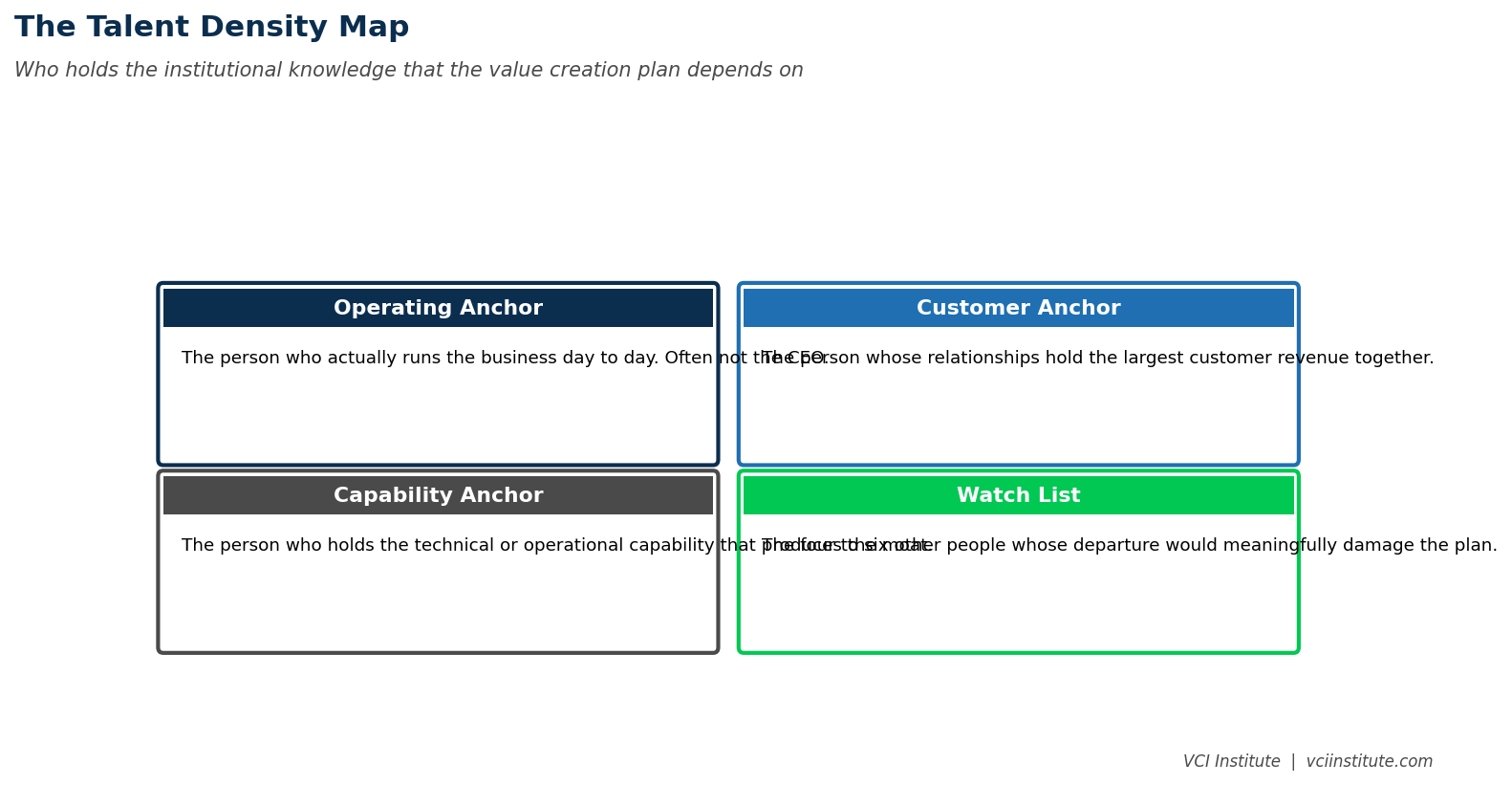
The first ninety days after close are the most expensive window in private equity for losing people. Not the people with the loudest titles. The people who actually make the business work. They are usually two or three names, sometimes four, and almost never the names that appeared in the management presentation deck. They are the operator who knows how the business gets delivered. The commercial relationship holder who keeps half a dozen large customers loyal through inertia and trust. The institutional memory in human form who knows where every workaround, every undocumented exception, every quiet fix is buried.
If any one of them leaves in the first ninety days, the business stutters. If two of them leave, the business stalls. If three of them leave, the value creation thesis is in serious trouble, and nobody on the deal team will admit, in writing, what just happened.
The short answer
The people a business genuinely depends on are rarely the ones in the management presentation. They fall into three archetypes: the operator who knows how delivery actually happens, the relationship holder who carries customer or supplier trust personally, and the memory who knows the undocumented history. They are lost through five mechanisms, of which compensation is only one and rarely the first. The map cannot be built from the org chart, because the org chart shows reporting lines rather than value flow. It is built from three questions asked privately of ten or twelve senior people in the first two weeks. Then the retention conversations happen in week three, not month three.
The risk is large because the window is short and visibility is poor. Operating partners arrive at close with relationships built mostly with the C suite. They do not know the second tier. They certainly do not know the third tier, where most of the indispensables live. Meanwhile, those same indispensables are watching what is happening, listening to what people are saying, and quietly deciding whether they want to stay or leave under new ownership. By the time anyone in the sponsor team realizes who they cannot lose, the conversation is happening on a recruiter's phone rather than at a kitchen table.
Who the Indispensables Actually Are
The pattern is consistent across mid-market businesses. The indispensables fall into three archetypes. Sponsors who recognize the archetypes find them faster.
The first archetype is the operator. This person knows the operational reality of the business at a level nobody else does. In a manufacturing business, it is the production manager who has been there fifteen years, knows every machine, has handled every supplier crisis, and can troubleshoot any quality issue in twenty minutes. In a services business, it is the senior project manager who runs the largest accounts and knows the personalities of every client team. In a distribution business, it is the operations manager who keeps the warehouse and logistics network functioning despite the data being incomplete. The operator does not have an executive title. The business depends on her completely.
The second archetype is the relationship holder. This person carries the personal trust of customers, suppliers, or partners that the company depends on. In a B2B services business, it is the senior account executive who has been the named contact at five strategic accounts for a decade. In a manufacturing business, it is the procurement leader who has built personal relationships with every key supplier. In a regulated industry, it is the compliance officer whose personal credibility with regulators is institutionally embedded. The company carries the customer or supplier on paper. The relationship holder carries it in practice. This is also the concentration risk that diligence reports routinely miss, because it does not appear in revenue by customer, which is the argument in customer concentration theatre.
The third archetype is the memory. This person knows everything about how the business has historically operated, including the things that are not documented anywhere. Why the pricing schedule has a particular irregular structure. Which contract has a clause that nobody noticed. How a process actually works rather than how the manual says it works. Where the bodies are buried in the legacy IT systems. The memory is often a long tenured employee in a role that does not look senior on paper. Lose her and the business spends two years rediscovering things that had been known for fifteen. The undocumented reconciliation logic surfaced by a single source of truth audit almost always traces back to one of these people.
These three archetypes are usually three different people. Sometimes they overlap. In small businesses, the founder might play all three roles, which is why losing a founder almost always cripples the business in ways the deal team did not anticipate.
How Indispensables Get Lost
The loss pattern is also consistent. There are five mechanisms by which the first ninety days produce departures.
The first mechanism is fear. The indispensable hears about the deal, understands that everything is about to change, and starts to evaluate her options before anyone has had a real conversation with her about what the change means for her specifically. By the time the operating partner gets to her in week eight, she has already taken three meetings with competitors and has an offer in hand.
The second mechanism is invisibility. The indispensable does not have a senior title, so the integration plan, the synergy plan, and the org chart redesign do not feature her by name. She watches the planning happen around her and concludes that her role is not strategic to the new owner. She starts to look for somewhere where it would be.
The third mechanism is reorganization. The new operating model places the indispensable under a new boss, in a new structure, with a new reporting line. The previous boss who understood her value is gone or sidelined. The new boss does not yet know what she does. She finds herself doing the same job under someone who is, from her perspective, less competent and less appreciative. She leaves.
The fourth mechanism is process imposition. The indispensable made the business work through judgment, instinct, and relationships. The new operating model installs processes that constrain judgment, second guess instincts, and bureaucratize relationships. She finds herself spending three days a week filling in forms that document work she used to do faster without them. She quits, sometimes loudly, more often quietly. This is the individual-level version of a company-level failure, and the wider pattern is set out in the founder speed tax.
The fifth mechanism is compensation neglect. The indispensable was on a compensation package that reflected her market value to the prior owner. The new owner does not yet understand her market value, and her existing package looks ordinary on paper. Meanwhile, every recruiter in the market knows that an acquisition just happened and is calling to make her offers that reflect what someone with her institutional knowledge is actually worth. Without proactive intervention, she leaves for fifteen percent more, and the new owner discovers, six months later, that fifteen percent more would have been the cheapest investment in the entire integration.
How to Find Them Before You Lose Them
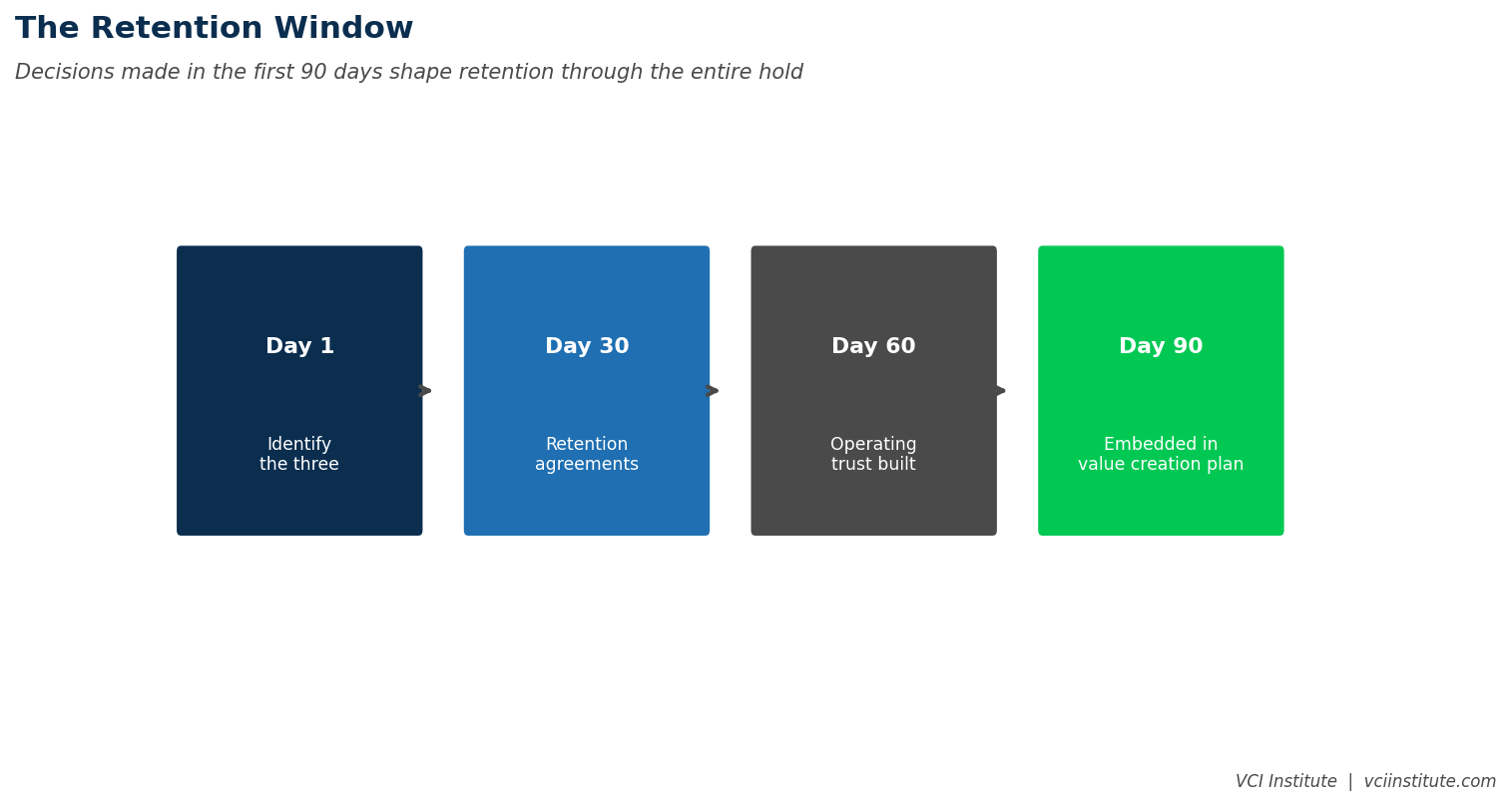
The simplest discipline is to spend the first three weeks after close mapping the indispensables explicitly. The map is a one page document. It lists by name the people the business genuinely depends on, organized by function, with a one line description of what makes each one indispensable.
The map cannot be built from the org chart. The org chart shows reporting relationships, not value flow. It has to be built from conversations. Operating partners who run this exercise well ask three questions of every senior person in the business, in private, in week one or two.
If you walked out tomorrow, who is the one person whose departure would worry you most. Why. The answer reveals the operator and the memory in their team.
If our largest customer called you with a problem, who is the one person inside the company you would want answering the phone. Why. The answer reveals the relationship holder, sometimes from a department the deal team had not focused on.
If we suddenly had to grow this business twice as fast, who is the one person whose work would be hardest to replicate at scale. Why. The answer reveals the talent that the business would need to retain through the next phase.
After ten or twelve such conversations, the indispensable map writes itself. The same names come up repeatedly, often from the second and third tier, often from people who were not on any presentation deck the deal team saw.
The Retention Conversation
Once the map exists, the retention conversations have to happen quickly. Not after the new operating model is rolled out. Before. Each indispensable should have a face to face conversation with a senior member of the sponsor team in the first thirty days. The conversation has three jobs.
The first job is to acknowledge the person's value explicitly. Most indispensables have rarely been told they are indispensable, because their immediate managers either did not know or did not want them to know. Hearing it from the new owner, in plain words, often resets the conversation in ways that retention bonuses alone cannot.
The second job is to understand what the person wants. Some indispensables want money. Some want title. Some want to be left alone. Some want to be more involved in strategy. Some want development. The mistake operating partners make is to assume the answer is always money. The answer is whatever this specific person wants. The conversation surfaces it.
The third job is to construct a retention package that fits. Sometimes that is a meaningful equity grant. Sometimes it is a long term cash retention agreement. Sometimes it is a guaranteed reporting line through someone the indispensable trusts. Sometimes it is a defined career path that did not exist before. The package is bespoke. The discipline is to do this in week three or four, not in week thirty after the first leaver has already announced.
What Sponsors Get Wrong
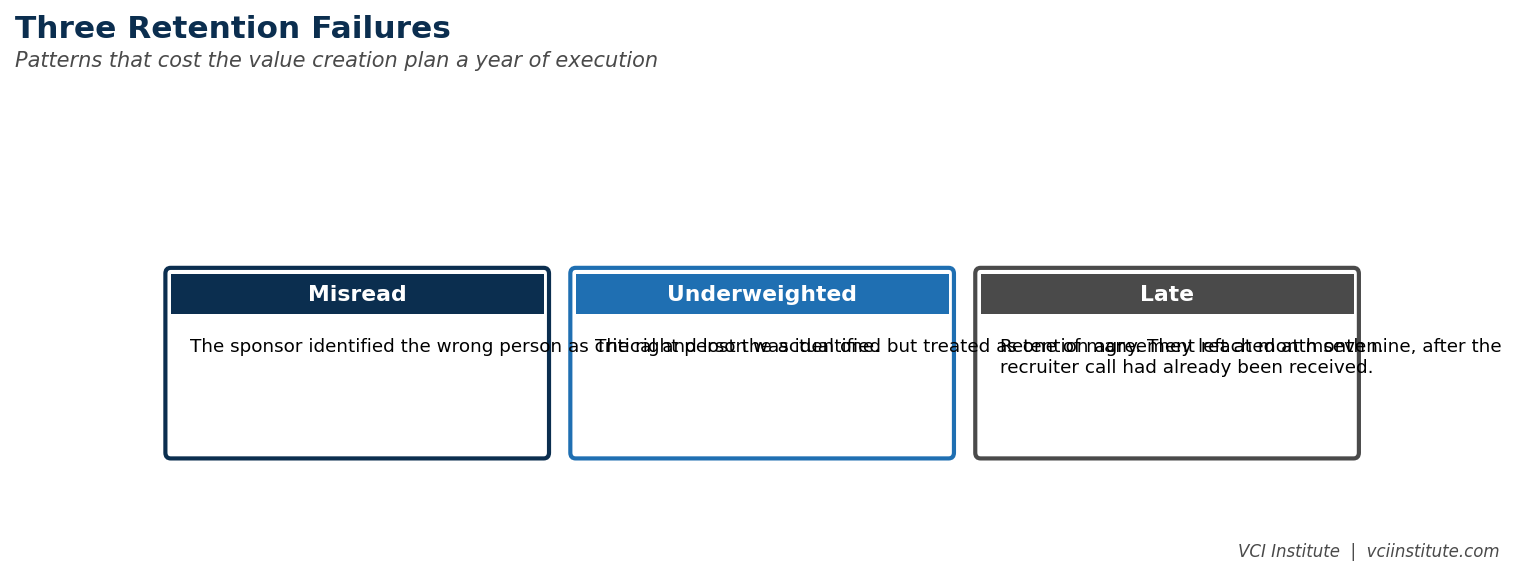
The most common error is to confuse the indispensables with the C suite. The C suite is important, well known, and contractually engaged from the close. The indispensables are usually neither well known to the sponsor nor contractually engaged. They are the highest risk and the lowest visibility group in the integration plan.
The second most common error is to delay the conversation. Operating partners who plan to do the talent map in month three discover that two of the indispensables have already left in month two. The window is much shorter than the standard integration playbook acknowledges. It is also competing directly with everything else in the first hundred days, which is why it belongs on the critical path rather than in the backlog, as argued in the 100-day autopsy.
The third most common error is to rely on the existing CHRO to identify the indispensables. The CHRO knows the org chart and the compensation bands. She often does not know the value flow as well as the senior operators in each function. Building the map requires going around the CHRO to the people who actually depend on the indispensables, who are the most reliable source of who they are.
The Operating Partner's First Page
The talent density map should be the first page of the integration plan, not an HR appendix. It should be reviewed weekly during the first ninety days. It should be referenced explicitly when any organizational change is contemplated. The question, will this affect any of the people on page one, should be the first question asked before any reorganization is approved. The discipline of treating the indispensables as a strategic asset rather than as a personnel matter is what separates sponsors who retain the operating capability of the businesses they buy from sponsors who unintentionally disassemble that capability while admiring their integration timelines.
The same map earns its keep again at the other end of the hold. Exit readiness depends on a buyer believing the business can run without heroics, and the retention agreements signed in week three are the evidence for that claim three years later. The link between retained operating capability and realised proceeds is the subject of the DPI reckoning.
Lose the wrong two people in the first ninety days and the value creation thesis is in trouble before the operating partner has had a chance to execute it. Retain them, build trust with them, and align them around the new ownership and the next chapter, and the integration becomes a force multiplier rather than a value destruction event. The names matter. The conversations matter. The timing matters. And in too many private equity integrations, none of the three get the attention they deserve until the recruiters have already done their work.
VCI Institute in collaboration with Mohamad Chahine
Published 25 June 2026
Related reading from the VCI Institute
The 100-Day Autopsy
Why this work competes with everything else in the same window, and usually loses.
The Founder Speed Tax
The company-level version of process imposition, and what it costs.
Customer Concentration Theatre
Why relationship-holder risk never appears in revenue by customer.
About the VCI Institute
The VCI Institute is a nonprofit dedicated to building practical capability and shared standards for value creation in private equity. The Institute publishes operator-grade frameworks and runs certification programs for operating partners, portfolio company CEOs, and value creation analysts, including COPPE and CVCA. Analysis published here draws on the Institute's certification curricula and on structured review of mid-market transaction patterns rather than on any single proprietary dataset. Where a figure is directional rather than measured, it is described as such.
Further material is available in the Institute's Insights library and its free resource library of templates, checklists, and case snapshots.
© 2026 VCI Institute. All rights reserved. The frameworks, terminology, and analysis presented in this article are the intellectual property of the VCI Institute. Reproduction or derivative use without written permission is prohibited. Citation with proper attribution is welcomed.
We have many great affordable courses waiting for you!
Stay connected with news and updates!
Join our mailing list to receive the latest news and updates from our team.
Don't worry, your information will not be shared.
We hate SPAM. We will never sell your information, for any reason.


 Practice private equity like a pilot trains