Dividend Recaps Reconsidered: When the Distribution Is Actually a Decision
Jul 30, 2026
The dividend recapitalization has returned to the private equity playbook with renewed intensity over the past eighteen months. The reason is not subtle. With exits slowed, DPI weak, and LPs pressing for distributions, sponsors have rediscovered that a leveraged dividend is one of the few mechanisms available to return capital without selling assets at uncertain prices.
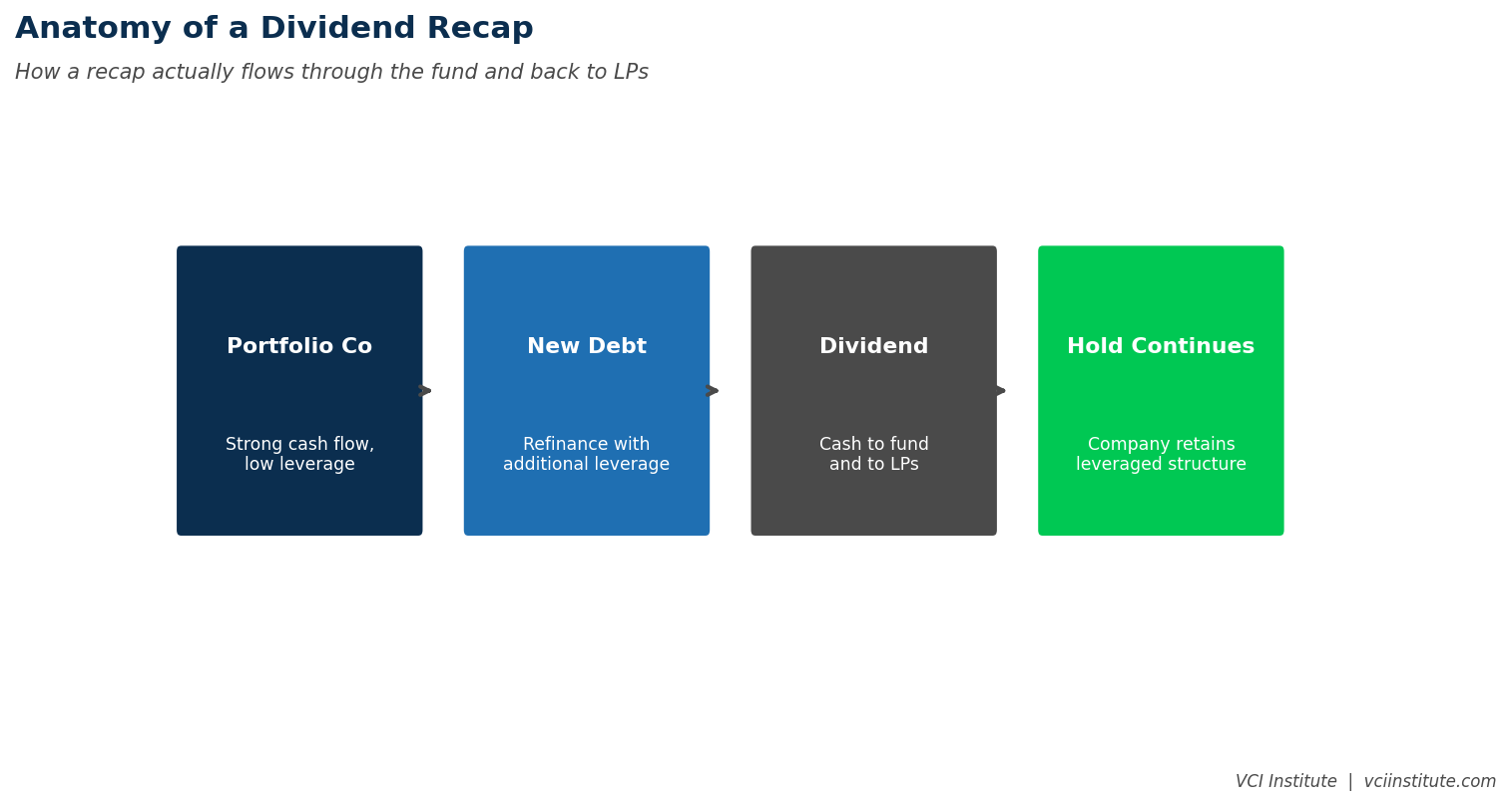
The mechanics are well known. The portfolio company refinances its existing debt, takes on additional debt against its cash flow, and uses the incremental proceeds to pay a dividend to the fund, which then distributes the dividend to LPs. The transaction does not change the operating structure of the business. It changes the capital structure. The fund books the distribution. The LPs receive cash. The DPI metric improves.
The short answer
A dividend recap converts future capacity to absorb financial risk into present cash distribution. Three tests separate the disciplined version from the reckless one. Operational stability, meaning the company has produced predictable cash through a full cycle including a downside, so the lender is underwriting history rather than the value creation plan. Competitive position, meaning the company can divert cash flow to debt service without falling behind on the investment its market requires. And residual equity value, meaning the retained stake is still the dominant economic interest rather than a lottery ticket. A recap distributing thirty percent of equity value is a partial exit. One distributing ninety percent is a near-full exit dressed as a refinancing.
When used carefully, the dividend recap is a legitimate tool. When used carelessly, it is a way to convert a longer term value creation thesis into a shorter term distribution event, transferring risk to lenders, to portfolio company management, and ultimately to the equity stake the fund continues to hold. The difference between careful and careless usage is, in too many cases, a matter of how the sponsor team has thought through the tradeoffs.
What the Recap Actually Does
A dividend recap takes future capacity to absorb financial risk and converts it into present cash distribution. The portfolio company that was carrying four times leverage now carries six times. The cash flow that was supporting growth investment, working capital, and debt service is now divided across a larger debt base. The cushion that protected the company from operational disappointments has shrunk.
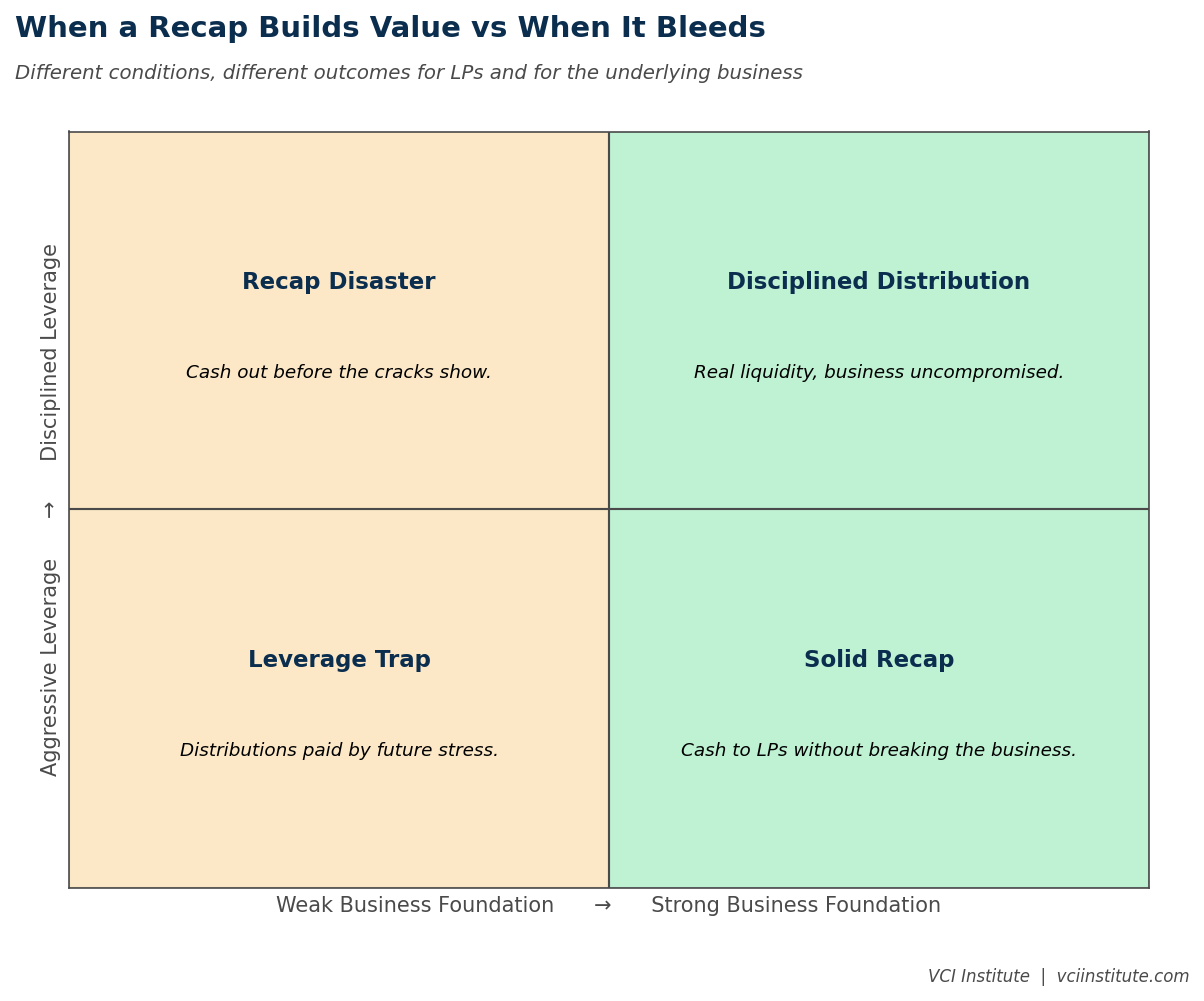
This is not necessarily wrong. If the company has strong cash flow visibility, a stable customer base, and a clear path to deleveraging, taking on more debt to return capital can be a sensible use of the company's borrowing capacity. The lenders are willing to underwrite the higher leverage because the company's risk profile supports it. The fund returns capital to its LPs. The equity stake remains, with continued upside potential. Everyone is reasonable about the risk transfer because the underlying risk is genuinely manageable.
The problem arises when the same mechanics are applied to companies that do not have the underlying risk profile to support the higher leverage. When the cash flow visibility is weaker than the lenders' diligence captured. When the customer base has concentration that the documentation does not fully reveal. When the deleveraging path depends on growth assumptions that are aggressive rather than realistic. In these cases, the dividend recap converts a recoverable situation into a fragile one, and the equity stake that the fund continues to hold becomes substantially more risky than the original investment thesis assumed.
The concentration point deserves particular care, because the standard top ten customer chart routinely understates the real exposure. A company whose revenue looks diversified by named account can be heavily concentrated by beneficial owner or by decision maker, and a leveraged capital structure is exactly the wrong place to discover that. The mapping that surfaces it is set out in the analysis of where concentration actually sits inside a portfolio company.
The Three Tests
Sponsors that use dividend recaps with discipline apply three tests before pulling the trigger.
The first test is operational stability. The portfolio company has demonstrated stable, predictable cash generation through at least one full operating cycle, including a downside scenario. The recap is taking visible borrowing capacity, not aspirational borrowing capacity. The lenders' underwriting is supported by historical performance, not by forecasts that depend on the value creation plan continuing to execute.
A company that has produced stable EBITDA for three years through varied conditions can support additional leverage with confidence. A company that has only recently arrived at strong EBITDA after a transformation, where the cash flow has not yet been tested by stress, is a different proposition. The same recap structure can be sound for the first company and reckless for the second. The discipline is to be honest about which company you actually own, and honesty here depends on reporting that can survive scrutiny, which is the single source of truth question.
The second test is competitive position. The portfolio company has a defensible market position that does not depend on continuous heavy investment to maintain. A company in a mature, slow growth market with strong market share can divert cash flow to debt service without compromising its competitive position. A company in a fast moving market that requires continuous product investment, customer acquisition, or capability building cannot afford to redirect cash flow without weakening its position.
The recap that takes growth investment off the table for a stable market leader is sensible. The recap that takes growth investment off the table for a company that needs to keep investing to defend its position is value destructive in ways the immediate distribution masks. The damage shows up two or three years later when the company has fallen behind competitors that retained their investment cadence. Technology is the most common casualty, and the discipline of pricing that spend honestly rather than treating it as discretionary is the argument in the digital EBITDA bridge.
The third test is residual equity value. The fund's residual equity stake after the recap remains substantial enough to be the dominant economic interest the fund holds. The recap is taking a portion of the equity value out as distribution, not converting the position from equity to debt with a token equity tail. When the distribution is large enough that the residual equity is a small fraction of the original investment value, the recap has effectively converted the position into a fee generating exit, and the residual equity is more lottery ticket than meaningful claim on future value.
A recap that distributes thirty percent of the equity value while leaving seventy percent intact is a partial exit that retains meaningful upside. A recap that distributes ninety percent of the equity value while leaving ten percent is a near full exit dressed up as a refinancing. The economics of the two are quite different, and LPs evaluating recap activity are increasingly sophisticated about reading which they are seeing.
What Lenders Are Pricing In
The lender side of the recap conversation is shifting in 2026. After several years of aggressive financing markets, lenders have become more careful about underwriting the recaps they are willing to fund. The willingness to extend leverage above five and a half or six times has tightened. The covenant packages have become firmer. The pricing has reflected the increased risk.
This shift has filtered into the mechanics of which recaps actually get done. Sponsors that could have completed transactions at attractive terms eighteen months ago are finding the same transactions either declined or repriced now. The recaps that are completing are increasingly those that pass careful lender scrutiny, which has the secondary effect of being the recaps most likely to clear the three tests above.
The recaps that are still being attempted but no longer financing are, generally, the ones that did not pass the tests in the first place. Sponsors that interpreted lender willingness as endorsement of the underlying transaction have found that endorsement was contingent on conditions that have changed. The discipline that was missing on the sponsor side is being substituted by the discipline now imposed on the lender side. From an LP perspective, this is a healthier outcome than the alternative, but it does mean that recaps that were assumed in fund models eighteen months ago are not all materializing.
Where the recap does not clear, sponsors have increasingly reached one level up the structure instead, borrowing against the fund's own net asset value. That substitution does not remove the underlying problem, it relocates it, which is the argument in NAV lending reconsidered.
What LPs Are Watching
LPs evaluating sponsor performance in 2026 are increasingly differentiating between organic distributions from completed exits and engineered distributions from dividend recaps. The two are both DPI on the headline number, but sophisticated LPs are tracking them separately. The reason that distinction has sharpened this cycle is set out in the DPI reckoning.
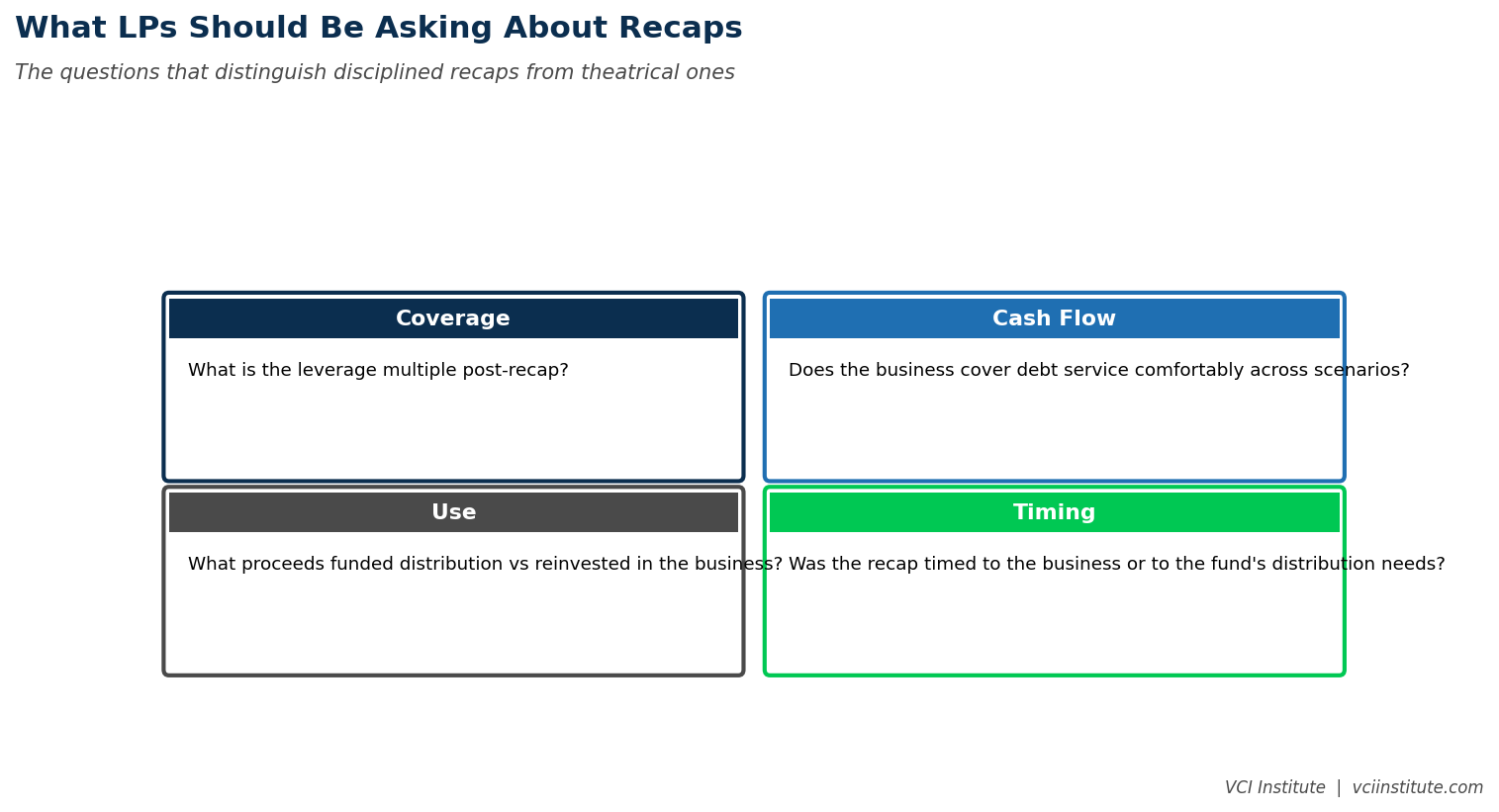
The questions that come up in LP advisory committee meetings about recap activity are predictable. What is the leverage profile of the company after the recap. What is the deleveraging schedule. What is the residual equity position relative to the original investment. What is the operational risk profile of the company under the new capital structure. What is the contingency plan if the operating performance disappoints.
Sponsors that can answer these questions with documentation and a coherent narrative are in a stronger position than those that cannot. The recap that was structured carefully, against a stable cash generating asset, with reasonable leverage and a meaningful retained equity position, supports the answers easily. The recap that was structured aggressively, against a less stable asset, with stretched leverage and minimal retained equity, does not. LPs are increasingly able to tell which is which.
The recap also becomes visible to the next buyer. A company that has been recapped arrives at exit with a capital structure history that a disciplined acquirer will read carefully, which is part of the information picture in sponsor to sponsor transactions.
The Operator's Role
Operating partners are sometimes excluded from the conversation about whether a portfolio company should be recapped. The fund finance and capital markets teams handle the structuring. The operating partner is informed about the transaction after it is being executed. This allocation of decision rights is a mistake in cases where the recap materially affects the operating reality of the company.
The operating partner has the clearest view of the company's actual operating stability, competitive position, and investment requirements. She knows whether the cash flow visibility is real or whether it depends on assumptions that have not yet been proven. She knows whether the company can absorb the diversion of cash flow to debt service without compromising its operations. Including her view in the recap decision, before the structuring is finalized, is the most direct way to ensure that the three tests are applied honestly. A structured read of what the company can currently sustain, rather than an impression of it, is what an operating maturity diagnostic is designed to provide.
Sponsors that have institutionalized the operating partner's voice in capital structure decisions, including dividend recaps, produce more durable outcomes than those that treat the recap as a financial decision separable from the operating reality. The integration is not always natural in firm cultures that historically separated deal teams from operating teams. Where it has been built, it produces better risk discipline.
When the Recap Creates Real Value
A well structured recap, applied to a genuinely stable business, with conservative residual leverage and a meaningful retained equity position, creates value for LPs in three specific ways.
It accelerates DPI without sacrificing eventual exit upside, which materially improves the LP's time weighted return on the investment.
It reduces the fund's exposure concentration in a single asset, which improves the diversification of remaining capital across the portfolio.
It tests the company's capital structure under realistic operating conditions before exit, which produces operational discipline that often improves the company's actual performance.
These are real benefits when the recap is done carefully. They are not benefits that justify reckless recaps applied to fragile businesses. The discipline that produces the benefits is the same discipline that prevents the failures. Most sponsors know this in the abstract. The question is whether they apply the discipline consistently when the immediate pressure to demonstrate DPI is intense.
The recap is a tool. It is not, by itself, a sign of strong or weak fund management. It is a sign of how well the fund team uses the tools available to it. The funds that use the tool with discipline through the next eighteen months will be among the better performing in the cycle. The funds that use it without discipline will discover that the distributions they manufactured today produced consequences that compromised the value creation thesis they were trying to deliver. LPs are watching, and they are more sophisticated about reading the signals than they were a fund cycle ago.
VCI Institute in collaboration with Mohamad Chahine
Published 30 July 2026
Related reading from the VCI Institute
The DPI Reckoning
Why distributed-to-paid-in is now the metric that matters, and the pressure driving recap activity.
NAV Lending Reconsidered
The tool sponsors reach for when the recap does not clear at the portfolio company level.
The Operating Maturity Index
A structured read of what the company can actually sustain, before the leverage decision is made.
About the VCI Institute
The VCI Institute is a nonprofit dedicated to building practical capability and shared standards for value creation in private equity. The Institute publishes operator-grade frameworks and runs certification programs for operating partners, portfolio company CEOs, and value creation analysts, including COPPE and CVCA. Analysis published here draws on the Institute's certification curricula and on structured review of mid-market transaction patterns rather than on any single proprietary dataset. Where a figure is directional rather than measured, it is described as such.
Further material is available in the Institute's Insights library and its free resource library of templates, checklists, and case snapshots.
© 2026 VCI Institute. All rights reserved. The frameworks, terminology, and analysis presented in this article are the intellectual property of the VCI Institute. Reproduction or derivative use without written permission is prohibited. Citation with proper attribution is welcomed.
We have many great affordable courses waiting for you!
Stay connected with news and updates!
Join our mailing list to receive the latest news and updates from our team.
Don't worry, your information will not be shared.
We hate SPAM. We will never sell your information, for any reason.


 Practice private equity like a pilot trains