The Thesis Operating System: From IC Memo to Tuesday Morning
Sep 14, 2026
The investment thesis is the most expensive document in private equity that almost no one reads after Tuesday of close week.
It sits in three places. The deal model. The IC memo. The board deck. None of those are operating documents. They are sourcing documents, pricing documents, and approval documents. They were never designed to run a company.
The short answer
A thesis has to survive four layers to actually run a company: the IC memo, the value creation plan, the quarterly cadence, and the weekly operating rhythm. Each layer speaks a different dialect, and the translation breaks at every handoff. Five things install the system. A one-page back-translation the CEO can recite. A VCP built backwards from it, where every initiative traces to one of three things that have to be true. A board meeting that opens with whether those three things are still true. A dashboard where every metric carries a thesis tag and untagged metrics get retired. And a fifteen minute weekly call between CEO and deal partner about the thesis rather than about operations.
The translation from thesis to Tuesday morning is the most under-engineered handoff in our industry. Funds spend a hundred hours debating a number on slide eleven of the IC memo, then spend zero hours on the question of how that number becomes a Tuesday morning conversation between a CFO and a category manager.
That gap is where value quietly leaks.
We call the solution the Thesis Operating System. Not because it is new software. Because the alternative is no system at all, and what most portfolio companies actually run on is a charisma operating system, where the thesis becomes whatever the loudest person in the room said last week.
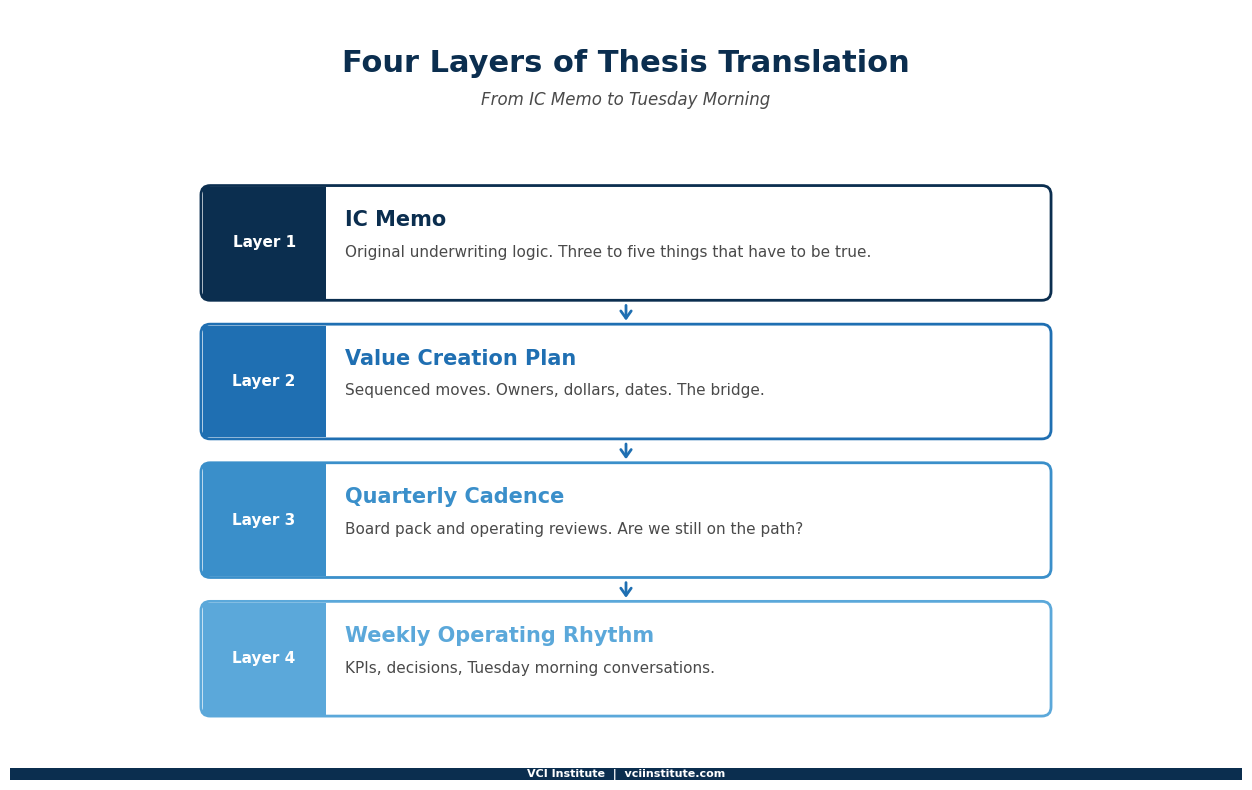
The Thesis Operating System has four layers, and each layer is a translation of the layer above it.
Layer one is the IC memo. The original underwriting logic. Three to five things that have to be true for this investment to work, and the proof points that will tell you whether they are coming true. This layer rarely changes. If it does, you are in trouble.
Layer two is the value creation plan. This is the IC memo expressed as a sequenced set of operational moves with owners, dollar values, and dates. Most VCPs at most funds are not this. Most VCPs are wish lists with EBITDA arrows pointing right. A real VCP is the deal model translated into work that humans can show up and do.
Layer three is the quarterly cadence. The board pack, the operating reviews, the variance analysis, the talent reviews. This layer asks one question: are we still on the path the IC memo described, or have we drifted? Most boards spend their time on layer four content (operating exceptions) and skip the layer three question entirely. That is a governance failure, not an operational one, and it is the same failure described in PE boards that actually work, where performance review crowds out the strategic question the board is uniquely positioned to ask.
Layer four is the weekly operating rhythm. The KPIs the CEO checks on Tuesday morning. The Slack messages between the head of supply chain and the CFO. The pricing decisions a category manager makes without escalating. If the thesis has not made it down to layer four, the company is not running on the thesis. It is running on something else.
The most common failure mode is not that the thesis is wrong. The most common failure mode is that the thesis is right, and the company is running on something unrelated to it.
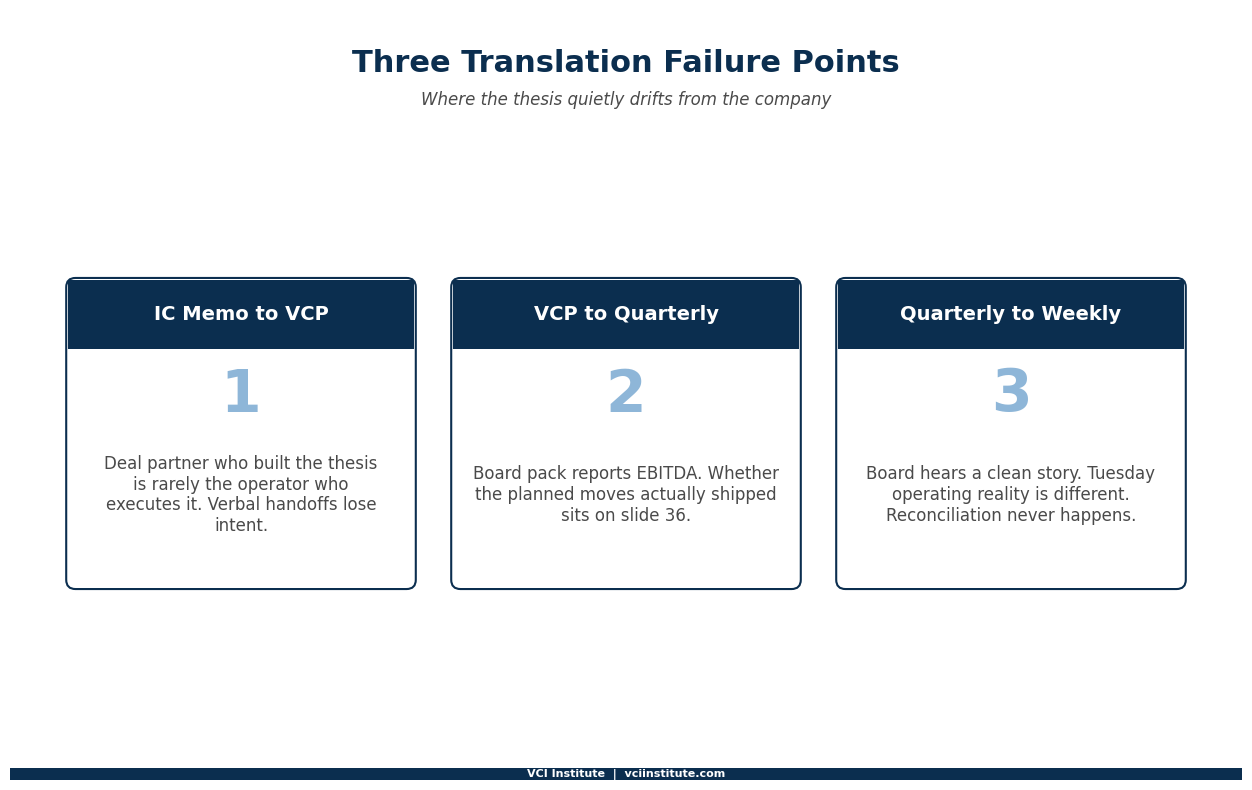
The translation breaks in three predictable places.
First, between the IC memo and the VCP. The deal partner who built the thesis is rarely the operating partner who has to execute it. The handoff is verbal, partial, and biased toward the parts the operator already agrees with. We have watched VCPs that were drafted in week six bear almost no resemblance to the IC memo from week minus four. Both documents are correct. Neither one is connected. This is exactly the boundary that the operating partner and CEO compact is meant to make explicit, and the reason the compact should be written in the same thirty days as the VCP.
Second, between the VCP and the quarterly cadence. The VCP says we will increase price by 4 percent across the top three SKUs. The board pack at quarter end says EBITDA was up 1.2 percent, mostly volume. Whether the price move happened is somewhere on slide thirty-six. Nobody asks. A real pricing program dies here more often than it dies in the market.
Third, between the quarterly cadence and the weekly rhythm. The board hears a clean story. The Tuesday operating meeting hears a different story. Both are true. The reconciliation never happens because neither side asks for it.
This is not a process problem. It is a translation problem. Each layer speaks a different dialect. Each layer optimizes for a different audience. None of them speak to each other unless someone designs the bridge.
The fix is not more meetings. The fix is fewer meetings, with explicit translation rules between layers.
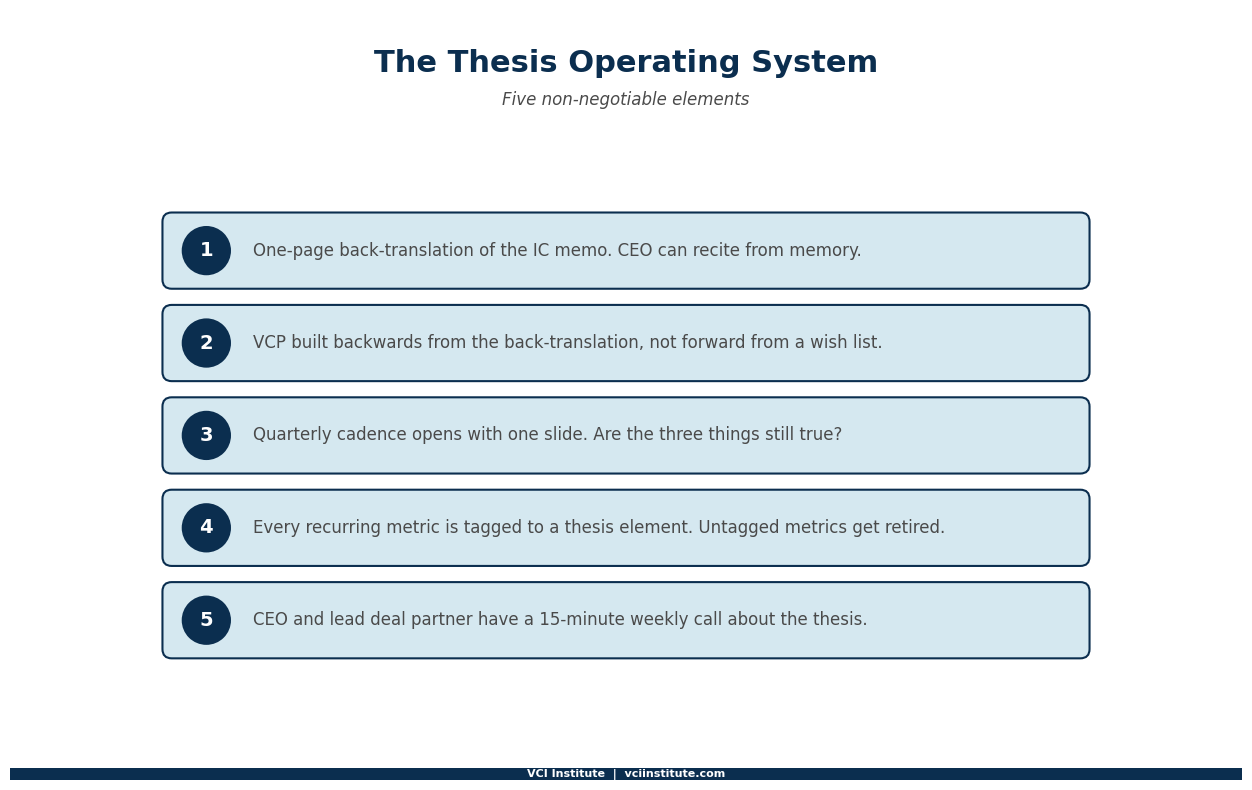
A working Thesis Operating System has five non-negotiable elements.
One. The IC memo gets a one-page back-translation that reads like a CEO memo. Three things that have to be true. Three numbers that prove it. One sentence on what we will give up to make those three things happen. If the CEO cannot recite this from memory in week eight, the OS is not installed.
Two. The VCP is built backwards from the back-translation, not forwards from a wish list. Every initiative in the VCP traces to one of the three things. Initiatives that do not trace are not in the VCP. They might still happen. They are not value creation. They are operating hygiene.
Three. The quarterly cadence opens with one slide. Are the three things still true? If yes, here is the evidence. If no, here is the new thesis. Everything else is supporting material. We have stopped attending board meetings where this slide is not first. They are not actually board meetings. They are status reviews dressed as governance.
Four. The weekly rhythm has a thesis tag. Every recurring metric on the operating dashboard is tagged to the thesis element it supports. Metrics without a tag get retired. Most operating dashboards we audit have between sixty and two hundred metrics. After tagging, they have twenty. This exercise almost always surfaces the deeper problem first, which is that the same metric produces three different numbers depending on which function you ask. That is the single source of truth problem, and it has to be solved before tagging means anything.
Five. The CEO and the lead deal partner have a fifteen-minute weekly call about the thesis, not about operations. If they only talk when something is on fire, the thesis has already drifted.
AI compresses each of these translations by an order of magnitude when the firm has built the operating practices to absorb the compression. The IC memo can become a draft VCP in twenty minutes instead of four weeks. The VCP can become a tagged dashboard in an afternoon instead of a quarter. The quarterly variance analysis can become a Tuesday morning conversation instead of a Friday board pack.
But AI does not install the operating system. It only accelerates whichever operating system is already running. If the company is running on charisma, AI accelerates charisma. If it is running on the thesis, AI accelerates the thesis. Most portfolio companies have not made the choice. The Thesis Operating System forces the choice and then makes the choice cheap to maintain. This is the same constraint described in the AI ceiling, where tooling capability keeps outrunning the operating model that has to absorb it.
The pattern we see at the funds running this well is not technical sophistication. It is discipline at the layer one to layer two handoff. The IC memo gets translated into a working VCP within thirty days of close, with a real owner, real numbers, and a real list of things the company will stop doing to make room. Everything else flows from that. Without it, every other process becomes a reporting exercise that produces decks instead of decisions.
The investment thesis is not the IC memo. It is what the company actually does on Tuesday. The Thesis Operating System is just the discipline of making sure those two things stay the same document.
COPPE Level 2
Layer one to layer two, done properly
The handoff from underwriting logic to a value creation plan is the whole spine of COPPE Level 2. Nine quantitative modules on one company held from entry to exit: the entry model, the debt schedule, the sequencing decisions, the exit bridge, and the evidence a buyer will actually demand. A supervised certification examination, and three months of PE Simulator access.
VCI Institute in collaboration with Mohamad Chahine
Published 14 September 2026
Related reading from the VCI Institute
PE Boards That Actually Work
From performance theatre to strategic counsel, and the layer three question boards keep skipping.
The Operating Partner and CEO Compact
Why it has to be written, and why it belongs in the same thirty days as the value creation plan.
The Single Source of Truth Audit
Data hygiene before dashboards, because thesis tagging is meaningless if the numbers disagree.
About the VCI Institute
The VCI Institute is a nonprofit dedicated to building practical capability and shared standards for value creation in private equity. The Institute publishes operator-grade frameworks and runs certification programmes for operating partners, portfolio company executives, and value creation analysts. You can see what each programme actually covers before deciding. Analysis published here draws on the Institute's certification curricula and on structured review of mid-market transaction patterns rather than on any single proprietary dataset. Where a figure is directional rather than measured, it is described as such.
Further material is available in the Institute's Insights library and its free resource library of templates, checklists, and case snapshots.
© 2026 VCI Institute. All rights reserved. The frameworks, terminology, and analysis presented in this article are the intellectual property of the VCI Institute. Reproduction or derivative use without written permission is prohibited. Citation with proper attribution is welcomed.
We have many great affordable courses waiting for you!
Stay connected with news and updates!
Join our mailing list to receive the latest news and updates from our team.
Don't worry, your information will not be shared.
We hate SPAM. We will never sell your information, for any reason.

 Practice private equity like a pilot trains