The 45-Day Math: Why PE Onboarding Is Shorter Than You Think
Sep 17, 2026
The 100-day plan is a corporate artifact that quietly migrated into private equity and never had to defend itself.
It is comforting. It feels rigorous. It maps to a calendar quarter. It is also wrong about the actual window in which sponsor confidence is formed.
The short answer
Sponsors do not wait one hundred days to form a view. The window decomposes into forty-five days of grace, forty-five days of proof, and ten days of forgiveness. The grace window is not for delivering results, it is for building the operating apparatus that will produce them. The proof window converts that apparatus into evidence. The final ten days are the last cheap opportunity to revise the board's draft judgment. The clock starts at signing, not when the operator feels ready, and reversing a bad slope after day one hundred is roughly three times harder than setting it correctly.
The real window is shorter, harder, and unforgiving in ways the 100-day frame obscures.
The clearest decomposition we have seen comes from the operator community itself. Forty-five days of grace. Forty-five days of proof. Ten days of forgiveness. After that, the slope is set, and the slope is the thing.
Sponsors do not wait one hundred days to form a view. They form the first draft of their view in forty-five and spend the next forty-five looking for evidence to confirm or reject it. The last ten days are the window in which a slipping operator can recover. After day one hundred, the operator is either compounding trust or burning it, and reversing the slope is roughly three times harder than setting it correctly the first time.
This is not pressure. It is geometry. The 45-day math is what actually happens. The 100-day plan is what executives write to make the timeline feel manageable.
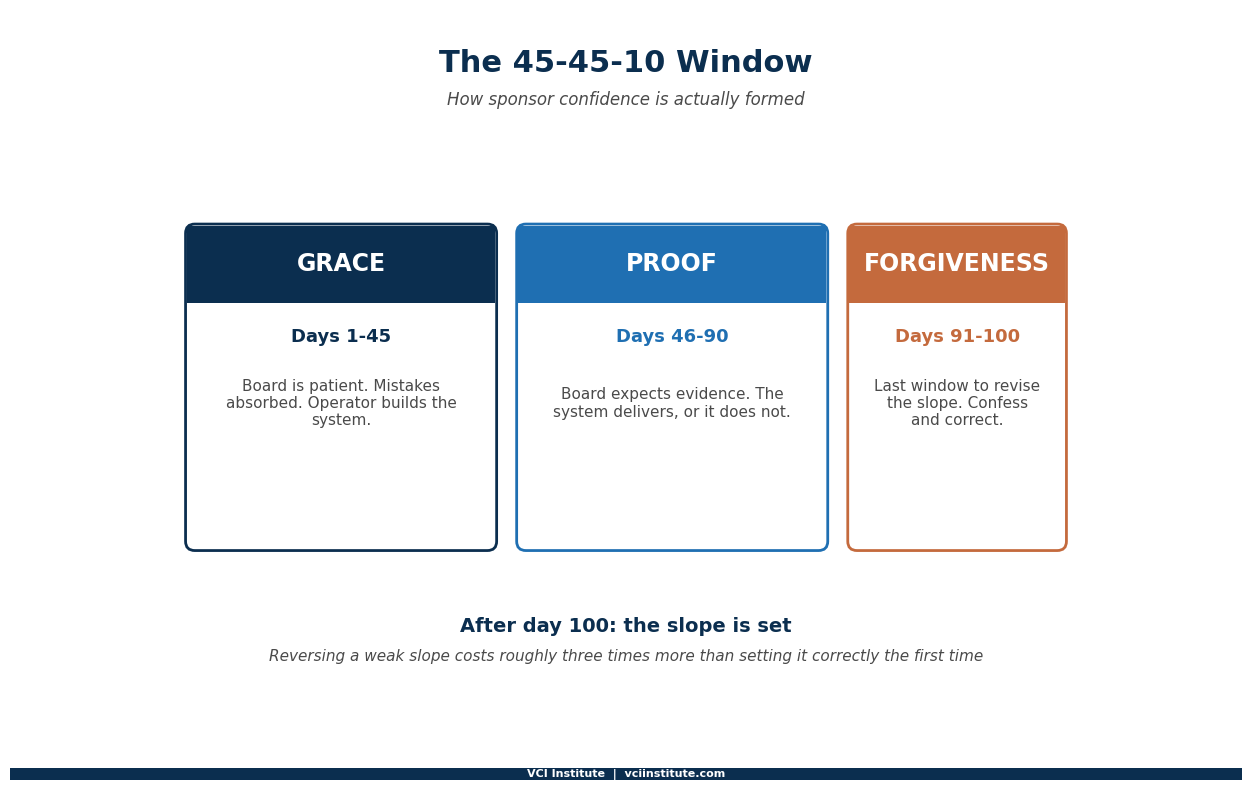
Days one through forty-five are the grace window. The board is patient. The deal team is supportive. Mistakes are absorbed. What is being measured is not output. What is being measured is the operator's ability to build the operating apparatus that will produce output. Cadence, KPIs, decision rights, talent calls. The deliverable is not results. The deliverable is the system that will deliver results.
The most common failure in the grace window is to spend it trying to deliver results. Operators feel the pressure of being new and want to show wins. So they ship a price increase, or close a deal, or fire someone visible. The board nods, then quietly asks whether anything underneath has changed. Usually it has not. The wins were drawn from existing system inertia. The new operator did not build anything. The system that produced the win is the same system that will fail to produce the next one. Intervening before diagnosing is the recurring version of this error, which is why an operating maturity diagnostic belongs in the first two weeks rather than the second quarter.
Days forty-six through ninety are the proof window. This is where the operator delivers against the system they built in the grace window. The board now expects a working operating rhythm. KPIs that mean something. Variance analysis that explains causes, not effects. Talent decisions that have been made, not deferred. A point of view on the value creation plan, not a recital of the plan inherited from the deal team.
The proof window is where most operators get into trouble. The grace window forgave them for not having a system. The proof window does not forgive them for not using it. Operators who arrive at day forty-six without an installed operating apparatus spend the proof window in apology mode, and apology mode is what kills the slope.
Days ninety-one through one hundred are the forgiveness window. This is the last window in which the board's first draft of judgment can be revised. After day one hundred, the cost of revision rises sharply. Operators who use the forgiveness window well treat it as a confession-and-correction sprint. The thing the board has been concerned about gets named, owned, and addressed in the same conversation. Operators who use it badly try to hide the slip, hoping the next quarter will catch them up. It rarely does. The board has already drafted the slope. They are looking for confirmation, not new information.
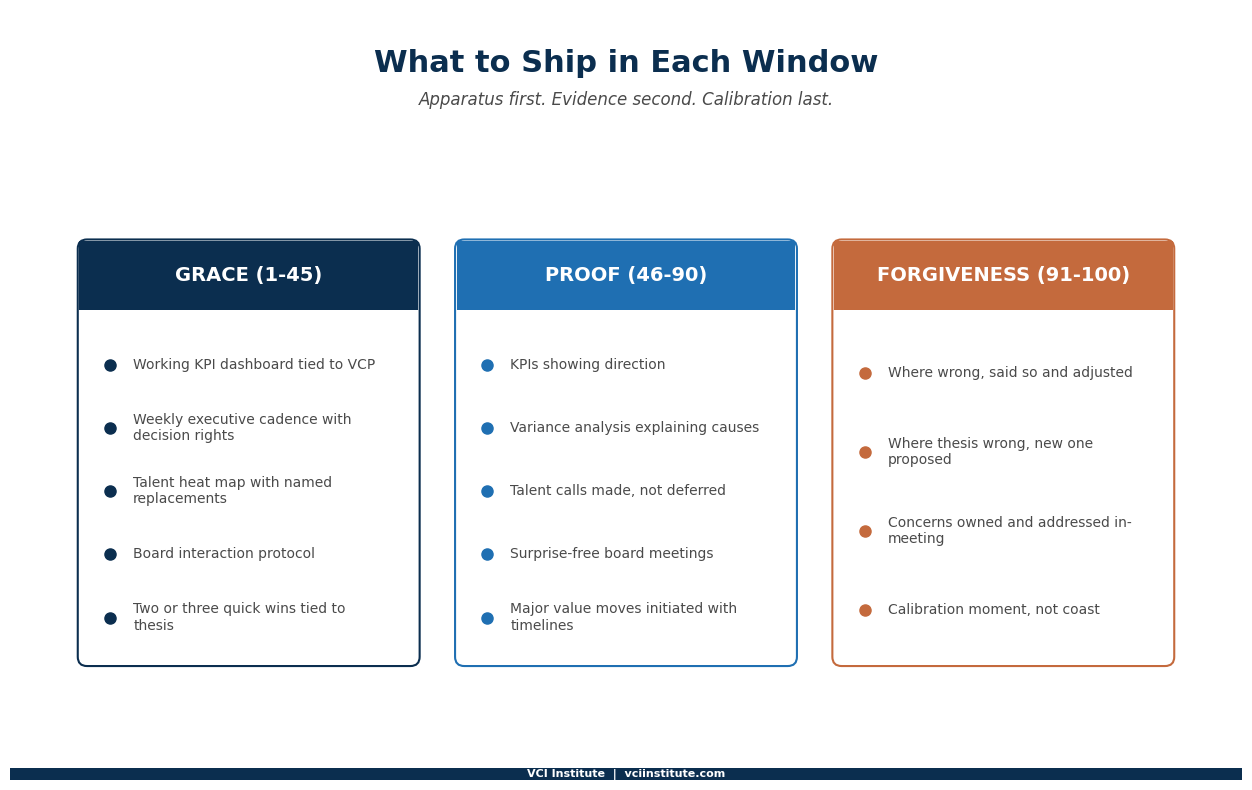
What gets shipped in each window is different.
In the grace window, the deliverables are operating apparatus. A working KPI dashboard tied to the value creation plan. A weekly executive cadence with clear decision rights. A talent heat map with named replacements where needed. A no-surprises board interaction protocol. An exit narrative draft that the deal team agrees with. Two or three quick wins tied to the thesis, not to system inertia. The talent heat map in particular has a short shelf life, because the people most likely to leave are the ones the post-close talent density map is designed to identify, and they typically decide within the same window.
In the proof window, the deliverables are evidence. The KPIs are now showing direction. The variance analysis is explaining why. The talent calls have been made. The board interactions have produced surprise-free meetings. The thesis is being executed against, not just discussed. One or two of the bigger value creation moves have been initiated, with timelines and owners. This is also the window in which the CFO upgrade question has to be answered, because the assessment window and the proof window run on the same clock.
In the forgiveness window, the deliverables are calibration. Where the operator was wrong, they have said so and adjusted. Where the thesis was wrong, they have said so and proposed a new one. Where a board concern was warranted, it has been addressed. Where it was not, it has been argued back, with evidence.
The pattern that produces a strong slope is consistent across the operators we have watched succeed. They under-promise output and over-deliver apparatus in the first forty-five. They convert apparatus into evidence in the next forty-five. They treat the last ten as a calibration moment, not a coast.
The pattern that produces a weak slope is also consistent. They over-promise output in the first forty-five to compensate for new-job anxiety. They miss the system build, then spend the proof window trying to deliver evidence with a system that does not exist. By day ninety-five they are managing optics. The board has already drafted the slope.
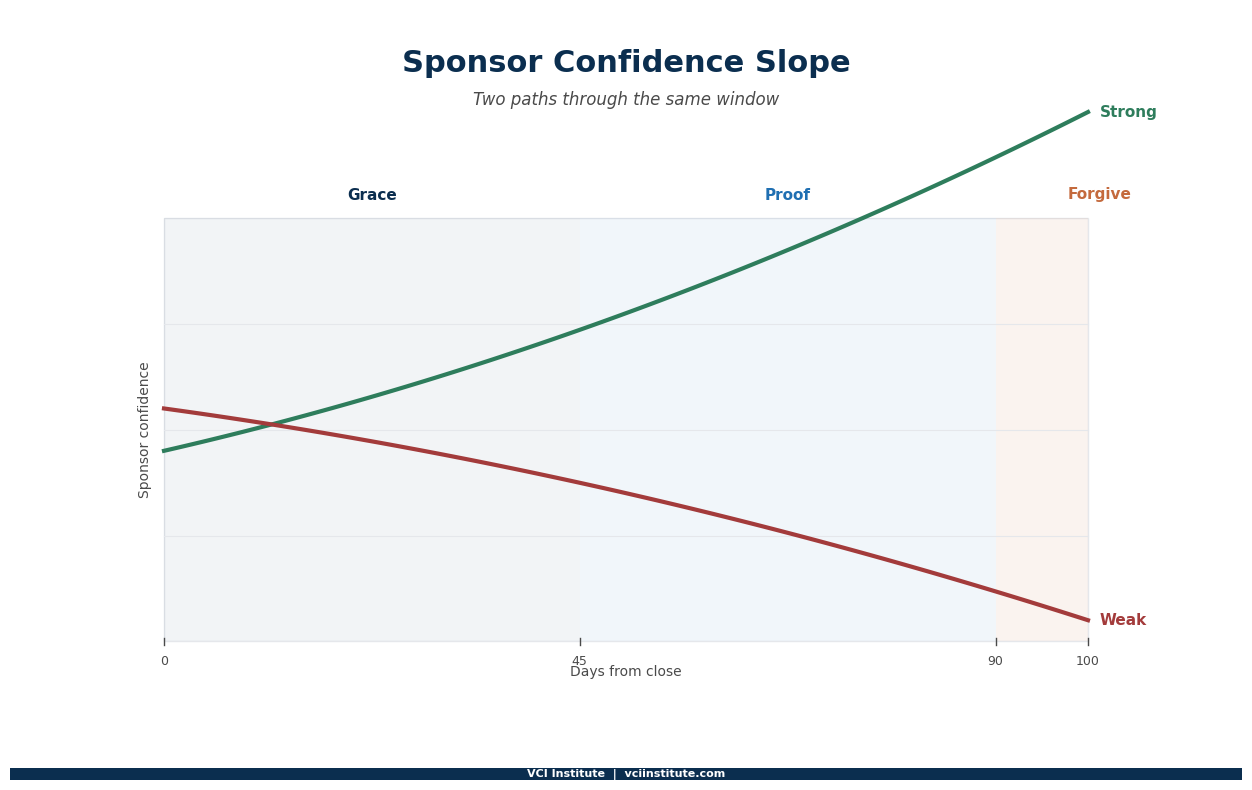
There is one more thing the 45-day math gets right that the 100-day frame gets wrong. The clock is not relative. It does not start when the operator feels ready, or when the integration finishes, or when the data room cleans up. It starts at signing. Operators who treat the period between signing and first board meeting as preparation time forfeit a third of the grace window.
The corollary is that the grace window can be extended, but only deliberately and only by the deal partner. We have seen funds where the deal partner explicitly tells the operator that the first forty-five days are protected, and the board cadence does not start until day sixty. Those operators ship better systems and produce stronger slopes. They are not slower. They are more sequenced. Making that protection explicit is precisely the kind of clause that belongs in the operating partner and CEO compact rather than being left to goodwill.
The deepest version of this is that PE onboarding is not a learning curve. It is a building project on a clock. The operator is not learning the company. The operator is building the operating system that the company will run on for the next four years. That work has to start in week one, with full velocity, before the operator has finished learning anything. What they are building, specifically, is the translation layer described in the Thesis Operating System.
If that sounds uncomfortable, it is. Private equity is not corporate. It rewards directional correctness at speed over absolute correctness on a calendar. The 45-day math is the first place that difference becomes concrete.
The 100-day plan is the comfort blanket. The 45-day math is the actual window. Operators who internalize the difference build slope. Operators who do not, do not.
COPPE Level 1
Learn the apparatus before you need it in week one
The grace window is too short to learn the craft inside. COPPE Level 1 covers the value creation levers, the hundred day structure, the governance relationship with a portfolio company chief executive, and the language a sponsor expects in a board pack. Twelve lessons, each with a written lesson, a Visual Companion, an audiocast and a videocast. Self paced.
VCI Institute in collaboration with Mohamad Chahine
Published 17 September 2026
Related reading from the VCI Institute
The Thesis Operating System
From IC memo to Tuesday morning, and what the operating apparatus is actually supposed to translate.
The Three People You Cannot Lose
A post-close talent density map, built on the same clock as the grace window.
The Operating Maturity Index
A diagnostic to run before you intervene, which belongs in week two rather than quarter two.
About the VCI Institute
The VCI Institute is a nonprofit dedicated to building practical capability and shared standards for value creation in private equity. The Institute publishes operator-grade frameworks and runs certification programmes for operating partners, portfolio company executives, and value creation analysts. You can see what each programme actually covers before deciding. Analysis published here draws on the Institute's certification curricula and on structured review of mid-market transaction patterns rather than on any single proprietary dataset. Where a figure is directional rather than measured, it is described as such.
Further material is available in the Institute's Insights library and its free resource library of templates, checklists, and case snapshots.
© 2026 VCI Institute. All rights reserved. The frameworks, terminology, and analysis presented in this article are the intellectual property of the VCI Institute. Reproduction or derivative use without written permission is prohibited. Citation with proper attribution is welcomed.
We have many great affordable courses waiting for you!
Stay connected with news and updates!
Join our mailing list to receive the latest news and updates from our team.
Don't worry, your information will not be shared.
We hate SPAM. We will never sell your information, for any reason.

 Practice private equity like a pilot trains