
Agentic Workflows in the Mid-Market: Where to Start, What to Skip
Jul 09, 2026
The conversation about AI in private equity has shifted in 2026. The earlier waves of copilot deployment, document summarization, and chatbot pilots have given way to a more ambitious framing. Agentic workflows. Systems that do not just respond to prompts but execute multi step processes autonomously, taking actions in real software systems, completing tasks end to end.
The short answer
Agentic workflows are reliable in 2026 under three conditions: structured data moving between stable systems, narrow scope with a clear definition of done, and a human review point before any consequential external action. Five use cases meet that bar today, including CRM hygiene, finance close support, procurement triage, customer service first response, and outreach drafting. Five should be deferred, including autonomous pricing, full sales cycle management, and autonomous production deployment. The screen is structural fit, economic case, and containment of failure. Score well on all three and deploy. Score on one or none and defer, whatever the demo showed.
New from VCI Institute
The AI Value Creation Model: a 53-page practical guide for deal teams, operating partners, and private equity leaders. Five components, one gate, twelve levers, a worked EBITDA bridge. Get the guide at no cost.
The framing is genuine and the technology is improving fast. Agents can now schedule meetings, complete data entry tasks, run reports, draft communications, and trigger downstream workflows with measurable reliability. Vendor pitches have shifted accordingly. Every enterprise AI provider now describes its product through the language of agents and autonomous workflows. Portfolio company management teams are arriving at board meetings with proposals to deploy agents across operations, sales, finance, and customer service.
For sponsors, the question is not whether agentic workflows will eventually become standard infrastructure. They will. The question is which mid-market portfolio companies should be deploying them now, where to start, and which use cases to defer. The answers are not the same across the portfolio.
The Honest State of the Technology
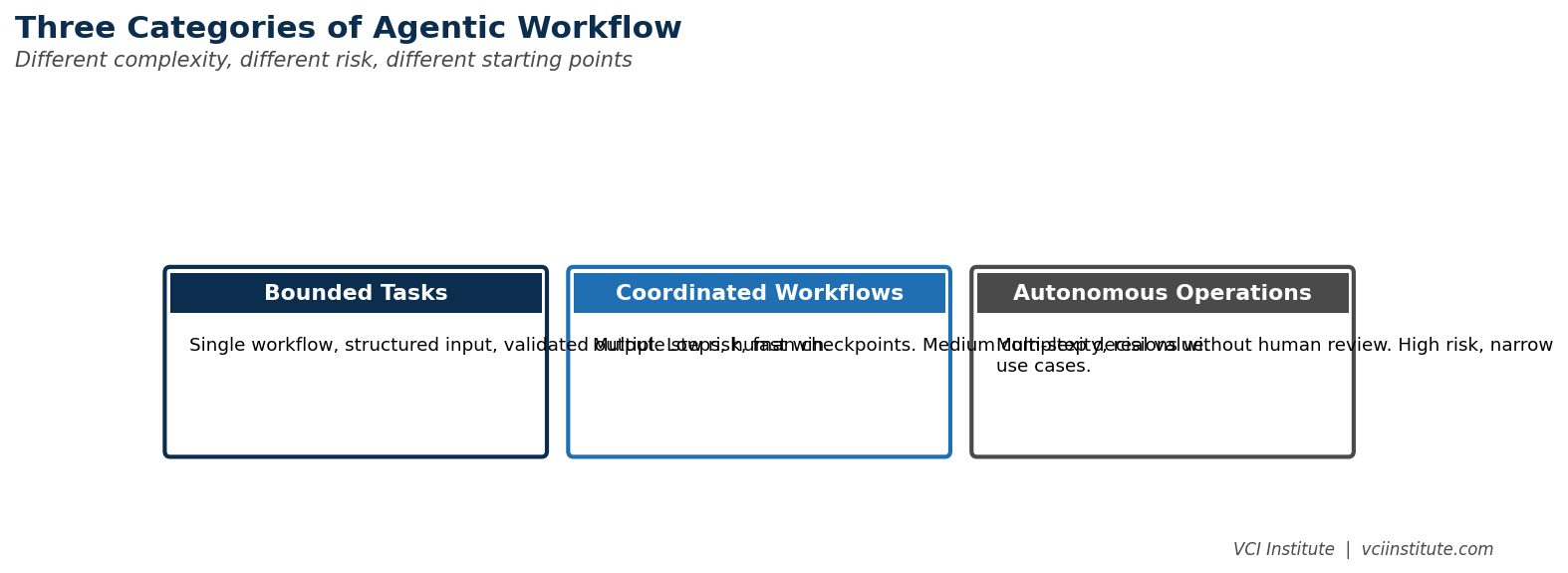
The first task is to be precise about what the technology actually does in 2026. Agentic workflows are most reliable in three conditions. First, when the task involves structured data flowing between known systems with stable interfaces. Second, when the task has a relatively narrow scope and a clear definition of completion. Third, when there is a human review point at the end of the workflow before any consequential external action is taken.
Outside these conditions, agentic workflows are still meaningfully unreliable. Multi step workflows that span unstructured inputs, ambiguous business rules, or systems with shifting interfaces produce errors at rates that make full autonomy impractical. The technology will improve, but in the current state, sponsors and management teams who deploy agents in the wrong contexts produce expensive failures. The discipline is to deploy where the technology genuinely works today and to defer where it does not.
This is not a conservative position. It is an accurate one. Agentic deployments succeed when matched to use cases that fit the technology's current capabilities. They fail when matched to use cases that require capabilities that are still emerging.
The first condition carries more weight than the other two, because it is the one most often assumed rather than verified. Structured data flowing between stable systems is not the default state of a mid-market business. It is an achievement, and most portfolio companies have not achieved it. Deploying an agent onto a data layer that disagrees with itself produces confident, wrong output at machine speed. The prior test is information hygiene, and the remediation sequence is the single source of truth audit.
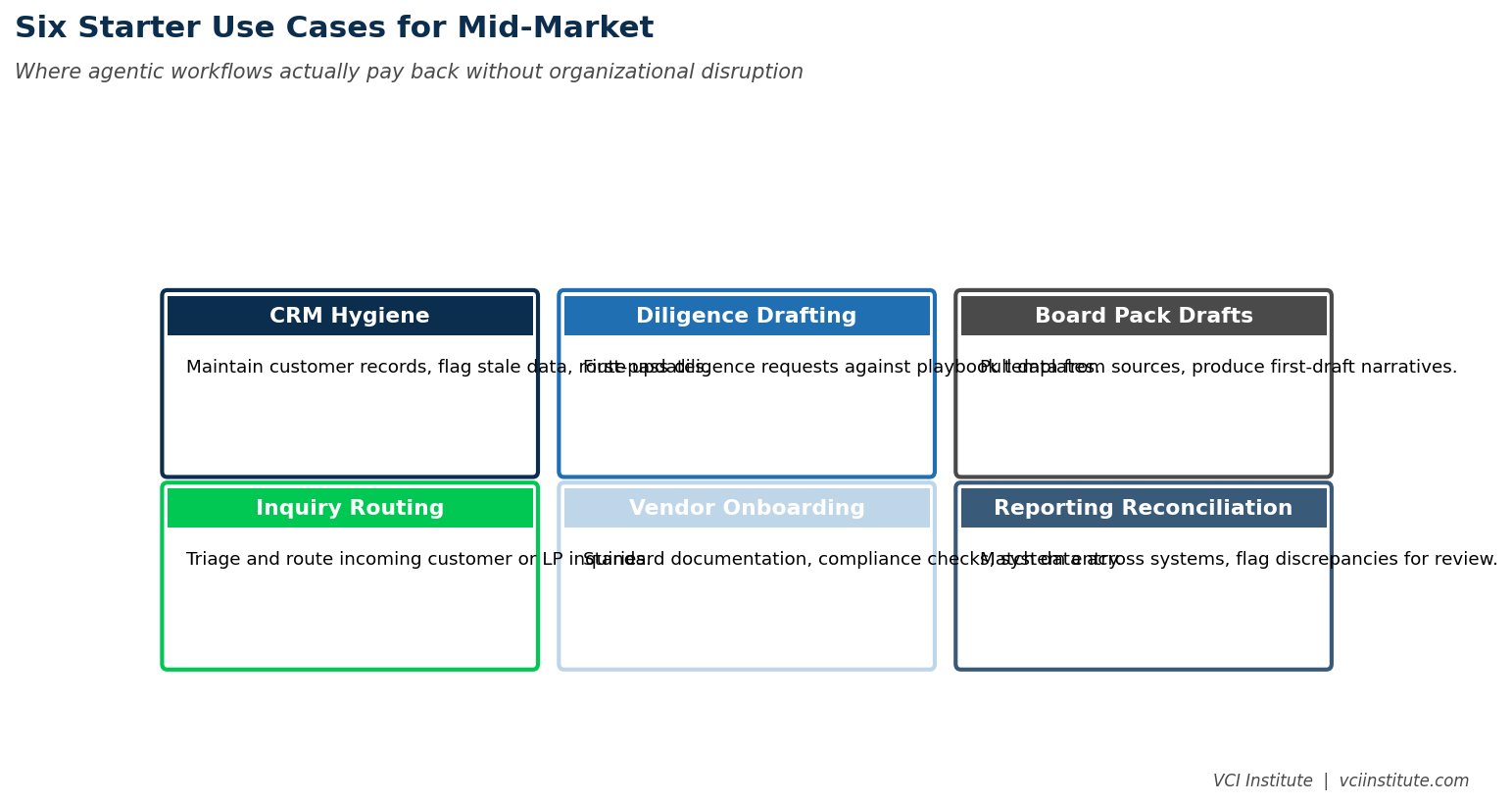
Five Use Cases That Generally Work in 2026
A handful of agentic use cases have become dependable enough that mid-market sponsors can deploy them with reasonable confidence in 2026. Each one shares the three conditions described above.
The first is sales operations data hygiene. Agents that update CRM records based on inbound information, deduplicate accounts, enrich contact data from external sources, and flag inconsistencies for human review. The use case is well defined, the systems involved are stable, and the cost of errors is contained because each action is reviewable. Mid-market sales operations functions are usually understaffed. Agents can absorb meaningful volume of data hygiene work that would otherwise be deferred.
The second is finance close support. Agents that prepare reconciliations, flag unusual transactions, draft variance commentary, and assemble close packages from underlying ledger data. The use case sits inside a structured system environment. The output is reviewed by the controller before sign off. Finance teams report material time savings, and the bridge to operating expense is direct.
The third is procurement triage. Agents that process incoming purchase requests, check them against approved vendor lists and budget thresholds, route them to the right approver, and update procurement systems with status. Mid-market procurement functions often run on email and ad hoc spreadsheets. Agentic workflows in this domain produce immediate process visibility and meaningful cost discipline.
The fourth is customer service first response. Agents that handle the first contact for inbound service inquiries, classify the issue, attempt resolution for known categories, and escalate to human agents for everything else. The economic case is clean because customer service costs are visible and labor intensive. The deployment risk is bounded because human escalation is built into the design.
The fifth is account based marketing personalization. Agents that research target accounts, draft personalized outreach drafts, schedule sequences, and update marketing automation systems with engagement data. The use case fits agentic capabilities and produces measurable lift in commercial productivity. It also intersects with one of the cleanest commercial levers in the mid-market, since the constraint on inbound conversion is usually elapsed time rather than message quality, as set out in speed-to-lead economics.
These five represent a credible starting set for most mid-market portfolio companies. Each one delivers measurable benefit in a single quarter. Each one sits inside the conditions where the technology is reliable today.
Five Use Cases to Defer
Equally important is the discipline of identifying use cases that should be deferred until the technology matures further or the business is structurally ready for them. Five appear repeatedly on portfolio company AI roadmaps and consistently fail in deployment.
The first is autonomous customer-facing communications without human review. The reputational risk of model errors in customer communications outweighs the labor savings, particularly for higher value transactions. Agentic drafting with human review is a different category and works. Full autonomy is, in 2026, not yet a productive use case for most mid-market companies.
The second is autonomous pricing decisions. Pricing models are technically advanced enough to recommend prices well. Allowing them to set prices autonomously, without human review, exposes the business to error costs that compound. Recommendation with human approval works. Autonomous pricing does not. The reason is that pricing power is a structural property of the business rather than an optimisation problem, which is the argument in pricing power as the first-order lever.
The third is end to end sales cycle management. Agentic workflows that attempt to handle entire sales cycles, from lead through close, fail because the unstructured judgment required at multiple points exceeds what the technology can reliably deliver. Component automation, lead routing, follow up scheduling, proposal drafting works. Full sales cycle automation does not.
The fourth is complex operational decisions that require integration of unstructured data. Examples include vendor selection in nuanced supply chain situations, hiring decisions, complex customer escalations, and any decision that requires weighing multiple ambiguous inputs. The technology produces plausible recommendations but unreliable judgment. Decisions of consequence still require human authority.
The fifth is autonomous code deployment in production environments. Some software development agents are productive in coding assistance and pull request drafting. Allowing them to deploy code to production without human review produces costs that exceed the time savings. The current state of agentic coding is supportive, not autonomous.
These five share a feature. The cost of error is high, the technology's reliability is meaningfully below human level, and the human review removed by going fully autonomous would have caught the errors that now propagate. The right time to revisit each of these is when the underlying technology improves enough to change the error economics. Until then, the right answer is no.
The Allocation Framework
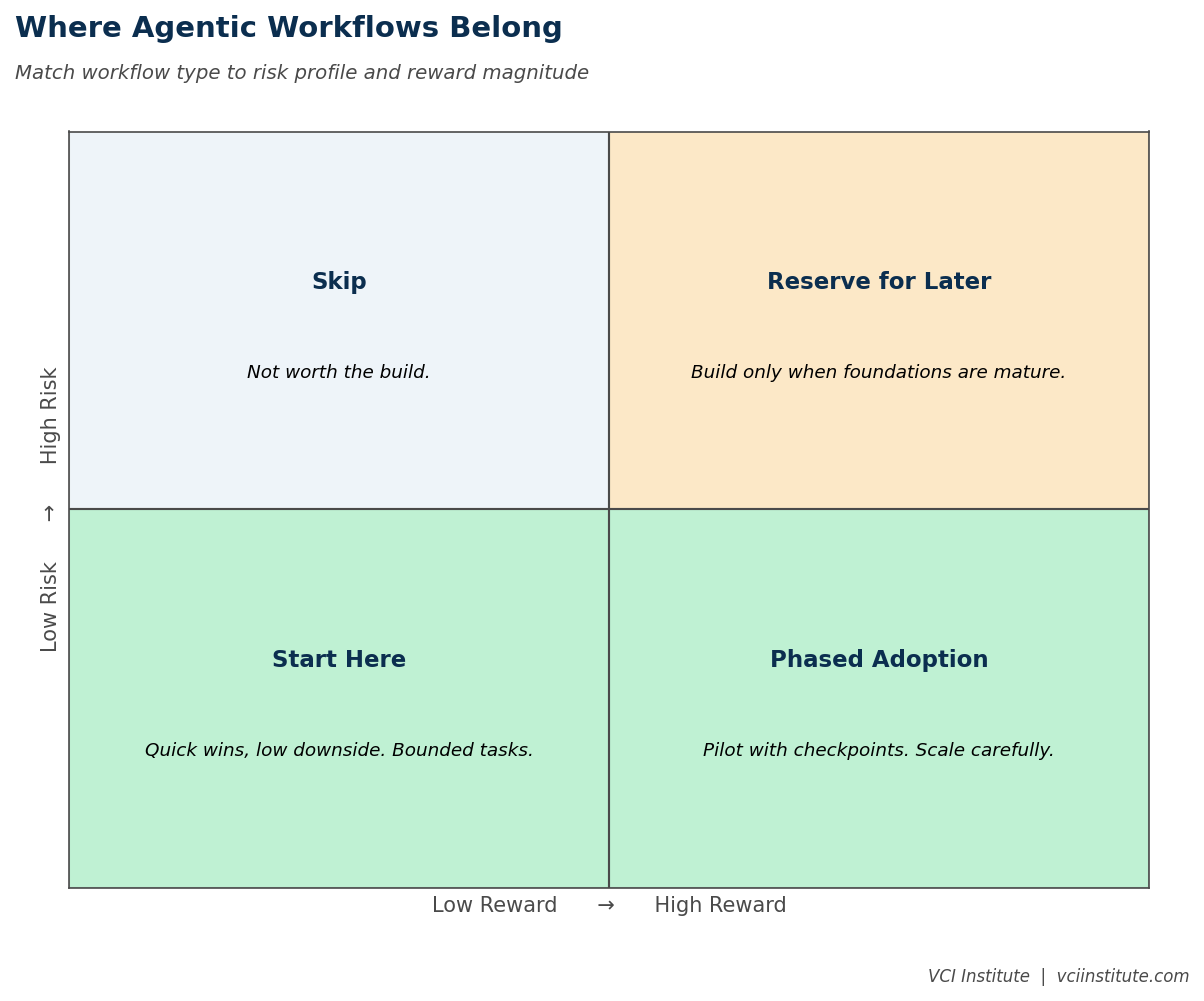
Operating partners considering agentic workflow proposals can apply a simple allocation framework. For each proposed use case, evaluate three dimensions.
The structural fit dimension asks whether the use case fits the conditions where agentic workflows are reliable today. Structured systems, defined scope, human review at the consequential action point. If the use case does not fit, defer it.
The economic case dimension asks what the workflow displaces, in labor cost, error reduction, or revenue capture. If the displaced economic activity is meaningful and the agentic deployment cost is bounded, the bridge clears. If the displaced activity is incremental and the deployment cost is high, the bridge does not clear. Building that bridge so it survives an exit conversation is the discipline in the digital EBITDA bridge.
The deployment risk dimension asks what happens if the agent fails or behaves unexpectedly. If failure is contained, recoverable, and visible, the risk is acceptable. If failure produces customer impact, regulatory exposure, or undetected propagation of errors, the risk is high enough to warrant either a different design or deferral.
A use case that scores well on all three dimensions is a strong candidate for deployment. A use case that scores well on two of three is worth careful design work. A use case that scores well on one or none should be deferred regardless of how compelling the vendor demo is.
The Sponsor's Posture
Operating partners are sometimes pressured by management teams to fund ambitious agentic deployments because the language is fashionable and the vendor enthusiasm is high. The right posture is supportive of agentic workflows in the right places, skeptical of agentic workflows in the wrong places, and explicit about the difference.
A useful posture statement, one we recommend operating partners adopt with their portfolio CEOs, runs roughly as follows. We are committed to deploying agentic workflows aggressively where they meet the structural fit, economic case, and deployment risk criteria. We will not deploy agentic workflows in domains where the technology is not yet reliable enough, regardless of the marketing language. We will revisit deferred use cases every six months as the technology matures.
This posture invites real investment in agentic capability while protecting the portfolio from the predictable failure modes that have cost early adopters meaningful capital and credibility. It also reframes the AI conversation inside portfolio companies from we have to do something with agents to we have a disciplined plan for which agents to deploy and when.
It is worth being clear about what limits the pace here. It is rarely the technology. It is how much change the organisation can absorb at once, which is the constraint described in the AI ceiling. A company running three stalled deployments does not need a fourth.
Where the Edge Will Come From
Two years from now, the firms that will have built the strongest AI driven operating advantage in their portfolios will not be the ones that deployed the most agents in 2026. They will be the ones that deployed the right agents in the right places, scaled them with discipline, and avoided the expensive failures of overreach.
The right agents in 2026 are usually unglamorous. CRM hygiene. Reconciliation support. Procurement routing. First response triage. Outreach drafting. None of them are conference keynote material. All of them produce measurable EBITDA contribution within a quarter and build the foundation on which more ambitious agentic capability can later be deployed responsibly.
The firms that get this right will be the ones whose operating partners had the discipline to say no to the wrong use cases and yes to the right ones. The technology is real. The opportunity is real. The trap is in deploying it indiscriminately. The advantage is in deploying it deliberately.
VCI Institute in collaboration with Mohamad Chahine
Published 9 July 2026
Related reading from the VCI Institute
The AI Ceiling
Why the pace limit on agentic deployment is organisational rather than technical.
The Single Source of Truth Audit
The data layer work that has to precede any agent touching a stable system.
Vertical AI Versus Horizontal AI
The same question read one level up, as a portfolio allocation decision.
About the VCI Institute
The VCI Institute is a nonprofit dedicated to building practical capability and shared standards for value creation in private equity. The Institute publishes operator-grade frameworks and runs certification programs for operating partners, portfolio company CEOs, and value creation analysts, including COPPE and CVCA. Analysis published here draws on the Institute's certification curricula and on structured review of mid-market transaction patterns rather than on any single proprietary dataset. Where a figure is directional rather than measured, it is described as such.
Further material is available in the Institute's Insights library and its free resource library of templates, checklists, and case snapshots.
© 2026 VCI Institute. All rights reserved. The frameworks, terminology, and analysis presented in this article are the intellectual property of the VCI Institute. Reproduction or derivative use without written permission is prohibited. Citation with proper attribution is welcomed.
We have many great affordable courses waiting for you!
Stay connected with news and updates!
Join our mailing list to receive the latest news and updates from our team.
Don't worry, your information will not be shared.
We hate SPAM. We will never sell your information, for any reason.


 Practice private equity like a pilot trains