Plans Do Not Fail on the Arithmetic: The Third Thing Nobody Diligences
Sep 19, 2026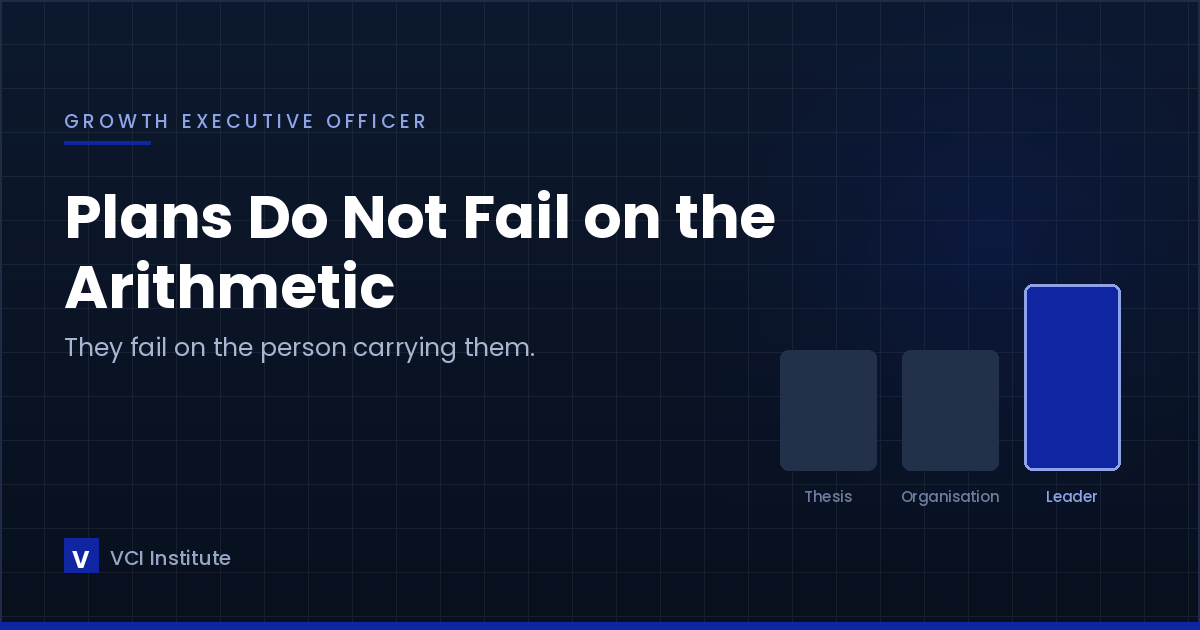
When a value creation plan fails, the post mortem almost always lands on the plan. The assumptions were optimistic. The market moved. The diligence missed something. The timing was unfortunate.
Occasionally it lands on the organisation. The team was not strong enough. The systems could not support it. The culture resisted.
It very rarely lands on the leader, and that is not because leaders are rarely the problem.
Three things have to hold
A growth plan needs a sound thesis, an organisation capable of executing it, and a leader able to hold the line when it becomes uncomfortable.
Look at where the investment goes. The thesis gets months of diligence, external advisors, and a committee that interrogates every assumption. The organisation gets attention too, usually late, usually after something has already gone wrong.
The third gets almost nothing. There is no diligence process for whether the chief executive can carry a plan through the month when the numbers are bad and the board is unhappy and the obvious move is to soften the target. There is a reference call and an instinct.
This is odd, because the third one is decisive. A mediocre plan carried with conviction outperforms an excellent plan abandoned in month seven, and every experienced operator knows this without ever having seen it written down.
What actually happens in month seven
Here is the pattern, and it is remarkably consistent.
The plan is agreed with genuine enthusiasm. The first quarter goes reasonably. The second quarter is soft, for reasons that are partly real and partly noise, and nobody can yet tell which.
Then a decision arrives that is unpopular and correct. A person who is well liked and not delivering. A customer relationship that consumes more than it returns. A product line that everyone is attached to and that loses money. A commitment made to the team that circumstances have made unwise.
This is the moment the plan is actually decided, and it is almost never the moment anybody analyses. The leader either holds or does not. If they do not, nothing dramatic happens. The plan is quietly re-baselined, the target moves, everyone agrees the environment was difficult, and eighteen months later the exit is disappointing for reasons that are attributed to the market.
Why this is not a character question
It is tempting to conclude that some leaders have the constitution for this and others do not, and that the answer is better selection.
That is mostly wrong, and it is a convenient conclusion because it removes any obligation to do something about it.
Most leaders have a default under pressure. Some avoid conflict and delay. Some over-control and centralise. Some go quiet and stop communicating exactly when communication matters most. Some become louder and more certain in inverse proportion to how much they actually know.
Almost none of them can name their own default. That is the actual problem. A default you can name is a default you can plan around. A default you cannot see runs you.
A question worth sitting with
Think of the last decision you delayed longer than you should have. Not one you got wrong. One you knew the answer to and postponed. What were you actually avoiding, and has that same thing shown up before?
Sequence, and the limits of absorption
There is a second failure that gets misdiagnosed as resistance.
An organisation can absorb a certain amount of change per unit of time, and that limit is real rather than attitudinal. Exceed it and you do not get slower change. You get the appearance of compliance with none of the substance, which is considerably worse because it looks like progress on a dashboard.
The right changes introduced faster than they can be absorbed produce the same result as the wrong changes. This is why sequencing is a leadership skill rather than a project management one, and why the leader who insists on doing everything in the first hundred days often achieves less than the one who does three things properly. Reading what the organisation can currently carry is the whole purpose of an operating maturity diagnostic run before the interventions start rather than after they stall.
What we built, and why it is uncomfortable
The Growth Executive Officer Masterclass is the one VCII programme that works on the person rather than on the business.
It is built around the UPCHANGE framework, giving you a repeatable approach to change rather than a set of disconnected tactics. Fifteen lessons, nine interactive tools that are diagnostics you run rather than illustrations you read, and leadership situations presented as decisions you must make before the outcome is revealed rather than as stories about people who succeeded.
That last choice is deliberate. Success stories teach very little, because they are reconstructed after the fact by someone who knows how it ended. A decision made without knowing the outcome is the only realistic form of practice.
A word of warning, offered honestly. Some of the diagnostics will return results you want to argue with. That reaction is information, and the instinct to dismiss it is the most predictable thing about the whole programme. People who sit with the uncomfortable results get something out of this. People who read past them do not, and there is no way for anyone else to tell the difference.
Growth Executive Officer Masterclass
The programme for the third thing
Fifteen lessons, nine interactive diagnostics, decision cases rather than profiles, a thirty question final assessment with an explanation for every answer, and twenty two bonus articles. Self paced, no start dates. $99.
If the numbers are fine and something still is not moving
That is usually the signal. When the thesis is sound, the analysis holds, the organisation is capable, and the plan is still not landing, the remaining variable is the one nobody puts on a slide.
If you would rather start with the analytical side, our free toolkit has working calculators for return attribution and covenant headroom. And if you are not sure which VCII programme fits your situation, the Certification Path Finder takes eight questions, captures nothing while you answer, and will tell you plainly which one you should not buy yet.
Published by VCI Institute. The Institute produces certification programmes, books and tools for operating partners, deal teams and portfolio company executives.
Related reading
We have many great affordable courses waiting for you!
Stay connected with news and updates!
Join our mailing list to receive the latest news and updates from our team.
Don't worry, your information will not be shared.
We hate SPAM. We will never sell your information, for any reason.


 Practice private equity like a pilot trains