
The Interpretive Era: Private Equity's Next Edge Is Not Financial
Apr 29, 2026
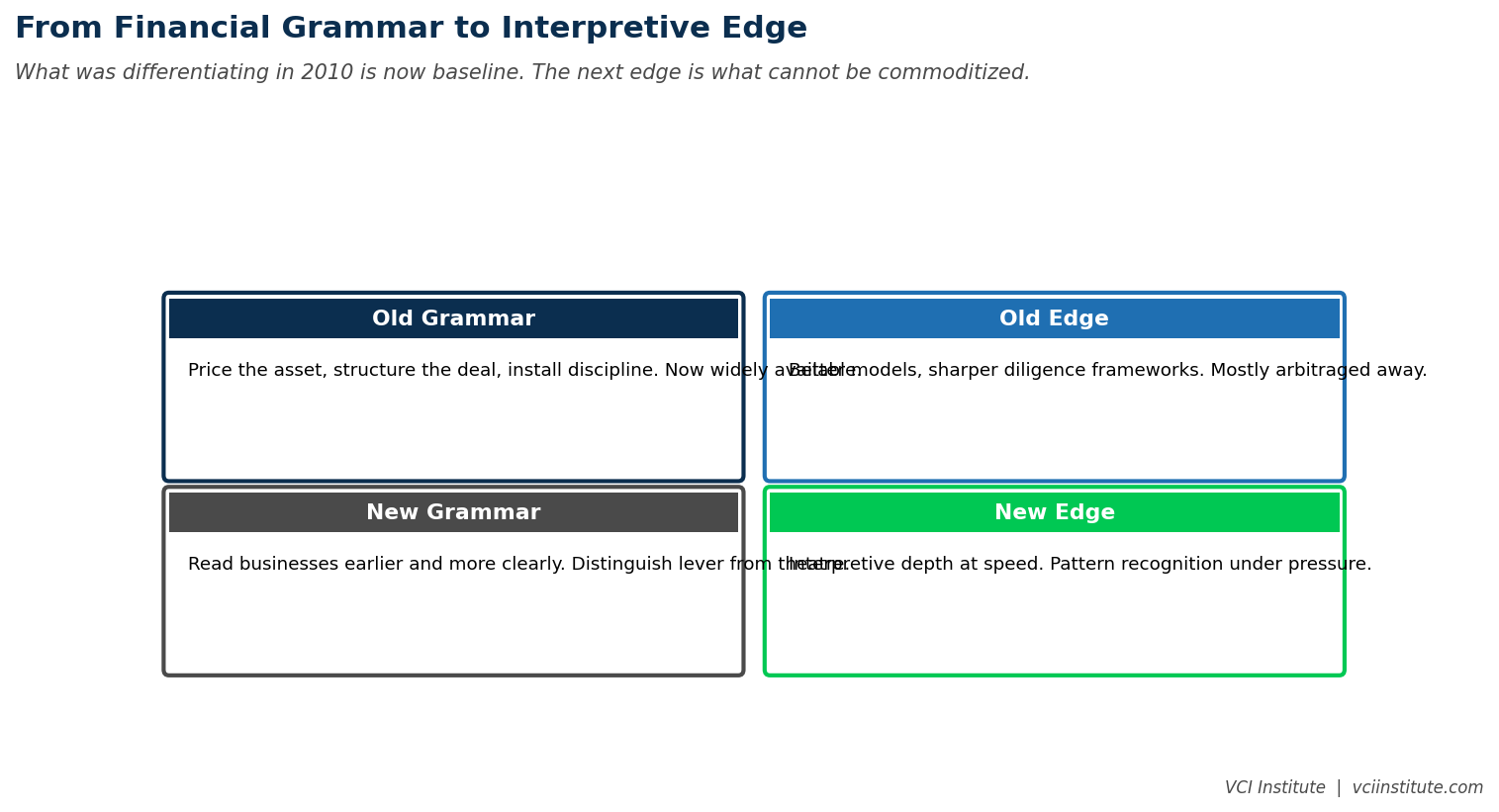
For most of the modern private equity era, the grammar of the business was financial. Price the asset correctly. Structure the deal cleanly. Layer in the right capital structure. Align management incentives. Apply discipline. Wait for the cycle. Sell at the right moment. The grammar was demanding, but it was knowable. Sponsors who learned it well outperformed sponsors who did not.
That grammar has not disappeared. It has commoditized. Almost every serious player in private equity now has access to the same playbook. The financing markets are deep. The diligence frameworks are mature. The operating playbooks are documented. The model assumptions are debated openly at industry conferences. What was once a source of competitive edge is now a baseline.
The next durable advantage in private equity will not be financial. It will be interpretive.
Figure: 33a grammar shift
What Interpretive Means
Interpretive depth, in this context, is the ability to read a business more clearly, earlier, and under pressure than competitors. It is the capacity to see what the numbers do not yet show. To distinguish a real value creation lever from a fashionable distraction. To assess whether a management team is fluent in causality or merely fluent in presentation. To identify whether the bottleneck in a stalled portfolio company is commercial, organizational, technological, or something the leadership team has been politely avoiding for two years.
This is not the soft side of investing. It is the hard side. The financial side has been progressively automated, codified, and shared. The interpretive side remains, stubbornly, in the heads of the people doing the work. It is what separates a senior partner with thirty years of pattern recognition from an analyst with the same model but no scar tissue. It is what separates a great operating partner from a credentialed one.
A diagnostic worth offering. A portfolio company comes into a board meeting and presents a commercial growth problem. The sales pipeline is weak. The conversion rates are slipping. The team has built a plan to hire more sales people and spend more on marketing. The numbers all support the diagnosis on paper. Three months of careful work reveals that the actual bottleneck is organizational, not commercial. The handoff between sales and delivery is broken. Deals are won and then lost because the customer cannot be onboarded smoothly. The marketing investment would have wasted millions. The hiring spree would have made the problem worse. The interpretive read found what the surface read missed.
This is the kind of moment that financial engineering will never resolve. It requires interpretive depth. It also requires institutional capability that most firms have not deliberately built.
Why the Shift Is Happening Now
Three forces have converged to make interpretive depth the next edge.
The first force is competitive saturation in financial engineering. There is too much capital chasing too few forgiving situations. The margin for error has narrowed materially. A sponsor that wins a deal at full price cannot afford to be wrong about anything important. The room for purely financial errors has closed. The room for interpretive errors has not.
The second force is the AI shift. Most of the AI investments going into PE will not produce step changes in returns, as discussed elsewhere in this work. The investments that will produce real value are the ones that compress the distance between information and interpretation. AI as a retrieval and pattern recognition layer can make a senior partner's tacit knowledge more available at the moment of decision. This is not transformation. It is amplification. But amplification of interpretive depth is, in a market where everyone has the same financial tools, a real and durable advantage.
The third force is the maturation of operating partner functions. The strongest operating partner teams have, over the past decade, accumulated genuine pattern recognition across portfolio companies. The firms that built these teams seriously, gave them authority, and integrated them with deal teams have produced more reliable outcomes than firms that treated operations as a service function. The interpretive layer is increasingly where these firms differentiate.
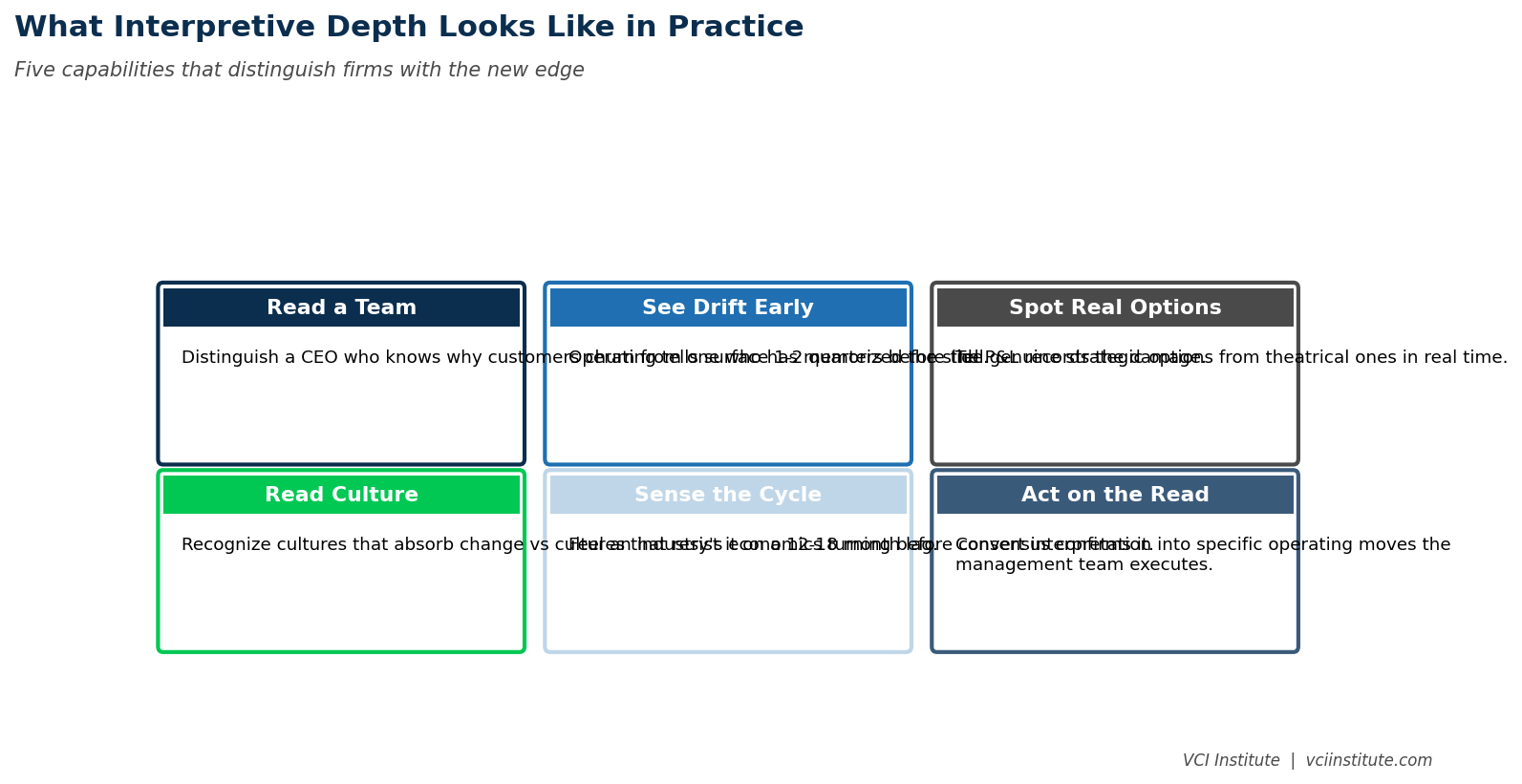
Figure: 33b interpretive capabilities
What Interpretive Depth Looks Like in Practice
Interpretive depth is easier to recognize than to define. It shows up in specific capabilities that the firms that have it can deploy and the firms that lack it cannot.
The capacity to read a management team in three meetings. Not their credentials. Not their slide quality. The actual question of whether they understand their business at the level required to run it well, or whether they have learned to talk fluently about business mechanics they do not actually control. The interpretive read distinguishes between a CEO who knows why customers churn and a CEO who has memorized the slide that lists the reasons.
The capacity to see operating drift before the financials reveal it. The weekly cadence of a business often shows stress patterns one to two quarters before the P&L records them. Inventory aging. Sales pipeline composition. Customer payment behavior. Employee turnover in specific functions. The interpretive lens reads these patterns. The financial lens does not pick them up until the damage is already in the report.
The capacity to distinguish real strategic options from theatrical ones. Most strategic plans contain a mixture of genuine options and aspirational fictions. The capacity to tell which is which, in real time, in a board meeting, with the management team watching, is interpretive work. It cannot be done from the spreadsheet alone.
The capacity to recognize cultural patterns that predict execution failure. Some businesses have cultures that absorb change. Others have cultures that resist it in ways that take twelve to eighteen months to surface. The interpretive read picks this up early enough to either calibrate the value creation plan or to shift the management team. The financial read picks it up only after the plan has stalled.
The capacity to read the market shift before the consensus does. The senior partner who has been through three cycles can sometimes feel an industry's economics turning before the data confirms it. This is not magic. It is pattern recognition built from years of being early and being late. It is also, in this market, one of the highest leverage forms of judgment a firm can possess.
What Builds Interpretive Depth
Interpretive depth is built deliberately, over years, through specific institutional choices. Three patterns separate firms that develop it from firms that do not.
The first pattern is exposure. Junior team members who spend significant time inside portfolio companies, watching senior partners work through real situations, develop interpretive depth faster than those who stay at the fund level. The exposure has to be real, with skin in the game and consequences for being wrong, not observational. Firms that protect their juniors from the messy parts of the work end up with juniors who can model deals but cannot read businesses.
The second pattern is structured reflection. Firms that systematically debrief deals, including the ones that worked, build pattern recognition faster than firms that move on quickly. The debrief has to be honest about what was missed and why, not a celebration of the outcome. This is harder to do than it sounds. The cultural commitment required is substantial. The payoff in pattern recognition is durable.
The third pattern is cross pollination. Operating partners and deal team members who work together across multiple deals develop shared interpretive frameworks that survive the rotation of any individual person. The institutional memory becomes a real asset. Firms that silo operating partners away from deal teams, or that rotate people too quickly, never build this.
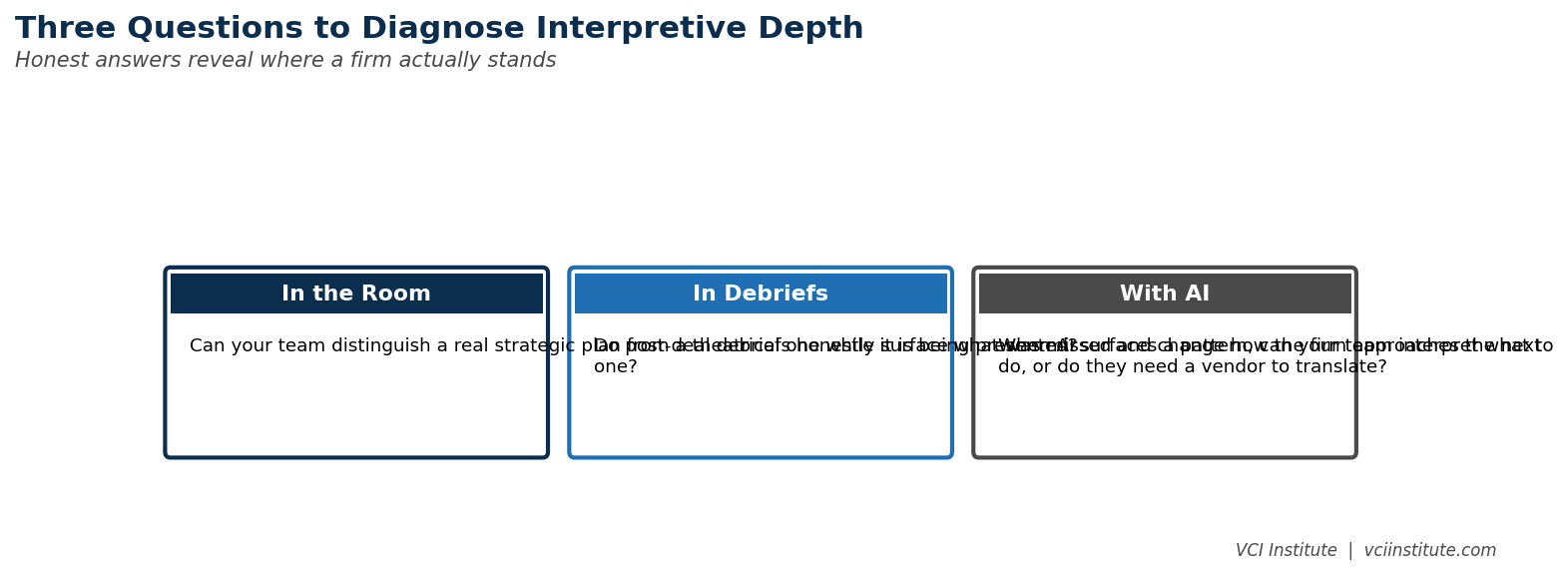
Figure: 33c three questions
What This Means for AI
The relationship between AI and interpretive depth is not what most firms assume. AI does not produce interpretive depth. It does, when deployed well, make interpretive depth more available and more consistent.
A firm that has built genuine interpretive capability can use AI to surface relevant historical patterns at the moment of decision, accelerating the senior partner's pattern matching. A firm that has not built interpretive capability cannot productively use AI for the same purpose, because there is no interpretive substrate for the AI to amplify. The output is more retrieval, faster, of patterns that the firm has not yet learned to read.
This explains the puzzle of why AI investments in PE have produced uneven results. The firms whose AI investments have paid back are usually the firms that had already built interpretive capability and used AI to extend it. The firms whose AI investments have disappointed are usually the firms that hoped AI would substitute for interpretive capability they had not yet built.
The strategic implication is straightforward. Interpretive depth is the foundation. AI is the accelerator on top of the foundation. Inverting the order produces frustration. Following the order produces compounding advantage.
The Three Questions
Sponsors that want to assess where they stand on interpretive depth can ask three questions.
Can our team distinguish a real strategic plan from a theatrical one in the room, while it is being presented, with the management team watching. If yes, the team has interpretive depth. If only sometimes, the team has it inconsistently. If no, the firm is operating with a financial reading and an interpretive blind spot.
Do our debriefs of completed deals honestly surface what was missed and why, in a way that changes how the firm approaches the next similar situation. If yes, the firm is building interpretive capability over time. If no, the firm is getting older without getting wiser.
When AI tools surface a pattern, can our team interpret what to do with it, or do they need a vendor or consultant to translate the pattern into action. If the team can interpret independently, the AI investment is amplifying real capability. If the team cannot, the AI is operating ahead of the interpretive substrate, which is the most expensive position in the industry to be in.
Three honest answers to these three questions tell a sponsor where the firm stands on what is becoming the most important dimension of competitive advantage in private equity. The financial dimension has been studied. The operational dimension has been documented. The interpretive dimension is, for most firms, still mostly invisible. That is precisely why it is the dimension that the next decade will reward.
Next step
Practise before the deal is real
The PE Simulator lets you practise the full private equity deal lifecycle, from sourcing to exit. Start with the free 10-minute demo, no sign-up. Try the free PE Simulator demo
Related reading
- Why Private Equity Is the Hardest Industry to Apply AI To
- The AI Ceiling: Why Tooling Keeps Outpacing the Operating Model
- The Strategic Reframe Lever: How a Better Description of the Business Changes Its Enterprise Value
About the VCI Institute
The VCI Institute is a nonprofit dedicated to building practical capability and shared standards for value creation in private equity. The Institute publishes operator-grade frameworks, runs training programs for emerging operating partners and CFOs, and operates a value creation simulator at vci.institute/simulator that lets sponsors and management teams stress test their value creation plans before committing capital. To learn more, visit vciinstitute.com.
© 2026 VCI Institute. All rights reserved. No part of this article may be reproduced or transmitted in any form without prior written permission of the VCI Institute.
We have many great affordable courses waiting for you!
Stay connected with news and updates!
Join our mailing list to receive the latest news and updates from our team.
Don't worry, your information will not be shared.
We hate SPAM. We will never sell your information, for any reason.






 Practice Platform