
The Loneliness Tax: Why PE-Backed CEOs Decide Slower Than They Should
Oct 12, 2026
The PE-backed CEO seat is one of the most surrounded and one of the most isolated jobs in modern business.
There is a sponsor in regular contact. A board with cadence. A bank watching covenants. An operating partner. A leadership team. Sometimes a chief of staff. Often a network of advisors and consultants.
The number of voices is high. The number of people the CEO can actually think out loud with is close to zero.
The short answer
Isolation in the PE-backed CEO seat is structural, not personal. The board governs and cannot co-think. The senior team modulates its own behaviour when it sees uncertainty. The sponsor sits on the cap table. The operating partner is reviewed on this deal. None of them can be the thinking partner. The cost shows up as slower decisions, problems that metastasise, optics management crowding out operating attention, and a senior team that mirrors the isolation. The antidote is a deliberately built external stack: a CEO peer roundtable, a trusted advisor outside the deal, a decision-quality coach, and a community of practice. It costs a few thousand a month and pays back in decision velocity the buyer prices at exit.
That gap is the loneliness tax. It is not a wellness issue. It is a decision-velocity issue, and decision velocity is one of the most expensive line items in the value creation equation.
When the covenant tightens, when a top customer wobbles, when the integration of an add-on is slipping, when the pivot frightens the senior team, the PE-backed CEO is the one carrying the burden alone. The board can be told, but the board is not the same as a thinking partner. Telling the board is a decision in itself. The CEO has already made several decisions before they tell anyone, and those upstream decisions are the ones the loneliness tax distorts.
The classic version of this is the 2 a.m. version. Self-doubt. The fear of looking unprepared. The instinct to manage optics rather than manage the business. Imposter syndrome at scale. None of that shows up cleanly on a P and L the next morning, which is why most boards do not price it.
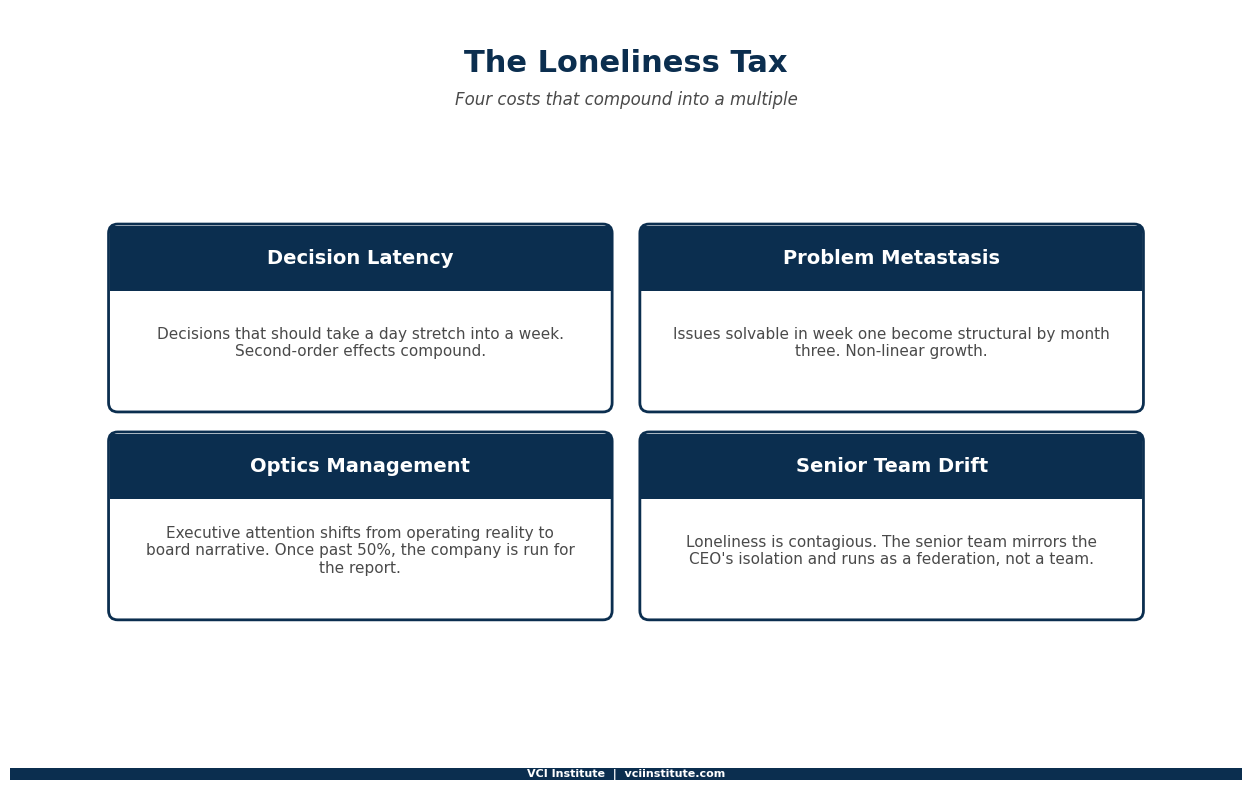
The version that does show up on the P and L is more concrete and more measurable.
Decisions that should take a day stretch into a week. The cost is not the week. The cost is the second-order effect that compounds across the organization, where every other decision waits on the first one.
Problems that could have been solved in week one metastasize. The cost is the gap between the size of the problem in week one and the size of the same problem in month three, and that gap grows non-linearly.
Executives start managing optics instead of managing the business. The cost is the share of executive attention spent on board narrative versus operating reality, and once that ratio crosses fifty percent, the company is being run for the report, not for the result. This is the same drift described in PE boards that actually work, seen from the CEO's side of the table rather than the board's.
Senior team members lose confidence quietly. Loneliness at the top is contagious. The CEO who is alone produces a senior team that is alone in turn, and the company runs as a federation of isolated functions instead of an integrated leadership team.
These four costs together compound through the hold period and show up at exit as multiple compression. The buyer cannot articulate it. They feel it. The company does not have decision velocity. The company is slower than it should be. The buyer prices that slowness, and the price is real. In the language of the six demand-side drivers, a slow company reads as low transferability, because the buyer cannot see the decision engine operating independently of the person in the seat.
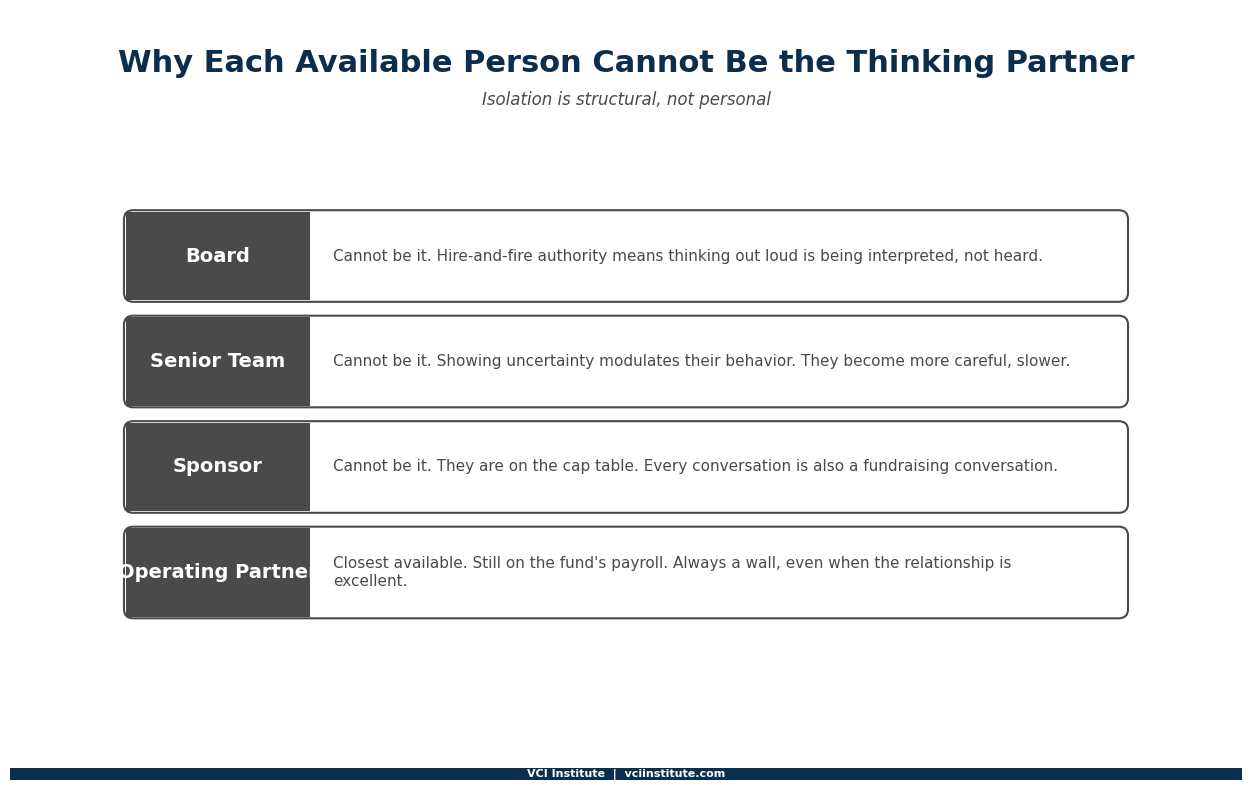
The structural sources of isolation are predictable, and recognizing them is the first step in pricing them.
The board cannot be the thinking partner. The board makes hire-and-fire decisions about the CEO, which means the CEO cannot think out loud with the board without managing how the thinking out loud is being interpreted. This is not a failure of the board. It is a failure of role definition. Boards govern. Thinking partners co-think. They cannot be the same people.
The senior team cannot be the thinking partner. The CEO cannot show full uncertainty to direct reports without those reports adjusting their own behavior in response. Direct reports who see uncertainty modulate it. They become more careful. They become slower in their own decisions. The CEO learns this and stops showing uncertainty, and the loneliness compounds.
The sponsor cannot be the thinking partner, even when the sponsor is excellent. The sponsor is on the cap table. Every conversation is also a fundraising conversation, in the sense that the next fund's narrative depends on the success of this one. The CEO cannot fully unbutton without paying for it later.
The operating partner is the closest available option, and even the operating partner is not enough. The operating partner is hired by the fund. They have their own performance review against this deal. The CEO can think out loud with them, partially, but not fully. There is always a wall. A written operating partner and CEO compact makes the wall explicit, which is better than pretending it is not there, but it does not remove it.
The result is that the PE-backed CEO has to construct a thinking-partner stack outside the deal, deliberately, before they need it. The CEOs who do this well are not isolated. The CEOs who do not, are.
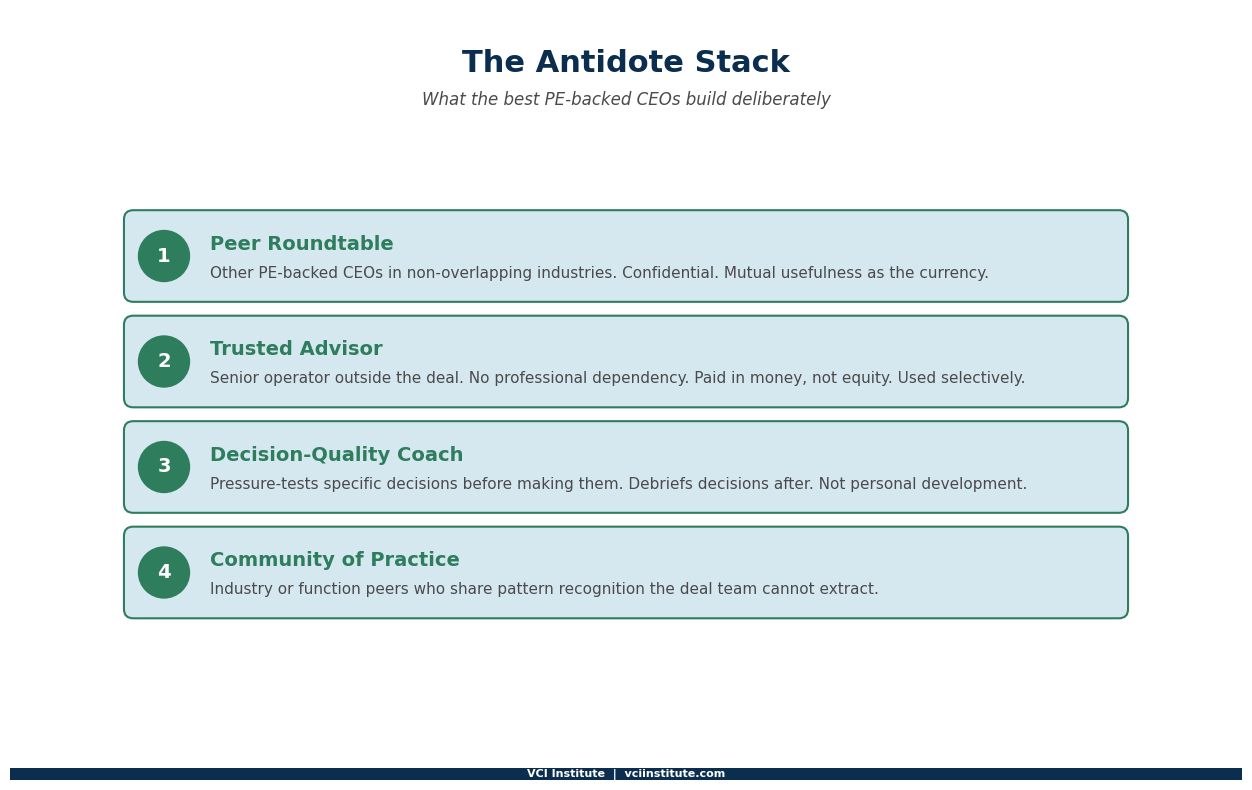
There is an antidote stack that the best PE-backed CEOs build, and the elements of it are concrete.
A peer roundtable of PE-backed CEOs. Other people in the same seat, in different industries, with no overlap of cap table or competitive interest. The conversation is confidential. The currency is mutual usefulness. Most CEOs we work with do not have this and are surprised by the difference when they get it. The decision velocity uplift is measurable inside ninety days.
A trusted advisor outside the deal. Not a consultant. A senior operator who has done the seat, has no professional dependency on the relationship, and is paid in money rather than equity, so the alignment is clean. One person, used selectively, on the highest-stakes decisions.
A coach, in the modern sense. Not a personal-development coach. A decision-quality coach. The CEOs who use this well do not use it for emotions. They use it to pressure-test specific decisions before making them, and to debrief specific decisions after making them, in a setting where the pressure-test does not signal weakness to anyone in the deal structure.
A community of practice. Industry peers, function peers, or both. The CEO is not the only person in the world solving this problem. Communities of practice provide pattern recognition that the CEO cannot extract from the deal team or the senior team, because both have different objective functions. This is particularly acute for executives who have just arrived from a corporate seat, where the support structure was different in kind, a transition covered in translation, not transfer.
The cost of building this stack is small. A few thousand dollars per month, two to four hours of the CEO's time per week. The return is faster decisions, fewer slips into optics management, and a senior team that watches the CEO operate with calm under pressure rather than with the appearance of calm. The buyer at exit prices the difference, and the difference is multiple turns over a five-year hold.
The deeper point is that isolation is not a personality trait of the CEO. It is a feature of the seat. Every PE-backed CEO is structurally isolated, regardless of how social or extroverted they are. The personality variable determines how the CEO handles the isolation. The structural variable is the isolation itself.
The fund that recognizes this and supports the antidote stack explicitly, including funding it as a portfolio operating expense, gets a different operating output across the portfolio. The fund that treats the antidote stack as the CEO's personal problem pays for the gap in decision velocity for the duration of every hold. Funds that run talent leadership as a strategic function tend to build this into the development apparatus rather than leaving it to each CEO to discover.
The loneliness tax is the most under-priced cost in private equity operations. It is also the easiest to lower. The mechanisms exist. The cost is small. The return is real.
The first step is naming it as a tax, not as a wellness concern. Wellness budgets get cut. Tax minimization budgets do not.
PE Simulator
Somewhere to be wrong at no cost
Part of what the antidote stack buys is a place to rehearse a decision before it is real. The PE Simulator runs a live deal from sourcing to exit. You allocate the capital, pull the operating levers, watch EBITDA move, and an AI advisor tells you what a partner would have done differently. Nine desks, eight arenas, four advisors. There is a free timed demo, about ten minutes, no signup and no card.
If the gap is the sponsor's dialect rather than the decision itself, COPPE Level 1 covers the governance relationship and the language a sponsor expects in a board pack.
VCI Institute in collaboration with Mohamad Chahine
Published 12 October 2026
Related reading from the VCI Institute
The Operating Partner and CEO Compact
Why it has to be written, and why making the wall explicit beats pretending it is not there.
The Sixth Lever PE Has Underbuilt
Talent leadership as a strategic function, including the development apparatus this stack belongs in.
Translation, Not Transfer
Why corporate executives struggle in PE, and why the isolation lands hardest on new arrivals.
About the VCI Institute
The VCI Institute is a nonprofit dedicated to building practical capability and shared standards for value creation in private equity. The Institute publishes operator-grade frameworks and runs certification programmes for operating partners, portfolio company executives, and value creation analysts. You can see what each programme actually covers before deciding. Analysis published here draws on the Institute's certification curricula and on structured review of mid-market transaction patterns rather than on any single proprietary dataset. Where a figure is directional rather than measured, it is described as such.
Further material is available in the Institute's Insights library and its free resource library of templates, checklists, and case snapshots.
© 2026 VCI Institute. All rights reserved. The frameworks, terminology, and analysis presented in this article are the intellectual property of the VCI Institute. Reproduction or derivative use without written permission is prohibited. Citation with proper attribution is welcomed.
We have many great affordable courses waiting for you!
Stay connected with news and updates!
Join our mailing list to receive the latest news and updates from our team.
Don't worry, your information will not be shared.
We hate SPAM. We will never sell your information, for any reason.


 Practice private equity like a pilot trains