The Sixth Lever PE Has Underbuilt: Talent Leadership as a Strategic Function
Oct 08, 2026
Private equity has spent forty years systematically professionalizing one thing after another, and producing one wave of returns after another from each iteration.
Financial engineering came first. Leverage, multiple arbitrage, basic cost discipline. The returns were extraordinary. Management teams mattered, but they were rarely the binding constraint.
The short answer
Private equity has professionalised four things in sequence: financial engineering, operational improvement, sector specialisation, and buy-and-build. Each took roughly twenty years to become table stakes. Talent leadership is about five years into the same curve and starting from a lower base. It is not a seventh lever, it is the spine running through all six, because alignment, operations, reporting, growth, M and A, and exit readiness each depend on a specific person being in a specific seat. The operating model has four parts: a curated leadership pipeline, a quarterly leadership assessment map, a development apparatus, and a rehearsed transition playbook.
Operational improvement came next. Margin expansion, working capital, KPIs, dashboards, repeatable execution. The operating partner role rose alongside this wave. Playbooks emerged. Execution became repeatable.
Sector specialization came after. Pattern recognition, sharper underwriting, smarter sourcing. Value creation became smarter, but remained episodic and sponsor-led.
Then came the buy-and-build wave. Platforms scaled fast through add-ons. Integration risk and organizational strain came with them. Organic growth and go-to-market discipline became the dominant growth engines, after a few cycles of working out which acquisitions actually compounded.
Each wave made sense. Each wave produced returns. Each wave eventually normalized.
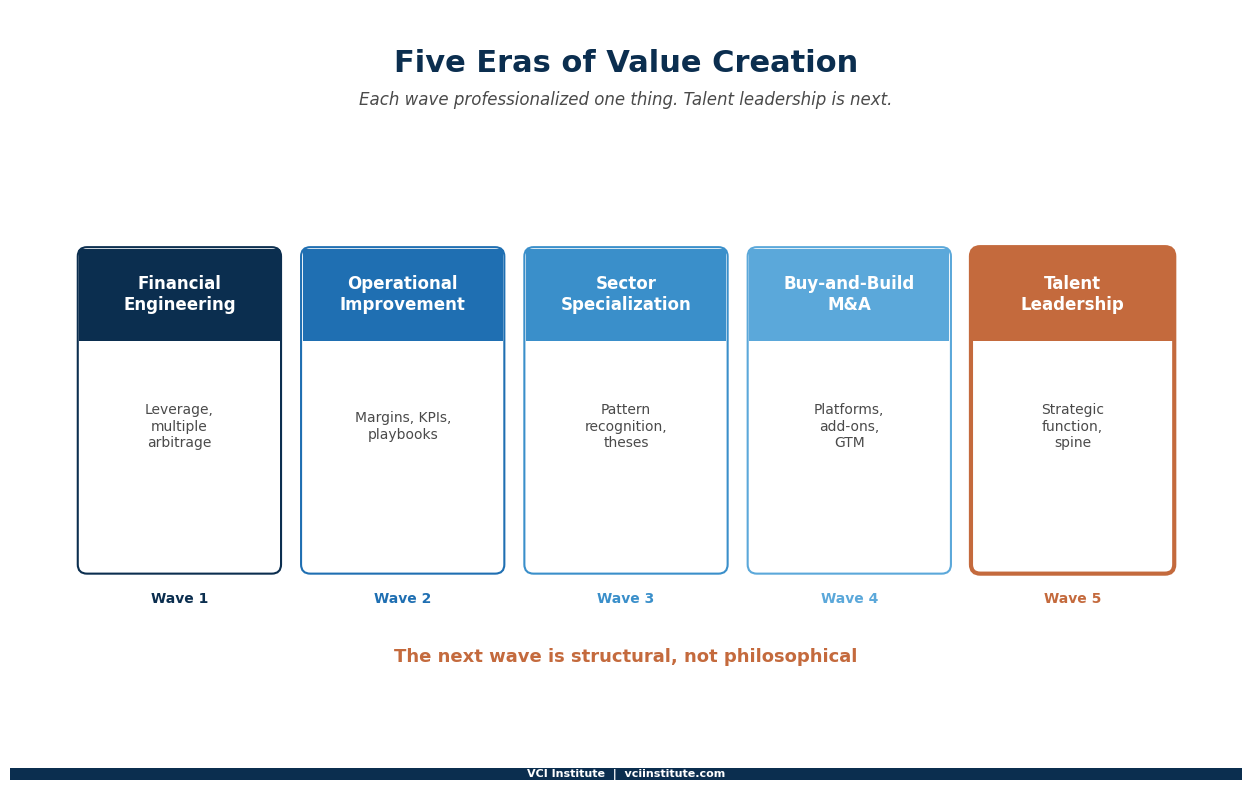
Sitting on top of all four waves is the constraint that the industry has been quietly understaffing for two decades.
Talent leadership.
Not human resources. Not benefits administration. Not the search firm relationship. Talent leadership as a strategic function. The integrated discipline of getting the right people into the right seats inside the portfolio, sequencing leadership transitions through the hold period, and treating the operator pool as a strategic asset of the fund rather than a transactional input to each deal.
The four prior waves all professionalized in roughly twenty years from first emergence to industry standard. Talent leadership is roughly five years into a similar curve, and it is starting from a lower base. Most funds do not have a chief talent officer. Most funds outsource the operator pool to executive search. Most funds treat the post-close talent assessment as a one-off project, not as an operating discipline that runs through the hold. Where the fund does build capability in-house, it looks like an internal operator bench rather than a talent network, and the distinction is the whole argument.
This is no longer sustainable, and the reason it is not sustainable is structural rather than philosophical.
Hold periods have lengthened. Five years has become seven years, sometimes longer. A leadership team that fits at year one rarely fits at year five. The fund that does not have a strategic talent function is forced to make late, reactive leadership changes that destroy twelve to eighteen months of value creation each time.
LP scrutiny has increased. LPs now ask specifically about the leadership pipeline. They want to see a system. The fund that cannot describe its operator bench in detail is competing on a smaller fundraising surface than the fund that can.
Exits have gotten harder. The buyers of the next decade will pay for transferability, and transferability is a function of leadership depth, not founder dependency. The fund that builds depth gets paid for it at exit. The fund that does not, gives up the multiple. Transferability is one of the six demand-side drivers, and it is the one most directly owned by the talent function.
Operating partners are stretched thin. The model of one operating partner across eight portfolio companies is breaking. Every additional add-on adds operating complexity. The operating partner becomes a triage function. The strategic talent function has to grow up to take the load that the operating partner cannot carry alone.
Operators themselves have more options. Fractional roles, advisory portfolios, independent sponsorship. The supply of capable, willing PE operators is not increasing at the rate the demand is growing. Funds that treat operators well, develop them deliberately, and reuse them across portfolios are winning the recruiting war by default.
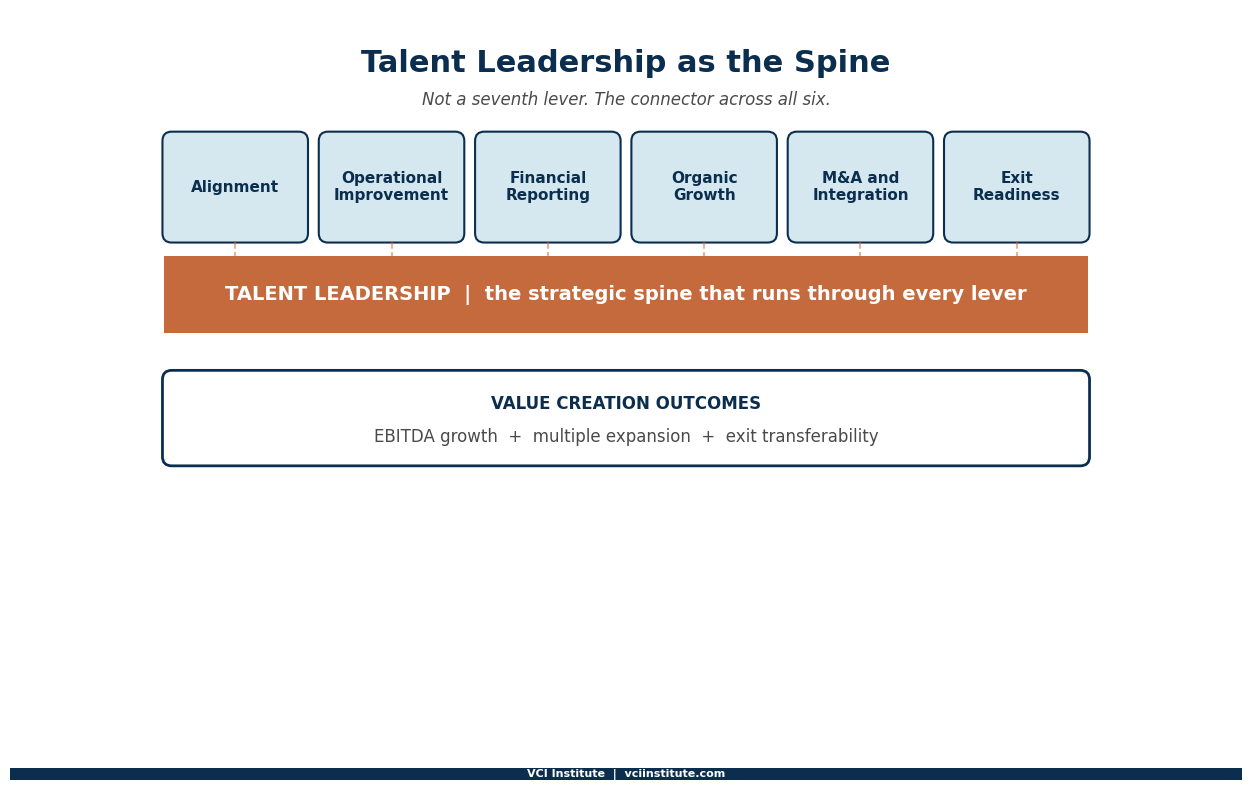
The six-lever taxonomy of value creation is the cleanest way to see why talent leadership has been underbuilt.
Lever one, alignment, depends entirely on talent leadership. Without the right CEO, alignment is theatre. The most elegant Thesis Operating System in the world will not run on a misaligned leadership team. Talent leadership is upstream of alignment, not parallel to it.
Lever two, operational improvement, depends on talent leadership. The operator who runs a tight operating cadence is a specific person, with specific reflexes, recruited and developed deliberately. Generic operating playbooks do not run themselves.
Lever three, financial reporting, depends on the CFO. The CFO is the most under-evaluated seat in most portfolio companies. Talent leadership decides whether the inherited CFO scales, gets augmented, or gets replaced. Most funds default to inheritance, which is the most expensive of the three options when it goes wrong. That decision, and its clock, is the CFO upgrade question.
Lever four, organic growth, depends on the chief revenue officer or commercial leader. Talent leadership decides whether the company has a real CRO or a sales VP with a bigger title. The decision is worth multiple turns of EBITDA over the hold.
Lever five, M and A, depends on a leadership team that can integrate. Many add-on acquisitions destroy value because the integration capability does not exist in the platform. Talent leadership is what builds that capability before the platform needs it.
Lever six, exit readiness, depends on a leadership team that can be diligenced cleanly by a buyer. The fund that has not invested in leadership depth pays for the gap at exit, in the multiple.
Talent leadership is not a seventh lever. It is the spine that runs through all six. Treating it as a support function is the structural error. The fund that recognizes talent leadership as a strategic function, integrated into every other lever, builds a different kind of value creation engine.
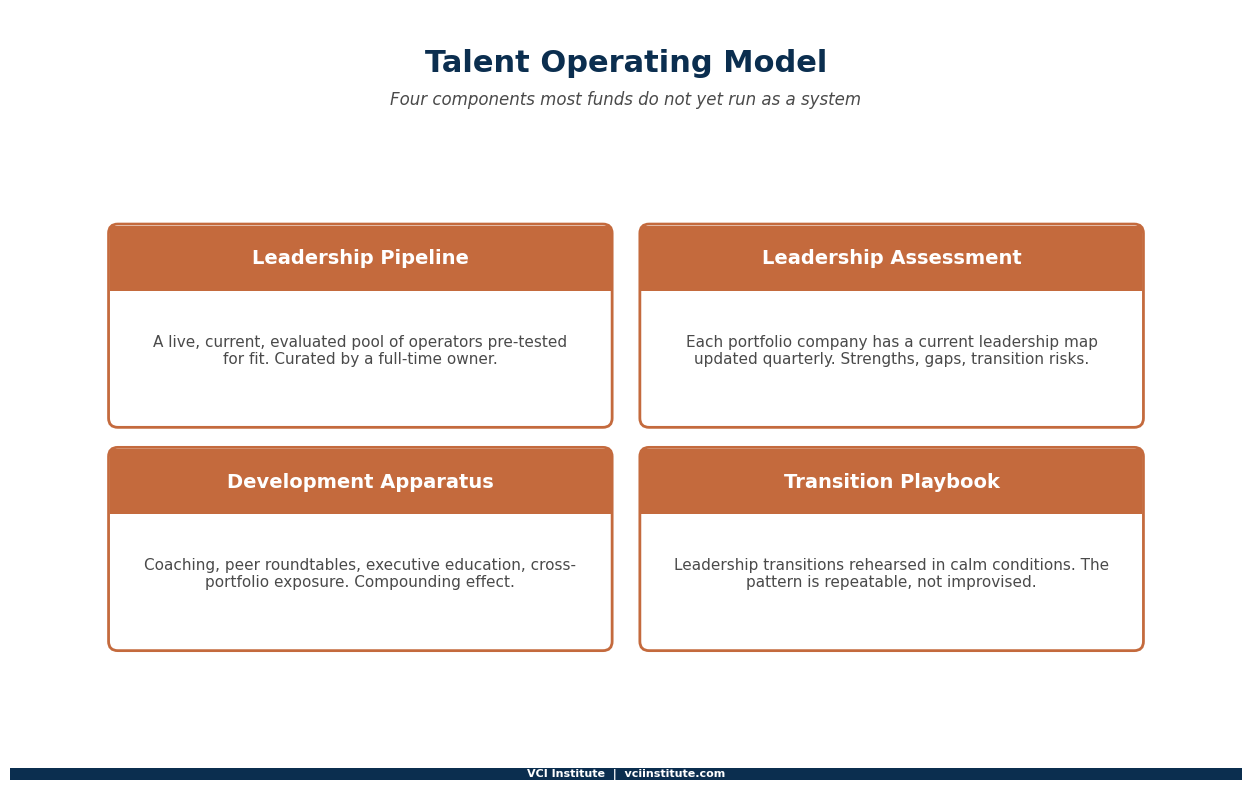
The operating model for a strategic talent function inside a fund has four components, none of which most funds currently run as a system.
A leadership pipeline. Not a contact list. A live, current, evaluated pool of operators who have been pre-tested for fit against specific portfolio profiles, with relationships maintained between deals. The pipeline is curated by someone whose full-time job is curation. Search firm relationships are an input, not the function. Pre-testing for fit means knowing which of the three operator archetypes each candidate actually is, rather than reading the resume.
A leadership assessment system. Each portfolio company has a current leadership map updated quarterly. Strengths, gaps, replacements identified, transition risks priced. The map is a living document used in operating reviews, not an artifact produced once at close. The starting version of it is the post-close talent density map.
A development apparatus. Operators in seats are developed deliberately. Coaching, peer roundtables, executive education, exposure across the portfolio. The fund that develops its operators creates a multi-deal compounding effect that the fund that does not, cannot match.
A transition playbook. Leadership transitions are inevitable. The funds that handle them well have practiced. Rehearsed. Built the playbook in calm conditions before they need it under pressure. The funds that handle them badly improvise in real time, lose months, and write the cost off as a one-time event. It is not one-time. It is the recurring cost of not having the function.
The argument for treating talent leadership as a strategic lever is not philosophical. It is mathematical. Roughly forty percent of underperforming PE deals trace primarily to a leadership issue that was either misdiagnosed at close or addressed too late during the hold. That is the largest single category of preventable performance loss in private equity.
The fund that solves the talent leadership problem builds a structural advantage that does not normalize the way the prior four waves did. Capital, operations, sectors, and add-ons all eventually became table stakes. Talent leadership, executed as a strategic function, is harder to copy because it depends on culture, continuity, and ten-year relationship investments that cannot be acquired in a single fundraising cycle.
The next era of outperformance will not be won on capital structure. It will be won on commitment. Clarity, alignment, and retention over longer cycles of execution.
That is the lever that has been waiting underbuilt while the rest of the industry was professionalizing the easier ones.
The Operating Partner Track
A development apparatus your operators can actually use
One of the four components above is a development apparatus, and it is the one most funds have no answer for. COPPE Levels 1 and 2 together cover the operating partner craft and then the arithmetic underneath it, on one company held from entry to exit. $379 for both, rather than $573 separately. Self paced, so it fits around a live portfolio.
See the Operating Partner Track Or find which programme fits you
Building this across a fund rather than for one seat? Write to [email protected] and ask about group enrolment.
VCI Institute in collaboration with Mohamad Chahine
Published 8 October 2026
Related reading from the VCI Institute
The Internal Operator Bench
Why funds need more than talent networks, and what the built version actually costs.
The CFO Upgrade Question
The most under-evaluated seat in the portfolio, and why late is the expensive answer.
The Six Demand-Side Drivers
What buyers price at exit, including the transferability the talent function owns.
About the VCI Institute
The VCI Institute is a nonprofit dedicated to building practical capability and shared standards for value creation in private equity. The Institute publishes operator-grade frameworks and runs certification programmes for operating partners, portfolio company executives, and value creation analysts. You can see what each programme actually covers before deciding. Analysis published here draws on the Institute's certification curricula and on structured review of mid-market transaction patterns rather than on any single proprietary dataset. Where a figure is directional rather than measured, it is described as such.
Further material is available in the Institute's Insights library and its free resource library of templates, checklists, and case snapshots.
© 2026 VCI Institute. All rights reserved. The frameworks, terminology, and analysis presented in this article are the intellectual property of the VCI Institute. Reproduction or derivative use without written permission is prohibited. Citation with proper attribution is welcomed.
We have many great affordable courses waiting for you!
Stay connected with news and updates!
Join our mailing list to receive the latest news and updates from our team.
Don't worry, your information will not be shared.
We hate SPAM. We will never sell your information, for any reason.


 Practice private equity like a pilot trains