
The Internal Operator Bench: Why Funds Need More Than Talent Networks
Aug 31, 2026
Most private equity firms have a talent network. They maintain relationships with executives across industries, function specialists who can be deployed for specific projects, advisors who can be brought in for diligence or post-close work, and former portfolio company leaders who occasionally take new assignments. The network is real and it is useful. It is not, however, the same thing as an internal operator bench, and the difference is the difference between firms that out-execute their peers consistently and firms that produce occasional bright spots inside an uneven track record.
An internal operator bench is a roster of full-time, senior, dedicated operating professionals who work inside the firm rather than alongside it. They are paid by the firm. They are accountable to the firm. They sit in the firm's offices and join the firm's meetings. They develop institutional knowledge that compounds over their tenure. They build relationships with the firm's deal teams that mature into real partnerships. They are part of the firm's culture rather than service providers who pass through it.
The short answer
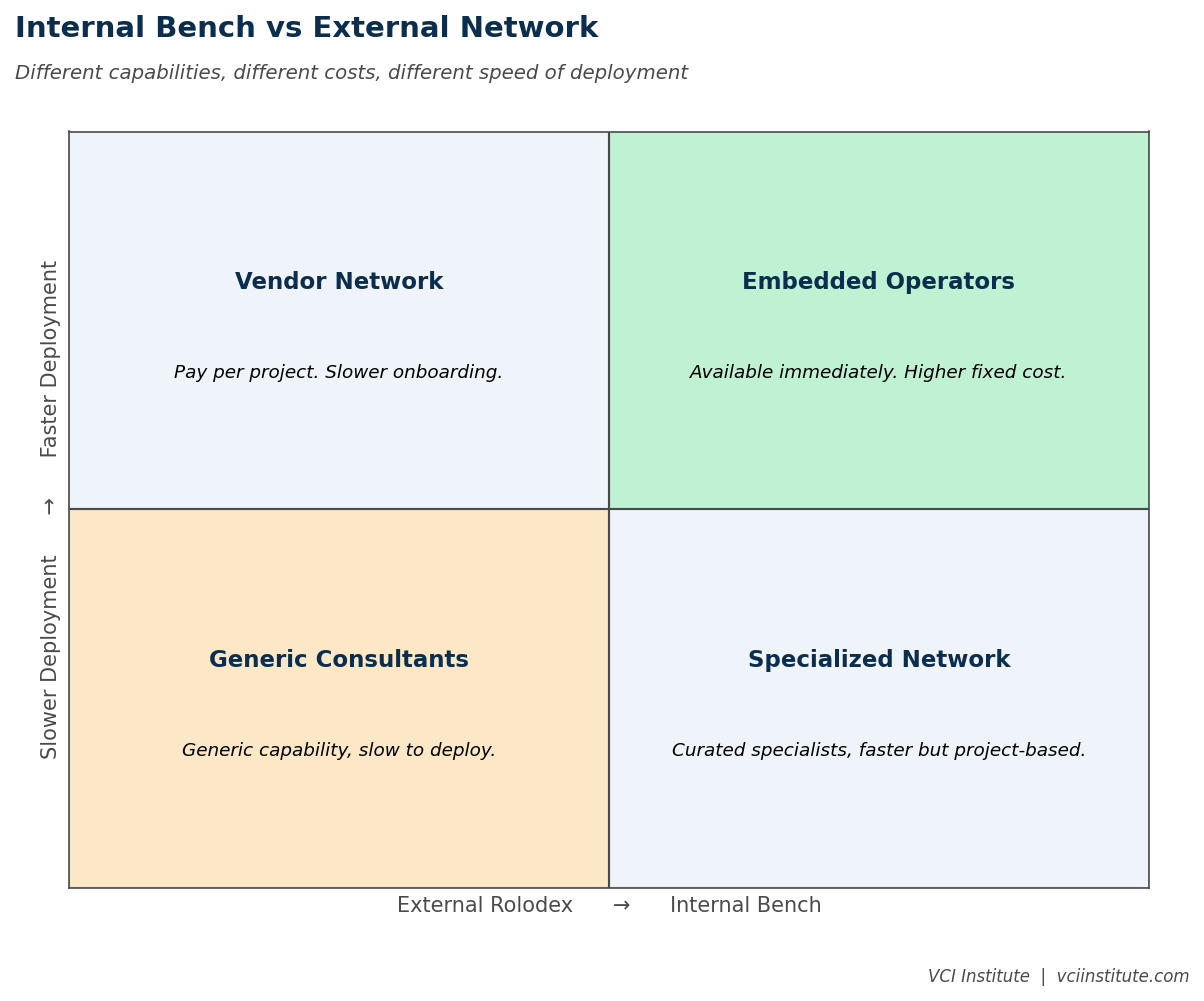
A talent network cannot do four things a bench can: deploy in twenty four hours rather than four to eight weeks, accumulate pattern recognition across the portfolio, mature its working relationship with the same deal teams, and hold economics tied to firm performance. A serious bench covers six capability areas, commercial excellence, operations and supply chain, finance and capital structure, technology and data, talent and organisation, and sector depth. It takes three to seven years to build and costs two to three times the direct compensation once infrastructure is included.
Building such a bench is expensive, slow, and culturally demanding. It is also, increasingly, the differentiator between firms that produce reliable value creation outcomes and firms that depend on luck.
What the Network Cannot Do
The talent network model has structural limitations that show up across the deal lifecycle.
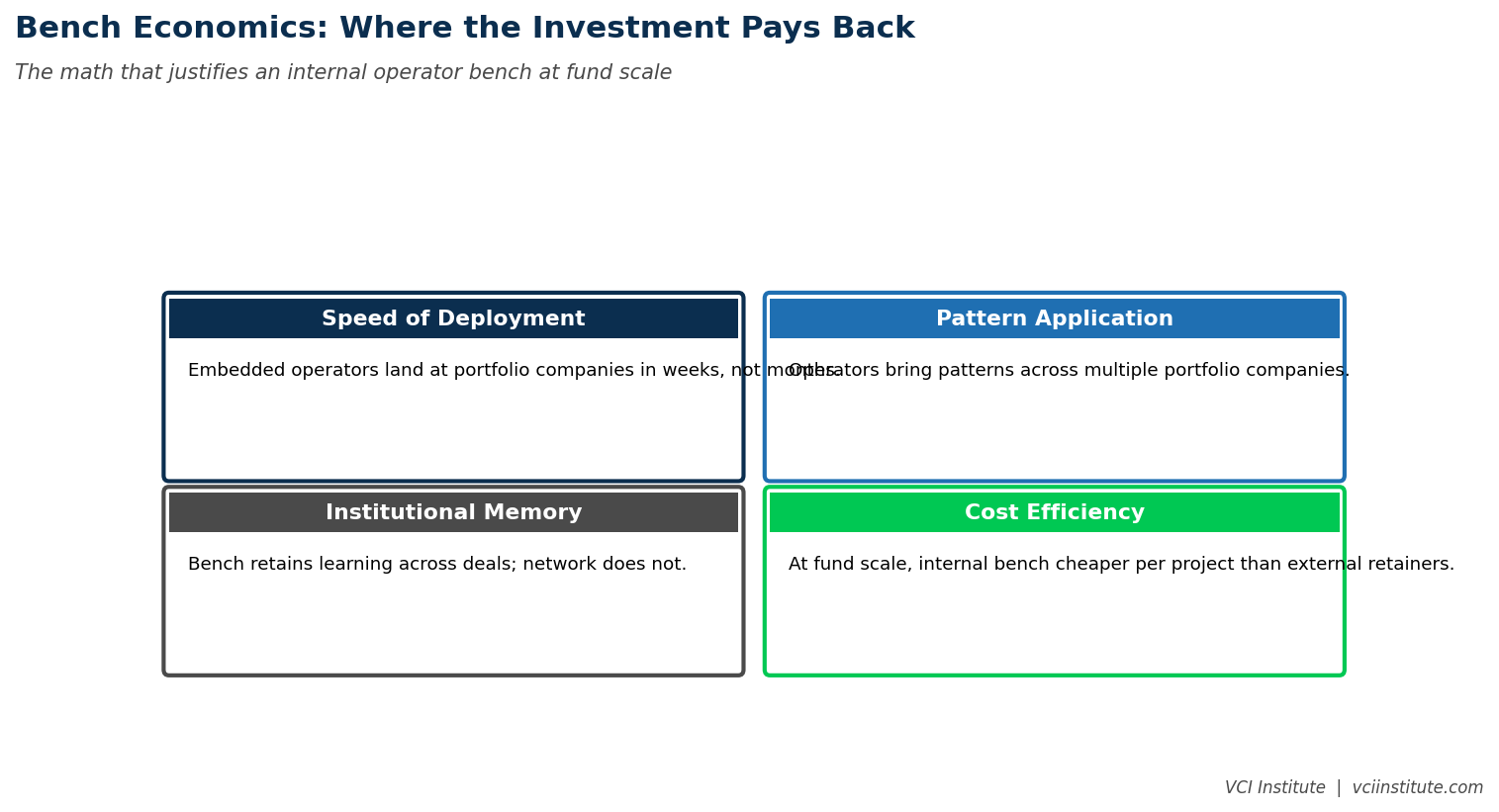
The network cannot move at the speed deals require. When a value creation issue surfaces in week six post-close that requires senior operator engagement, the network has to be activated, the right person has to be identified, terms have to be negotiated, the engagement has to be scoped, and the work has to start. The cycle takes four to eight weeks even when it goes well. The internal bench can be deployed in twenty four hours. This matters most in exactly the window where speed is most valuable, since the first ninety days after close are when the cost of a delayed intervention is highest.
The network cannot accumulate institutional knowledge. Each engagement is bounded by the scope of the project. The lessons learned from a sales transformation in one portfolio company do not automatically inform the sales transformation in another, because the network operator is not present for both. The internal bench accumulates pattern recognition across the portfolio that compounds into institutional capability.
The network cannot be invested in for the long term. Network operators come and go based on availability, alternative opportunities, and commercial terms. The skills the firm develops in working with a particular network operator are partially lost when that operator becomes unavailable for the next deal. The internal bench retains and develops the skills.
The network cannot fully integrate with the deal team. Network operators are usually present for a defined engagement and then leave. The deal team works with the network operator for that period and then with someone else for the next engagement. The repeated handoffs create friction and inconsistency. The internal bench works with the same deal teams across multiple deals, building working relationships that mature over time. It also makes the operating partner and CEO compact a repeatable institutional practice rather than an improvisation each time a new face arrives.
The network cannot be measured in firm performance terms. Network operators are paid for engagements, not for outcomes across the firm's portfolio. The economic incentive structure does not align with the firm's cumulative success. The internal bench is paid in part through carry or other mechanisms tied to firm performance, which aligns incentives across deals.
These limitations do not mean networks are not useful. They are useful for specific situations. They are also not a substitute for an internal bench in firms that aspire to consistent operational excellence.
What the Bench Costs
Building an internal operator bench is expensive in ways that take time to fully appreciate.
The direct compensation cost is significant. Senior operating partners are expensive to hire and retain at the level required for them to be genuinely useful to portfolio companies. Total compensation packages of two million dollars or more per senior operator are not unusual. A bench of five to ten such operators carries a fully loaded annual cost of fifteen to twenty-five million dollars.
The indirect cost is also significant. Senior operators require infrastructure to be effective. Administrative support. Travel and time inside portfolio companies. Functional specialists who deepen the bench in specific domains. Tools and systems that support their work. The total cost of the bench is often two to three times the direct compensation cost.
The cultural cost is the least visible and the most demanding. An internal operator bench is not a department. It is a community of senior people who need to be integrated into the firm's deal teams, the firm's investment committee, and the firm's portfolio companies in a way that produces genuine partnership rather than political tension. The firms that have built effective benches have invested in the cultural integration as much as they have invested in the bench itself.
The aggregate cost is meaningful. For most mid-market firms, building a serious internal bench requires diverting twenty to thirty percent of management fees toward operating capability that the network model would have left to portfolio companies or third-party advisors. The investment is justified only if the bench produces returns that exceed its cost across the portfolio. For firms that have built strong benches, the returns are clear. For firms that have built weak benches, the cost has been wasted.
What the Bench Produces When It Works
The economic case for the internal bench rests on three categories of value that mature over time.
The first category is faster execution. The bench can be deployed at the moment of need rather than after a procurement cycle. Issues that surface in early hold are addressed within days rather than months. Opportunities that emerge during the value creation plan are pursued within weeks rather than quarters. Across a portfolio of fifteen to twenty deals, the cumulative speed advantage compounds into measurable returns.
The second category is institutional learning. The bench operators see patterns across the portfolio that no individual deal team sees. They notice that pricing strategies that worked in one specialty distribution business apply to another. They observe that talent profiles that succeeded in one services business succeed in similar ones. They detect that operating cadences that produced strong outcomes in one mid-market technology business produce comparable outcomes in adjacent ones. The pattern recognition turns into institutional methodology that the firm applies systematically rather than rediscovers deal by deal. A firm-wide view of where pricing power actually sits is worth considerably more than the same insight discovered independently in five separate companies.
The third category is talent depth. The bench, properly developed, becomes a source of senior talent for portfolio companies as well as a source of internal capability. Operators who have served on the bench for several years and who have demonstrated specific capability in particular industries become natural candidates for portfolio company CEO or other senior roles. The transition from bench to portfolio company is faster and more reliable than external CEO searches because the bench operator already knows the firm's working style. The same logic applies to finance leadership, where a bench candidate resolves the CFO upgrade question in weeks rather than quarters.
These three categories together produce returns that, for firms that have built strong benches, are clearly positive. The returns are also lumpy and lagged. They show up in reduced churn of management teams, faster execution of value creation plans, fewer surprises in late hold, and more reliable exit outcomes. Each individual deal is incrementally better. The aggregate over the fund is meaningfully better.
The Capability Map
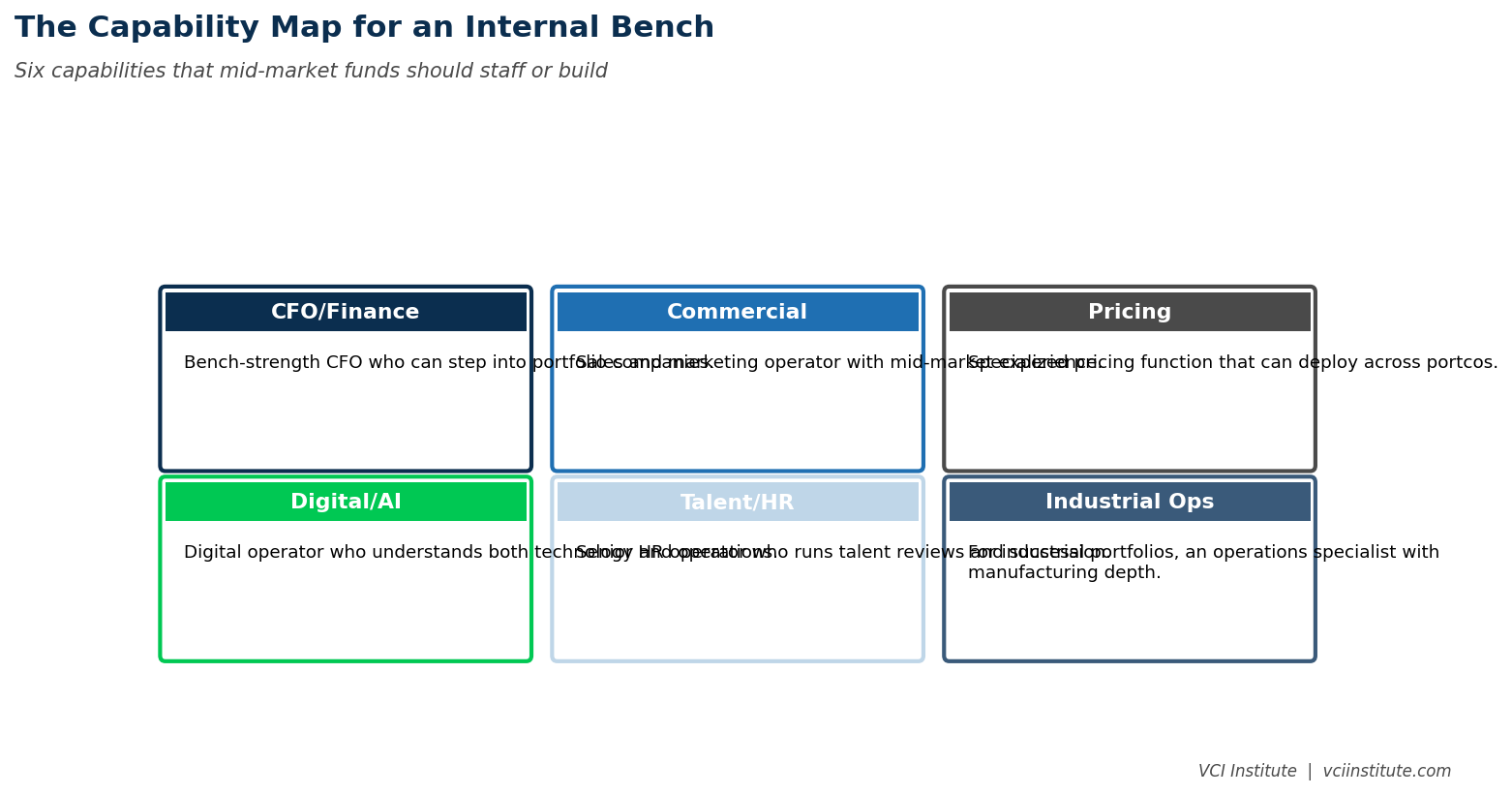
A strong bench is not a collection of generalists. It is a deliberate set of capabilities mapped against the firm's portfolio strategy. Six categories of capability are usually represented in a well-built bench.
Commercial excellence operators specialize in pricing, sales operations, and customer success. They engage with portfolio companies on revenue lever execution. Many firms have one or two specialists in this domain.
Operations and supply chain operators specialize in manufacturing, logistics, and procurement. They engage with portfolio companies on cost lever execution and operational redesign. Firms with industrial or distribution exposure typically have at least one specialist here.
Finance and capital structure operators specialize in CFO support, financial reporting, treasury, and capital structure. They engage with portfolio companies on the financial dimensions of the value creation plan. This category often overlaps with the firm's traditional finance function but sits closer to portfolio companies than to fund finance.
Technology and data operators specialize in systems, data infrastructure, and digital transformation. They engage with portfolio companies on the technology dimension of the value creation plan. The capability is increasingly important as digital and AI investments become standard parts of the value creation thesis, and it is usually the first bench capability to encounter the gap between available tooling and the operating model that has to absorb it.
Talent and organization operators specialize in management team development, organizational design, and culture. They engage with portfolio companies on the people dimension of value creation. This category is often underweighted in firms that built their benches before the importance of talent had become as clear as it now is.
Sector specialists specialize in specific industries that the firm invests in heavily. They bring domain depth that generalists cannot match. Firms with concentrated sector strategies typically have one or two sector specialists per major sector.
A bench that maps cleanly against these six categories, with at least one strong operator in each relevant category, has the capability to support the full range of value creation activities the portfolio is likely to require. A bench that has gaps in particular categories will find that the gaps become binding constraints when those capabilities are needed.
The Build Path
The investment to build a serious bench takes between three and seven years depending on the starting point and the scale of ambition. The path is not subtle, but it requires patience.
Year one is foundation. The firm hires two to four senior operators in the highest priority capability areas. The hires are made deliberately, with searches that focus on cultural fit as much as on credentials. The early hires set the tone for the bench and have outsized influence on what the bench eventually becomes.
Years two and three are extension. The firm adds operators to fill the remaining capability gaps. By the end of year three, the bench has full coverage of the six categories and is producing measurable contribution to the portfolio. Some of the early hires may have left, and replacements are made with more refined search criteria informed by what worked and what did not.
Years four through seven are maturation. The bench accumulates the institutional knowledge that turns individual operator capability into firm methodology. The first generation of bench operators becomes senior enough to mentor the next generation. The integration with deal teams matures from cooperation to true partnership. The firm's value creation outcomes become measurably better than they were before the bench existed. A shared diagnostic language helps here, and firms that standardise on something like an operating maturity index reach methodology faster than firms where each operator brings a personal framework.
This path is unforgiving of impatience. Firms that try to compress it by hiring rapidly without sufficient cultural integration produce benches that are technically capable but operationally fragmented. Firms that try to defer it by relying on the network model for too long find that they cannot catch up to firms that started building earlier.
The Strategic Question
The bench versus network choice is, ultimately, a strategic question about what kind of firm the sponsor wants to be. Firms that aspire to consistent operational excellence as a differentiator have to build the bench. Firms that aspire to financial discipline and selective use of operational capability can rely on the network with less investment.
Both strategies can produce strong returns. Neither is structurally superior in all market conditions. The mistake is to claim aspiration to consistent operational excellence while only investing in network capability. The gap between the claim and the investment becomes visible to LPs over a fund cycle and produces a credibility problem at the next fundraise.
Firms that have built strong benches are usually clear about the strategic choice they have made. They invest accordingly, they protect the investment through market cycles, and they build the institutional culture that makes the bench effective. Firms that have weak benches but claim operational excellence as a differentiator are usually not clear about the strategic choice. They underinvest, they protect the investment poorly, and they build cultures that treat operating capability as a service function rather than a source of competitive advantage.
The choice does not have to be made loudly. It does have to be made clearly. The internal operator bench is a substantial commitment that produces substantial returns when it works and substantial waste when it does not. The sponsors that build it well are increasingly the ones whose value creation outcomes look durable across cycles. Those that build it badly, or do not build it at all, are increasingly the ones whose outcomes look uneven.
The Operating Partner Track
Building bench capability, one operator at a time
A bench is only as strong as the standard its operators are held to. COPPE Levels 1 and 2 together cover the value creation levers, the hundred day structure, the governance relationship with a portfolio company chief executive, and then the arithmetic behind all of it on one company held from entry to exit. $379 for both, rather than $573 separately.
See the Operating Partner Track Or find which programme fits you
Building a bench for a whole firm rather than one seat? The same programmes are available for teams. Write to [email protected] and ask about group enrolment.
VCI Institute in collaboration with Mohamad Chahine
Published 31 August 2026
Related reading from the VCI Institute
The Operating Partner and CEO Compact
Why it has to be written, and how a bench turns it into institutional practice rather than improvisation.
The CFO Upgrade Question
The finance leadership decision a mature bench can resolve in weeks rather than quarters.
PE Boards That Actually Work
From performance theatre to strategic counsel, and where bench operators add most in the governance layer.
About the VCI Institute
The VCI Institute is a nonprofit dedicated to building practical capability and shared standards for value creation in private equity. The Institute publishes operator-grade frameworks and runs certification programmes for operating partners, portfolio company executives, and value creation analysts. You can see what each programme actually covers before deciding. Analysis published here draws on the Institute's certification curricula and on structured review of mid-market transaction patterns rather than on any single proprietary dataset. Where a figure is directional rather than measured, it is described as such.
Further material is available in the Institute's Insights library and its free resource library of templates, checklists, and case snapshots.
© 2026 VCI Institute. All rights reserved. No part of this article may be reproduced or transmitted in any form without prior written permission of the VCI Institute.
We have many great affordable courses waiting for you!
Stay connected with news and updates!
Join our mailing list to receive the latest news and updates from our team.
Don't worry, your information will not be shared.
We hate SPAM. We will never sell your information, for any reason.


 Practice Platform