
The Value Creation CEO Archetype: What the Best Sponsors Are Actually Hiring For
Jun 08, 2026
The CEO who succeeds in a private equity owned mid-market business is a specific archetype. She is distinct from the founder who built the business from scratch. She is distinct from the corporate executive who ran a division of a Fortune 500. She is distinct from the turnaround specialist who fixes broken businesses. She has overlapping skills with each of these other archetypes, but the combination she embodies is its own profile, and it is the profile that the most sophisticated sponsors are explicitly hiring for in 2026.
This is not the way the search market has historically described the CEO role. The standard search has tended to seek a generic strong leader with industry experience and growth orientation. The generic search has produced inconsistent results. The disciplined sponsors that have looked at their hit rates over time have noticed that the CEOs who succeed in private equity ownership share a recognizable cluster of capabilities, and that hiring against this cluster, rather than against the generic profile, produces a meaningfully better hit rate.
The cluster has a name worth using. The value creation CEO. The naming is not theatrical. It captures something specific about the combination of capabilities the role actually requires.
The Four Archetypes and Why They Differ
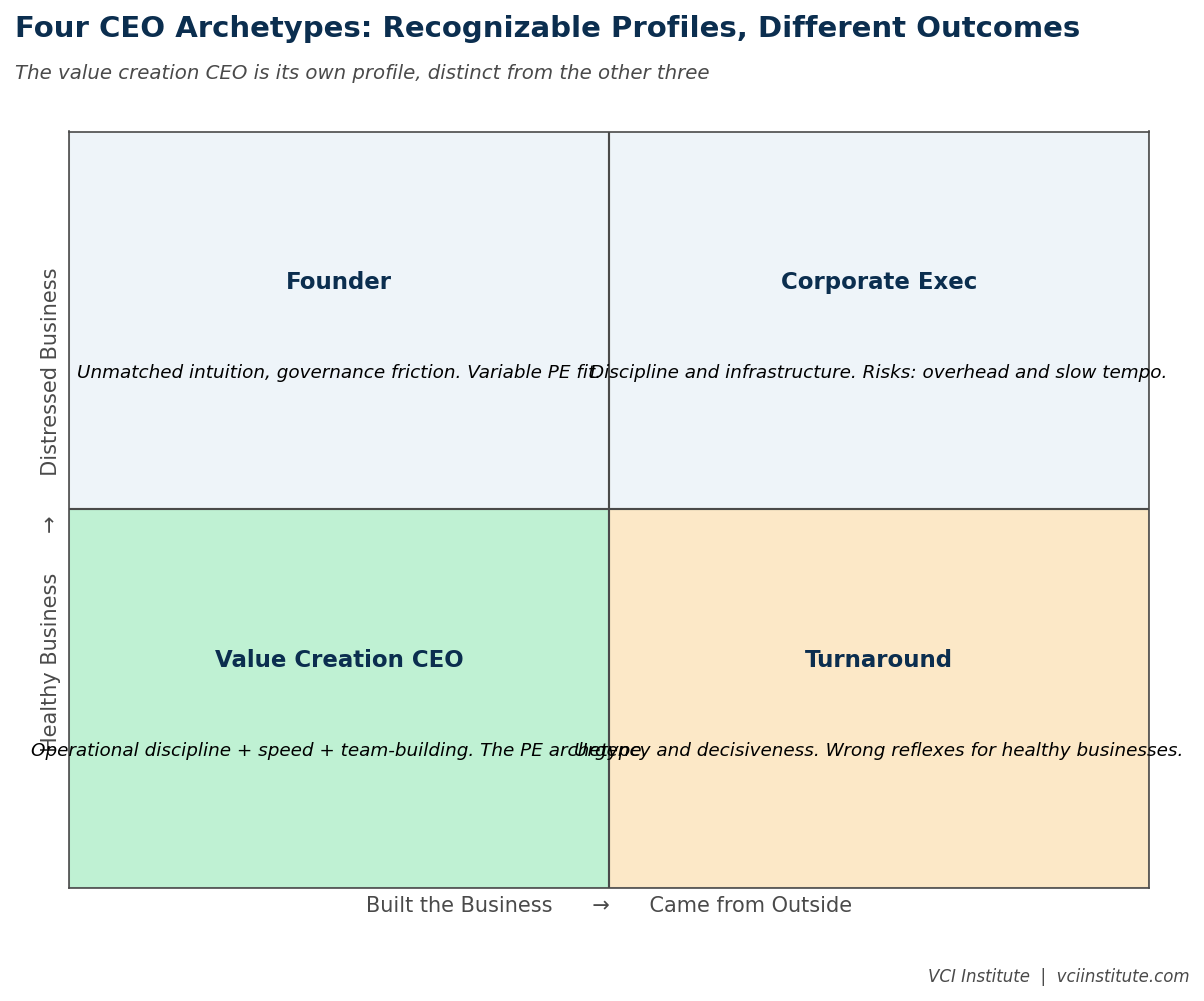
To understand what the value creation CEO is, it helps to be clear about what she is not.
The founder archetype is the leader who built the business and continues to run it under PE ownership. The founder has unmatched intuition about the business, deep customer relationships, and personal authority over the team. Her strengths are also her structural risks under PE ownership. She runs the business as an extension of her personal style, often without the institutional infrastructure that scaling requires. She struggles with the governance cadence that PE requires. Her response to operating partner involvement varies from constructive to resistant, often depending on her temperament rather than on the merits of any specific intervention.
The corporate executive archetype is the leader who came up through a large company and is now running a smaller, leaner business under PE ownership. The corporate executive brings discipline, institutional infrastructure, and capability investment that the business may have lacked. She also often brings overhead, slow decision making, and a preference for committee-driven governance that does not fit the speed and decisiveness PE expects. The corporate executive who succeeds in PE has typically managed to shed the corporate habits that do not fit. The corporate executive who fails has not.
The turnaround archetype is the leader who specializes in fixing broken businesses. The turnaround specialist brings urgency, decisive action, and willingness to make hard choices that more measured leaders defer. The strengths are also limitations. The turnaround playbook produces results in distressed situations and can be destructive in healthy businesses. The turnaround CEO who runs a healthy business as if it needs turning around can damage the business by applying interventions that do not match the actual situation.
The value creation CEO is not a hybrid of these three. She is a different archetype with her own profile. She combines the operational discipline of the corporate executive with the speed and decisiveness of the turnaround specialist, set within a leadership style that builds team capability the way the best founders do. The combination is rare, which is why the search for the value creation CEO is genuinely difficult.
The Profile of the Value Creation CEO
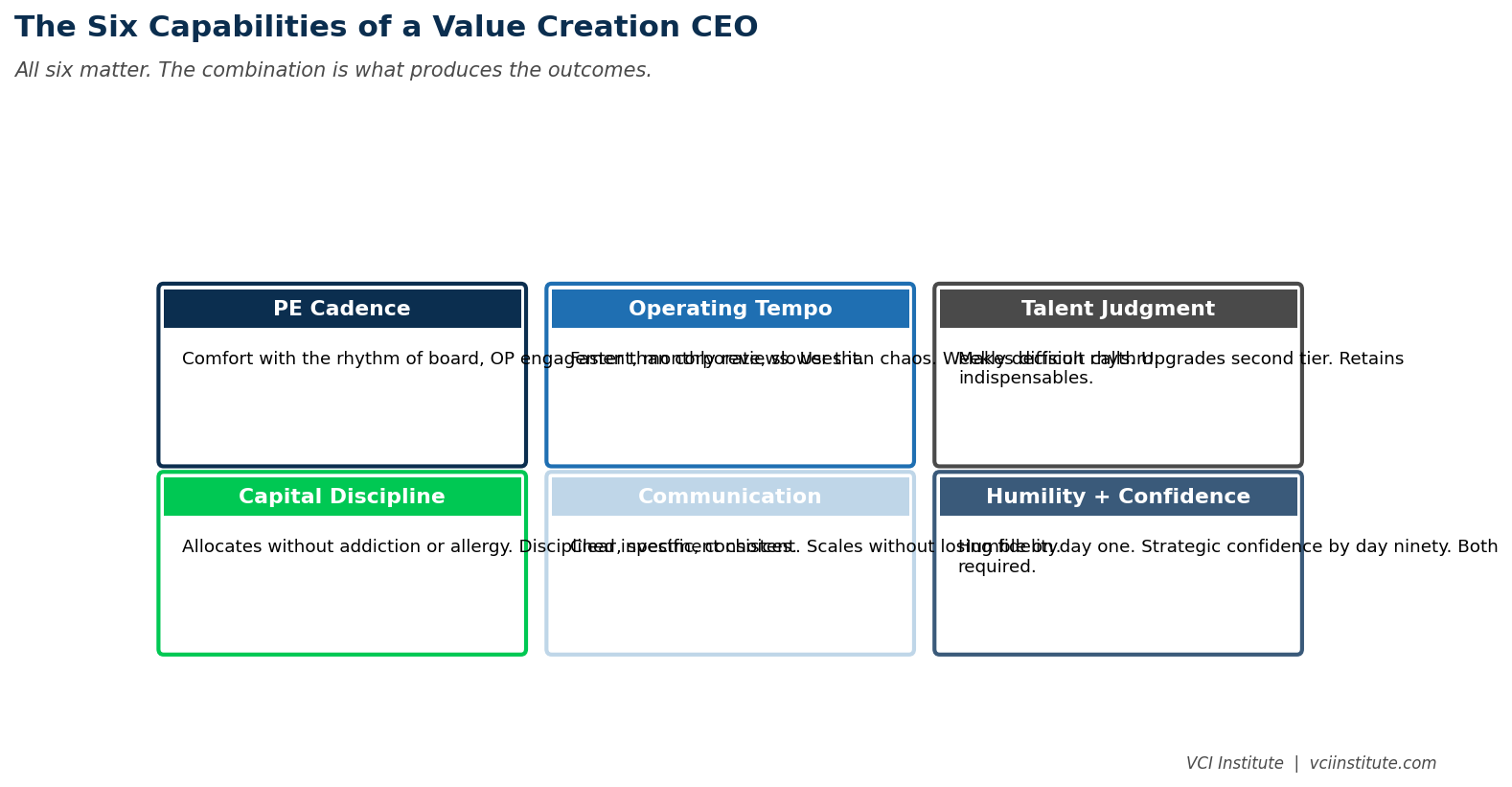
Six capabilities define the value creation CEO archetype. Each one matters. The combination is what produces the outcomes.
The first capability is comfort with the PE governance cadence. The value creation CEO operates well within the rhythm of board meetings, monthly operating reviews, quarterly portfolio updates, and the constant engagement of operating partners. She does not experience this cadence as an imposition. She uses it. The reporting discipline produces the operating clarity that allows her to run the business better than she could without it.
The second capability is operational tempo. The value creation CEO drives a faster operating cadence than most corporate businesses run at, but slower than the chaos of an early-stage founder business. Decisions get made on a weekly rhythm rather than a quarterly one. Performance is reviewed continuously rather than at quarter-end. Issues get addressed when they are visible, not when they are urgent. The tempo produces the kind of operating compounding that turns five years of ownership into meaningful enterprise value growth.
The third capability is talent judgment. The value creation CEO is good at evaluating talent, both inherited and recruited. She makes the difficult talent calls that the prior CEO might have deferred. She upgrades the second tier of management with deliberate sequencing. She retains the indispensables. She works productively with the operating partner on the talent agenda rather than treating it as a sponsor imposition.
The fourth capability is capital allocation discipline. The value creation CEO understands that the business is not just generating profit but is also producing capital that has to be allocated. She makes the discipline-driven choices about where to invest, where to hold steady, and where to harvest. She is not allergic to capital expenditure when the business case justifies it, and she is not addicted to capital expenditure as a way to drive growth that organic execution should produce.
The fifth capability is communication that scales. The value creation CEO communicates clearly to the senior team, to the broader organization, and to the board. She produces the narratives that align the company around what matters. She does not produce the political theater that some founders mistake for communication. She does not produce the bureaucratic memos that some corporate executives default to. The communication style is direct, specific, and consistent, which is the style that scales without losing fidelity.
The sixth capability is operational humility paired with strategic confidence. The value creation CEO is humble about what she does not know about the business when she arrives. She listens carefully, asks questions, and absorbs context before making major moves. She is also confident about her strategic judgment once she has the context. The combination of humility on day one and confidence by day ninety is the profile that produces strong outcomes. The CEO who is confident from day one often makes mistakes that humility would have prevented. The CEO who remains humble through the hold period struggles to drive the strategic clarity the business requires.
What This Profile Is Not
The value creation CEO profile is not the same as the operationally excellent senior executive. Many strong senior executives have most of the six capabilities but lack one or two that turn out to be binding. Without all six, the executive is competent but does not produce the value creation outcomes the role requires.
A common gap is the talent judgment capability. The executive is strong on operations but defers difficult talent calls. The team underperforms because weak players are tolerated longer than they should be. The operating outcomes suffer because the team is not strong enough.
Another common gap is operational tempo. The executive understands what to do but operates on a corporate cadence that is too slow for the PE timeline. The plan that should have been executed in six months takes eighteen. The hold period passes with the value creation thesis only partially delivered.
A third common gap is comfort with PE governance. The executive can run a business but experiences operating partner involvement as friction. The relationship deteriorates. The CEO and the sponsor find themselves litigating governance rather than collaborating on outcomes. The execution suffers regardless of what either party intended.
The value creation CEO profile requires all six capabilities at acceptable levels, with at least three or four at strong levels. Candidates with five out of six can sometimes succeed if the missing capability is supportable through team or operating partner involvement. Candidates with four out of six rarely succeed, regardless of how strong the four are.
How to Assess for the Profile
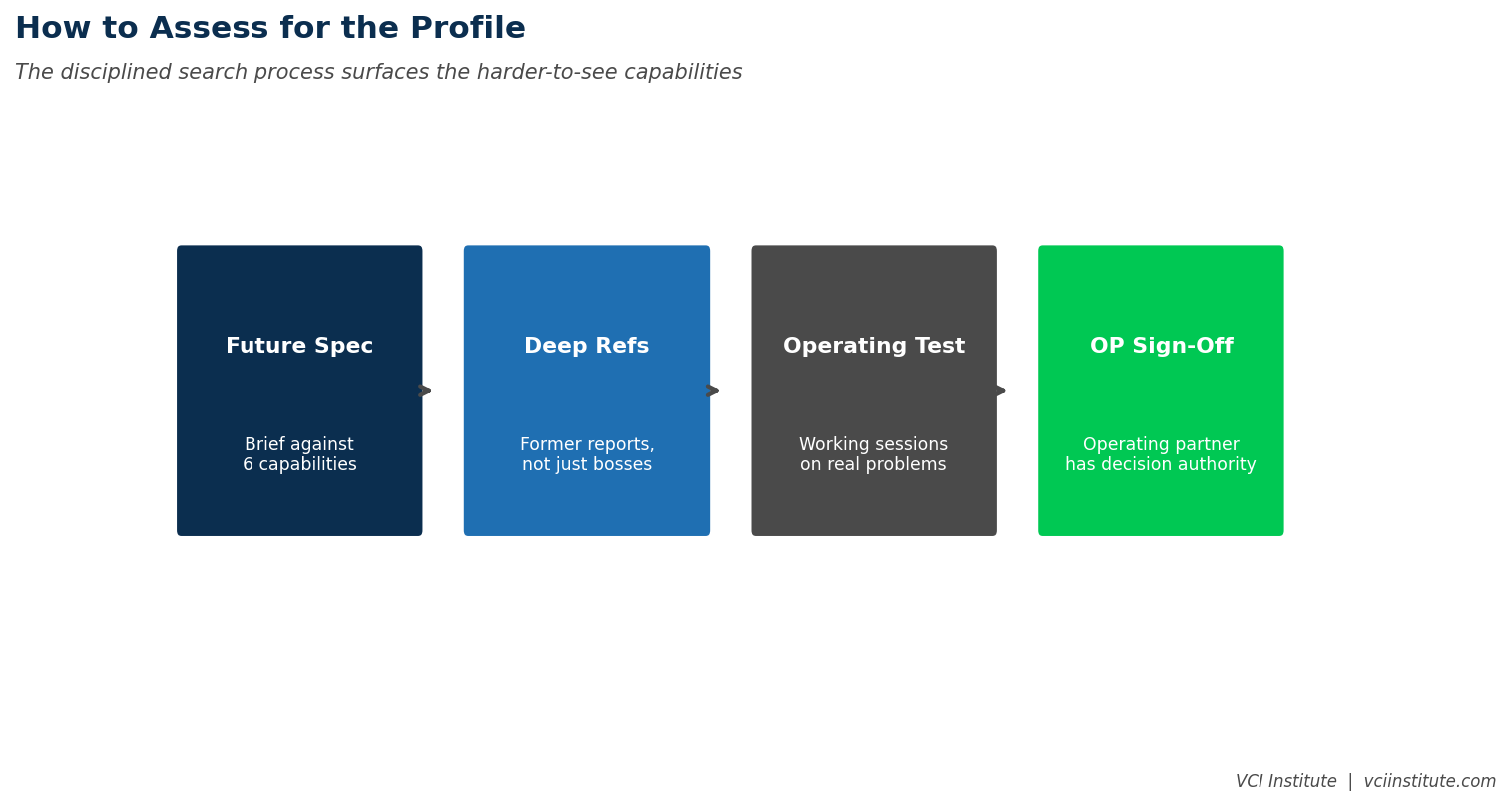
Assessment of the six capabilities requires deliberate effort beyond the typical search process. The standard CEO interview surfaces some of the capabilities but not all. The capabilities that show up in interviews are operational tempo, communication that scales, and to some extent strategic confidence. The capabilities that are harder to surface in interviews are talent judgment, capital allocation discipline, comfort with PE governance, and operational humility.
Assessing talent judgment requires deep reference calls with people who have worked for the candidate. How did she handle the underperformer who needed to be replaced. How did she identify the second-tier hire who became a strong performer. How did she handle the political talent situation that required nuance. The reference work, done well, surfaces talent judgment in ways that interviews cannot.
Assessing capital allocation discipline requires probing specific decisions the candidate has made. The capital expenditure she approved that worked out and why. The investment she did not make and why. The acquisition she did or did not pursue and the logic. The discipline shows up in the specifics of past decisions, not in the candidate's general philosophy.
Assessing comfort with PE governance requires conversations with people who have observed the candidate working with private equity sponsors before, or in similar governance contexts. References from PE board members the candidate worked with. References from operating partners. The way the candidate describes prior PE relationships, with attention to whether she describes them productively or with subtle resentment.
Assessing operational humility requires structured conversation about what the candidate has gotten wrong in her career and what she learned. Candidates who genuinely have humility can answer this question concretely, with specific examples. Candidates who lack it produce generic answers or deflect to circumstances rather than learning. The distinction is visible to interviewers who probe carefully.
What This Means for Sponsors
For sponsors building the disciplined hiring process around the value creation CEO archetype, three commitments produce most of the value.
The first commitment is to write the brief specifically against the six capabilities, not against generic CEO criteria. Each search has different weights on the capabilities depending on the situation, but the framework remains consistent. The recruiters and the search committee work to the same framework. The candidates are evaluated against the framework. The discipline of the framework prevents the drift toward charisma and surface evaluation that produces the recurring CEO mistakes.
The second commitment is to invest in the assessment work that surfaces the harder-to-see capabilities. Reference calls that go deep. Working sessions that test specific capabilities. Time observing the candidate in operating situations. The investment is meaningful in time and effort. The return is the difference between a good hit rate and a great hit rate over multiple searches.
The third commitment is to involve the operating partner who will work with the CEO in the assessment, with real authority on the decision. The operating partner has different signals than the deal team. She is the one who will be working with the CEO daily. Her read on the candidate is not advisory. It is consequential.
Sponsors that have built these three commitments into their hiring process produce a different hit rate on CEO hires than sponsors that have not. The difference compounds across portfolios. The portfolios with stronger CEOs produce stronger value creation outcomes. The pattern, once established, becomes visible to the market. The sponsors who hire well attract better candidates because better candidates know which firms tend to make good choices. The sponsors who hire badly continue to recruit from a thinner pool because strong candidates have learned to be cautious about firms whose hiring track record is uneven.
The value creation CEO archetype is not a magic profile. It is a recognizable cluster of capabilities that, in combination, produces the outcomes private equity ownership requires. The archetype has been visible to the most disciplined sponsors for over a decade. The archetype has been increasingly named explicitly in the past three years. The disciplined hiring against it is the work that distinguishes the firms that build durable value creation track records from the firms that produce uneven outcomes and explain them through other lenses.
The next CEO hire your firm makes will follow one of two paths. The disciplined path that hires for the six capabilities, with rigorous assessment and operating partner involvement. The default path that hires for charisma, industry expertise, and credentials, with insufficient assessment of the capabilities that actually predict success. The two paths produce different outcomes. The choice of path is the choice that, over time, separates the sponsors who build great portfolios from the sponsors who keep wondering why their CEO hires produce inconsistent results.
Next step
Planning your next seat?
The Operating Partner Career Track gives you eight artefacts, a fund target list, a 100 day plan and PE Simulator access. Explore the Operating Partner Career Track
Related reading
- The Wrong CEO Hire: Why Sponsors Make the Same Mistake Every Three Years
- The Operating Partner and CEO Compact: Why It Has to Be Written
About the VCI Institute
The VCI Institute is a nonprofit dedicated to building practical capability and shared standards for value creation in private equity. The Institute publishes operator-grade frameworks, runs training programs for emerging operating partners and CFOs, and operates a value creation simulator at vci.institute/simulator that lets sponsors and management teams stress test their value creation plans before committing capital. To learn more, visit vciinstitute.com.
© 2026 VCI Institute. All rights reserved. No part of this article may be reproduced or transmitted in any form without prior written permission of the VCI Institute.
We have many great affordable courses waiting for you!
Stay connected with news and updates!
Join our mailing list to receive the latest news and updates from our team.
Don't worry, your information will not be shared.
We hate SPAM. We will never sell your information, for any reason.






 Practice Platform