
The Information Hygiene Crisis: Why Most Portfolio Companies Are Not Ready for AI Yet
Jun 01, 2026
Every board meeting in 2026 contains the same scene. The chair turns to the CEO and asks the question that has now become ritual. What is your AI strategy? The CEO produces a slide. There is a vendor logo, a use case, a pilot, and a confident sounding number. The board moves on. Everyone leaves the room satisfied that the company is on the right side of the future.
Then the operating partner stays behind and asks a quieter question. What was revenue last week? The room goes silent. The CFO offers one figure. The COO offers another. Someone from FP&A says they need to reconcile a feed before anyone should rely on either. By the time the conversation ends, twenty minutes have been spent triangulating a number that should have arrived as one clean line on a Monday morning report.
The short answer
AI tools assume input data that is clean, current, consistent, and complete. In most mid-market portfolio companies none of those four conditions hold, so the investment produces faster confusion in a more persuasive interface. Five conditions define readiness: system consolidation, master data discipline, reporting cadence, metric definition, and decision rhythm. A company meeting two or three of them is not ready, whatever the roadmap says. The ten minute test is to ask how long the weekly operating report takes to produce, how many systems are involved in the customer count, and what revenue and cash were last Friday.
New from VCI Institute
The AI Value Creation Model: a 53-page practical guide for deal teams, operating partners, and private equity leaders. Five components, one gate, twelve levers, a worked EBITDA bridge. Get the guide at no cost.
This is the gap. Private equity is trying to have an AI conversation with portfolio companies that have not yet won the basic argument about what is true.
We call this the information hygiene crisis. It does not show up in the IC memo. It is rarely flagged in due diligence. It almost never appears in the value creation plan. Yet it sits underneath every digital lever a sponsor wants to pull, and until it is fixed, those levers will deliver a fraction of their promised return.
The Pattern We Keep Seeing
The pattern is consistent across mid-market companies. CRM systems are half populated. Sales pipelines are tracked in spreadsheets that one analyst maintains and three departments edit. Inventory data lives in a different database than financial data, which lives in a different database than customer data. Reporting is late, and when it arrives, finance and operations argue about which version to trust. The monthly board pack is built by a team that spends three days reconciling numbers that should have been settled automatically by the systems running the business.
Now imagine layering AI on top of that.
The pitch sounds attractive. A predictive forecasting model. An automated customer scoring engine. A dynamic pricing tool. A copilot that drafts proposals from CRM data. Each of these tools assumes the input data is clean, current, consistent, and complete. In most mid-market portfolio companies, none of those four conditions hold.
The result is faster confusion. The model produces a forecast built on incomplete pipeline records. The pricing tool optimizes against a segmentation that is partially wrong. The copilot drafts a proposal using outdated account information. The output looks confident because the interface is clean and the language is fluent. Underneath, however, the foundation is the same broken data set, now wrapped in a more persuasive package.
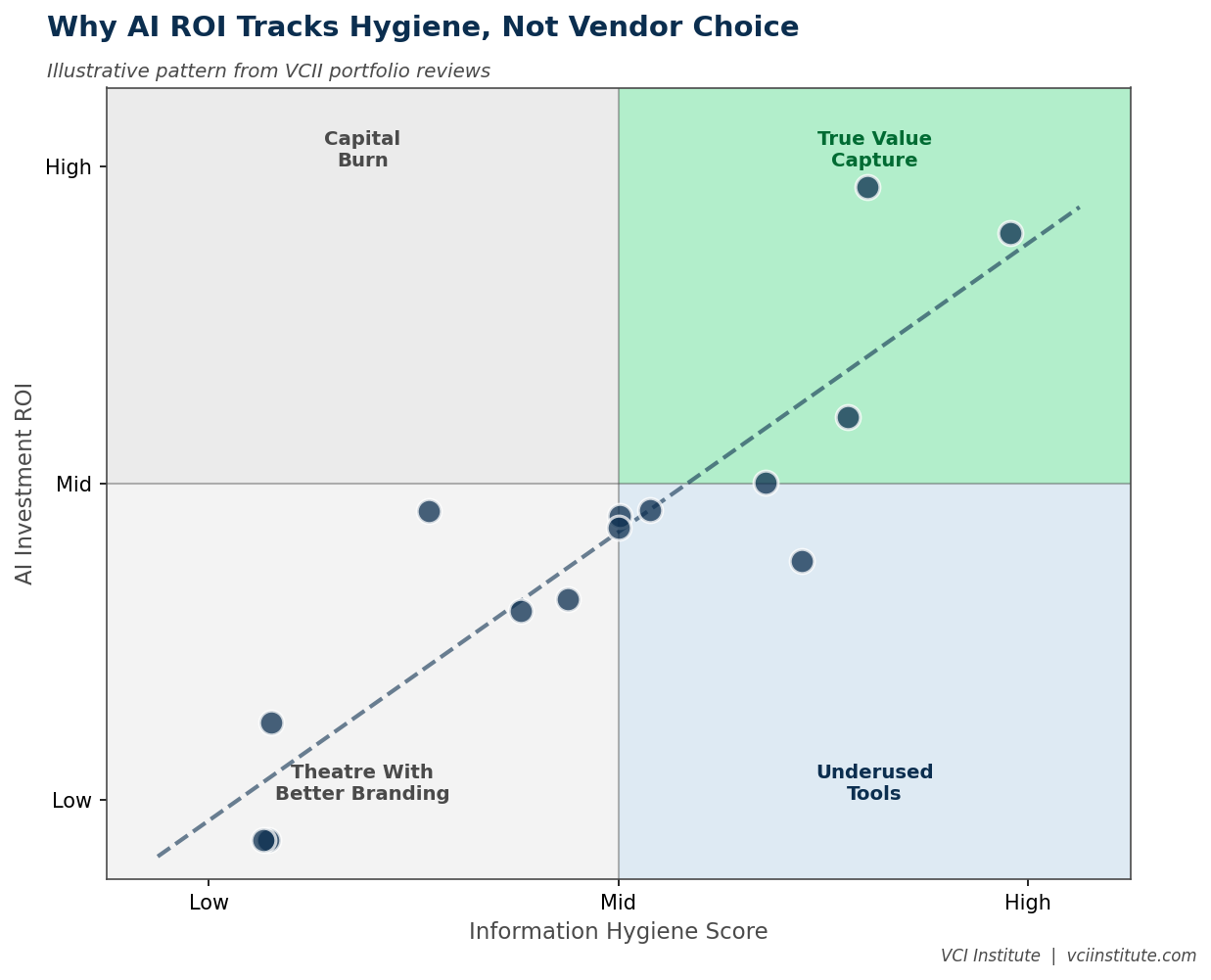
This is why so many AI investments inside private equity portfolios fail to translate into measurable EBITDA. The capital was deployed into the visible layer. The invisible layer, the data and process layer, was assumed to work. It did not. Building the case so that the invisible layer is priced rather than assumed is the discipline in the digital EBITDA bridge.
The Five Conditions of AI Readiness
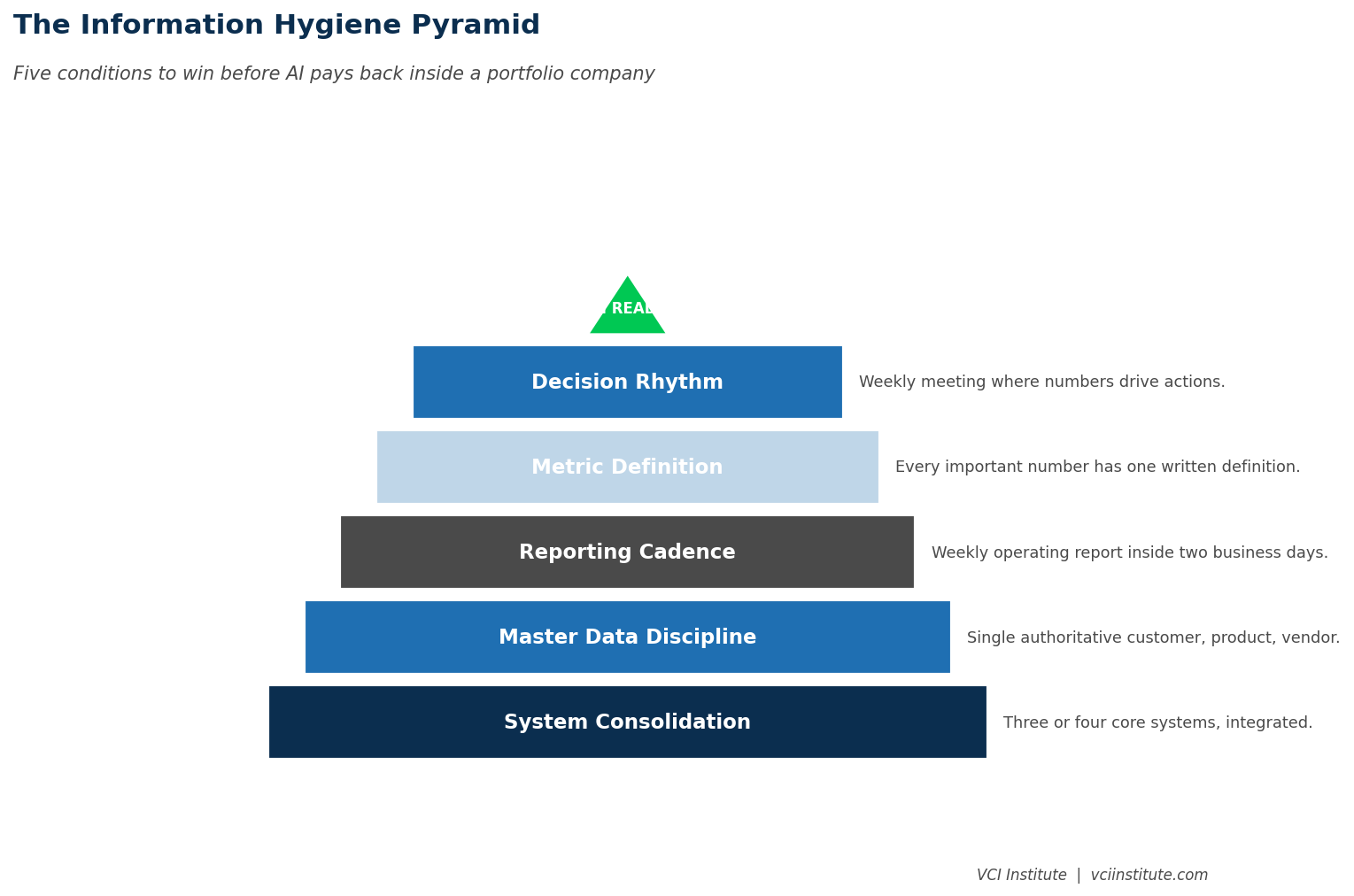
The fix is unglamorous, but it is among the highest leverage moves a sponsor can make in the first twelve months of ownership. We frame information hygiene around five conditions. A portfolio company that meets all five is genuinely ready to deploy AI. One that meets two or three is not, regardless of what the management deck claims.
The first condition is system consolidation. The business runs its commercial activity on a small number of integrated systems rather than a sprawl of legacy tools, spreadsheets, and shadow IT. Most mid-market companies fail this test. They have grown through acquisition or organic expansion, and each new function brought its own software. The sponsor's job is to identify the three or four core systems that actually matter and to retire or integrate the rest within the first year.
The second condition is master data discipline. The business has a single, authoritative version of its customer list, product catalog, vendor records, and chart of accounts. Anyone in the company querying any system gets the same answer. This sounds basic. It is rare. Mid-market companies routinely carry three or four different customer counts, depending on which department you ask. The structured process for resolving that, and the reason it has to precede any dashboard investment, is the single source of truth audit.
The third condition is reporting cadence. The business produces a clean weekly operating report that reaches the CEO and the chair within two business days of week-end. The report covers revenue, gross margin, pipeline, conversion, key operating KPIs, and cash. It is not a fifty page document. It is one or two pages, derived from systems automatically, with one human review for narrative. If the report takes a week to produce or arrives in a different format every Monday, the company has not won the cadence argument.
The fourth condition is metric definition. Every important number used to run the business has a single written definition that is understood across functions. What counts as a qualified lead. What counts as recurring revenue. What constitutes a billable hour. What counts as gross margin. Most companies have implicit, contradictory definitions, which is why finance and sales never quite agree on the pipeline figure.
The fifth condition is decision rhythm. The management team uses the report to make decisions. There is a weekly operating meeting where the numbers drive the agenda, exceptions are discussed, and actions are assigned. Without this rhythm, the data is just a record, not a tool. With it, the business begins to compound small operating improvements week after week. The distinction between a meeting that records what happened and one that changes what happens next is the same distinction that separates functioning boards from ceremonial ones, examined in PE boards that actually work.
What Good Looks Like
A portfolio company that wins these five conditions has built the foundation on which AI actually pays back. Forecasting models work because the pipeline data is real. Pricing tools work because the customer segmentation is consistent. Copilots accelerate work because the underlying records are accurate. The same vendor demo that would have produced a disappointing pilot in a hygiene poor company now produces a measurable lift in a hygiene rich one.
Hygiene is necessary rather than sufficient. A company that has won all five conditions can still stall on adoption, because the constraint moves from the data layer to the organisation's capacity to absorb new tools at all. That second constraint is the subject of the AI ceiling. Hygiene gets you to the starting line. It does not run the race.
There is a second order benefit that sponsors often miss. Information hygiene is also the foundation of credible reporting to the LP base. When a sponsor can show that its portfolio companies operate on consistent definitions, integrated systems, and reliable cadence, the entire fund's valuation discipline becomes more defensible. LPs are increasingly skeptical of marks, and increasingly focused on distributions rather than paper appreciation, which is the shift described in the DPI reckoning. Hygiene is what turns marks into evidence.
A Ten Minute Diagnostic for Sponsors
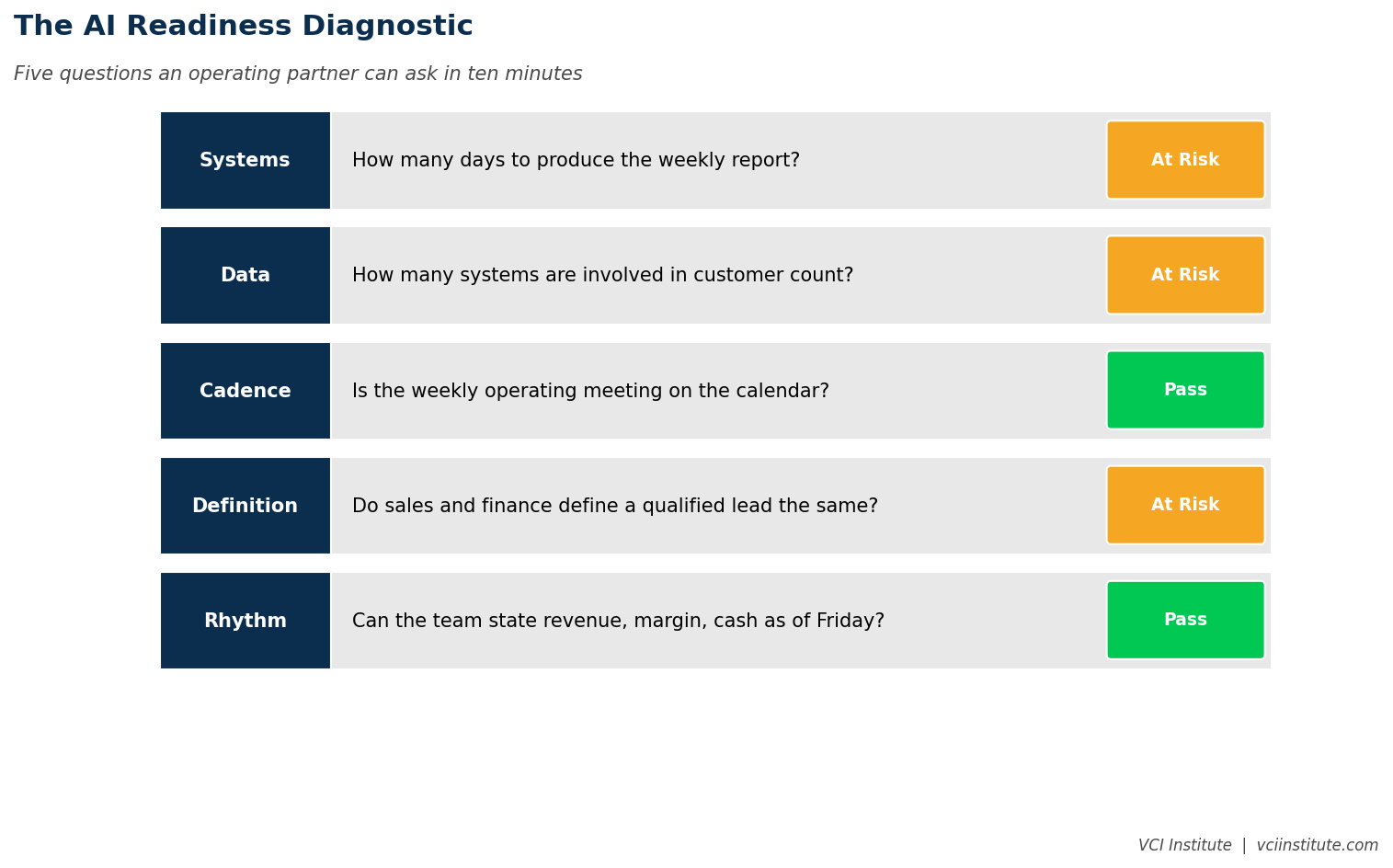
Before approving the next AI roadmap from a portfolio company, an operating partner can ask five direct questions. They take ten minutes to ask and reveal almost everything about the readiness of the business.
How long does it take to produce the weekly operating report. If the answer is more than two business days, hygiene is not yet in place.
How many systems are involved in producing the customer count. If the answer is more than two, master data is not consolidated.
How does sales define a qualified opportunity, and would finance agree. If the two functions cannot answer in the same language, definitions have not been settled.
What is the standing weekly meeting cadence at which numbers drive decisions. If it is not on the calendar, the rhythm does not exist.
What was the revenue, gross margin, and cash position as of last Friday. If the management team cannot answer cleanly without spreadsheets, the company is not ready for any tool that promises intelligence.
These are not technology questions. They are operating discipline questions. They are also the only honest test of whether AI will deliver value or simply absorb capital. Where they sit inside a wider read of the business is set out in the operating maturity index, which treats technology maturity as one of five dimensions rather than as a standalone question.
The Order Matters
This reframes the conversation private equity should be having about AI. The question is not which copilot to buy or which pricing engine to license. The question is whether the business is even instrumented to benefit from one. If it is not, the AI investment is a deferred cost waiting to be written down, dressed up as a strategic initiative.
Operating partners who understand this sequence their interventions differently. They spend the first hundred days on system rationalization, master data clean up, and reporting cadence. They look skeptical when management presents an AI roadmap before the basics are in place. They use the following sixty days to introduce a single, well chosen tool against a now cleaner data foundation. Which tool, and in which category, is a genuine allocation decision rather than a vendor preference, and the two categories behave differently enough to warrant separate treatment in vertical AI versus horizontal AI.
Sponsors who skip this step pay twice. Once for the AI tool that disappoints. Then again for the hygiene work that should have happened first.
The boring truth is that the most underrated AI strategy in private equity right now is to fix the spreadsheet problem before buying the copilot. Every dollar spent on hygiene raises the return on every subsequent dollar spent on intelligence. The order matters. So does the discipline.
The portfolio companies that will win the next decade are not the ones with the loudest AI roadmap. They are the ones that can answer last week clearly, last month confidently, and last quarter without a reconciliation exercise. From that base, anything is possible. Without it, AI is theatre with better branding.
VCI Institute in collaboration with Mohamad Chahine
Published 1 June 2026
Related reading from the VCI Institute
The Single Source of Truth Audit
The structured process for winning the master data condition, in four to eight weeks.
The AI Ceiling
The constraint that binds after hygiene is fixed, and why it is organisational rather than technical.
Vertical AI Versus Horizontal AI
Choosing the single well chosen tool once the foundation is in place.
About the VCI Institute
The VCI Institute is a nonprofit dedicated to building practical capability and shared standards for value creation in private equity. The Institute publishes operator-grade frameworks and runs certification programs for operating partners, portfolio company CEOs, and value creation analysts, including COPPE and CVCA. Analysis published here draws on the Institute's certification curricula and on structured review of mid-market transaction patterns rather than on any single proprietary dataset. Where a figure is directional rather than measured, it is described as such.
Further material is available in the Institute's Insights library and its free resource library of templates, checklists, and case snapshots.
© 2026 VCI Institute. All rights reserved. The frameworks, terminology, and analysis presented in this article are the intellectual property of the VCI Institute. Reproduction or derivative use without written permission is prohibited. Citation with proper attribution is welcomed.
We have many great affordable courses waiting for you!
Stay connected with news and updates!
Join our mailing list to receive the latest news and updates from our team.
Don't worry, your information will not be shared.
We hate SPAM. We will never sell your information, for any reason.


 Practice Platform