The Board Is Not Your Audience: How PE Boards Reward Conversation
Oct 15, 2026
The default mental model of a board meeting in most operators' heads comes from corporate America. It does not survive contact with private equity.
In corporate, the board meets quarterly. The deck is prepared two weeks ahead. The CEO presents. The board listens, asks a few questions, votes on the items requiring votes, and adjourns. The board is an audience. The CEO is a presenter. Performance is reviewed in arrears.
The short answer
Corporate boards approve, review prepared material, and measure performance against plan. Private equity boards prioritise, work the material live, and measure progress against thesis. Six practices convert theatre into a working session. Cut the deck to fifteen pages. Open every meeting with the same slide asking whether the three things that had to be true are still true. Frame, then step back. Deliver bad news in the first ten minutes, not the last. Make real decisions in the room. Close with five to seven owned, dated actions circulated within forty-eight hours. The test after every meeting is one question: did decisions get made.
In private equity, the board meets monthly or more often. The deck is one of the inputs, not the event. The CEO does not present. The CEO frames, the board engages, the conversation produces decisions, and the conversation is the work product.
The board is not your audience. The board is your operating partner.
Operators who do not internalize this difference produce theater. The deck is polished. The presentation is clean. Nothing material gets decided. Eighteen months later, the operator is gone, and the fund is wondering what happened.
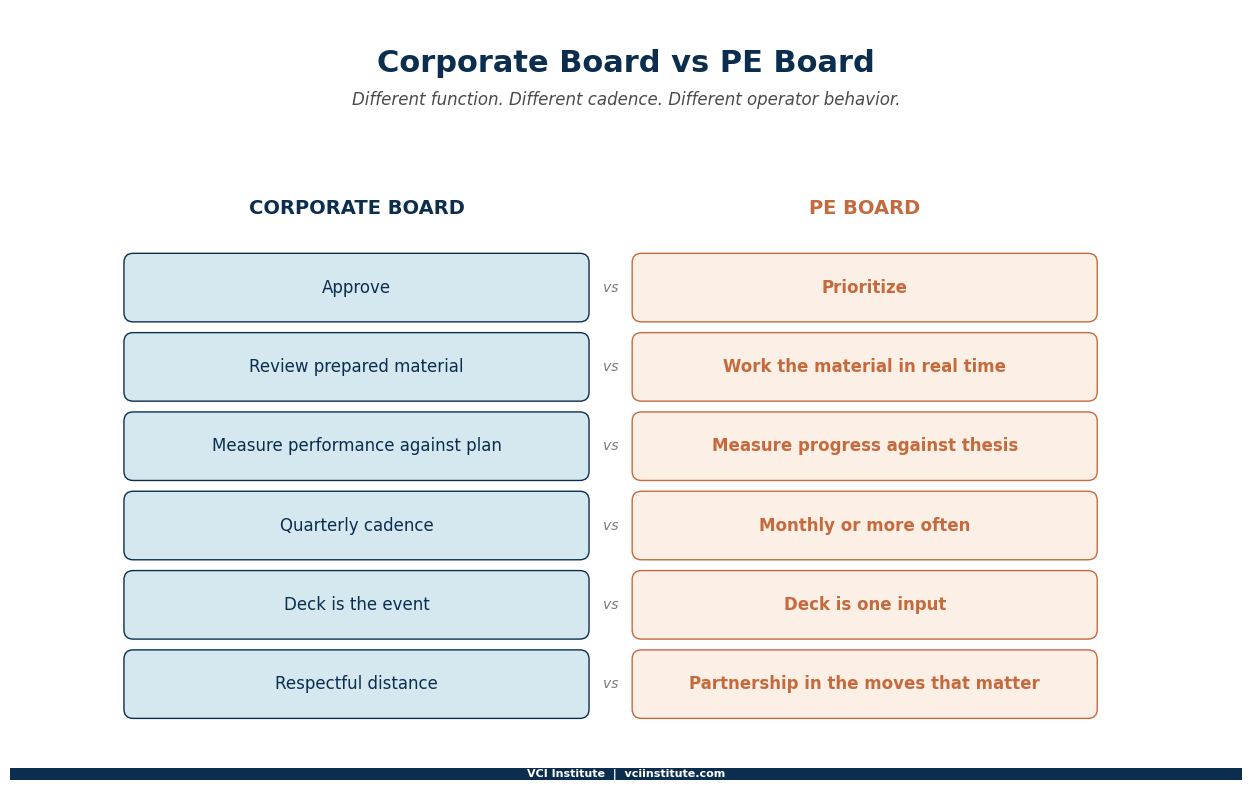
The PE board is structured for a different function than the corporate board. The corporate board exists to govern. The PE board exists to allocate capital and manage risk inside a defined window. Those two functions look similar from a distance and produce very different meeting behaviors up close.
Corporate boards approve. PE boards prioritize.
Corporate boards review prepared material. PE boards work the material in real time.
Corporate boards measure performance against plan. PE boards measure progress against thesis.
Corporate boards expect respectful distance. PE boards expect partnership in the moves that matter.
These differences are not stylistic. They produce different cadence, different prep, and different in-room behavior. The operator who shows up to a PE board with corporate cadence is not unprepared. They are prepared for the wrong meeting. That mismatch is one of the five dialect problems set out in translation, not transfer, and it is usually the one that surfaces first.
The healthiest PE board interactions feel like working sessions. Not friendly. Working. The agenda is short. The data is current. The leading questions are about prioritization, not about validation. The discussions are about trade-offs, not about reporting. The decisions are made in the room and tracked to next month.
Operators who run the meeting this way build trust faster, get oversight pulled back, and ship more. Operators who run the meeting like a corporate review get more oversight, slower decisions, and a senior team that watches the CEO get smaller in the seat over time.
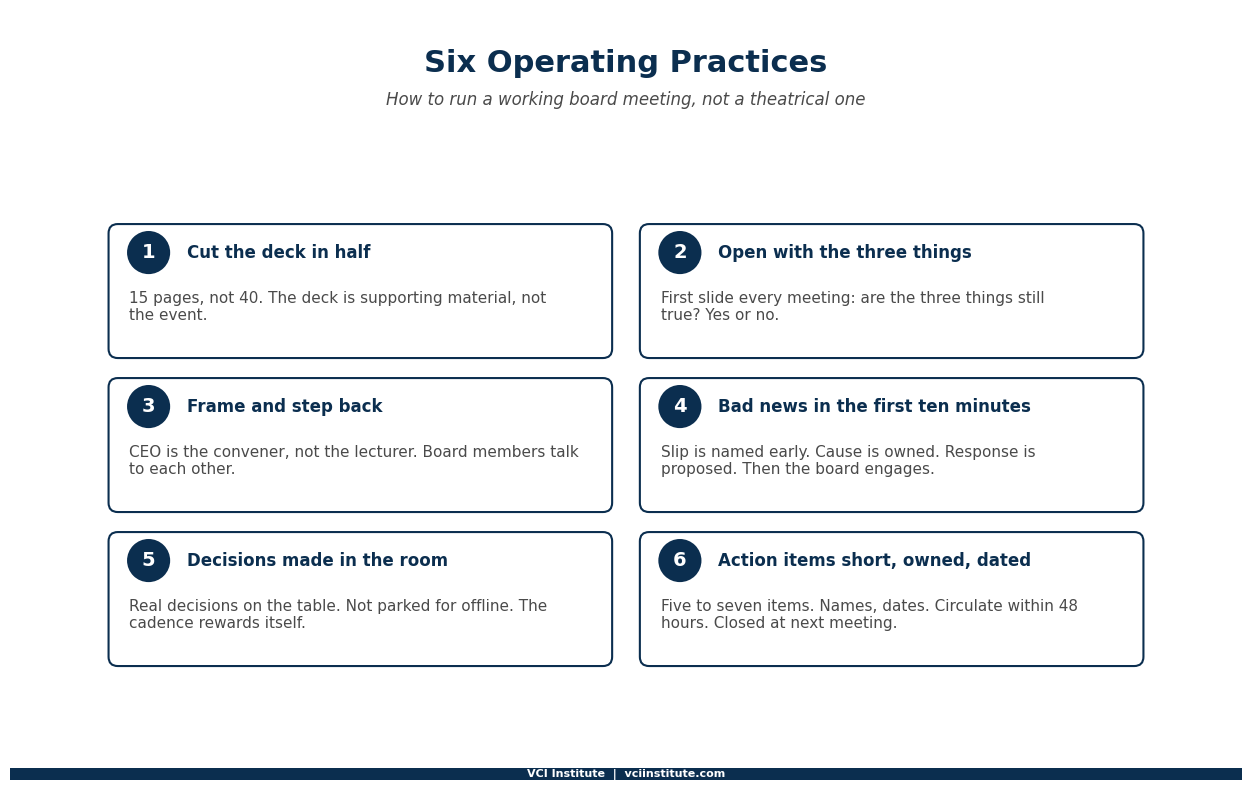
The shift from theater to working session has six concrete operating practices. None of them are difficult. All of them are uncommon.
The deck is shorter than the operator wants. Fifteen pages, not forty. The deck is the supporting material, not the event. Operators who arrive with sixty-page decks signal to the board that they are managing optics rather than managing the business. The first move that improves a board interaction is cutting the deck in half.
The first slide names the three things. The investment thesis lives in three to five propositions that have to be true for this deal to work. Every board meeting opens with the same first slide. Are the three things still true. If yes, here is the evidence. If no, here is the new thesis. The board's first ten minutes are spent on this slide, every time. The rest of the meeting is calibrated against it. This is the layer three discipline described in the Thesis Operating System, and it is the practice most boards skip entirely.
The CEO frames, then steps back. The CEO opens each section with one paragraph of context, then the conversation runs. The CEO is not the lecturer. The CEO is the convener. The board members talk to each other and to the CEO. The CEO interjects to redirect, not to defend. The CEOs who do this well produce more board engagement and less board frustration. The CEOs who do not, produce more board talking time and less board confidence.
Bad news arrives early. The slip is named in the first ten minutes, not in the last ten minutes. The narrative is owned, the cause is explained, the response is proposed. The board is not surprised at the end of the meeting. They are surprised in the first ten minutes, and they have ninety more minutes to engage with the response. Operators who reverse this sequence pay a credibility tax that compounds across meetings, and the compounding is fastest inside the first hundred days, when the board is still drafting its view.
Decisions get made in the room. The PE board is not a permission body, but it is also not a no-op. There are real decisions on the table at every meeting. The operator who treats the meeting as a status review and saves decisions for offline conversation produces a board that loses interest in the meeting and starts running a parallel process. The operator who pulls real decisions into the room produces a board that respects the cadence. Which decisions belong in the room at all is a question worth settling in advance, in the operating partner and CEO compact.
Action items are short, owned, and dated. The output of a working board meeting is a list of decisions made and actions assigned. Five to seven items, no more. Every item has a name and a date. The list circulates within forty-eight hours. The next meeting opens by closing the list. Operators who do this run a different organization. The discipline travels downstream into the senior team and into the operating cadence.
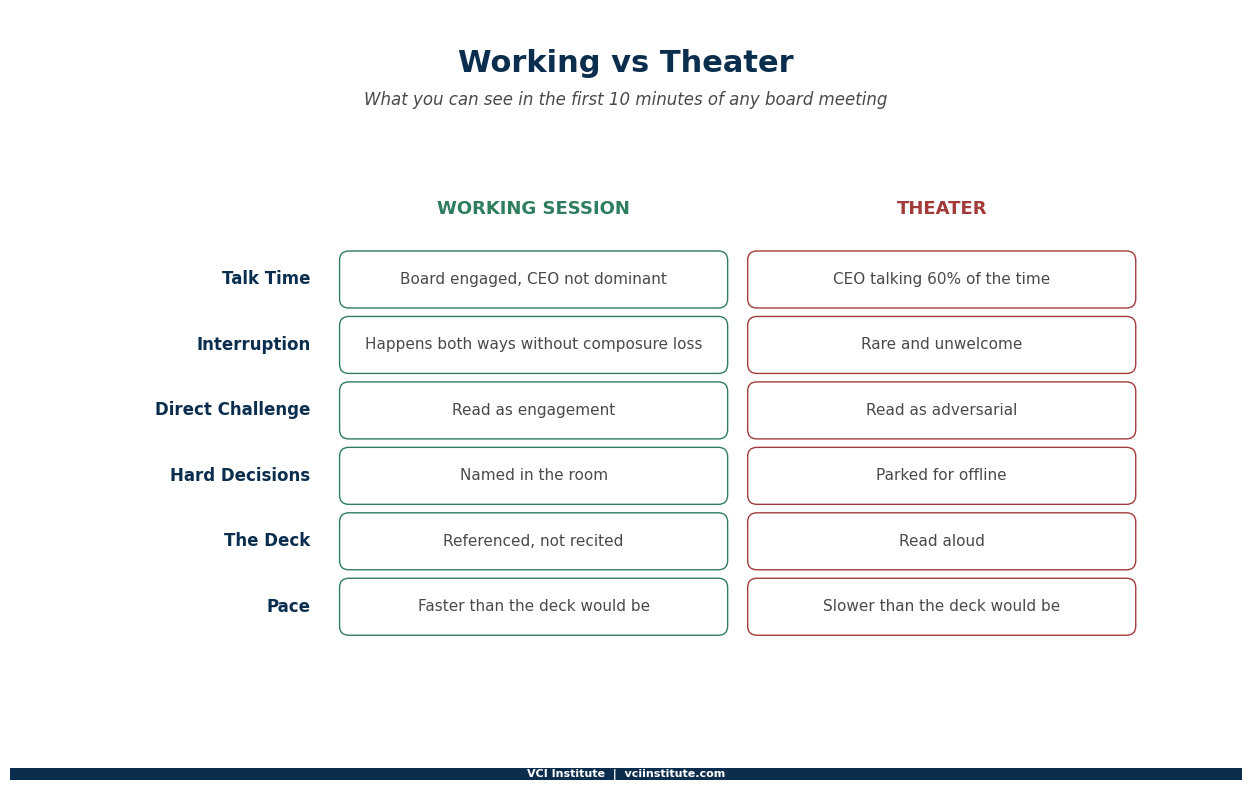
The signals that distinguish a working board interaction from a theatrical one are visible inside the first ten minutes.
In the working version, the CEO is not the most-talking person in the room. The board is engaged. Interruption happens, in both directions, without anyone losing composure. Direct challenge is read as engagement, not as criticism. Hard decisions get named, not deferred. The deck is referenced, not recited. The conversation is faster than the deck would be.
In the theatrical version, the CEO is talking sixty percent of the time. The board is polite. Interruption is rare and unwelcome. The deck is being read aloud. Direct challenge is read as adversarial. Hard decisions get parked for offline. The meeting is slower than the deck would be.
The two versions look almost identical in calendar invites and almost nothing alike in operating output.
The deeper reframe is that the board is not measuring you. The board is working with you. The verb matters. Operators who internalize the working verb make the seat sustainable. Operators who default to the measuring verb produce performance review behavior, and performance review behavior corrodes both sides of the table. It also deepens the isolation, because a CEO who is being measured cannot think out loud, which is the mechanism behind the loneliness tax.
There is a useful test. After every board meeting, ask one question. Did decisions get made. If yes, the meeting was working. If no, the meeting was theater, regardless of how well the deck was received.
The default in most PE-backed companies is theater, because theater is the imported corporate habit, and most CEOs have not been taught the alternative. The CEOs who learn it become disproportionately effective in the seat, not because they are better operators, but because they have rebuilt the highest-leverage operating practice the company runs on. The board's own half of this redesign, including composition and agenda structure, is set out in PE boards that actually work.
The board meeting is the single largest concentration of fund attention the operator gets each month. Treating it as a presentation event burns the time. Treating it as a working session compounds it. The operating output of a five-year hold is, in part, the sum of those sixty meetings. Each one is either compounding or burning.
If you are a PE-backed CEO, the question is not how to make your board meetings better. The question is whether you are running working sessions or running theater. The answer is visible to everyone in the room, including you, by minute eleven of every meeting.
The board is not your audience. Treat it as an operating partner, and the seat changes.
COPPE Level 1
The language a sponsor expects in a board pack
Most CEOs were never taught the alternative to theatre, because the corporate habit was the only model on offer. COPPE Level 1 covers the governance relationship with a sponsor directly, alongside the value creation levers and the hundred day structure. Twelve lessons, each with a written lesson, a Visual Companion, an audiocast and a videocast. Self paced, no start dates.
VCI Institute in collaboration with Mohamad Chahine
Published 15 October 2026
Related reading from the VCI Institute
PE Boards That Actually Work
The same redesign seen from the board's side, covering composition and agenda structure.
The Thesis Operating System
From IC memo to Tuesday morning, and the first slide every board meeting should open with.
The Loneliness Tax
Why PE-backed CEOs decide slower than they should, and what the measuring verb costs.
About the VCI Institute
The VCI Institute is a nonprofit dedicated to building practical capability and shared standards for value creation in private equity. The Institute publishes operator-grade frameworks and runs certification programmes for operating partners, portfolio company executives, and value creation analysts. You can see what each programme actually covers before deciding. Analysis published here draws on the Institute's certification curricula and on structured review of mid-market transaction patterns rather than on any single proprietary dataset. Where a figure is directional rather than measured, it is described as such.
Further material is available in the Institute's Insights library and its free resource library of templates, checklists, and case snapshots.
© 2026 VCI Institute. All rights reserved. The frameworks, terminology, and analysis presented in this article are the intellectual property of the VCI Institute. Reproduction or derivative use without written permission is prohibited. Citation with proper attribution is welcomed.
We have many great affordable courses waiting for you!
Stay connected with news and updates!
Join our mailing list to receive the latest news and updates from our team.
Don't worry, your information will not be shared.
We hate SPAM. We will never sell your information, for any reason.
 Practice Platform