
Defense Tech and Dual-Use: A Private Equity Category Worth Serious Reframing
Sep 03, 2026
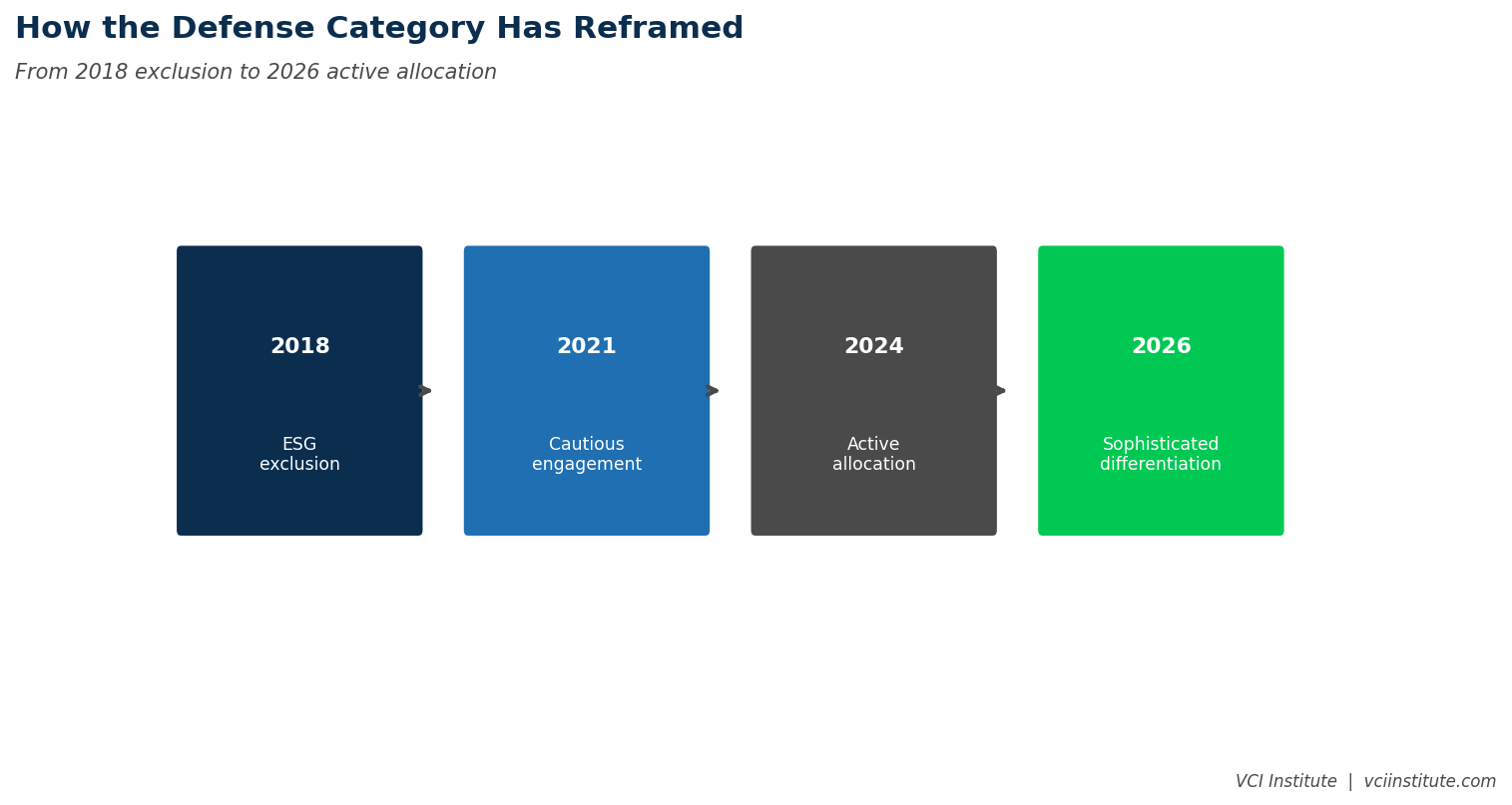
For most of the past decade, defense and defense-adjacent technology sat in the exclusion column of mainstream private equity. The reasoning was familiar. ESG screens flagged the category. LPs preferred not to be associated with it. The exit pool was perceived as narrow. The regulatory complexity was perceived as prohibitive. The combined effect was that meaningful capital flowed around the category rather than into it, and most mid-market sponsors did not develop the diligence muscle, the regulatory fluency, or the LP narrative that would have allowed them to participate.
That position has shifted materially over the past three years. The shift is not subtle. It is being driven by a combination of geopolitical pressure, sovereign capital reallocation, and the recognition that the line between defense technology and commercial technology has blurred to the point where exclusion frameworks built in 2018 no longer describe the actual landscape. Sponsors that have rebuilt their position on the category have begun to see deal flow that was not previously available. The ones that have continued to operate from the old framework are finding their LP base increasingly willing to engage on the question, sometimes more willing than the GP itself.
The short answer
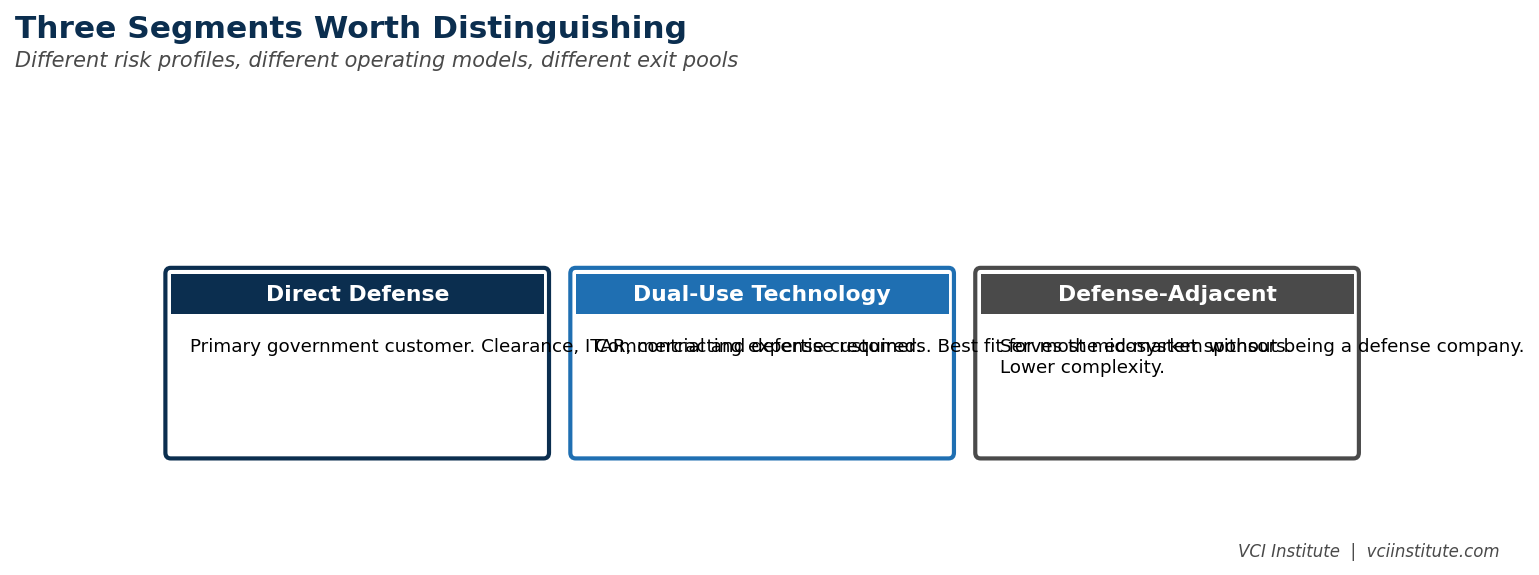
The 2018 exclusion framework treated defense as one discrete, screenable category. It is now three. Direct defense, where government is the primary customer and the regulatory burden is full. Dual-use technology, where commercial and defense revenue coexist and the commercial trajectory provides downside protection. And defense-adjacent infrastructure, where a largely commercial business benefits from defense spending as a tailwind. Each requires different diligence, a different operating playbook, and a different exit narrative. Collapsing them into one category produces both missed opportunities and miscalibrated risk.
This is the category worth serious reframing. The old framing was simpler. The new framing is more honest, and the firms that produce a credible new framing are positioned for a category that has the structural support of long-cycle government demand and the operational complexity that creates genuine moats for the businesses that get the work done.
Why the Old Framing Has Aged Out
The old framing rested on three premises that have not held up. The first premise was that defense technology was a discrete category, identifiable by end-customer and exclusion-screenable on that basis. The second premise was that ESG-conscious LPs would not engage with the category and that allocating to it would damage the GP's broader fundraising. The third premise was that the addressable market was bounded by traditional defense procurement, which was slow, relationship-driven, and dominated by a small number of prime contractors who would not allow new entrants to compete.
Each of these premises has weakened. The discrete category framing has dissolved as dual-use technology has expanded. The same satellite imagery analytics platform serves logistics companies and military intelligence. The same autonomous systems software runs warehouse robots and military drones. The same cybersecurity infrastructure protects financial institutions and military networks. The same advanced materials supply chain serves aerospace, semiconductor manufacturing, and military hardware. Drawing a clean line between defense and commercial in 2026 requires drawing it through the middle of individual product categories, which is not how exclusion frameworks were built.
The LP framing has shifted as a result of geopolitical events that have reframed national security as a public good rather than a partisan position. Several major LPs have publicly revised their exclusion policies. Sovereign wealth funds and pension funds in NATO countries have explicitly added defense and dual-use to their allocations. The conversation has changed from whether to engage to how to engage thoughtfully. GPs that had built their identity around exclusion now face the awkward conversation with LPs who would prefer engagement.
The market structure framing has shifted because procurement itself has changed. The Pentagon, the Department of Defense's contracting authorities, and equivalent agencies in allied countries have been actively reforming acquisition processes to bring in non-traditional vendors at speed. Programs like the Defense Innovation Unit, AFWERX, and the Office of Strategic Capital have created entry points that did not exist five years ago. The traditional prime contractor dominance has loosened in the categories where speed of innovation matters most. Mid-market companies with the right capability now have access to government revenue that would have been unreachable in the prior framework.
The Three Segments Worth Distinguishing
Reframing the category usefully requires distinguishing three segments that the old framing collapsed into one. Each has a different risk profile, a different buyer, and a different operating model.
The first segment is direct defense. Businesses whose primary customer is the Department of Defense, allied militaries, or intelligence agencies. The revenue is concentrated in government contracts. The diligence work is significant. Security clearances, ITAR compliance, and contracting expertise are all binding. The exit pool is mostly strategic acquisitions by primes or other defense-focused buyers. This is the segment closest to the old framing and where the old framing remains partially valid. It is also the segment where mid-market sponsors with serious diligence capability can compete because the larger sponsors have not always built the operational depth.
The second segment is dual-use technology. Businesses whose technology serves both commercial and defense customers, with revenue split between the two. Many of the most interesting opportunities in 2026 sit here. Advanced manufacturing companies serving both aerospace primes and commercial OEMs. Software companies whose platforms address both enterprise and government use cases. Materials science companies whose products feed both consumer electronics and military applications. The diligence work is more nuanced because the company's commercial trajectory is real and the defense exposure is incremental rather than primary. The exit pool is broader because both commercial and defense buyers can engage.
The third segment is defense-adjacent infrastructure. Businesses that serve the broader defense ecosystem without being defense companies themselves. Specialty distribution to defense suppliers. Maintenance services for dual-use equipment. Cybersecurity for the supply chain that supports defense. These businesses have largely commercial customer bases with defense exposure as a tailwind rather than a primary thesis. The old framing often missed them because they did not present as defense companies. The new framing identifies them as participants in the broader category whose economics benefit from defense spending without bearing the full regulatory weight of direct defense work.
These three segments require different diligence approaches, different operating playbooks, and different exit narratives. Treating them as a single category, which the old framing tended to do, produced both missed opportunities and miscalibrated risk assessments.
What the Diligence Actually Looks Like
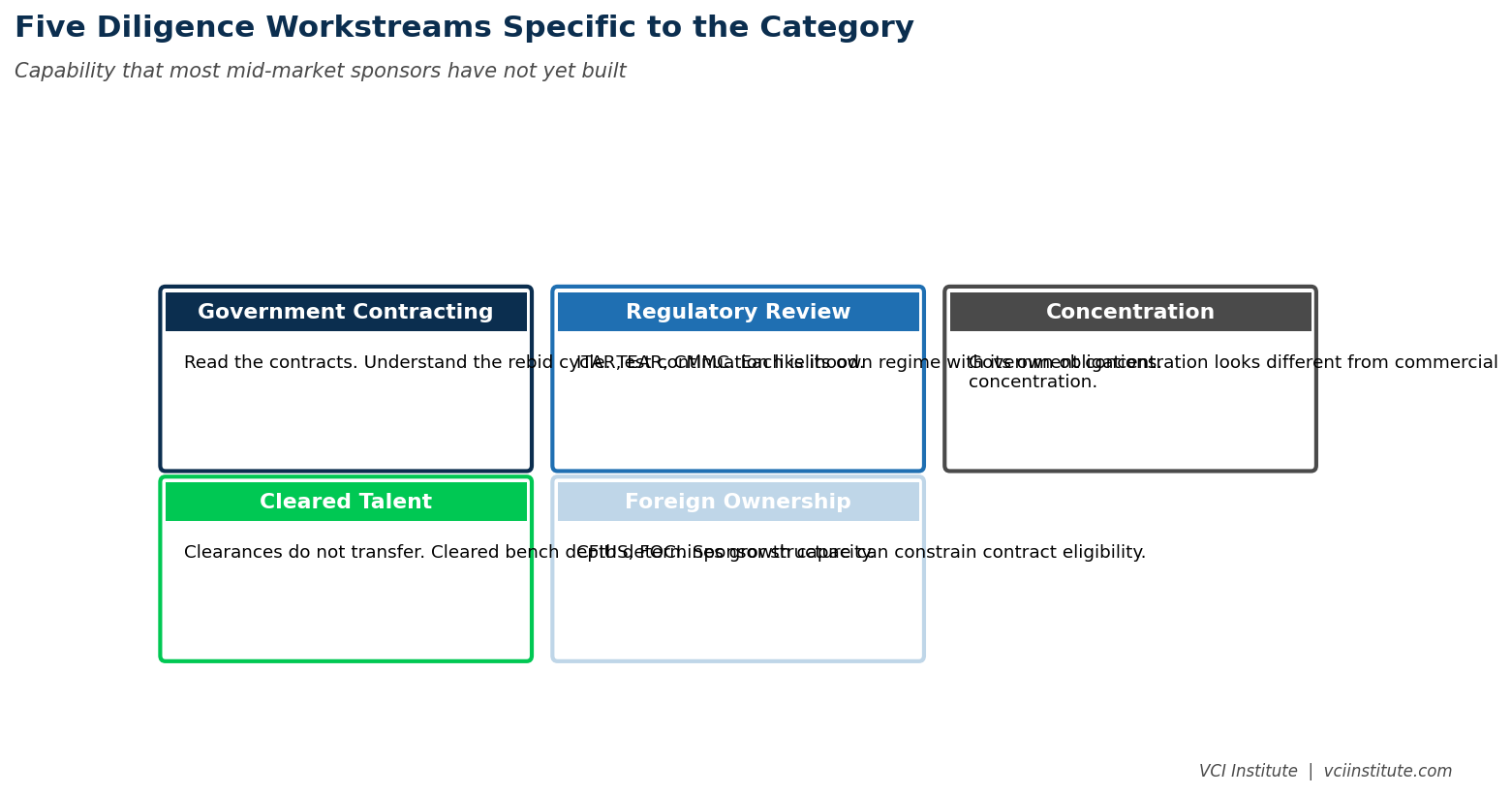
Sponsors entering the category seriously have to build diligence capability that most mid-market firms have not yet developed. Five workstreams matter, each of which has more depth than the standard diligence framework treats them with.
Government contracting fluency. Understanding the difference between cost-plus, fixed-price, and indefinite-delivery contracts. Reading the actual government contract documents, not just the company's summaries of them. Understanding the rebid cycle, the protest process, and the realistic likelihood of contract continuation versus loss. Most generic diligence work does not produce useful answers on these questions because the diligence team does not know the right questions to ask.
Regulatory and compliance review. ITAR, EAR, FAR, DFARS, CMMC. The acronyms multiply. Each is a specific regulatory regime with specific obligations. A company that has not built its compliance infrastructure to the right level produces hidden liability that surfaces post-close. The diligence work has to assess not just the current compliance state but the likely cost of bringing the company up to the level its growth plan requires.
Customer concentration analysis specific to government revenue. Government customer concentration looks different from commercial customer concentration. A single contract with a five year term that has been renewed twice is structurally different from a comparable commercial customer relationship. The concentration risk is real but the dynamics differ. Generic concentration analysis misreads government contracts in both directions, sometimes treating them as more durable than they are and sometimes as more fragile. The beneficial owner and decision maker mapping that improves commercial concentration analysis needs a government specific variant, where the contracting office rather than the agency is often the real unit of concentration.
Talent and clearance review. Many defense and dual-use businesses depend on talent with active security clearances. Clearances are not easily transferable, and the time to hire cleared talent is meaningfully longer than commercial hiring. Diligence has to assess the cleared bench depth and the realistic ability to hire into the growth plan. Companies that look strong on the org chart can have hidden capacity constraints that only show up when growth requires hiring at speed. This is a sharper version of the general problem that the post-close talent density map is designed to surface, because in this category a departure cannot simply be backfilled from the open market.
Foreign ownership and control review. CFIUS, FOCI, and equivalent regimes. A sponsor's ownership structure, including LP composition, can affect the company's ability to win or retain certain contracts. The diligence work has to map the sponsor's structure against the company's contract portfolio and identify any constraints. Some structures will not work in this category regardless of how attractive the underlying business is.
These five workstreams together require either internal capability or trusted external advisors. Building the capability takes investment that most mid-market sponsors have deferred. The sponsors that have made the investment have built a real moat against generalist competitors who can show up in a process but cannot underwrite the deal as cleanly. This is precisely the kind of capability that argues for an internal operator bench with genuine sector depth rather than a network activated deal by deal.
What the LP Conversation Looks Like Now
The LP conversation has changed in three specific ways that GPs have to navigate.
The first change is that exclusion is no longer the default. Most LPs have moved to a position where engagement is acceptable provided it is done thoughtfully. The GP that comes to the conversation prepared to discuss segment differentiation, diligence approach, and ethical framework will find LPs who engage seriously. The GP that comes with a generic pitch about defense as an asset class will find LPs uncomfortable, not because of the category but because of the lack of sophistication in the pitch.
The second change is that some LPs are now actively seeking exposure. Sovereign wealth funds in countries with explicit national security interests, certain pension funds with policies that favor strategic technology investment, and increasing numbers of family offices have specifically articulated allocations to the category. GPs that present credibly are recruited rather than tolerated. The GPs that have built positions early are finding LP engagement that the old framing would have predicted impossible.
The third change is that the ethical framework conversation has matured. LPs increasingly want to understand the GP's view on which kinds of defense work are acceptable and which are not. Lethal autonomous systems. Cyber offensive tools. Foreign sales. Each is its own conversation. GPs that have an articulated position, with reasoning, navigate the conversation cleanly. GPs that treat all defense work as equivalent or that avoid the conversation entirely produce LP discomfort regardless of their actual portfolio.
Where the Opportunities Actually Are
The reframing produces a clearer view of where mid-market sponsors should focus. Several patterns now stand out.
The dual-use software category is unusually attractive because the commercial trajectory provides downside protection while the defense exposure provides upside. A company whose software serves enterprise customers and has a growing defense practice is structurally less risky than a pure-play defense software company. The exit pool is broader. The customer diversification is genuine.
Specialty manufacturing for the defense supply chain is attractive because the businesses are typically real, with physical assets and skilled workforces, and because the defense supply chain is being deliberately rebuilt to reduce foreign dependency. Capital is flowing into reshoring at a pace that the existing supply chain cannot absorb. The companies that already have capacity, expertise, and contracts are positioned to grow at rates their commercial trajectories alone would not support.
Cybersecurity and information security companies serving both commercial and government customers benefit from the same dynamics. Government demand for cyber capability has grown faster than the supply, and commercial customers are increasingly buying capability that was developed for defense applications. The dual-use position is genuine.
Maintenance, repair, and overhaul services for defense equipment are attractive because the work is recurring, the contracts are long, and the entry barriers are real. Mid-market companies with established contract positions can be acquired at multiples that reflect commercial industrial businesses while delivering the durability of government revenue.
These categories share three features. Real underlying businesses that work without defense exposure. Defense exposure as a growth tailwind rather than the entire thesis. Diligence requirements that demand sponsor capability beyond what generalist firms have built.
The Strategic Position
For sponsors deciding whether to develop the category seriously, the question is not whether to engage. It is when. The window in which mid-market sponsors with disciplined diligence and clear LP frameworks can build positions in the category is open now. It will not stay open indefinitely. Larger sponsors are building the capability deliberately. Specialist defense-focused funds are scaling. The advantages of being early are real, and the cost of being late will compound.
The reframing is the work that distinguishes the firms that will participate in the category from the firms that will continue to walk past it. The reframing is not ideological. It is operational. The category as it actually exists in 2026 is not the category that the 2018 framework described. The firms that update their framework to match the actual landscape will be operating with material advantages over the firms that have not.
The defense and dual-use category is no longer an ESG exclusion. It is a serious allocation question for sponsors that have built the capability to engage with it well. The capability is real, the diligence is demanding, and the LP conversation requires preparation. None of these are reasons to avoid the category. They are the conditions under which serious participation in a structurally important and growing area of the economy is possible. The firms that meet the conditions will compound. The firms that do not will, in five years, find themselves explaining to their LP base why they did not.
APEX Masterclass
Underwriting a category you have not underwritten before
The Advanced Private Equity Accelerator covers the deal side of the craft: how a thesis is built, how diligence is scoped against it, and how the underwriting logic survives contact with a real company. Self paced, no start dates.
VCI Institute in collaboration with Mohamad Chahine
Published 3 September 2026
Related reading from the VCI Institute
The Internal Operator Bench
Why funds need more than talent networks, and where sector depth becomes a real underwriting moat.
Customer Concentration Theatre
How diligence reports disguise the real risk, and why government revenue needs its own concentration lens.
The Carve-Out Underperformance Pattern
Why buying from corporates is harder than the memo says, which applies directly to aerospace and defense divestitures.
About the VCI Institute
The VCI Institute is a nonprofit dedicated to building practical capability and shared standards for value creation in private equity. The Institute publishes operator-grade frameworks and runs certification programmes for operating partners, portfolio company executives, and value creation analysts. You can see what each programme actually covers before deciding. Analysis published here draws on the Institute's certification curricula and on structured review of mid-market transaction patterns rather than on any single proprietary dataset. Where a figure is directional rather than measured, it is described as such.
Further material is available in the Institute's Insights library and its free resource library of templates, checklists, and case snapshots.
© 2026 VCI Institute. All rights reserved. No part of this article may be reproduced or transmitted in any form without prior written permission of the VCI Institute.
We have many great affordable courses waiting for you!
Stay connected with news and updates!
Join our mailing list to receive the latest news and updates from our team.
Don't worry, your information will not be shared.
We hate SPAM. We will never sell your information, for any reason.






 Practice Platform