The Carve-Out Underperformance Pattern: Why Buying From Corporates Is Harder Than the Memo Says
Aug 10, 2026
Carve outs have been a celebrated category of private equity deal sourcing for decades. The narrative is appealing. A subsidiary inside a larger corporation has been under-managed, under-invested, and held back by parent company priorities. Liberated from the parent, with focused private equity ownership, dedicated operating attention, and capital aligned with the business's actual needs, the carve out can flourish in ways the corporate parent never allowed.
The narrative is partly true. Some of the most successful private equity deals in the history of the asset class have been carve outs that were transformed under independent ownership. The narrative is also incomplete. Across the broader population of carve out transactions, returns are systematically below those of other deal sources. The successful carve outs that get profiled at conferences are not representative. The unsuccessful ones get less attention but represent a meaningful share of the category.
The short answer
Carve outs underperform as a category because the acquirer is not buying a company, it is assembling one. Three costs are consistently understated in underwriting: technology and systems separation, shared services replacement, and the loss of parent procurement leverage. The carve outs that work share three conditions: a parent that was deliberately under-investing, a buyer with genuine separation capability, and a price that funds the transition rather than assuming it away.
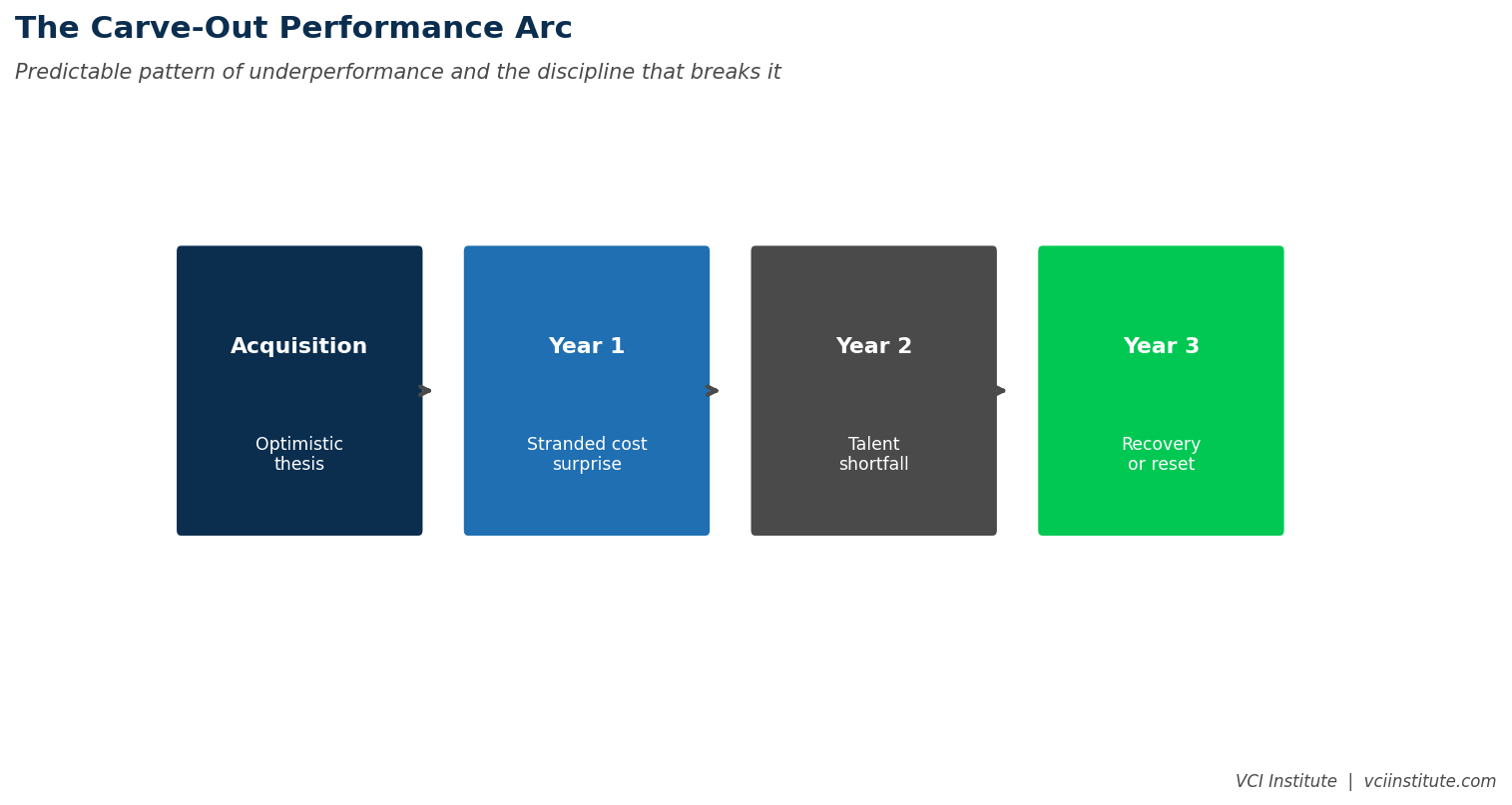
The pattern of underperformance is consistent enough that operating partners can predict it. The structural reasons are knowable. The disciplines that produce successful carve outs are different from the disciplines that produce successful platform acquisitions, and firms that fail to recognize the difference often produce carve out outcomes well below their underwriting case.
What Carve Outs Actually Require
A carve out is not simply an acquisition. It is the assembly of an independent operating entity from a piece of an existing one. The infrastructure, systems, talent, customer relationships, and supplier relationships that the business depended on were partly its own and partly inherited from the parent. Separating the business from the parent requires building, replacing, or restructuring the inherited components. This work is real, expensive, and time consuming, and it is consistently underestimated in carve out underwriting.
Three categories of separation work are typically underestimated.
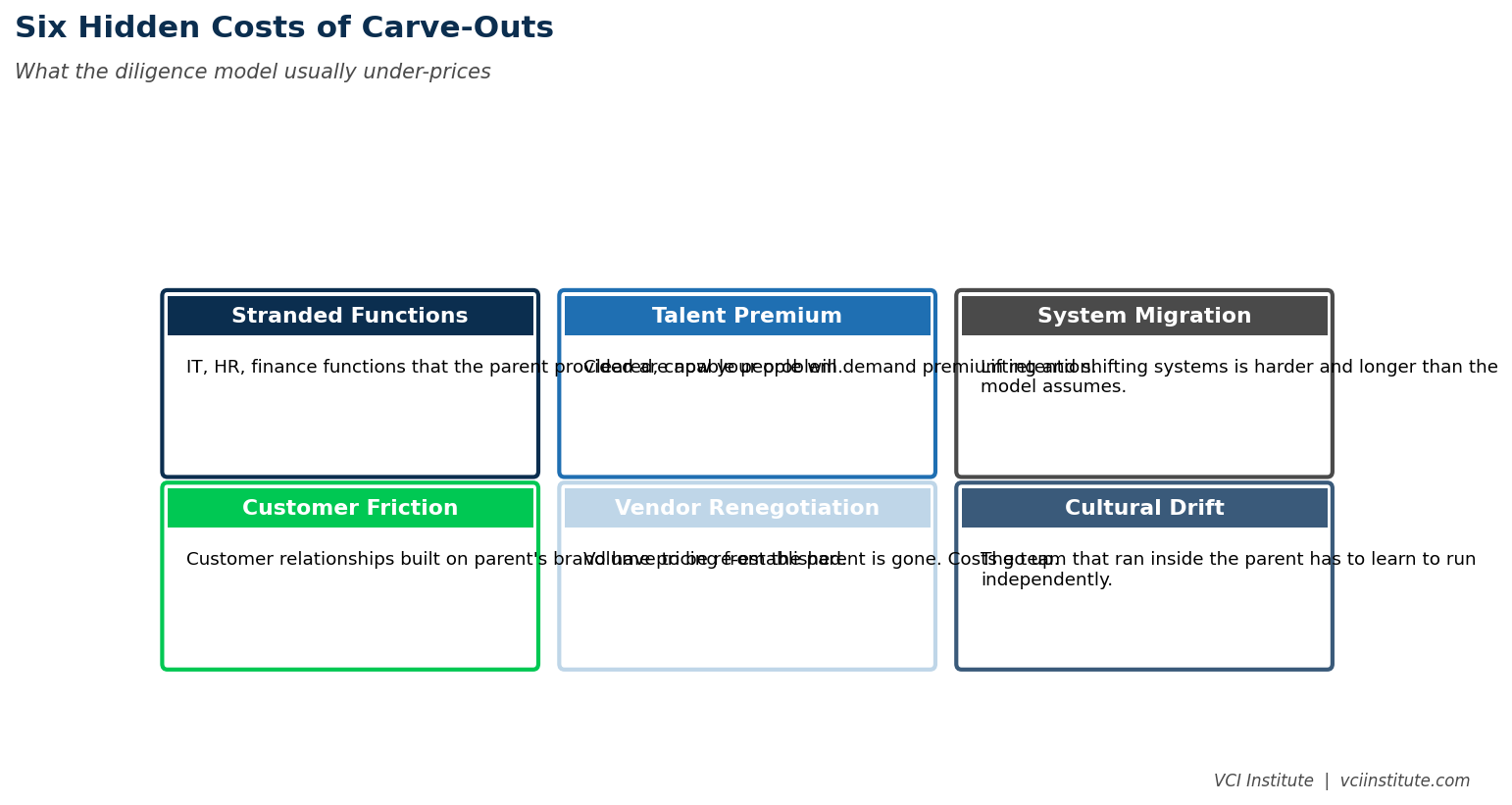
The first category is technology and systems separation. The carve out has been running on the parent's IT infrastructure, often integrated with corporate systems, sometimes sharing applications, frequently using parent company IT services. The new owner has to either purchase a transition services agreement that allows continued use of parent infrastructure for a defined period, build new systems before close, or do both in some combination. The transition services period typically lasts twelve to thirty six months, costs hundreds of thousands to several million dollars annually, and ends with a hard cutover that often produces operational disruption regardless of how carefully it has been planned. New system implementations typically take longer and cost more than the underwriting model assumes. The reporting layer is usually the last thing to stabilise, which is why the single source of truth problem tends to surface in a carve out well before anyone is ready to solve it.
The second category is shared services replacement. The carve out has been receiving HR, finance, legal, procurement, and other corporate services from the parent. These services have to be replicated in the new independent entity. Hiring functional leadership, building processes, and establishing infrastructure for these functions takes between one and two years. The cost is meaningful, often several percent of revenue. The disruption during the build is significant. Many carve outs underperform in the first eighteen months not because the operating business is struggling but because the management team is consumed with building shared services rather than running the business.
The third category is supplier and customer relationship separation. Some of the carve out's relationships are with the standalone business. Others are framework agreements at the parent level, with terms that may not transfer cleanly to the carve out. Renegotiating these relationships, on terms that may be less favorable to the smaller standalone entity, takes management time and may produce unfavorable economic outcomes. Customer relationships sometimes weaken during the separation period, as the parent's brand strength no longer supports the standalone entity. Supplier relationships may tighten as the carve out's smaller scale produces less negotiating leverage.
What The Parent Was Actually Doing
A second category of underestimated effects relates to what the parent corporation was actually doing for the business that the standalone entity now has to do for itself.
Procurement leverage is one of the clearest examples. A subsidiary of a multi-billion dollar parent receives input pricing that reflects the parent's aggregate purchasing power. The standalone entity, with much smaller volumes, often pays meaningfully higher input costs. The increase can be five to fifteen percent on key categories, which translates directly into margin compression that the underwriting case did not anticipate.
Capital allocation is another. As a subsidiary, the business may have been operating with capital expenditure budgets and working capital lines that reflected the parent's broader capital management. The standalone entity must establish its own capital structure, which often produces less favorable terms than the parent provided. Working capital that was previously absorbed in the parent's centralized treasury function now requires standalone financing.
Brand and credibility effects are also material in some industries. Customers who bought from the subsidiary because of the parent's reputation, regulators who certified the subsidiary in part because of parent oversight, employees who stayed because of parent benefits, may all see the standalone entity differently. The standalone has to earn its independent reputation, which takes time and can produce demand softness in the interim.
Each of these effects is sometimes addressed in carve out underwriting, but rarely all of them at the magnitude that actually materializes. The cumulative effect is that the carve out's apparent baseline performance, the EBITDA the business produced as a subsidiary, often does not transfer cleanly to the standalone entity. Some portion of the EBITDA was being supported by parent infrastructure, parent leverage, and parent reputation, and that support disappears at separation. This is the same reading discipline that applies to any seller document, and the habit of reading the CIM between the lines is worth more in a carve out than almost anywhere else.
The Talent Question
Carve outs raise particular talent questions that platform acquisitions do not.
The senior management of a carved out subsidiary may not have been the parent's strongest talent. The subsidiary may have been run by managers the parent did not see as central to the broader enterprise. After separation, the standalone entity needs management that can run the business as an independent enterprise, with all the strategic and operational responsibilities that implies. The existing management team may be capable. They may also be the team the parent was prepared to let go.
The second tier of management is often more critical to carve out success than the C suite. Operating leaders, sales leaders, and functional leaders who can build and run the standalone capabilities the parent previously provided are essential. Many carve outs underperform because the second tier was either less capable than the C suite acknowledged or, more commonly, departed during the separation period when the new ownership and the new operating model produced anxiety about future prospects. Mapping the three people you cannot afford to lose before signing is a cheaper exercise than replacing them in month four.
Cultural cohesion is another talent concern. The carve out's employees have spent their careers as part of a larger corporate culture. The transition to private equity ownership, with different governance, different incentive structures, and different operating tempo, requires cultural adaptation that some employees do not navigate successfully. Retention rates in the first two years after a carve out are typically lower than in other transaction types. Each departure carries some institutional knowledge with it, and accumulated departures can hollow out the standalone entity's operating capability.
Why Carve Outs Still Sometimes Work
Despite these challenges, some carve outs produce extraordinary returns. The conditions are specific.
The first condition is that the parent corporation was systematically under-investing in the business in ways the new owner can correct. The corporate parent had higher return alternatives for capital and was deliberately starving the subsidiary of investment. With focused private equity ownership, the carve out can deploy capital that the parent was not willing to provide, addressing operational gaps that materially improve performance. The investment thesis is grounded in a specific gap that the parent was explicitly creating.
The second condition is that the new owner has genuine operating capability tailored to the carve out's needs. Building shared services infrastructure, implementing new systems, hiring operating talent, and establishing independent processes are real disciplines. Firms with strong carve out track records have invested in these capabilities and apply them rigorously. Firms without these capabilities often underestimate what is required and produce execution outcomes well below the model. Running an operating maturity diagnostic before intervening tells you whether the gap is capital, capability, or both.
The third condition is that the price reflects the actual transition costs and operating gaps that need to be addressed. Carve out underwriting that prices the business as if it were already a fully independent entity, with no transition costs, no shared services build, no margin compression from lost parent leverage, will produce a return profile that reality does not support. Underwriting that explicitly prices the transition produces more accurate expectations and better returns when execution matches the model.
The Carve Out Discipline
Operating partners with strong carve out track records apply a specific set of disciplines that distinguish them from generalist private equity buyers.
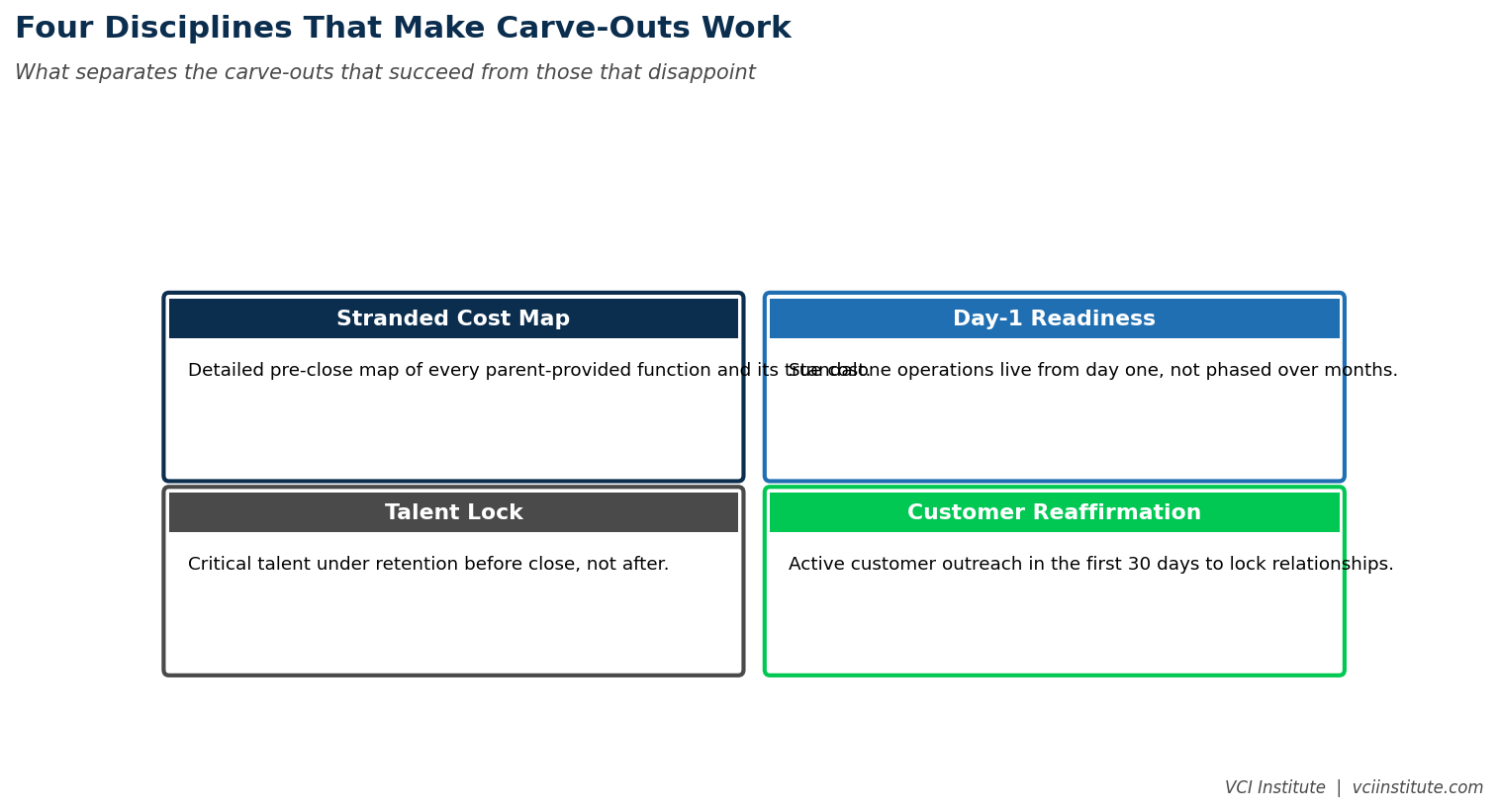
They invest substantially in pre close diligence on the separation question. Understanding what infrastructure is shared with the parent, what services are inherited, what relationships are at the parent level, and what the realistic timeline and cost of building independence looks like. This diligence is more expensive than standard due diligence, but it produces sizing of separation costs that underwriting cases without it consistently understate.
They negotiate transition services agreements aggressively. The TSA terms, duration, scope, pricing, and exit conditions, materially affect both the cost and the disruption of separation. Strong carve out buyers do not accept TSA terms that the parent's M&A team proposes. They negotiate the TSA as a strategic instrument that determines how the next eighteen to thirty six months will play out.
They invest in shared services build before they need to. Hiring functional leadership, beginning to construct independent processes, and establishing the infrastructure during the transition period rather than waiting until the TSA expires. This avoids the late stage scramble that produces operational disruption when the TSA actually ends.
They focus management attention on the operating business while delegating separation work to dedicated transition teams. The CEO and the operating leaders need to run the business. The separation work is staffed separately. Carve outs where the management team is consumed with separation tend to produce operating drift in the underlying business that compounds the separation challenges.
They reset financial expectations honestly with LPs. The first year of a carve out is usually disruptive. Reported EBITDA may be lower than the standalone EBITDA the underwriting case assumed, because of separation costs and operating gaps that have not yet been closed. Investors who understand this and are prepared for it remain supportive. Investors who are surprised by it become more difficult to retain through the longer hold periods that carve outs often require.
The Honest Conversation
The honest conversation about carve outs is that they are harder than the memo describes. Some are spectacular successes. Many are mediocre. A few are genuine disasters. The aggregate return profile is below comparable transactions in other deal source categories. This is not a reason to avoid carve outs. It is a reason to approach them with discipline calibrated to their actual character.
Firms that have built genuine carve out capability, with diligence, operating, and integration teams that specialize in the category, can produce strong returns from this deal flow. Firms that approach carve outs as if they were standard platform acquisitions, with standard diligence and standard operating support, produce returns that reflect the underestimation. The difference between the two outcomes is large enough to matter at the fund level. The same discipline gap shows up in sponsor to sponsor transactions, where the buyer also inherits a business whose easiest improvements have already been taken.
The carve out narrative will continue to attract capital. The successful examples will continue to be celebrated. The structural underperformance will continue to be relatively quiet. Operating partners who want to capture the genuine opportunity in carve outs need to invest in the specific disciplines the category requires and to underwrite with the realism that the data on the broader population of carve outs warrants. Done well, carve outs remain a productive part of private equity sourcing. Done casually, they remain a category where good IC memos consistently exceed actual outcomes.
VCI Institute in collaboration with Mohamad Chahine
Published 10 August 2026
Related reading from the VCI Institute
The Sponsor-to-Sponsor Trap
Why buying from another private equity firm costs more than the underwriting case usually assumes.
Reading the CIM Between the Lines
What sellers are telling you in the document without ever saying it directly.
The Operating Maturity Index
A diagnostic to run before you intervene, so the playbook matches the company you actually bought.
About the VCI Institute
The VCI Institute is a nonprofit dedicated to building practical capability and shared standards for value creation in private equity. The Institute publishes operator-grade frameworks and runs certification programs for operating partners, portfolio company CEOs, and value creation analysts, including COPPE and CVCA. Analysis published here draws on the Institute's certification curricula and on structured review of mid-market transaction patterns rather than on any single proprietary dataset. Where a figure is directional rather than measured, it is described as such.
Further material is available in the Institute's Insights library and its free resource library of templates, checklists, and case snapshots.
© 2026 VCI Institute. All rights reserved. No part of this article may be reproduced or transmitted in any form without prior written permission of the VCI Institute.
We have many great affordable courses waiting for you!
Stay connected with news and updates!
Join our mailing list to receive the latest news and updates from our team.
Don't worry, your information will not be shared.
We hate SPAM. We will never sell your information, for any reason.


 Practice private equity like a pilot trains