

The Retail PE Distribution Problem: Solving the Liquidity Mismatch for the Mass Affluent
Sep 10, 2026
The retail capital wave entering private equity is one of the most significant structural shifts in the asset class in a generation. Mass affluent investors who were historically excluded from private markets are now being offered access through interval funds, business development companies, semi-liquid vehicles, and increasingly through wealth management platforms that have made allocation a click rather than a commitment. The capital is flowing in volumes that, projected forward, would meaningfully reshape the LP base of the industry. The premise is appealing. Democratize access. Diversify the LP base. Provide retail investors with the return profile that institutional investors have enjoyed.
The premise is also incomplete in a way that the industry has not yet fully reckoned with. Private equity is, structurally, an illiquid asset class. The returns come from holding companies for five to seven years, working through operational improvement and exit timing, and capturing value that requires patience. Retail investors, structurally, have liquidity expectations. The combination produces a mismatch that the current generation of retail vehicles has tried to manage through structural compromises that may or may not survive contact with a serious downturn. The structures look elegant in benign conditions. They have not yet been stressed.
The short answer
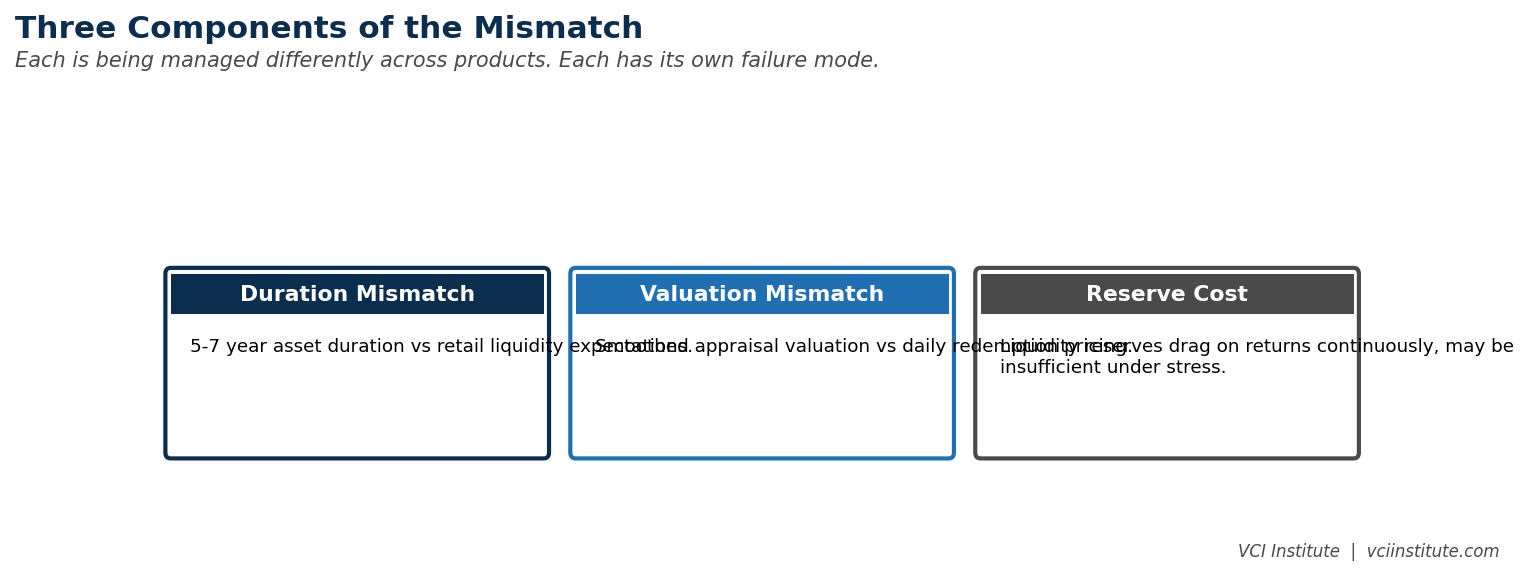
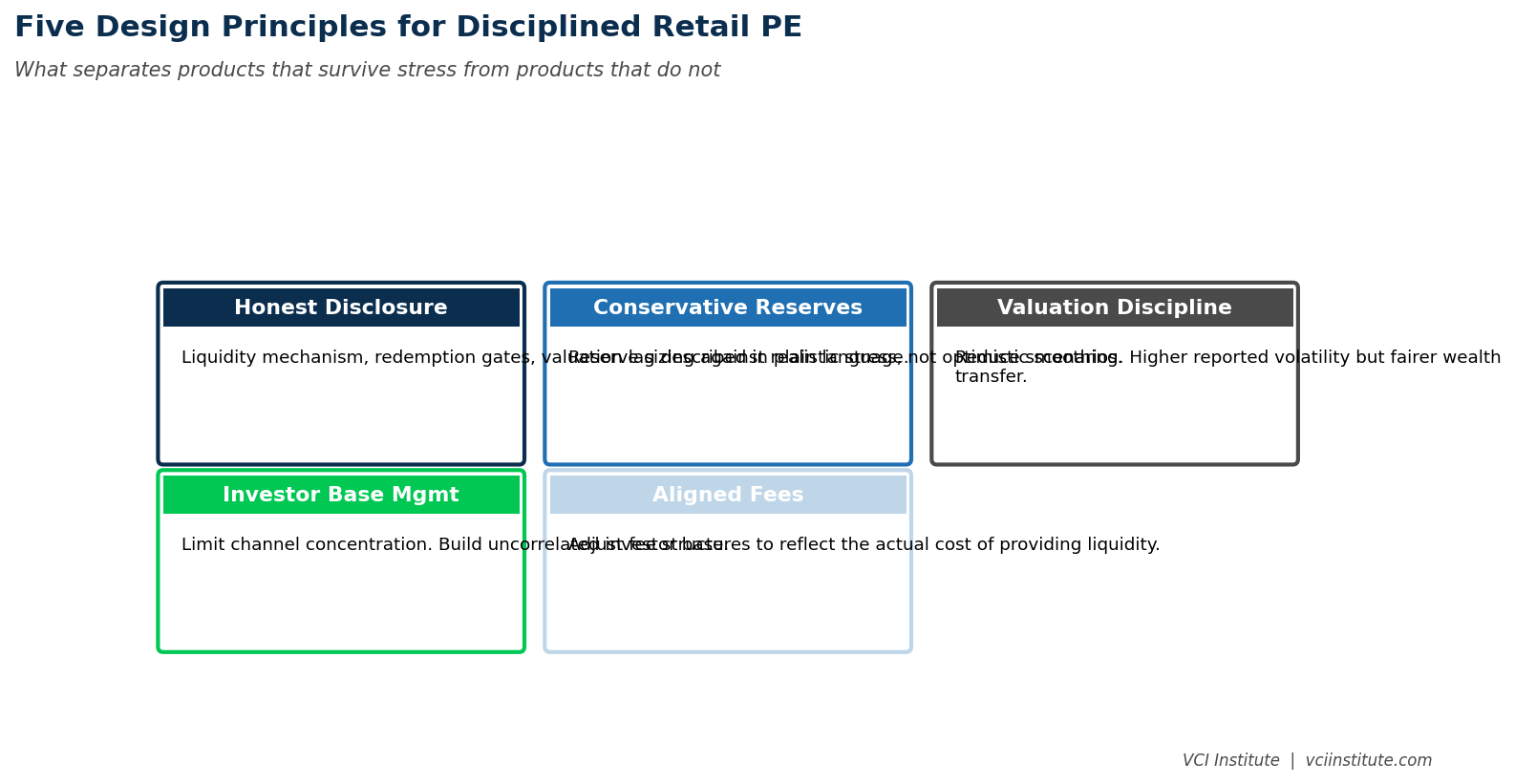
The mismatch has three parts. Duration, because private equity assets run five to seven years and retail expects quarterly windows. Valuation, because smoothed appraisal marks lag reality and let early redeemers exit at stale prices at the expense of those who stay. And reserve cost, because the cash held to fund redemptions drags on returns for everyone continuously. No current structure resolves all three. Disciplined design means plain-language disclosure of the gates, conservative reserves, valuation policy that reduces smoothing rather than maximises it, deliberate investor base diversification, and fees aligned to the liquidity actually provided.
New from VCI Institute
The AI Value Creation Model: a 53-page practical guide for deal teams, operating partners, and private equity leaders. Five components, one gate, twelve levers, a worked EBITDA bridge. Get the guide at no cost.
This is the retail PE distribution problem. It is solvable, but the current solutions are partial, and the firms that are designing for the mismatch with discipline are operating differently from the firms that are simply opening distribution channels and hoping that the structures hold.
The Capital Wave Is Real
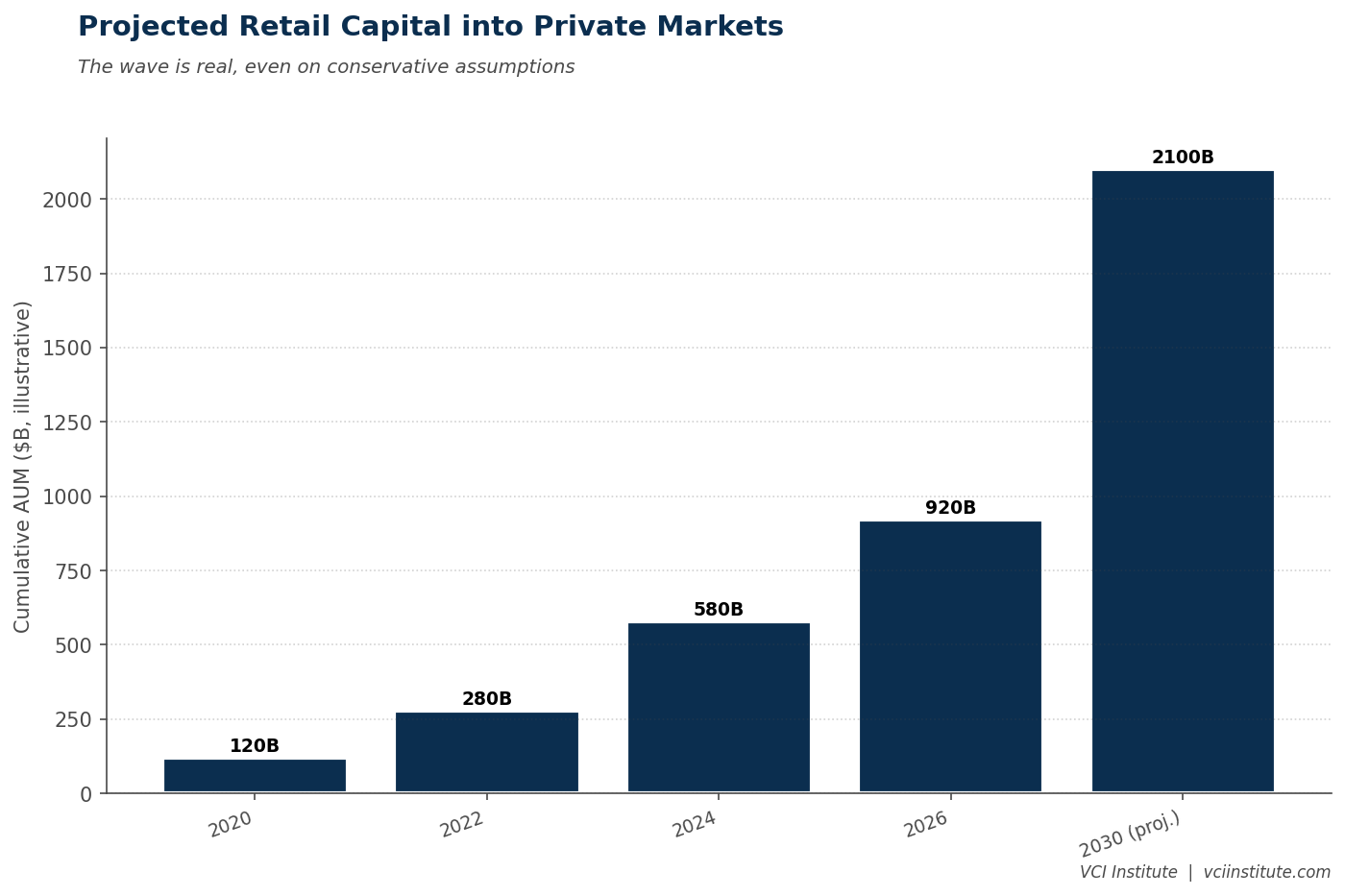
The numbers driving the conversation are large. Estimates of mass affluent and high net worth capital potentially flowing into private markets over the next decade range across multiple trillions of dollars depending on the assumptions used. Even discounted versions of these estimates represent capital flows that would dwarf the institutional growth of the past decade. The wealth management platforms that distribute these vehicles have built infrastructure that did not exist five years ago. The product structures that allow the access have proliferated. The regulatory framework that constrains them has become more permissive in some jurisdictions and more codified in others.
The demand from retail investors is real. Twenty years of institutional outperformance in private equity, alongside extended periods of mediocre public equity returns, have produced retail demand that is rational on its face. The supply of products to meet the demand has grown to match. Most major asset managers now offer some form of retail-accessible private market product. The conversation has moved from whether retail will participate to how the industry should manage the participation responsibly.
This is the right conversation. The conversation is not, however, primarily about access. It is about structure. The structures being deployed have features that work in some conditions and may fail in others. Understanding the structural mechanics is the work that distinguishes thoughtful product design from optimistic product design.
The Anatomy of the Mismatch
The structural mismatch has three components, each of which is being addressed differently by different products and each of which has different failure modes under stress.
The first component is the duration mismatch. Private equity assets have effective durations of five to seven years. Retail investors expect liquidity windows that are meaningfully shorter. The standard solution is to structure vehicles with periodic redemption windows, typically quarterly, with redemption caps that limit how much capital can leave at any one window. The structure works in normal conditions because most retail investors do not redeem aggressively. It works less well when sentiment shifts and a meaningful share of the investor base attempts to redeem simultaneously. The redemption caps prevent the vehicle from being forced to sell assets at distressed prices, but they also produce a situation where investors who expected liquidity find themselves unable to access their capital. The reputational consequences of this scenario have been visible in adjacent asset classes during recent stress periods. The pressure is amplified by the same underlying condition that has driven the DPI reckoning on the institutional side, namely that realised distributions have lagged reported performance for several years.
The second component is the valuation mismatch. Private equity assets are valued through periodic appraisal processes that produce smoothed returns that do not reflect daily market movement. Retail vehicles, regardless of their structure, have to produce some kind of net asset value for redemption purposes. The smoothed valuation produces a benefit during normal conditions, dampening apparent volatility and making the asset class look attractive on a risk-adjusted basis. During stress, the smoothing creates a known problem. The valuation lags the actual deterioration in the underlying assets. Investors who redeem early effectively exit at stale valuations that benefit them at the expense of remaining investors. The longer the lag, the larger the wealth transfer from patient investors to redeeming ones. This problem has been understood for decades in adjacent asset classes and has not been solved satisfactorily.
The third component is the liquidity reserve cost. To meet redemption requests in normal conditions, retail vehicles hold cash or liquid securities reserves that drag on returns. The reserves are real cost, paid by all investors continuously, in exchange for liquidity that most investors do not use most of the time. The reserves can also be insufficient in a stress scenario, in which case the vehicle has to either gate redemptions or sell underlying assets, which raises the issues described above. Some managers have reached instead for balance sheet solutions, which introduces the set of trade-offs discussed in NAV lending reconsidered, where the tool that solves the liquidity problem creates a leverage problem one layer up.
These three components together produce the structural mismatch. None of the current product structures fully resolve them. Each manages one or two while accepting trade-offs on the others. Understanding which trade-offs each structure makes is the diligence work for advisors and platforms recommending these products and for investors choosing among them.
What the Failure Modes Look Like
The failure modes have been visible in adjacent asset classes recently and are worth taking seriously rather than treating as theoretical.
The redemption gate scenario. A meaningful share of investors attempt to redeem during a stress period. The redemption cap activates. Investors who expected access to their capital discover that access is constrained. The fund's marketing materials had described the redemption mechanism but had not emphasized the cap. The reputational damage extends beyond the specific fund to the broader retail private markets product category. Distribution platforms become more cautious about offering similar products. The industry's growth trajectory in retail capital slows.
The valuation litigation scenario. A stress period produces meaningful divergence between smoothed appraisal valuations and the actual mark-to-market value of the underlying assets. Some investors have redeemed during the lag period at favorable valuations. Other investors have remained and now bear concentrated exposure to the deterioration. The remaining investors initiate complaints, regulatory inquiries, or legal action. The fund manager faces multiple kinds of pressure simultaneously. Even if the fund manager prevails in any specific dispute, the broader category bears the cost.
The reserve cost scenario. An extended period of mediocre returns produces investor frustration with the liquidity reserves that have been dragging on returns continuously. Investors compare their realized returns against the institutional class of the same fund and discover that the retail class has underperformed by an amount that reflects the cumulative reserve cost. Some leave. Some remain but with reduced confidence. The product category as a whole acquires a reputation for delivering meaningfully worse returns than the institutional comparator, which is in fact accurate.
None of these scenarios are speculative. Each has happened in adjacent asset classes within the past decade. Each is plausible in retail private equity vehicles under conditions that are well within the range of historical market behavior. The current structures have not been tested by any of them. The industry's confidence in the structures rests on a track record of benign conditions rather than on stress testing against realistic adverse scenarios.
What Disciplined Design Looks Like
The firms that are designing retail private market products with discipline are addressing the structural mismatch through specific design choices rather than relying on structural compromises that work in benign conditions.
The first design choice is honest disclosure of the liquidity mechanism. The redemption gates, the valuation lag, and the reserve cost are described in plain language in marketing materials, not buried in offering documents. Investors are educated about the failure modes before they commit, not after. This produces a smaller initial commitment from investors who decide the trade-offs are not for them, which in turn produces a more aligned and more durable investor base.
The second design choice is conservative reserve structuring. The vehicle holds liquidity reserves at levels that can absorb realistic redemption stress, accepting the return drag as a cost of providing genuine rather than theoretical liquidity. The reserve sizing is set against actual stress scenarios, not optimistic ones, and is reviewed regularly as the investor base evolves.
The third design choice is valuation discipline that aims to reduce smoothing rather than maximize it. The fund's valuation policy is designed to produce marks that approximate fair value as quickly as possible, even at the cost of higher reported volatility. This reduces the wealth transfer dynamics during stress and produces investor returns that more accurately reflect the underlying performance.
The fourth design choice is investor base management. The fund actively limits the share of capital from any single distribution channel, the concentration of capital in any single investor, and the velocity of capital inflow. The objective is to build an investor base whose redemption behavior is uncorrelated rather than highly correlated. This is a structural choice that limits the fund's growth rate but reduces the risk of correlated redemption stress. The logic is the same one that applies to operating businesses, where the real concentration sits in the decision maker rather than the named account. A thousand retail investors on one platform is one decision, not a thousand.
The fifth design choice is alignment of fee structures with the actual liquidity profile. Funds that charge fees consistent with institutional structures while delivering retail-style liquidity create misalignment. Funds that adjust fees to reflect the cost of providing liquidity, either through explicit liquidity fees or through fee structures that share returns more equitably across the investor base, produce alignment that supports long-term participation.
These five design choices together produce products that have a chance of working through stress. The choices are individually unglamorous. Together they describe a different category of product from the typical retail private market vehicle. The firms that are building these products are accepting slower growth and lower marketing simplicity in exchange for products that have a realistic chance of delivering on their promises across full market cycles.
What This Means for the Industry
The retail PE distribution opportunity is real, and the industry will participate in it whether or not specific firms participate thoughtfully. The question facing each firm is whether to be among the firms that design products with discipline or among the firms that take the easier path and rely on structural compromises that work until they do not.
The firms that take the disciplined path will participate at a slower rate of capital accumulation. They will deliver products that hold up through stress. They will build distribution relationships that compound over time as the market matures and as platforms increasingly distinguish products that have been stress-tested from products that have not. The path is harder in the early years and stronger in the later years.
The firms that take the easier path will accumulate capital faster in the near term. They will face higher reputational risk during the first serious stress event in retail private market vehicles. They may or may not survive the resulting investor reaction with their distribution capability intact. The path is easier in the early years and exposed in the later years.
For the industry as a whole, the outcome depends on which path the largest distributors and product designers take. If the dominant participants take the disciplined path, the category establishes itself as a credible long-term addition to the retail allocation playbook. If the dominant participants take the easier path, the first stress event produces a setback that may take a decade to recover from, and that retains the category permanently as a smaller and more constrained piece of the retail allocation landscape than the optimistic projections currently assume.
The choice is being made now, in the design decisions that firms are taking on products that have not yet been stress tested. The decisions are not theatrical. They are the difference between a category that delivers on its promise and a category that becomes the next cautionary case in the history of retail access to alternative assets. The disciplined firms are recognizable. They are designing for the stress scenarios that the industry has not yet faced. The undisciplined firms are designing for benign conditions and assuming the conditions will continue.
The mismatch between private equity duration and retail liquidity expectations is a real engineering problem. It has solutions. The solutions require accepting trade-offs that look unattractive in the marketing brochure and that prove decisive in the redemption window. The firms that build their products around the trade-offs honestly will be operating, in five years, in a category that has matured in their favor. The firms that build their products around aspirational liquidity claims will be explaining, in five years, why the category did not develop the way the early optimism predicted. The choice is structural. The discipline is the asset. The shortcuts will not survive the first real stress event in any visible way that does not damage the category for everyone.
CVCA Level 1
Where the returns actually come from
Structures like these only work if the underlying assets perform. The Certified Value Creation Analyst programme teaches the taxonomy underneath that performance: the value creation levers, the EBITDA bridge, and the working capital mechanics that decide whether a hold delivers. Self paced.
VCI Institute in collaboration with Mohamad Chahine
Published 10 September 2026
Related reading from the VCI Institute
The DPI Reckoning
Why distributed-to-paid-in is now the metric that matters, and the liquidity pressure sitting behind it.
NAV Lending Reconsidered
A tool that solves one problem and creates another, increasingly reached for at the fund level.
Fund-of-One Structures
Customization at the cost of standardization, and what happens when the LP base fragments in the other direction.
About the VCI Institute
The VCI Institute is a nonprofit dedicated to building practical capability and shared standards for value creation in private equity. The Institute publishes operator-grade frameworks and runs certification programmes for operating partners, portfolio company executives, and value creation analysts. You can see what each programme actually covers before deciding. Analysis published here draws on the Institute's certification curricula and on structured review of mid-market transaction patterns rather than on any single proprietary dataset. Where a figure is directional rather than measured, it is described as such.
Further material is available in the Institute's Insights library and its free resource library of templates, checklists, and case snapshots.
© 2026 VCI Institute. All rights reserved. No part of this article may be reproduced or transmitted in any form without prior written permission of the VCI Institute.
We have many great affordable courses waiting for you!
Stay connected with news and updates!
Join our mailing list to receive the latest news and updates from our team.
Don't worry, your information will not be shared.
We hate SPAM. We will never sell your information, for any reason.






 Practice Platform