Diligence the System, Not the Resume: Why Founder Companies Break When PE Changes the Physics
Sep 24, 2026
Most diligence asks the wrong question.
The question is usually some version of, is this a good management team. The answer is some version of yes, with footnotes. The deal closes. Twelve months later, the management team is the same management team, and the numbers are not.
The mistake was the question.
The short answer
In a founder-led company the founder is the operating system. Private equity replaces that system on day one, and the same team now performs worse inside a system that has not been built yet. Three outcomes follow. Absorption, where the system adapts, in roughly one deal in five. Rejection, where the company performs compliance while still running on charisma underneath. And fragmentation, the most common and most costly, where different functions adopt different operating logics and the board sees clean reports over an incoherent reality. Diligence should test five system behaviours rather than individual capability: alignment, decisioning, learning, communication, and adaptation. All five require observation, not interviews.
Execution is not an individual sport. It is a system outcome. What looked like a strong management team in diligence was a strong management team operating inside a system that worked. PE arrives, changes the system, and the same management team is now operating inside a different system that has not been built yet. They look weaker. They are not weaker. The system is gone.
This is the most under-discussed risk in private equity diligence, and it is the source of more first-year disappointment than any line item we audit.
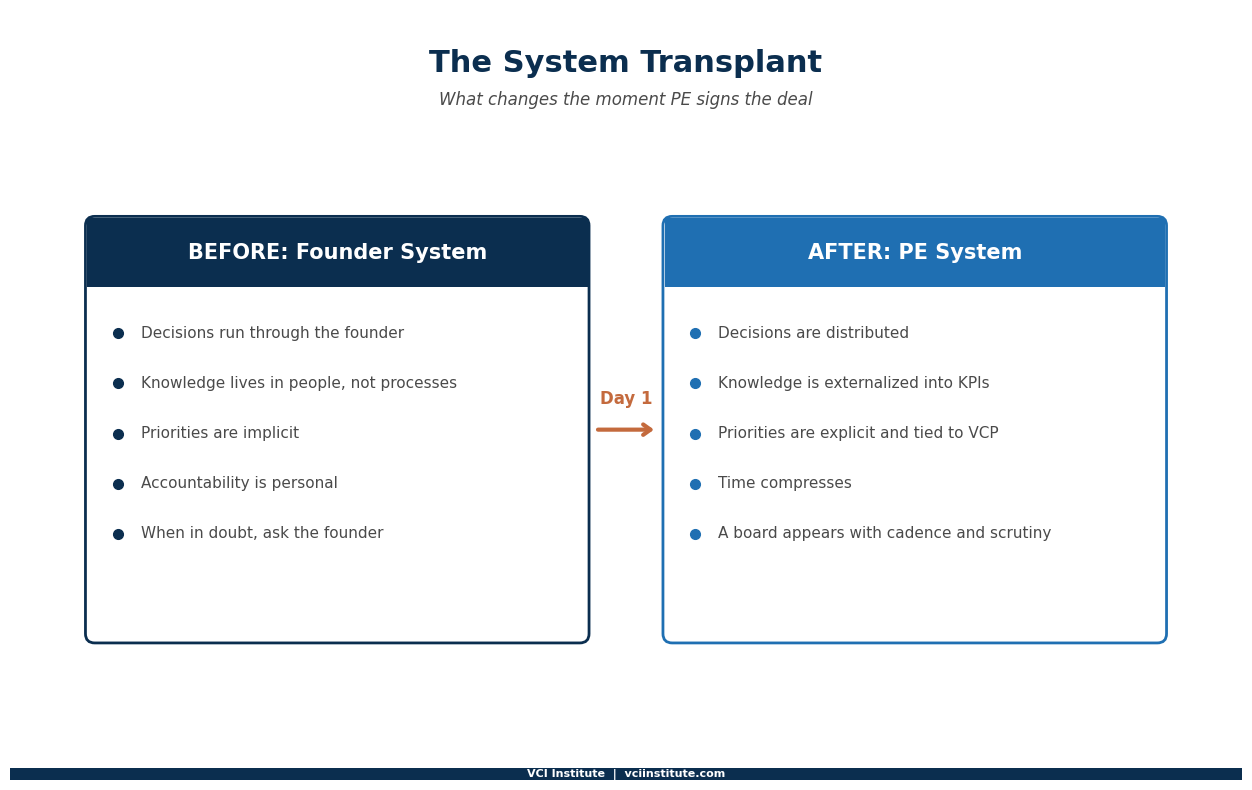
Before close, a typical founder-led company is a working system that nobody designed deliberately.
Decisions are fast because they all run through the founder. Knowledge lives in people, not processes. Priorities are implicit. Accountability is personal. When in doubt, ask the founder. When the founder is not available, wait. The system is not scalable, not institutional, not best practice. It is also not broken. It works. It just does not work the way PE will need it to work.
The founder is the operating system.
Post-close, PE rewires the physics. Decisions must be distributed. Knowledge must be externalized into KPIs and dashboards. Priorities must be explicit and tied to the value creation plan. Time compresses. A board appears, with cadence and scrutiny. What worked gets replaced with what scales.
This is not an upgrade. It is a system transplant. And like any transplant, it produces immediate destabilization. Decisions slow down because authority is unclear. Meetings increase but clarity does not. KPIs appear but behavior does not change. Reporting expands but insight shrinks. The board asks questions the system cannot yet answer. The reporting problem is usually more literal than anyone expects, because externalising knowledge into dashboards exposes the fact that the functions have never agreed on the numbers. That is the single source of truth problem, and it surfaces in week three rather than month six.
The people did not change. The system did. The drift in the numbers is the drift in the system, not the drift in the people. Where the transplant goes too far, the cost is measurable as the founder speed tax, in which the sponsor pays a premium for velocity and then installs the process that removes it.
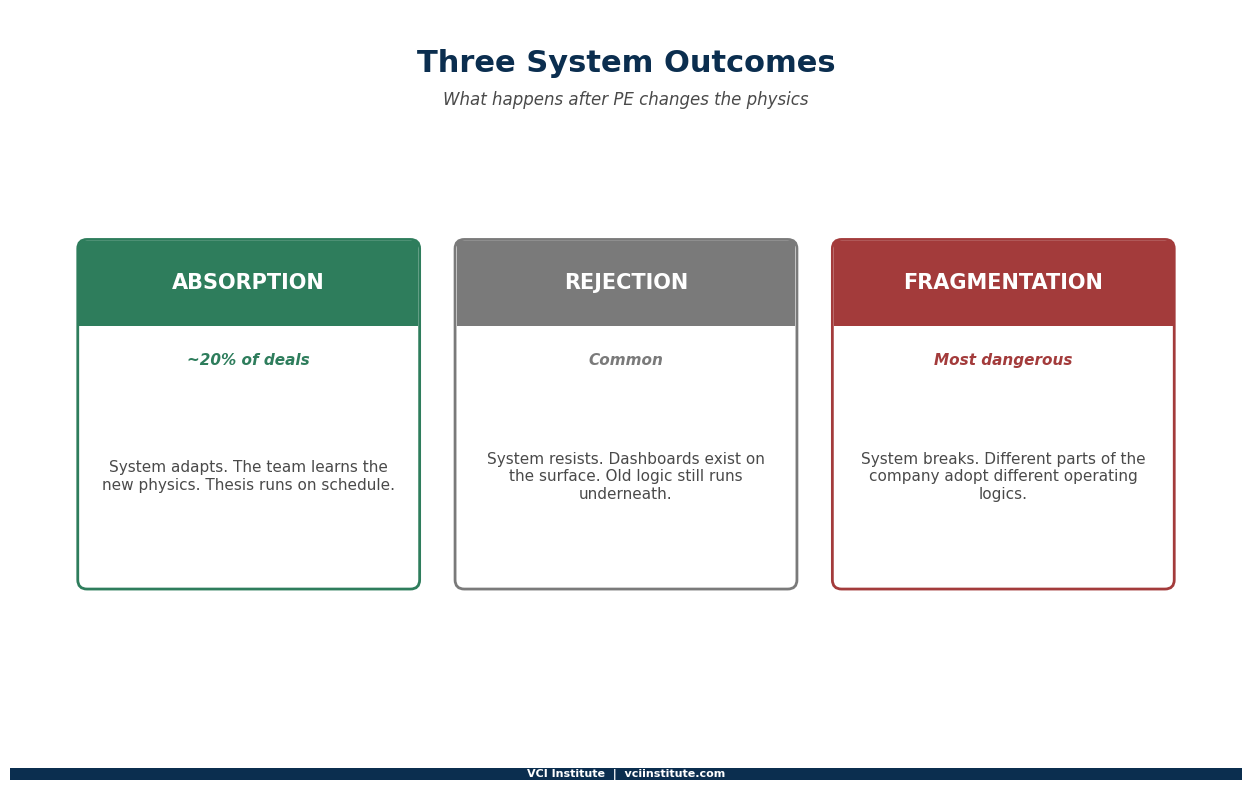
Three patterns emerge after the transplant. Diligence should be designed to predict which pattern this company will produce.
Absorption is the rare and best case. The system adapts. The operator and team learn the new physics, internalize the cadence, and the system becomes more capable than it was before. The thesis runs on schedule. We see absorption in roughly twenty percent of founder-led deals, and almost always when the founder either steps back deliberately or partners explicitly with a hire who carries the change mandate. Which of those two routes applies depends on which of the three operator archetypes is actually in the seat.
Rejection is when the system resists. The founder, the senior team, or the cultural backbone refuses to operate in the new physics. They go through the motions. The dashboards exist. The cadence runs. Underneath, the company is still being run on charisma and tacit knowledge. The first eighteen months look acceptable in the numbers because the inherited momentum carries the company. After that, the gap between the reported system and the actual system widens, and exits become difficult because buyers see through it.
Fragmentation is the most common and most dangerous outcome. The system breaks. Different parts of the company adopt different operating logics. Sales runs on the old founder logic. Finance runs on the new PE logic. Operations runs on whatever its director thinks is fashionable. The board sees clean reports. The Tuesday morning operating reality is incoherent. By the time the numbers reflect the fragmentation, the company has lost twelve to eighteen months of value creation, and the fix requires a leadership change that the deal team did not budget for. Fragmentation is precisely what the Thesis Operating System exists to prevent, by forcing one logic to run from the IC memo down to the weekly rhythm.
The first failure of diligence is treating these three outcomes as a personality issue. They are not. They are system outcomes. The same management team can produce all three depending on how the transition is designed and how the deal team intervenes.
The second failure is testing the wrong thing. Most diligence tests historical performance and references. Both are downstream signals of a system that no longer exists post-close. They tell you the founder system worked. They do not tell you whether the new system can be installed.
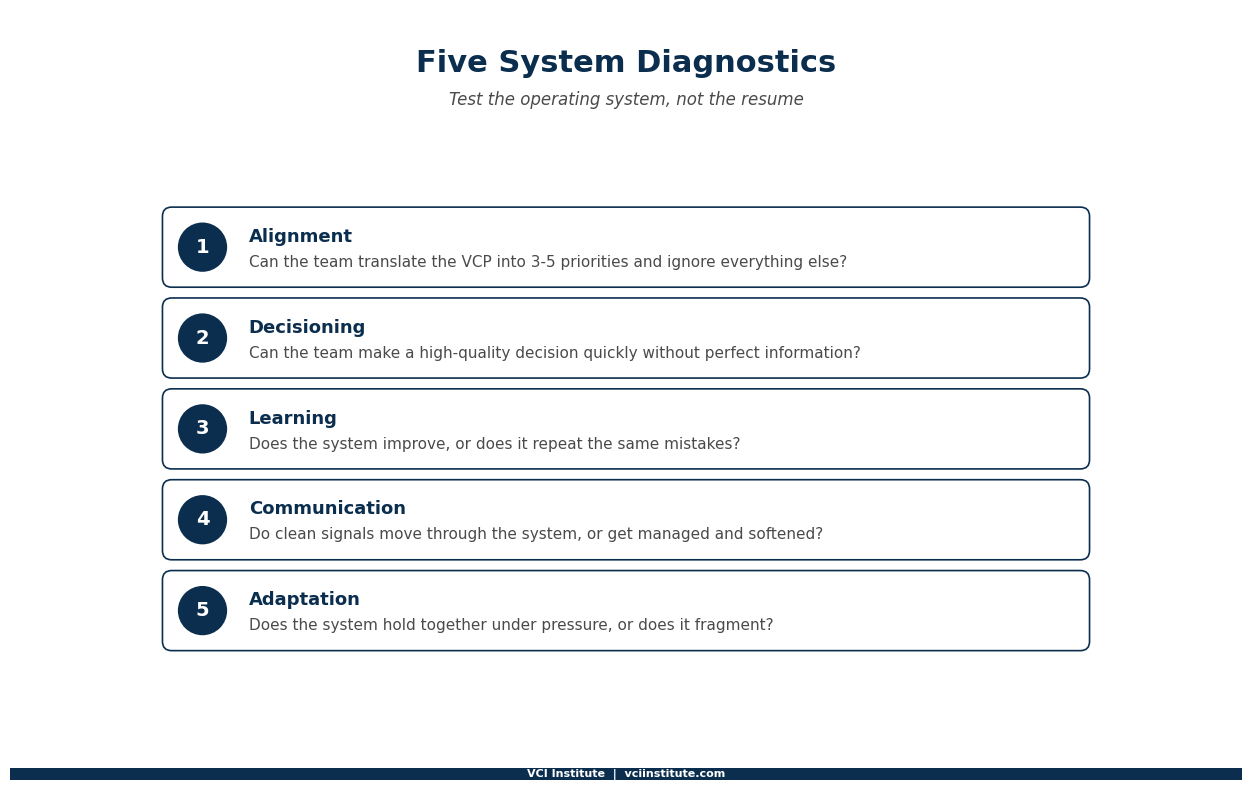
What diligence should test instead is system behavior, not individual capability.
Five things matter, and all five can be tested in the diligence window if the deal team is willing to spend the time.
Alignment. Can the team translate the value creation plan into three to five priorities and ignore everything else? Most founder-led teams cannot. They will name twelve. The list will be defended. That is the diagnostic, not a complaint.
Decisioning. Can the team make a high-quality decision quickly, without perfect information? Test it. Introduce a forced trade-off in a working session. Watch the latency. Watch who actually makes the call. Watch how it gets communicated downstream.
Learning. Does the system improve, or does it repeat mistakes? Ask what changed after the last operating miss. The answer reveals whether the company has institutional reflexes or only personal ones.
Communication. Do clean signals move through the system, or do they get managed and softened on the way up? Sit in on a real operating meeting. The pattern of who interrupts whom, who is corrected, who is deferred to, tells you more than any organization chart. It also tends to reveal which two or three people actually hold the company together, which is the same output as the post-close talent density map but available before signing rather than after.
Adaptation. Does the system hold together under pressure, or does it fragment? You cannot fully test this in diligence, but proxies exist. How did the company handle the supply chain disruption in the last cycle? How did it handle the last customer concentration scare? What did the founder do when the senior team disagreed?
These five tests are not interview questions. They are observation tasks. Most diligence processes do not include observation, only Q and A. That is why diligence keeps producing the same systematic surprise after close.
The deeper point is that the moment PE signs the deal, the system the company was running on is already in transition. The next ninety days will determine whether it absorbs, rejects, or fragments. Diligence is the only window in which the deal team can see the original system clearly enough to predict which outcome they are about to produce. The clock on that window is the one described in the 45-day math, and it starts at signing.
The boards that do this well treat the operator and the system as two separate underwriting questions. They underwrite the operator on capability, alignment, and motivation. They underwrite the system on absorption probability, with explicit interventions designed to push the probability up before close, not after.
The boards that do not, end up writing checks for the wrong thing.
You are not investing in a team. You are investing in a system of execution. The team is one input. The cadence, the decision rights, the information flow, and the cultural reflexes are the other inputs, and most of them are invisible until the system gets stressed.
Resumes do not tell you the truth. Systems do.
APEX Masterclass
Diligence that tests the system, not the deck
The Advanced Private Equity Accelerator covers how a thesis is built, how diligence is scoped against it, and how underwriting logic survives contact with a real company rather than a data room. Self paced, no start dates.
VCI Institute in collaboration with Mohamad Chahine
Published 24 September 2026
Related reading from the VCI Institute
Founder, Hire, Incumbent
The three operators PE underwrites, and which archetype is sitting inside the system you just bought.
The Operating Maturity Index
A diagnostic to run before you intervene, and a structured way to score absorption probability.
The Thesis Operating System
From IC memo to Tuesday morning, and the discipline that prevents fragmentation.
About the VCI Institute
The VCI Institute is a nonprofit dedicated to building practical capability and shared standards for value creation in private equity. The Institute publishes operator-grade frameworks and runs certification programmes for operating partners, portfolio company executives, and value creation analysts. You can see what each programme actually covers before deciding. Analysis published here draws on the Institute's certification curricula and on structured review of mid-market transaction patterns rather than on any single proprietary dataset. Where a figure is directional rather than measured, it is described as such.
Further material is available in the Institute's Insights library and its free resource library of templates, checklists, and case snapshots.
© 2026 VCI Institute. All rights reserved. The frameworks, terminology, and analysis presented in this article are the intellectual property of the VCI Institute. Reproduction or derivative use without written permission is prohibited. Citation with proper attribution is welcomed.
We have many great affordable courses waiting for you!
Stay connected with news and updates!
Join our mailing list to receive the latest news and updates from our team.
Don't worry, your information will not be shared.
We hate SPAM. We will never sell your information, for any reason.

 Practice private equity like a pilot trains