The Industrial Energy Transition Lens: Beyond Climate Tech, Into Hard Infrastructure
Sep 07, 2026
The energy transition story in private equity has been dominated by a category that captures the imagination but represents a small fraction of where the actual capital needs to flow. Climate tech, defined narrowly, is the venture-backed software and biotech that occupies most of the headlines. Battery chemistry startups. Carbon capture demonstration projects. Hydrogen fuel-cell developers. The category is real and important, but it is not where mid-market private equity has its highest leverage opportunity. The opportunity sits one layer down in the value chain, in the unglamorous industrial infrastructure that has to be built, upgraded, and operated for the transition to actually happen.
This is the industrial energy transition. It is not the technology. It is the manufacturing, the supply chain, the installation services, the maintenance operations, and the specialized industrial businesses that turn the technology from prototype into deployed asset. The category is large. It is growing. It is structurally suited to mid-market private equity. And it is materially underserved by the climate tech narrative that dominates the industry conversation.
The short answer
The energy transition has five investable layers. Technology belongs to venture. Project development belongs to infrastructure funds. Layers three, four, and five, equipment manufacturing, installation and services, and input supply, are where mid-market private equity actually fits, because those businesses are cash generative, fragmented, and operationally familiar. The demand behind them is structural rather than cyclical, driven by legislated multi-decade spending, corporate decarbonisation commitments with shareholder accountability, and insurance pressure. The framing was the constraint, not the deal flow.
New from VCI Institute
The AI Value Creation Model: a 53-page practical guide for deal teams, operating partners, and private equity leaders. Five components, one gate, twelve levers, a worked EBITDA bridge. Get the guide at no cost.
What the Climate Tech Narrative Misses
The climate tech narrative is built around innovation. New chemistries, new processes, new business models. The story makes for compelling pitch decks and press releases. The investment characteristics are venture-style. Long time horizons. High failure rates. Binary outcomes. The successful investments produce extraordinary returns. The failures are total. The asset class as a whole has produced mixed results, with vintage performance varying widely depending on cycle timing and category exposure.
Private equity, by contrast, is structurally suited to a different kind of investment. Established businesses with cash flow. Operating improvement opportunities. Acquisition-driven growth. Five to seven year holds. The mismatch between climate tech investment characteristics and private equity investment characteristics has produced the predictable pattern. Most mid-market sponsors have engaged with the energy transition tentatively, often through a single thematic fund or a limited allocation, while the bulk of their capital has continued to flow into other sectors where the investment characteristics fit better.
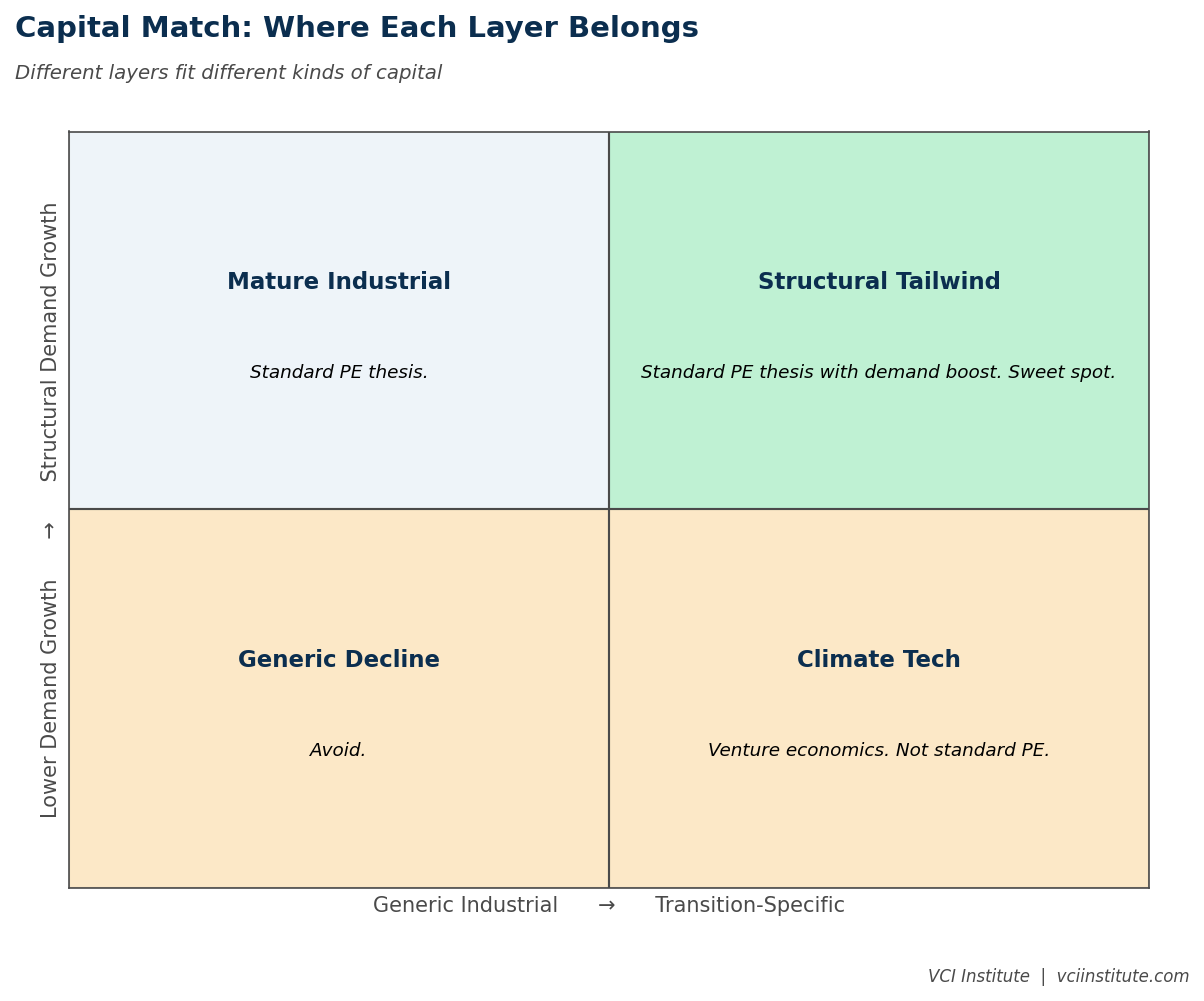
This is the wrong response. The energy transition is not just climate tech. It is also the industrial layer underneath, which has investment characteristics that fit private equity precisely. The companies in this layer are operational, cash-flow generative, and primed for growth that is being driven by the largest infrastructure spending cycle in modern history. The mid-market sponsors that have figured this out have built positions that are paying back at rates the climate tech category as a whole cannot match.
The Industrial Layer Cake
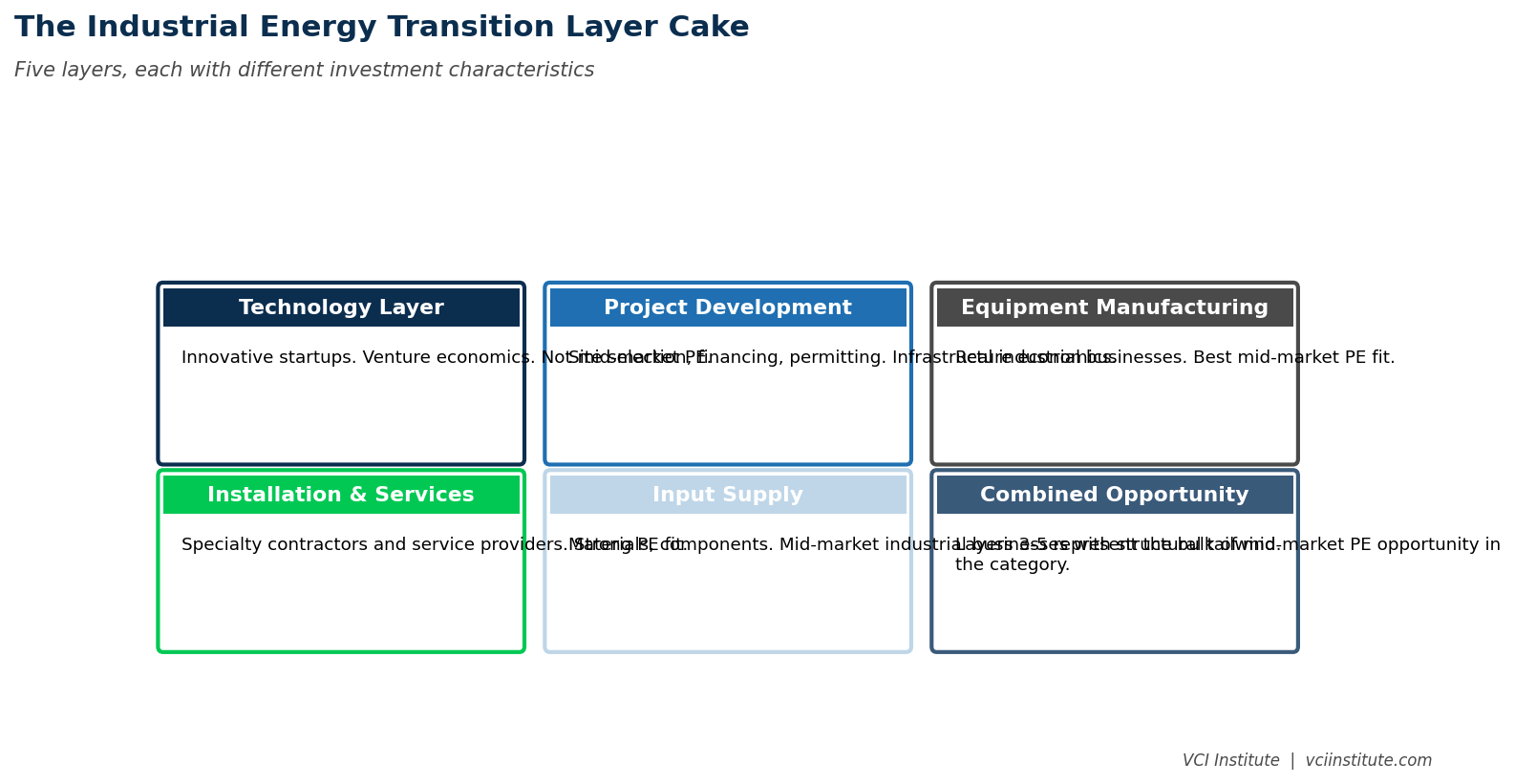
The energy transition produces work at multiple layers, each with different investment characteristics. Understanding the layers clarifies where private equity actually fits.
The top layer is the technology layer. Innovative startups developing new chemistries, processes, and business models. Venture capital sits here. The economics are venture economics. Most mid-market sponsors should not be playing in this layer.
The second layer is the project development layer. Developers who identify sites, structure financing, secure permits, and build out specific projects. Solar fields. Wind farms. Battery storage installations. The economics are infrastructure economics, with long-duration cash flows and project finance dynamics. Infrastructure funds and dedicated project finance vehicles play here. Mid-market private equity sometimes plays at the developer level but rarely at the project level. The long-duration cash flow profile also draws permanent capital vehicles, whose hold mandates fit this layer better than a closed end fund's do.
The third layer is the equipment manufacturing layer. The companies that produce the components that go into the projects. Wind turbine components. Solar panel mounting systems. Battery management systems. Transformers and switchgear. Specialized HVAC equipment for industrial decarbonization. These businesses are real industrial companies with manufacturing operations, customers, and competitive dynamics that look like other industrial businesses. Mid-market private equity fits this layer well, and most of the meaningful opportunity for mid-market sponsors sits here.
The fourth layer is the installation and services layer. The contractors and service providers that install, commission, maintain, and operate the equipment. Specialty electrical contractors for grid infrastructure. Wind turbine maintenance providers. Battery storage commissioning specialists. Industrial HVAC service businesses. These are services businesses with the operating dynamics that mid-market private equity understands well. The category is fragmented, the consolidation opportunity is real, and the demand growth is structural.
The fifth layer is the input supply layer. The materials, chemicals, and components that feed the upper layers. Specialty steel for wind towers. Critical minerals processing. Battery-grade lithium and graphite supply. Industrial gas suppliers. These are commodity-adjacent businesses with regional and quality differentiation that creates real competitive moats. Some of these businesses have been overlooked by generalist private equity precisely because they are unglamorous.
Layers three, four, and five together represent where mid-market private equity has the strongest fit. The investment characteristics match the asset class. The deal flow is real. The operating playbooks are familiar. And the demand growth is structural in a way that few other categories in 2026 can match.
What Makes This Demand Different
The demand growth driving the industrial energy transition is structural for reasons that are not subject to the cyclical variation that affects other industrial categories.
Government policy in the United States, the European Union, and most major economies has committed to multi-decade infrastructure investment cycles that are funded through legislation rather than annual appropriations. The Inflation Reduction Act, the bipartisan infrastructure framework, equivalent European regulation, and policies in major Asian economies have committed multiple trillions of dollars to energy transition infrastructure over fifteen to twenty year horizons. The capital is flowing whether the cycle is up or down.
Corporate capital allocation has shifted in a way that is also structural rather than cyclical. The largest industrial companies have committed to operational decarbonization targets that require sustained capital investment in their own facilities and supply chains. These commitments have shareholder accountability that does not relax during downturns. The corporate spending alongside the government spending creates a combined demand profile that is unusually durable.
Insurance and re-insurance pressure is producing a third source of structural demand. Property and casualty insurers facing climate-related losses are pressing their commercial customers to invest in resilience and adaptation infrastructure. The investment is required to maintain insurance coverage, which is required to operate. The demand is real even when broader corporate capital expenditure pulls back.
These three demand drivers operate together and reinforce each other. The result is a demand profile that mid-market industrial businesses have not seen in their categories at this scale in living memory. The companies positioned to serve the demand are growing faster than their commercial trajectories alone would have predicted. The pattern is recognizable to operating partners who have spent time in industrial businesses through cycles. This cycle has structural support that prior cycles did not.
The Specific Opportunities Worth Naming
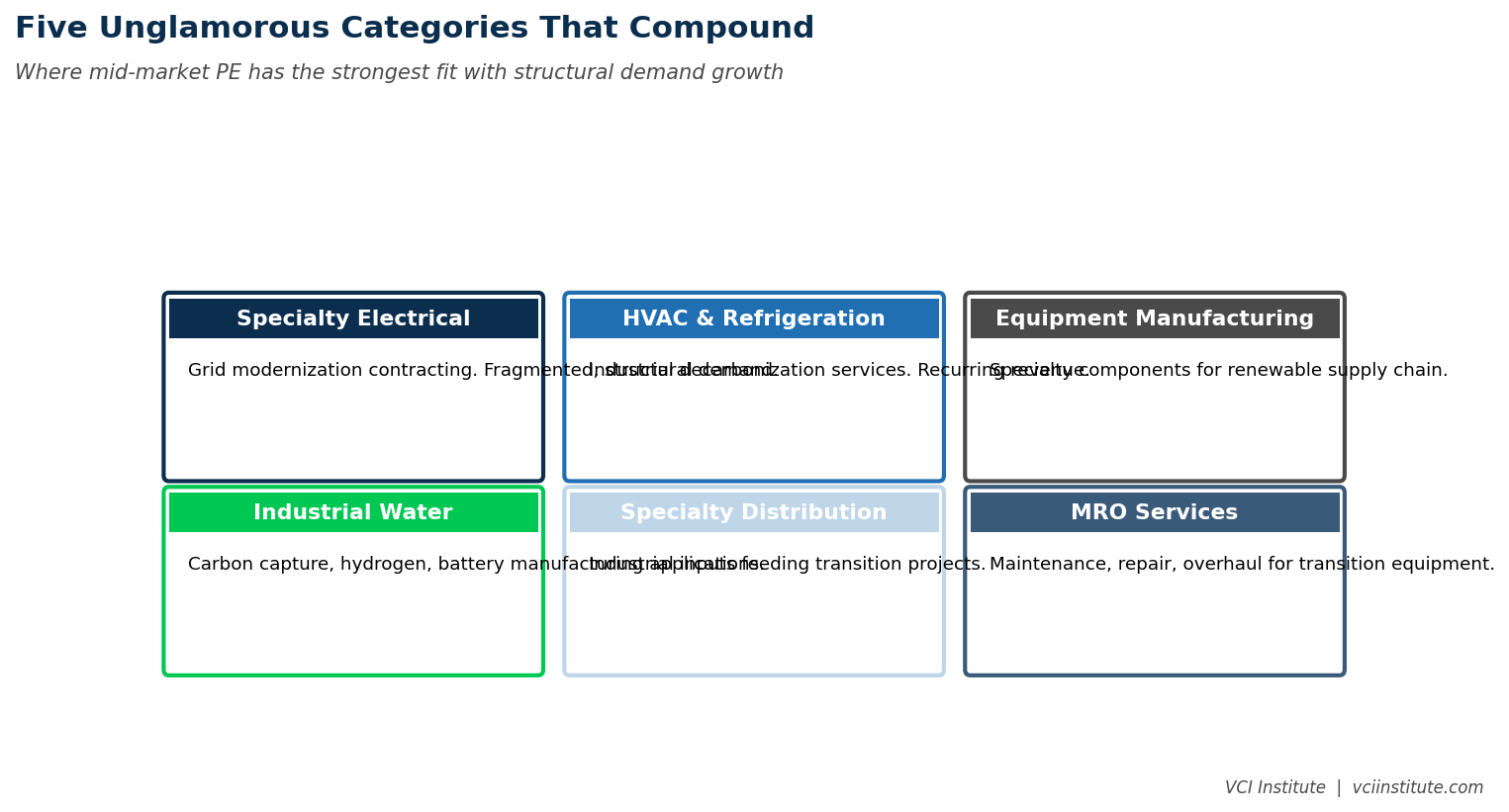
The categories where mid-market private equity has the strongest opportunity are recognizable and worth naming specifically.
Specialty electrical contracting for grid modernization. The grid in most developed economies is being substantially rebuilt to handle distributed generation, electric vehicle charging, and increased industrial load. The work requires specialized contractors with utility relationships and journeyman-level talent. The category is highly fragmented in most regions, the demand is structural, and the operating playbook for consolidation is well-understood.
HVAC and refrigeration services for commercial and industrial decarbonization. Building systems represent a substantial fraction of industrial energy use. The transition to electrified heating and high-efficiency systems requires specialized installation and service capability. The category is fragmented, the technical complexity is increasing, and the recurring service revenue is durable.
Specialty equipment manufacturing for the renewable energy supply chain. Companies producing the specialized components that go into wind, solar, battery storage, and grid infrastructure projects. Many of these companies are mid-market industrial businesses that have been overlooked by generalist private equity because their end-markets were not previously growth markets. They are now. Several of the strongest assets in this layer will come out of corporate parents rationalising their portfolios, which brings the carve-out underperformance pattern directly into the underwriting.
Industrial water and wastewater services for decarbonization-related applications. Carbon capture, hydrogen production, and battery manufacturing all require specialized water treatment capability. The companies serving these applications are growing alongside their customers. The category is technical enough to deter generalist capital and large enough to support real consolidation.
Specialty distribution serving the broader industrial energy transition supply chain. Distributors of specialty fasteners, electrical components, valves, and other industrial inputs that feed transition-related projects. These businesses benefit from the demand cycle without bearing the technology risk of the upstream layers. Distribution is also where unexercised pricing power is most commonly found, because owners have historically calibrated price to a demand environment that no longer exists.
Each of these categories has the operating characteristics that mid-market private equity understands well. Each has structural demand growth that generic industrial categories do not have in 2026. Each has fragmentation that supports buy-and-build strategies. Each is materially underserved by climate-tech-focused capital that has flowed into more visible categories.
What Operating Partners Should Look For
The diligence work for industrial energy transition opportunities has specific dimensions that distinguish it from generic industrial diligence.
The first dimension is the durability of the demand profile in the specific subsegment. Not all transition-related demand is equally structural. Some categories ride policy specifics that could shift. Others are structurally embedded in long-cycle infrastructure investment. The diligence work has to test the demand assumption against multiple scenarios rather than assuming the broad transition narrative applies uniformly.
The second dimension is the talent constraint. Most transition-related industrial businesses are growth-constrained by talent rather than by demand. The diligence has to assess the realistic hiring trajectory, the apprentice and training pipeline, and the wage cost trajectory. The companies that have built genuine talent capability are positioned to capture demand. The companies that depend on a tight labor market without a strategy for it are not. In a skilled trades business the constraint is often concentrated in a handful of individuals, which is exactly what the post-close talent density map is built to expose.
The third dimension is the regulatory complexity specific to the subsegment. Energy transition work intersects with utility regulation, building codes, environmental permitting, and tax credit structures. The companies that have built regulatory fluency have advantages. The companies that do not have hidden cost.
The fourth dimension is the technology risk specific to the layer. Investment in the equipment manufacturing layer carries technology risk if the underlying technology evolves rapidly. Investment in the services layer carries less technology risk because the business adapts to whatever equipment is installed. Investment in the input supply layer carries commodity exposure that has to be priced. Each layer has its own risk profile that the diligence work has to address explicitly.
These four dimensions, applied alongside standard industrial diligence, distinguish thoughtful entries into the category from generic ones. The sponsors that have built the diligence capability are recruiting deal flow that less prepared competitors cannot underwrite as cleanly. The pattern is now visible in transaction outcomes across the category, and it is another argument for sector depth held inside the firm rather than rented for the duration of a process.
The Lens That Reframes the Category
The industrial energy transition lens is the reframe that converts what looks like a niche climate-tech allocation into a substantial mid-market industrial opportunity. The reframe is not theatrical. It is empirical. The capital flows are real. The demand growth is structural. The companies that fit the category are recognizable as the kinds of mid-market industrial businesses that private equity has been good at building for decades. The only thing that needed to change was the framing that grouped these businesses under climate tech and dismissed them as outside the asset class.
For sponsors thinking about how to allocate the next vintage of capital, the industrial energy transition layer represents one of the most attractive structural opportunities in the mid-market in 2026. The opportunity does not require building venture-style capability or accepting venture-style risk. It requires the operating discipline, the consolidation playbooks, and the industrial diligence muscle that private equity has been developing for forty years, applied to a category that has structural demand growth that generic industrial categories cannot match.
The firms that have figured this out are building positions quietly. They are not branding themselves as climate funds. They are buying specialty contractors, equipment manufacturers, and industrial services businesses with strong cash flow and growth trajectories that benefit from the transition without depending on it for survival. The combination is producing returns that fit private equity expectations while contributing to an infrastructure cycle that has broader economic significance.
The lens is the asset. Once you have it, the deal flow becomes visible. The opportunity has been there. The framing was the constraint. The firms that update the framing first will, over the next decade, build positions that the firms that did not will look back on with the recognition that the category was hiding in plain sight, mislabeled by a narrative that failed to describe what was actually happening on the ground.
TVC Masterclass
A lens you can apply to any category, not just this one
Total Value Creation is the framework behind reframes like this one: how value is actually built across a hold, which levers move enterprise value, and how to tell a structural demand story from a cyclical one. Twelve modules on Marlow Precision Group, with a forty question final assessment at an eighty percent pass mark.
VCI Institute in collaboration with Mohamad Chahine
Published 7 September 2026
Related reading from the VCI Institute
Defense Tech and Dual-Use
Another category where the 2018 exclusion framing no longer describes the actual landscape.
Permanent Capital Vehicles
The patient money reshaping the mid-market, and why hold mandate matters in long-cycle infrastructure.
The Carve-Out Underperformance Pattern
Why buying from corporates is harder than the memo says, which applies to most industrial divestitures in this category.
About the VCI Institute
The VCI Institute is a nonprofit dedicated to building practical capability and shared standards for value creation in private equity. The Institute publishes operator-grade frameworks and runs certification programmes for operating partners, portfolio company executives, and value creation analysts. You can see what each programme actually covers before deciding. Analysis published here draws on the Institute's certification curricula and on structured review of mid-market transaction patterns rather than on any single proprietary dataset. Where a figure is directional rather than measured, it is described as such.
Further material is available in the Institute's Insights library and its free resource library of templates, checklists, and case snapshots.
© 2026 VCI Institute. All rights reserved. No part of this article may be reproduced or transmitted in any form without prior written permission of the VCI Institute.
We have many great affordable courses waiting for you!
Stay connected with news and updates!
Join our mailing list to receive the latest news and updates from our team.
Don't worry, your information will not be shared.
We hate SPAM. We will never sell your information, for any reason.






 Practice Platform