
The data room used to be a reading problem. Four thousand documents, six weeks, three junior analysts, and a partner who wanted the summary on Friday. Whatever got missed got missed, and the reps and ...
Every mid-market fund now runs some version of the same pitch internally. We will use AI to widen the funnel. We will screen more companies, faster, on more signals, and we will find the ones our comp...
Key-person risk is the danger that a company's value depends on one individual, and Elon Musk is the largest example the modern market has ever produced. SpaceX told regulators in writing this year: "...

The default mental model of a board meeting in most operators' heads comes from corporate America. It does not survive contact with private equity.
In corporate, the board meets quarterly. The deck is...

The PE-backed CEO seat is one of the most surrounded and one of the most isolated jobs in modern business.
There is a sponsor in regular contact. A board with cadence. A bank watching covenants. An o...

Private equity has spent forty years systematically professionalizing one thing after another, and producing one wave of returns after another from each iteration.
Financial engineering came first. Le...
Every year, accomplished corporate executives decide private equity is the natural next chapter. Smaller companies. Faster pace. Greater impact. Bigger upside.
On paper, they look ideal. Brand-name em...

The most useful private equity question is also the least asked.
Operators spend their time on what they will build. Funds spend their time on what they will measure. Almost no one spends time on the ...

Most executives think the compensation negotiation is about compensation.
It is not. It is about behavior. The dollars are real, but the dollars are downstream of a question the sponsor is silently as...
Pilots train in simulators before they carry passengers. Surgeons practise before they operate. Traders run paper books before they run real ones.
Private equity has no equivalent. People learn to al...

Most diligence asks the wrong question.
The question is usually some version of, is this a good management team. The answer is some version of yes, with footnotes. The deal closes. Twelve months later...

Every PE-backed CEO is one of three people, and the difference matters more than tenure, industry, or pedigree.
There is the founder, who built the company and stayed.
There is the hire, who was recru...
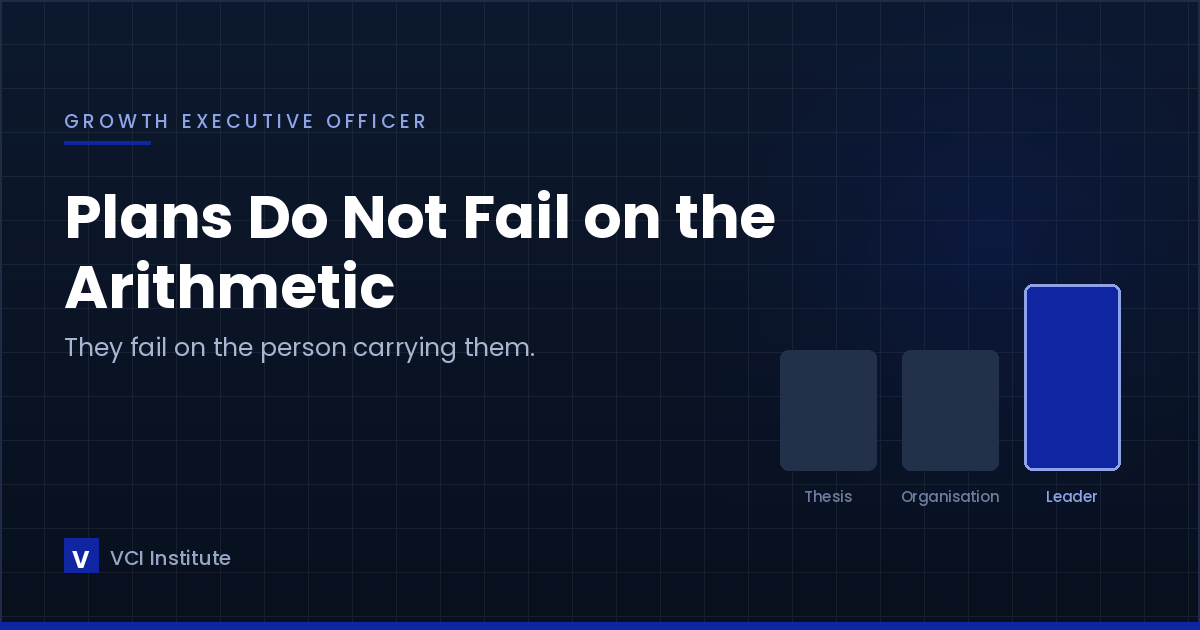
When a value creation plan fails, the post mortem almost always lands on the plan. The assumptions were optimistic. The market moved. The diligence missed something. The timing was unfortunate.
Occas...

The 100-day plan is a corporate artifact that quietly migrated into private equity and never had to defend itself.
It is comforting. It feels rigorous. It maps to a calendar quarter. It is also wrong ...

The investment thesis is the most expensive document in private equity that almost no one reads after Tuesday of close week.
It sits in three places. The deal model. The IC memo. The board deck. None ...